AI Generated Quiz

Primary 3 Science Systems Quiz

Free AI-Generated Qwen3.7 Plus Primary 3 Science Systems quiz with questions and answers for Singapore students. This page is rendered as a direct URL so the questions and answers can be discovered without pressing in-page buttons.

These static practice materials are generated from the site's syllabus and paper-generation workflow, with source and model context shown so students and parents can evaluate the material before use.

Primary 3 Science AI Generated Generated by Qwen3.7 Plus Updated 2026-06-04

Questions

<!-- TuitionGoWhere generation metadata: stage=5-1; model=qwen/qwen3.7-plus; model_label=Qwen3.7 Plus; generated=2026-06-04; Sources: Stage 4-0 LLM templates, syllabus context, and Stage 2 evidence where available. -->

Primary 3 Science Quiz - Systems

Name: __________________________
Class: __________________________
Date: __________________________
Score: ________ / 20

Duration: 45 minutes
Total Marks: 20

Instructions to Candidates:

  1. This quiz consists of 20 questions.
  2. Answer all questions.
  3. Write your answers in the spaces provided.
  4. For questions requiring diagrams, refer to the descriptions provided.

Section A: Multiple Choice Questions (Questions 1–10)

For each question, four options are given. Choose the correct answer and write its number (1, 2, 3, or 4) in the bracket provided. Each question carries 1 mark.

1. Which of the following is a characteristic of all living things? (1) They can move from place to place. (2) They need air, food, and water. (3) They have legs. (4) They are green. [ ]

2. Look at the list below.

  • A growing bean plant
  • A toy robot that walks
  • A cat
  • A river

Which of these are living things? (1) A and B only (2) A and C only (3) B and D only (4) C and D only [ ]

3. Why is a car considered a non-living thing? (1) It cannot move. (2) It does not need fuel. (3) It cannot grow or reproduce. (4) It is made of metal. [ ]

4. Which part of a plant absorbs water and minerals from the soil? (1) Leaf (2) Stem (3) Flower (4) Root [ ]

5. What is the main function of the stem in a plant? (1) To make food for the plant (2) To hold the plant upright and transport water (3) To attract insects for pollination (4) To anchor the plant in the soil [ ]

6. Which of the following animals has a life cycle with 3 stages? (1) Butterfly (2) Cockroach (3) Frog (4) Chicken [ ]

7. In the life cycle of a butterfly, what is the stage between the egg and the pupa? (1) Larva (Caterpillar) (2) Adult (3) Nymph (4) Tadpole [ ]

8. Which of the following is NOT a stage in the life cycle of a human? (1) Baby (2) Child (3) Pupa (4) Adult [ ]

9. Why do plants need sunlight? (1) To keep warm (2) To make their own food (3) To help their roots grow deeper (4) To change colour [ ]

10. Which of the following statements about fungi is true? (1) They are plants because they do not move. (2) They are non-living things. (3) They are living things but do not make their own food. (4) They need sunlight to make food. [ ]


Section B: Structured Questions (Questions 11–20)

Answer the following questions in the spaces provided. Marks are indicated in brackets.

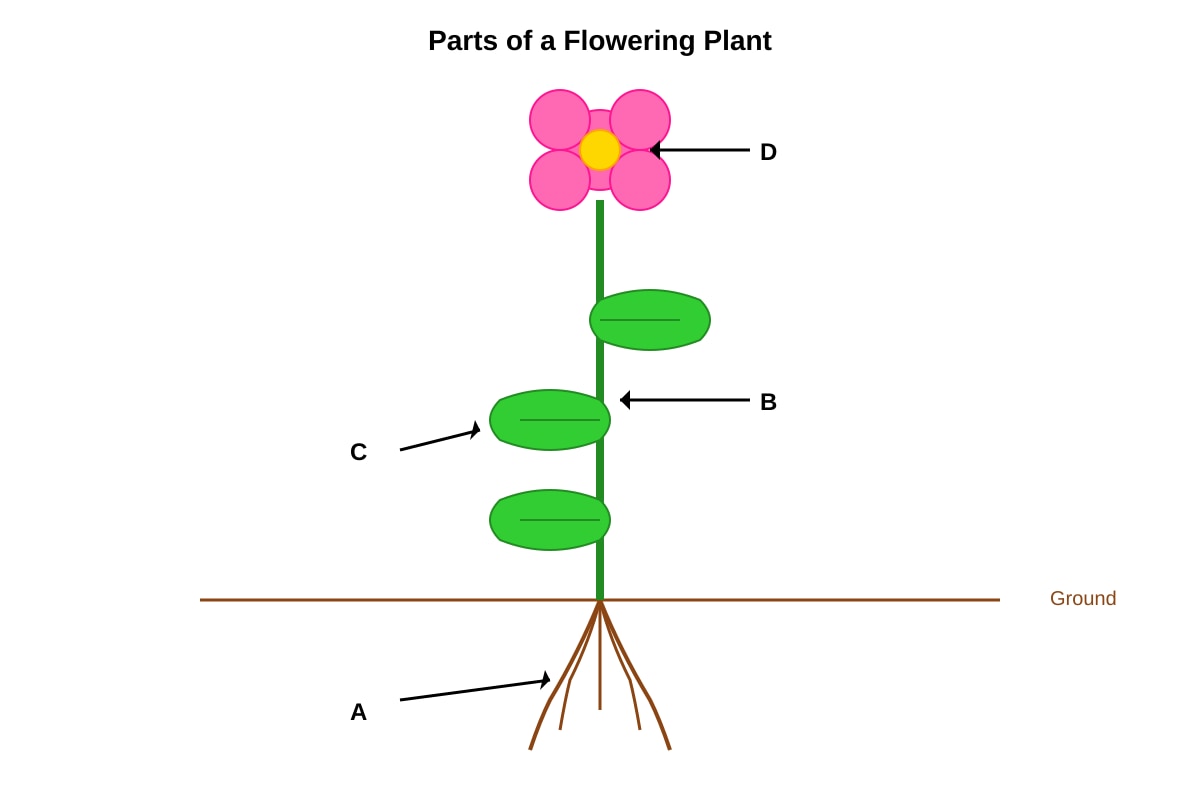
11. The diagram below shows a plant. <image_placeholder> id: Q11-fig1 type: diagram linked_question: Q11 description: A simple line drawing of a flowering plant with four arrows pointing to different parts. labels: Arrow A points to the underground part. Arrow B points to the main upright stalk. Arrow C points to the flat green structures. Arrow D points to the colourful reproductive part at the top. values: None must_show: Clear distinction between root, stem, leaf, and flower. </image_placeholder>

(a) Identify parts A, B, C, and D. [2] A: __________________________ B: __________________________ C: __________________________ D: __________________________

(b) Which part (A, B, C, or D) is responsible for making food for the plant? [1] Answer: _________

12. Study the table below which lists three objects.

ObjectNeeds Water?Grows?Reproduces?
PYesYesYes
QNoNoNo
RYesNoNo

(a) Which object (P, Q, or R) is a living thing? [1] Answer: _________

(b) Give one reason for your answer in (a). [1]


(c) Object R needs water but does not grow or reproduce. Give one example of what Object R could be. [1] Answer: __________________________

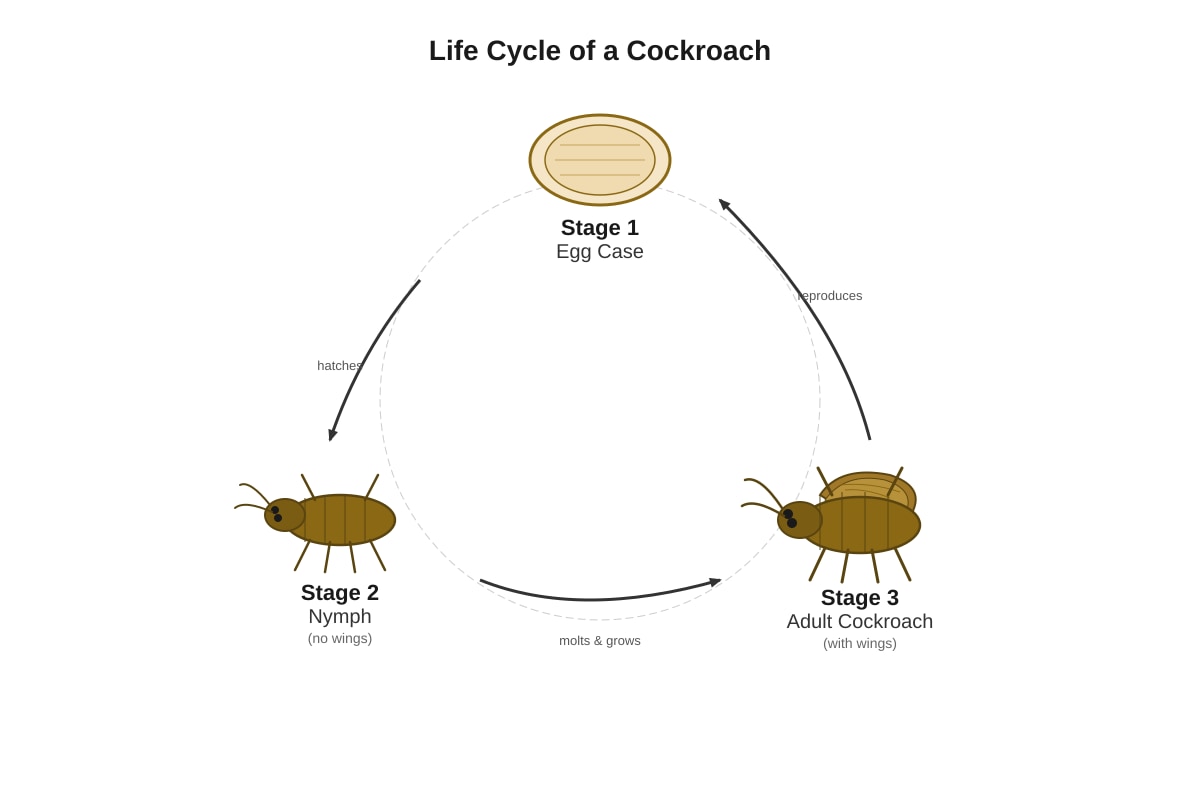
13. The life cycle of a cockroach is shown below. <image_placeholder> id: Q13-fig1 type: diagram linked_question: Q13 description: A circular diagram showing three stages of a cockroach life cycle. labels: Stage 1: Egg case. Stage 2: Nymph (looks like a small adult without wings). Stage 3: Adult cockroach (with wings). Arrows connect them in a cycle. values: None must_show: The nymph should look similar to the adult but smaller and wingless. </image_placeholder>

(a) How many stages are there in the life cycle of a cockroach? [1] Answer: _________

(b) How is the nymph different from the adult cockroach? [1]


(c) Does a cockroach undergo metamorphosis? Explain your answer. [1]


14. Ali placed a potted plant in a dark cupboard for one week. He watered it every day.

(a) What would happen to the leaves of the plant after one week? [1] (1) They will turn green. (2) They will turn yellow. (3) They will grow bigger. (4) They will fall off immediately. [ ]

(b) Explain why this happened. [1]


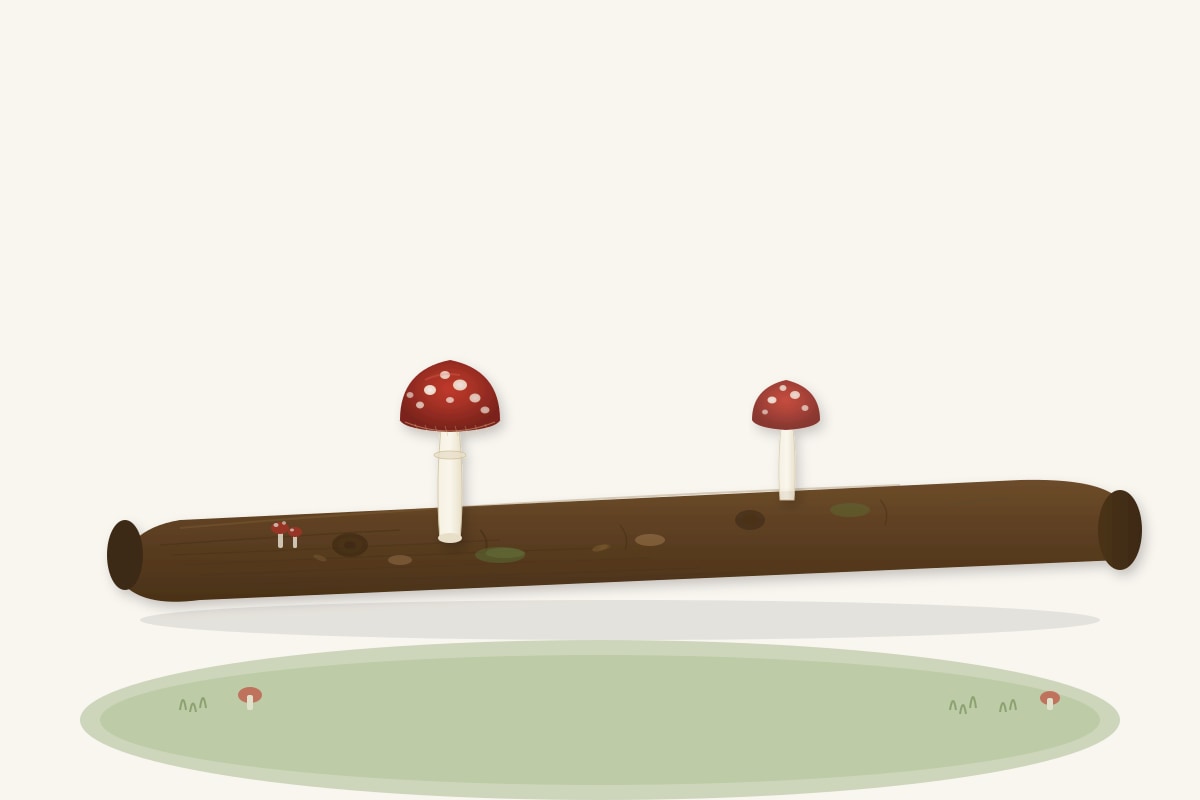
15. Look at the picture of a mushroom. <image_placeholder> id: Q15-fig1 type: figure linked_question: Q15 description: A realistic drawing of a mushroom growing on a rotting log. labels: None values: None must_show: The mushroom cap and stem, and the texture of the log. </image_placeholder>

(a) Is a mushroom a plant? [1] Answer: _________

(b) Give one reason for your answer. [1]


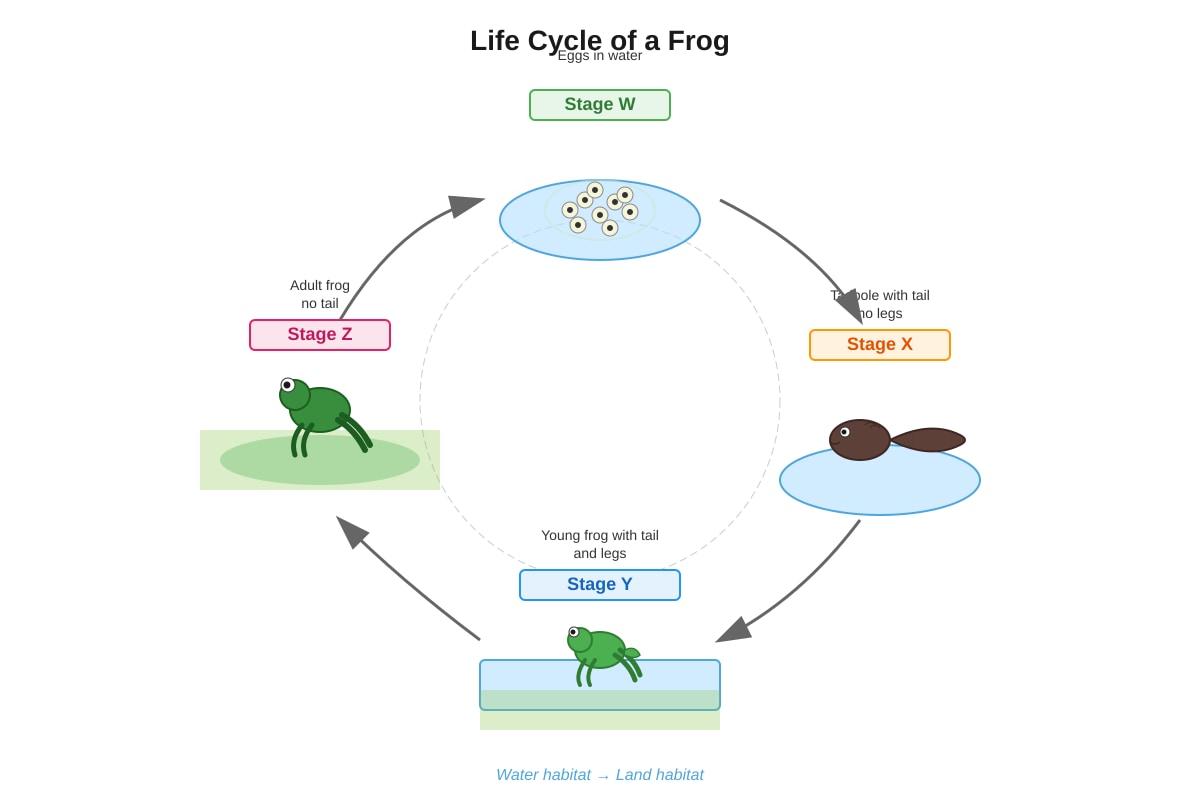
16. The diagram shows the life cycle of a frog. <image_placeholder> id: Q16-fig1 type: diagram linked_question: Q16 description: Four stages of a frog life cycle arranged in a circle. labels: Stage W: Eggs in water. Stage X: Tadpole with tail, no legs. Stage Y: Young frog with tail and legs. Stage Z: Adult frog with no tail. values: None must_show: Clear progression from water-dwelling tadpole to land-dwelling adult. </image_placeholder>

(a) Which stage (W, X, Y, or Z) lives only in water? [1] Answer: _________

(b) At which stage does the frog start to breathe with lungs instead of gills? [1] Answer: _________

17. Classify the following animals into two groups based on how they reproduce. Cat, Chicken, Butterfly, Dog, Fish, Eagle

Group A: Animals that lay eggsGroup B: Animals that give birth to young ones
1. __________________________1. __________________________
2. __________________________2. __________________________
3. __________________________3. __________________________

[3]

18. Why do living things need to reproduce? [1]


19. John found a strange object in his garden. It was hard and did not move. After a few days, it cracked open and a small green shoot came out.

(a) Was the object a living thing or a non-living thing before it cracked open? [1] Answer: __________________________

(b) Give one characteristic of living things shown by the object. [1]


20. The table below shows the characteristics of two organisms, X and Y.

CharacteristicOrganism XOrganism Y
Needs airYesYes
Needs waterYesYes
Can move by itselfNoYes
Makes its own foodYesNo

(a) Organism X is likely a ________________. [1]

(b) Organism Y is likely a ________________. [1]

Answers

<!-- TuitionGoWhere generation metadata: stage=5-1; model=qwen/qwen3.7-plus; model_label=Qwen3.7 Plus; generated=2026-06-04; Sources: Stage 4-0 LLM templates, syllabus context, and Stage 2 evidence where available. -->

Primary 3 Science Quiz - Systems (Answer Key)

Total Marks: 20

Section A: Multiple Choice Questions

1. (2)

  • Explanation: All living things need air, food, and water to survive. Not all living things move from place to place (e.g., plants), have legs (e.g., snakes, fish), or are green (e.g., animals, fungi).

2. (2)

  • Explanation: A growing bean plant (A) and a cat (C) are living things because they grow, reproduce, and need basic needs. A toy robot (B) is non-living (man-made). A river (D) is non-living (natural but does not reproduce or grow biologically).

3. (3)

  • Explanation: Living things grow and reproduce. A car cannot do these things. It moves using fuel, but movement alone does not make something living.

4. (4)

  • Explanation: Roots anchor the plant and absorb water and minerals from the soil. Leaves make food, stems transport water, and flowers are for reproduction.

5. (2)

  • Explanation: The stem supports the plant (holds it upright) and contains tubes to transport water and minerals from the roots to the leaves, and food from the leaves to other parts.

6. (2)

  • Explanation: The cockroach has a 3-stage life cycle: Egg \rightarrow Nymph \rightarrow Adult. The butterfly and frog have 4 stages. The chicken has 2 main stages (Egg \rightarrow Chick/Adult) but is often taught as hatching from an egg; however, in P3, insects are the primary focus for 3 vs 4 stages. Cockroach is the standard example for 3 stages.

7. (1)

  • Explanation: The butterfly life cycle is: Egg \rightarrow Larva (Caterpillar) \rightarrow Pupa \rightarrow Adult. The stage between egg and pupa is the larva.

8. (3)

  • Explanation: Humans do not have a pupa stage. Pupa is a stage in the life cycle of insects like butterflies and moths. Human stages are Baby, Child, Teenager, Adult, Elderly.

9. (2)

  • Explanation: Plants use sunlight, water, and carbon dioxide to make their own food through a process called photosynthesis.

10. (3)

  • Explanation: Fungi are living things because they grow, reproduce, and need air/water/food. However, they are not plants because they cannot make their own food (they do not have chlorophyll).

Section B: Structured Questions

11. (a) A: Root, B: Stem, C: Leaf, D: Flower [2]

  • Marking: 0.5 marks for each correct label. (b) C (Leaf) [1]
  • Explanation: Leaves contain chlorophyll and trap sunlight to make food for the plant.

12. (a) P [1] (b) It shows all three characteristics of living things: it needs water, grows, and reproduces. [1]

  • Note: Accept "It grows and reproduces" as the key differentiators from non-living things that might "need" maintenance. (c) A sponge / A piece of wood / A dried seed (before germination) [1]
  • Explanation: Any non-living thing that absorbs water but does not grow biologically. A sponge is a common example.

13. (a) 3 [1] (b) The nymph does not have wings, while the adult has wings. (Or: The nymph is smaller than the adult). [1] (c) No. [1]

  • Explanation: Metamorphosis involves a drastic change in form (like caterpillar to butterfly). The nymph looks like the adult, so it is incomplete metamorphosis, but in P3 terms, we often distinguish "metamorphosis" as the 4-stage drastic change. Correction for P3 Level: Simply stating "No, because the young looks like the adult" is sufficient.

14. (a) (2) [1] (b) The plant needs sunlight to make food. Without sunlight, it cannot make food and the leaves will turn yellow and die. [1]

15. (a) No [1] (b) It cannot make its own food. (Or: It does not have leaves/chlorophyll). [1]

  • Explanation: Plants make their own food. Fungi get food from decaying matter.

16. (a) X (Tadpole) [1]

  • Note: Stage W (Eggs) are also in water, but X is the active living stage fully aquatic. Accept W or X if justified, but X is the distinct feeding stage. (b) Y (Young frog) [1]
  • Explanation: As the tadpole develops legs and lungs (Stage Y), it begins to breathe air.

17. [3]

  • Marking: 0.5 marks for each correct animal placement.
  • Group A (Eggs): Chicken, Butterfly, Fish, Eagle (Any 3)
  • Group B (Give Birth): Cat, Dog (Any 2 - wait, the question asks to classify the list. The list has 6 items. 4 lay eggs, 2 give birth. The table has 3 slots each. This is a trick. Let's re-read the list: Cat, Chicken, Butterfly, Dog, Fish, Eagle.
    • Eggs: Chicken, Butterfly, Fish, Eagle.
    • Birth: Cat, Dog.
    • Correction in Question Design: The table has 3 slots per group. There are 4 egg-layers and 2 live-birthers. Students should fill the slots available.
    • Group A: Chicken, Butterfly, Fish (or Eagle)
    • Group B: Cat, Dog (Leave one blank or repeat? No, usually lists match. Let's assume the student picks any 3 for A and the 2 for B. Or perhaps "Fish" is ambiguous in P3? No, fish lay eggs. I will accept any 3 correct egg-layers in A and the 2 correct live-birthers in B. If a student puts Eagle in A, it is correct.)

18. To ensure their kind continues to exist / To prevent extinction. [1]

19. (a) Living thing [1]

  • Explanation: It was a seed. Seeds are living things even if they appear dormant. (b) It grows. [1]

20. (a) Plant [1]

  • Explanation: It makes its own food and does not move by itself. (b) Animal [1]
  • Explanation: It cannot make its own food and moves by itself.