AI Generated Quiz

Primary 3 Science Systems Quiz

Free AI-Generated Kimi K2 6 Free Primary 3 Science Systems quiz with questions and answers for Singapore students. This page is rendered as a direct URL so the questions and answers can be discovered without pressing in-page buttons.

These static practice materials are generated from the site's syllabus and paper-generation workflow, with source and model context shown so students and parents can evaluate the material before use.

Primary 3 Science AI Generated Generated by Kimi K2 6 Free Updated 2026-06-07

Questions

<!-- TuitionGoWhere generation metadata: stage=5-1; model=moonshotai/kimi-k2.6:free; model_label=Kimi K2.6 Free; generated=2026-06-06; Sources: Stage 4-0 LLM templates, syllabus context, and Stage 2 evidence where available. -->

Primary 3 Science Quiz - Systems

Name: _________________________________ Class: _______ Date: _________

Duration: 40 minutes

Total Marks: 40 marks

Instructions: Answer all questions. Write your answers in the spaces provided. Show your working where required.


Section A: Multiple Choice (Questions 1–10, 1 mark each)

Choose the correct answer and write its letter (A, B, C, or D) in the box provided.


1. Which system helps humans take in oxygen and remove carbon dioxide?

A) Digestive system

B) Respiratory system

C) Circulatory system

D) Nervous system

[ ]

2. Which of the following is NOT a main part of the human respiratory system?

A) Lungs

B) Trachea

C) Stomach

D) Nose

[ ]

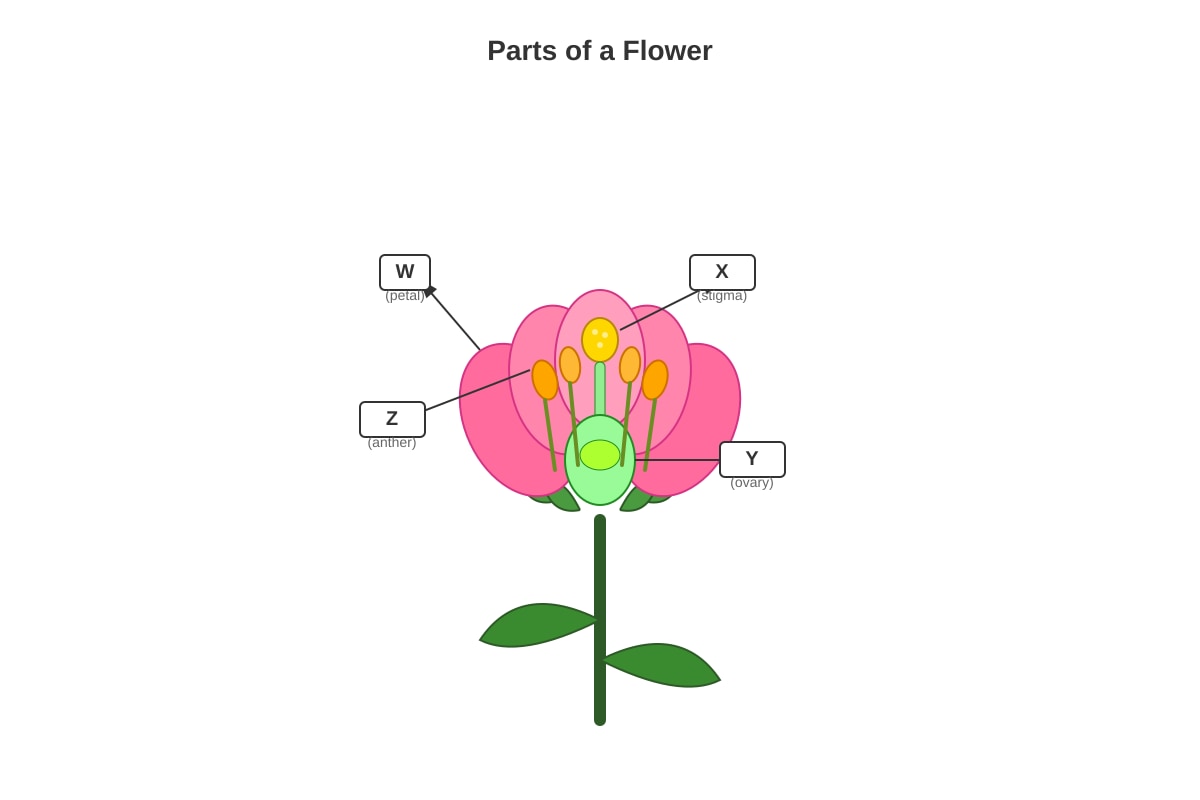
3. The diagram below shows parts of a flower.

<image_placeholder> id: Q3-fig1 type: diagram linked_question: Q3 description: A simple diagram of a flower with parts labeled W, X, Y, Z pointing to different structures labels: W (petal), X (stigma), Y (ovary), Z (anther) values: none must_show: Clear flower cross-section with labeled parts W, X, Y, Z; arrows connecting letters to structures </image_placeholder>

Which part produces pollen grains?

A) W

B) X

C) Y

D) Z

[ ]

4. What is the main function of roots in the plant transport system?

A) To make food using sunlight

B) To absorb water and minerals from the soil

C) To release oxygen into the air

D) To attract insects for pollination

[ ]

5. Which system carries digested food and oxygen around the human body?

A) Respiratory system

B) Digestive system

C) Circulatory system

D) Skeletal system

[ ]

6. The table shows the journey of food through the human digestive system in the wrong order.

OrderPart of Digestive System
1Small intestine
2Mouth
3Large intestine
4Stomach

What is the correct order?

A) 2, 4, 1, 3

B) 2, 1, 4, 3

C) 4, 2, 1, 3

D) 2, 4, 3, 1

[ ]

7. Leaves have tiny openings called stomata. What is their function in the plant system?

A) To store food

B) To allow exchange of gases

C) To support the leaf

D) To produce seeds

[ ]

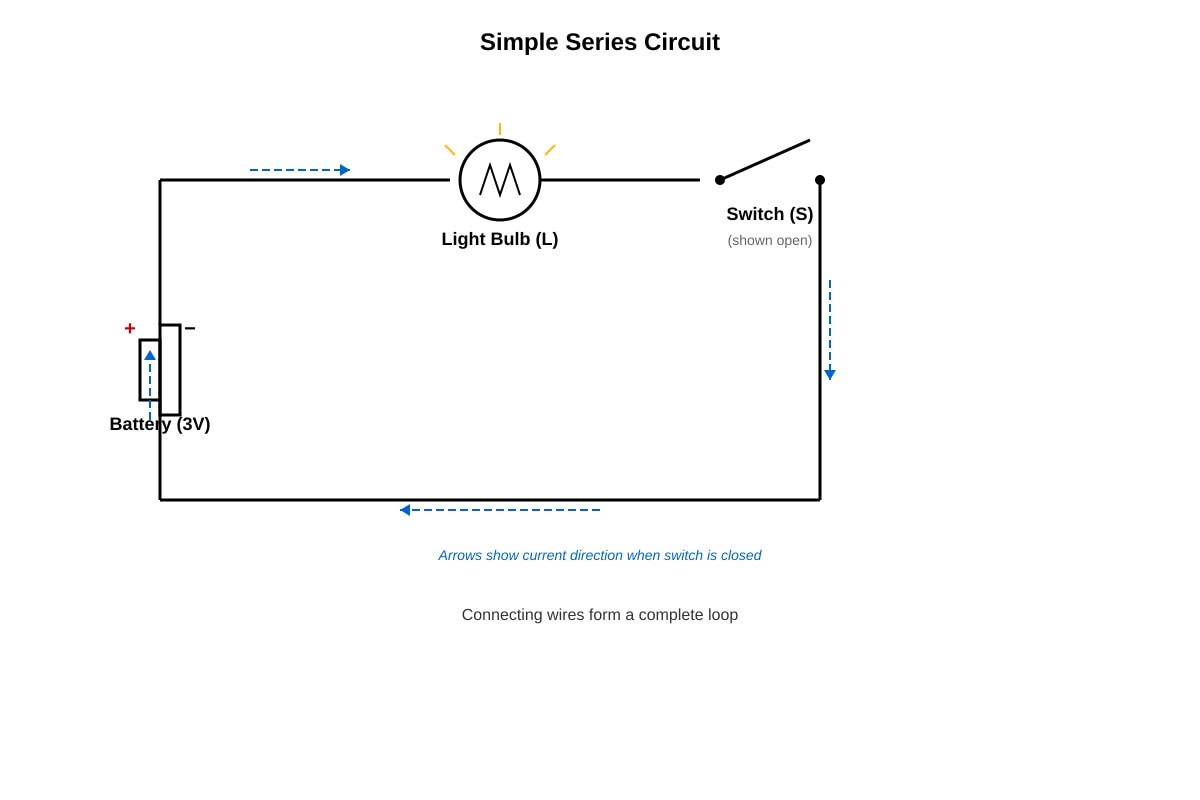
8. Look at the electrical circuit below.

<image_placeholder> id: Q8-fig1 type: diagram linked_question: Q8 description: A simple series circuit diagram with a battery, a light bulb, a switch, and connecting wires labels: Battery (3V), Light bulb (L), Switch (S), Wires with arrows showing current direction when switch is closed values: Battery voltage 3V must_show: Complete circuit with battery symbol, bulb symbol, open switch symbol, connecting wires; clear closed loop; current direction arrow </image_placeholder>

What happens when the switch is closed?

A) The battery will stop working

B) The bulb will light up

C) The wires will melt

D) Nothing will happen

[ ]

9. Which of these materials is the best conductor of electricity in a simple circuit system?

A) Plastic ruler

B) Wooden spoon

C) Metal key

D) Rubber band

[ ]

10. In a simple system, what does a switch do in an electrical circuit?

A) Provides electrical energy

B) Controls whether electricity flows or stops

C) Converts electricity to light

D) Stores electricity for later use

[ ]

Section A Total: _____ / 10 marks


Section B: Fill in the Blanks and Short Answers (Questions 11–15, 2 marks each)

Answer in the spaces provided. Each question carries 2 marks.


11. The human digestive system breaks down food into smaller pieces.

(a) Name the two systems that work together with the digestive system to supply energy to the body. [1 mark]


(b) Explain briefly how these two systems help the digestive system. [1 mark]


Answer space:

(a) _______________________________________________________
(b) _______________________________________________________
_______________________________________________________

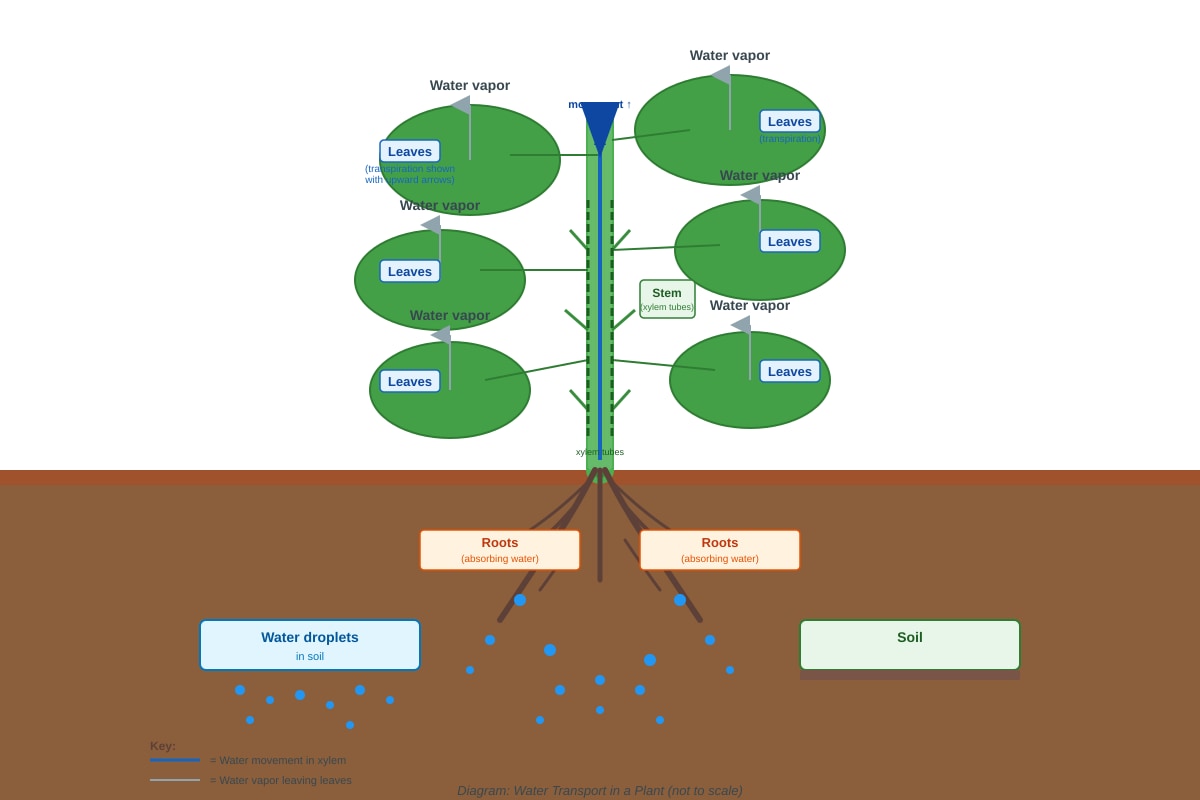
12. The diagram shows the human water transport system.

<image_placeholder> id: Q12-fig1 type: diagram linked_question: Q12 description: A simplified diagram of water transport in a plant showing roots, stem, and leaves with arrows indicating water movement labels: Roots (absorbing water), Stem (xylem tubes indicated), Leaves (transpiration shown with upward arrows), Water droplets in soil values: none must_show: Roots in soil with water droplets, stem with vertical tubes labeled as xylem, leaves with small arrows showing water vapor release; large arrow from roots to leaves showing water movement direction </image_placeholder>

(a) Name the tube-like structure in the stem that transports water from the roots to the leaves. [1 mark]

_______________________________________________________

(b) Process X causes water to move up the stem. Name Process X and explain what causes it to happen. [1 mark]

_______________________________________________________
_______________________________________________________

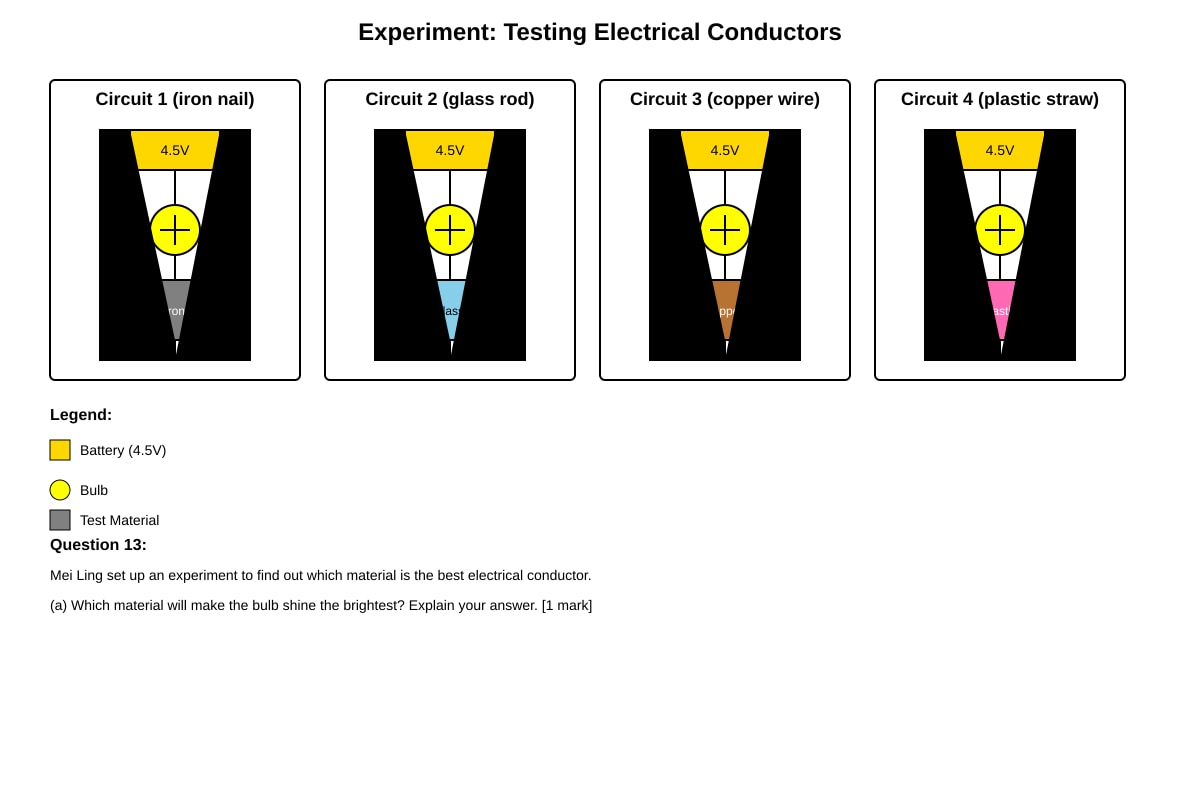
13. Mei Ling set up an experiment to find out which material is the best electrical conductor.

<image_placeholder> id: Q13-fig1 type: experimental_setup linked_question: Q13 description: An experiment setup with identical circuits testing four different materials, each with a bulb and a test material in the circuit labels: Circuit 1 (iron nail), Circuit 2 (glass rod), Circuit 3 (copper wire), Circuit 4 (plastic straw); each circuit has battery and bulb values: 4.5V battery for each circuit; identical bulbs must_show: Four identical parallel circuit setups, each with a battery, bulb, and gap filled with different test material; all bulbs should be drawn with same brightness capability; clear labels for each test material </image_placeholder>

(a) Which material will make the bulb shine the brightest? Explain your answer. [1 mark]

_______________________________________________________
_______________________________________________________

(b) Name one material in the diagram that is an insulator. What would you observe with this material? [1 mark]

_______________________________________________________
_______________________________________________________

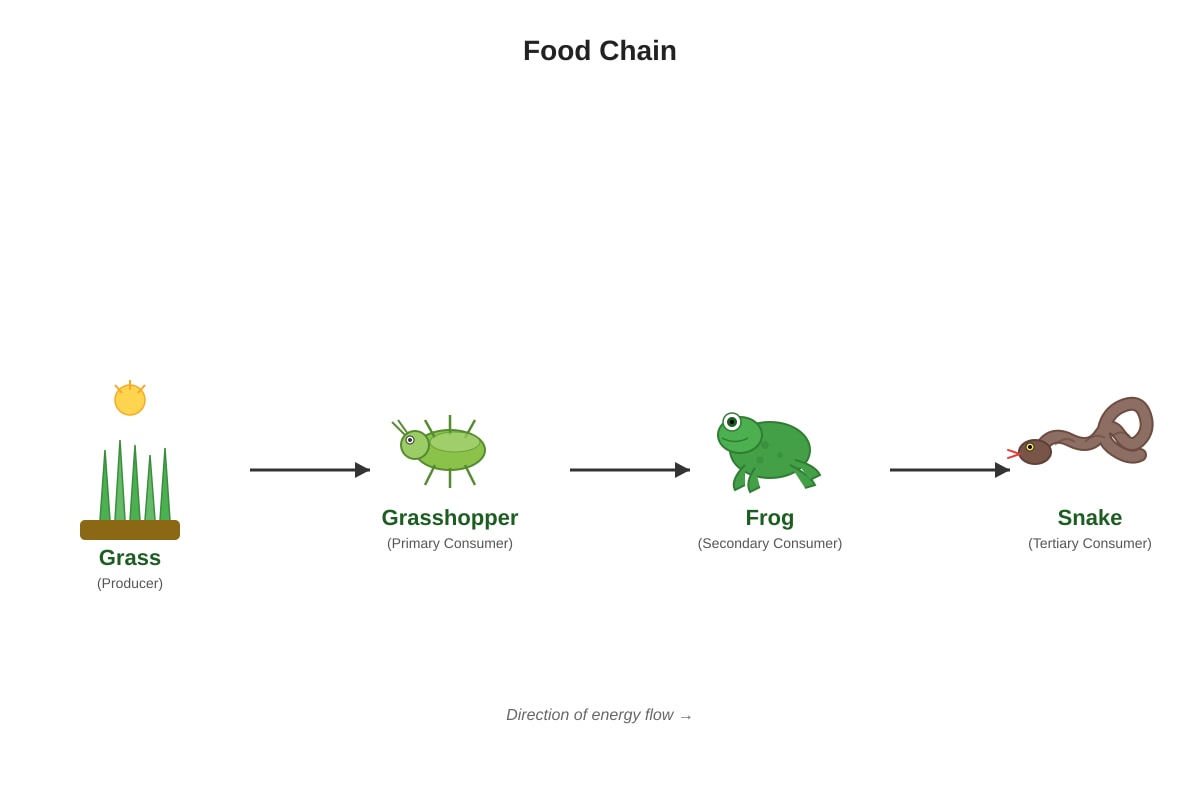
14. Study the food chain below.

<image_placeholder> id: Q14-fig1 type: diagram linked_question: Q14 description: A simple food chain diagram showing four organisms in a line with arrows pointing from one to the next labels: Grass → Grasshopper → Frog → Snake values: none must_show: Four organisms arranged left to right; arrows clearly showing energy flow direction from grass to grasshopper to frog to snake; each organism clearly labeled with both name and simple drawing </image_placeholder>

(a) Which organism is the producer in this food chain? How does it make its own food? [1 mark]

_______________________________________________________
_______________________________________________________

(b) What will happen to the frog population if all the snakes are removed? Explain your answer. [1 mark]

_______________________________________________________
_______________________________________________________

15. The human skeleton works together with muscles to allow movement.

(a) Name one function of the skeletal system apart from helping the body move. [1 mark]

_______________________________________________________

(b) Explain why muscles must work in pairs to move a bone. [1 mark]

_______________________________________________________
_______________________________________________________

Section B Total: _____ / 10 marks


Section C: Application and Reasoning (Questions 16–20, 4 marks each)

Answer in the spaces provided. Show your reasoning clearly.


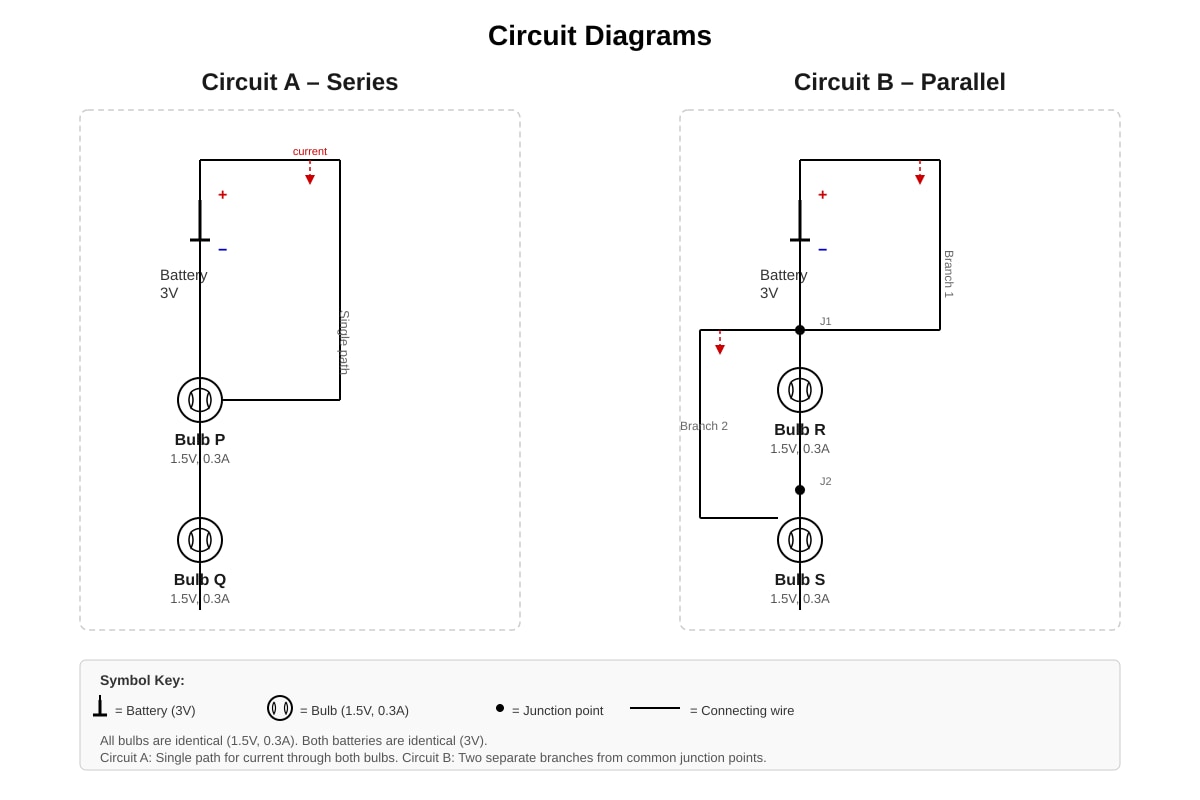
16. Jia Hui and her friends are learning about electrical systems. They set up the following circuits to test different connections.

<image_placeholder> id: Q16-fig1 type: diagram linked_question: Q16 description: Two circuit diagrams side by side showing Series Circuit A and Parallel Circuit B with identical batteries and two bulbs each labels: Circuit A - Series: Battery 3V, Bulb P, Bulb Q connected in single loop; Circuit B - Parallel: Battery 3V, Bulb R and Bulb S on separate branches with complete circuit paths values: Both batteries 3V; all bulbs identical rating 1.5V, 0.3A must_show: Clearly distinguish series vs parallel arrangement; in Circuit A single path through both bulbs; in Circuit B two separate branches from common points; identical battery symbols; bulb symbols identical; main junction points visible in parallel circuit </image_placeholder>

Jia Hui predicted: "In Circuit B, if Bulb R is removed, Bulb S will still light up. In Circuit A, if Bulb P is removed, Bulb Q will not light up."

(a) Do you agree with Jia Hui's prediction? Explain your answer using what you know about series and parallel circuits. [2 marks]

_______________________________________________________
_______________________________________________________
_______________________________________________________
_______________________________________________________

(b) A student says, "Circuit B uses more electrical energy from the battery than Circuit A because it has more paths." Is this statement correct? Explain. [2 marks]

_______________________________________________________
_______________________________________________________
_______________________________________________________
_______________________________________________________

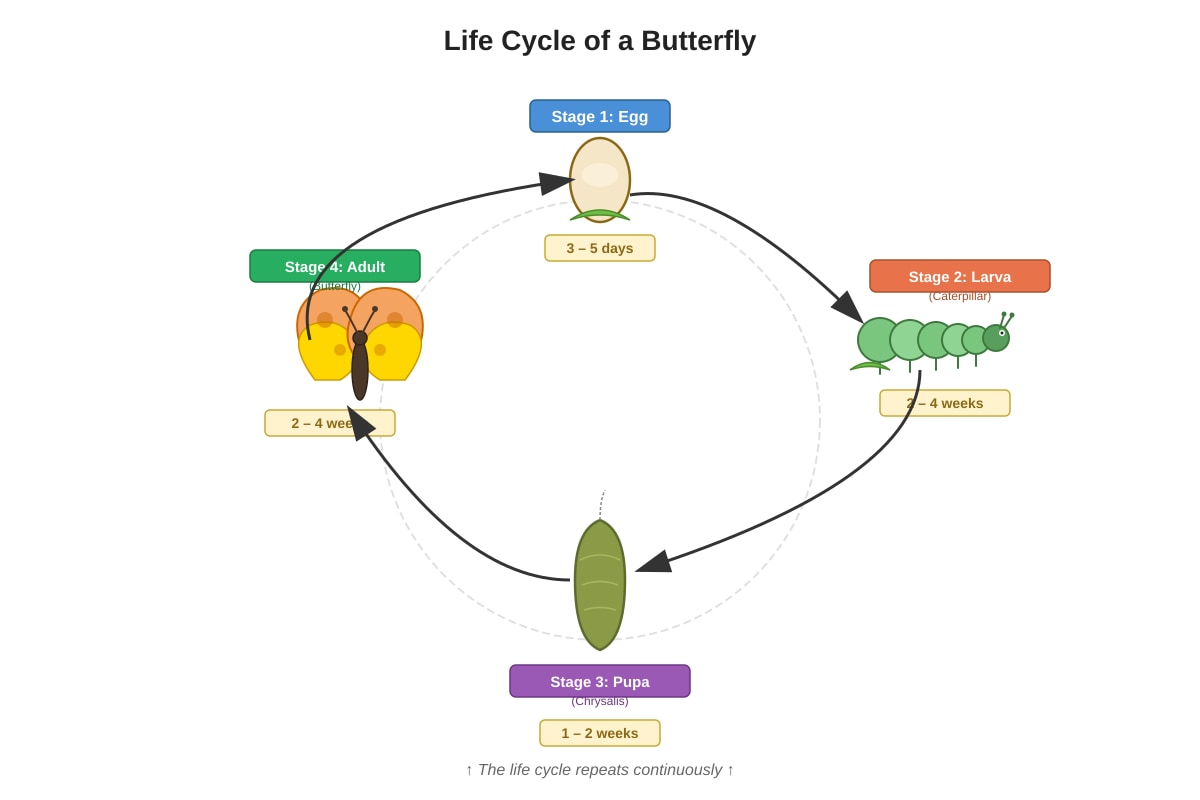
17. Study the life cycle of a butterfly below and answer the questions.

<image_placeholder> id: Q17-fig1 type: diagram linked_question: Q17 description: Life cycle diagram of a butterfly showing four stages in a circular arrangement with arrows labels: Stage 1 (Egg), Stage 2 (Larva/Caterpillar), Stage 3 (Pupa/Chrysalis), Stage 4 (Adult Butterfly) values: Time indicators: Egg (3-5 days), Larva (2-4 weeks), Pupa (1-2 weeks), Adult (2-4 weeks) must_show: Circular cycle with arrows between stages; each stage with simple illustration and name; time duration for each stage shown; clear directional flow; all four stages present and labeled </image_placeholder>

(a) Name the process by which a caterpillar changes into a pupa, and then into a butterfly. [1 mark]

_______________________________________________________

(b) Explain why the adult butterfly needs to lay many eggs, even though not all eggs will survive to become adult butterflies. [1 mark]

_______________________________________________________
_______________________________________________________

(c) A student claims that the life cycle of a butterfly is an example of a system because each stage depends on the previous stage. Do you agree? Give two reasons to support your answer. [2 marks]

_______________________________________________________
_______________________________________________________
_______________________________________________________
_______________________________________________________

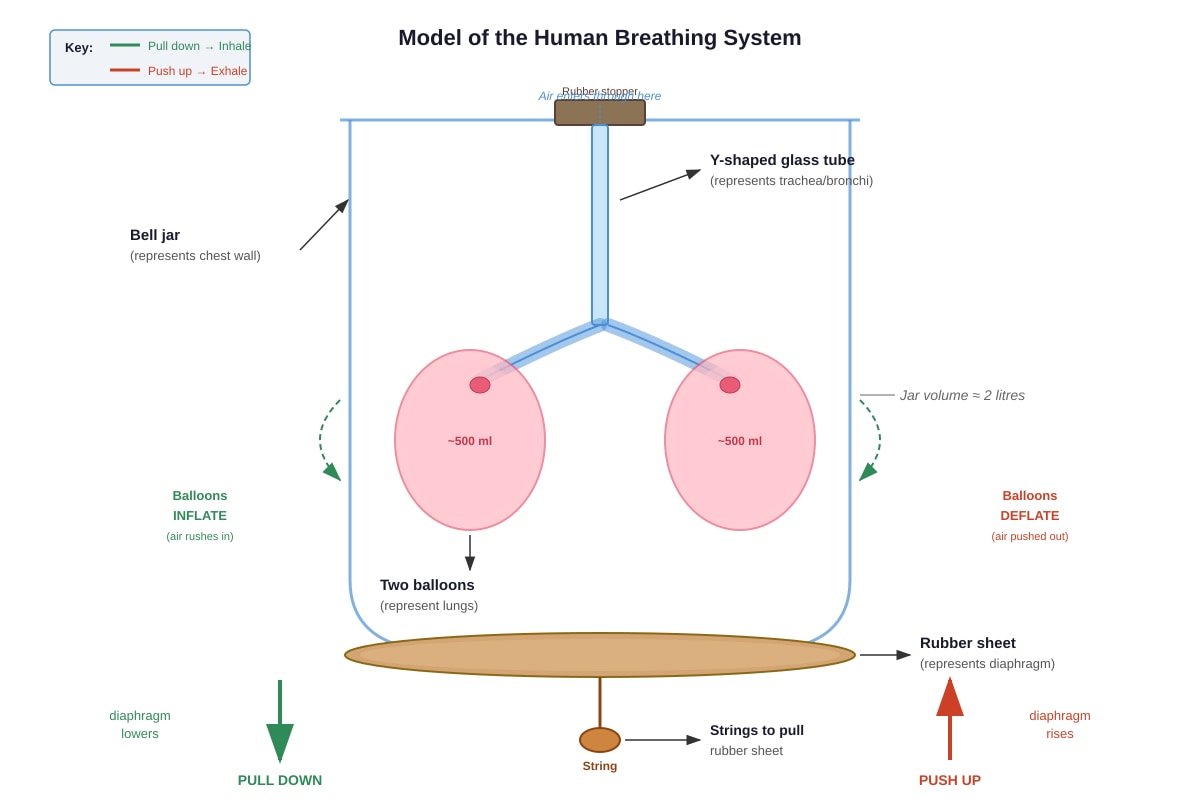
18. Mrs. Tan's class is studying the human breathing system. She set up an experiment to show how the diaphragm works.

<image_placeholder> id: Q18-fig1 type: experimental_setup linked_question: Q18 description: Model of human breathing system using a bell jar, rubber sheet, glass tube, and two balloons labels: Bell jar (represents chest wall), Rubber sheet at bottom (represents diaphragm), Y-shaped glass tube (represents trachea/bronchi), Two balloons at tube ends (represent lungs), Strings to pull rubber sheet values: Jar volume approximately 2 liters; balloons inflated to about 500ml each when relaxed must_show: Clear bell jar with Y-tube entering through stopper at top; balloons attached to lower tube ends inside jar; rubber sheet sealed at bottom with string handle; arrows or labels showing: pull down = diaphragm lowers, balloons inflate; push up = diaphragm rises, balloons deflate </image_placeholder>

(a) What happens to the balloons when the rubber sheet is pulled down? Explain why this happens. [2 marks]

_______________________________________________________
_______________________________________________________
_______________________________________________________
_______________________________________________________

(b) When you breathe in, your diaphragm moves down and your chest expands. Using this model, explain one limitation (problem) of using the rubber sheet to represent the diaphragm. [2 marks]

_______________________________________________________
_______________________________________________________
_______________________________________________________
_______________________________________________________

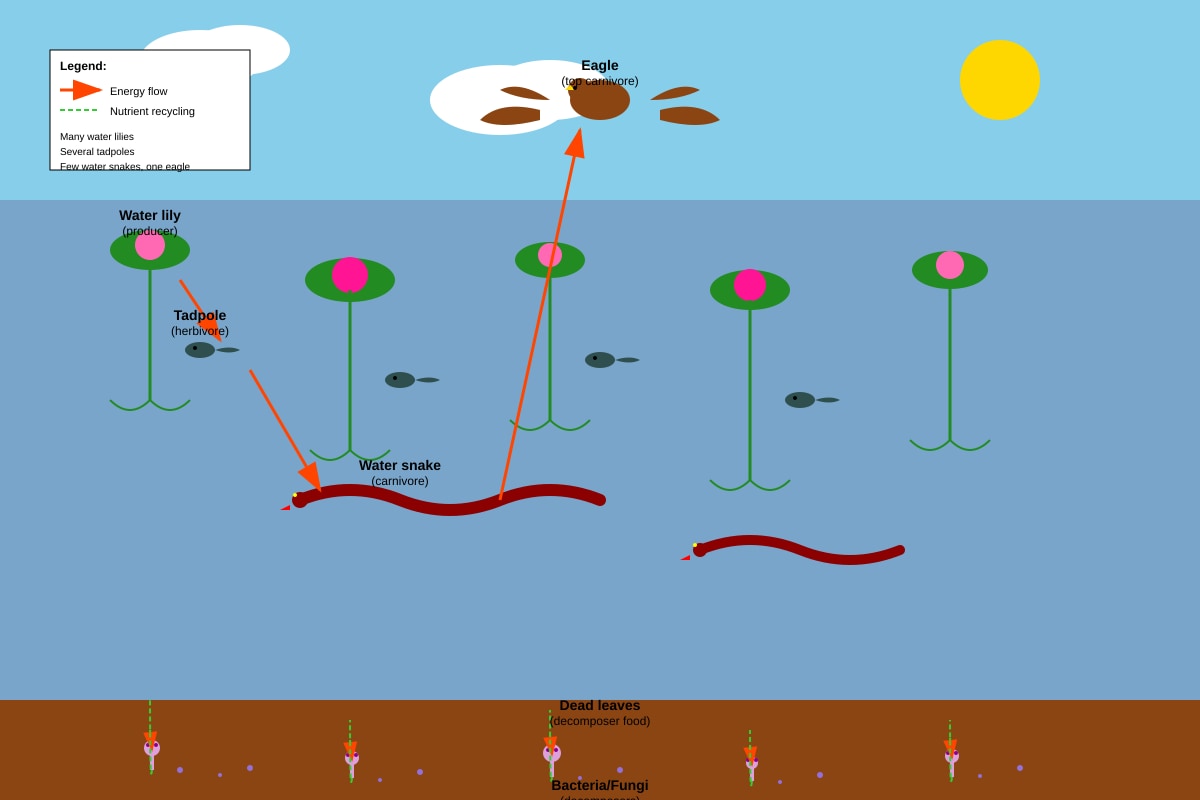
19. The diagram shows a simple ecosystem in a Singapore pond.

<image_placeholder> id: Q19-fig1 type: diagram linked_question: Q19 description: A pond ecosystem diagram showing various organisms and their interactions with arrows indicating feeding relationships labels: Water lily (producer), Tadpole (herbivore), Water snake (carnivore), Eagle (top carnivore), Dead leaves (decomposer food), Bacteria/Fungi (decomposers) shown as small organisms near bottom values: Simple energy flow arrows; approximate numbers: many water lilies, several tadpoles, few water snakes, one eagle must_show: Water lily with leaves on surface and roots below; tadpole swimming near plants; water snake in water; eagle flying above or perched nearby; decomposers near decaying matter at bottom; arrows showing: water lily → tadpole → water snake → eagle; dead leaves → decomposers with return arrow to nutrients for water lily </image_placeholder>

(a) Name the role of bacteria and fungi in this pond system. Explain one important function they perform. [2 marks]

_______________________________________________________
_______________________________________________________
_______________________________________________________
_______________________________________________________

(b) Explain what would happen to the water snakes if all the water lilies died because of pollution. Give reasons for your answer. [2 marks]

_______________________________________________________
_______________________________________________________
_______________________________________________________
_______________________________________________________

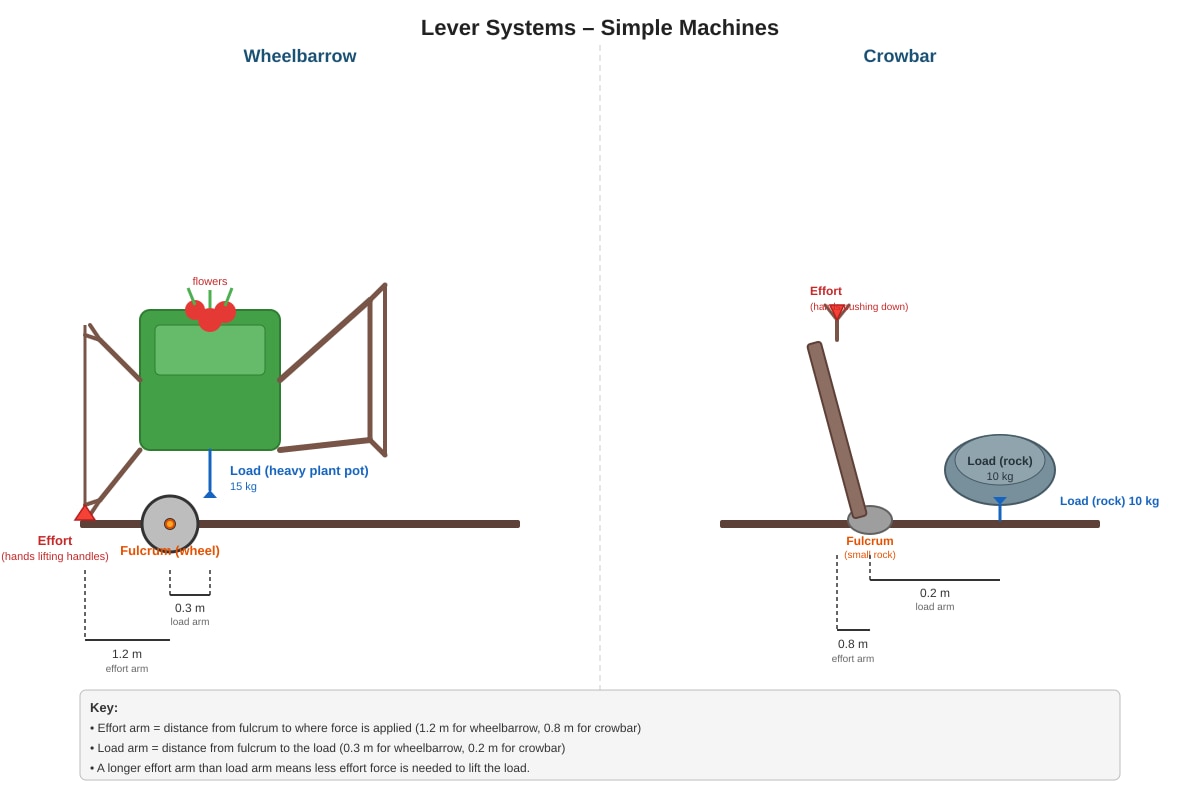
20. Daniel's grandfather uses a simple machine system to lift heavy pots in his garden.

<image_placeholder> id: Q20-fig1 type: diagram linked_question: Q20 description: A lever system diagram showing a wheelbarrow and a crowbar as examples of simple machines labels: Wheelbarrow: Load (heavy plant pot), Fulcrum (wheel), Effort (hands lifting handles); Crowbar: Load (rock), Fulcrum (small rock underneath crowbar), Effort (hands pushing down on crowbar end) values: Wheelbarrow: load 15kg, effort arm 1.2m, load arm 0.3m; Crowbar: load 10kg, effort arm 0.8m, load arm 0.2m must_show: Two separate diagrams; wheelbarrow side view with labels for load, fulcrum (wheel), effort; crowbar side view with rock as load, small supporting rock as fulcrum, hand applying downward force; distances marked clearly; arrows showing force directions </image_placeholder>

(a) Using the wheelbarrow example, explain why this lever system makes it easier to lift a heavy load. Relate your answer to the lengths of the effort arm and load arm. [2 marks]

_______________________________________________________
_______________________________________________________
_______________________________________________________
_______________________________________________________

(b) Daniel's grandfather wants to lift a very heavy rock of 50 kg. Should he use a wheelbarrow or a crowbar? Explain your choice using what you know about how these simple machine systems work. [2 marks]

_______________________________________________________
_______________________________________________________
_______________________________________________________
_______________________________________________________

Section C Total: _____ / 20 marks


END OF PAPER

Overall Total
Section A_____ / 10
Section B_____ / 10
Section C_____ / 20
Grand Total_____ / 40

Teacher's Use Only

Marker:Checker:
Date:Grade/Level:

Answers

<!-- TuitionGoWhere generation metadata: stage=5-1; model=moonshotai/kimi-k2.6:free; model_label=Kimi K2.6 Free; generated=2026-06-06; Sources: Stage 4-0 LLM templates, syllabus context, and Stage 2 evidence where available. -->

Primary 3 Science Quiz - Systems: Answer Key

Total Marks: 40 marks


Section A: Multiple Choice (1 mark each)

1. B) Respiratory system

  • The respiratory system includes the nose, trachea, bronchi, and lungs. It brings oxygen into the body and removes carbon dioxide. The nose filters and warms air, the trachea is the windpipe, and the lungs are where gas exchange happens. [1 mark]

2. C) Stomach

  • The stomach is part of the digestive system, not the respiratory system. The respiratory system includes the nose, trachea, bronchi, and lungs. [1 mark]

3. D) Z

  • In a flower diagram, the anther (label Z) is the male part that produces pollen grains. The stigma (X) receives pollen, the ovary (Y) contains ovules, and petals (W) attract insects. The anther sits on top of the filament and is part of the stamen. [1 mark]

4. B) To absorb water and minerals from the soil

  • Roots have root hairs that increase surface area for absorption. They anchor the plant and absorb water with dissolved minerals. This is the start of the plant's transport system, moving water up through xylem tubes. [1 mark]

5. C) Circulatory system

  • The circulatory system includes the heart, blood vessels, and blood. It carries digested food (nutrients) from the small intestine and oxygen from the lungs to all body cells. It also removes waste like carbon dioxide and urea. [1 mark]

6. A) 2, 4, 1, 3

  • Correct order: Mouth (2) → food chewed and mixed with saliva; Stomach (4) → food mixed with acid and churned; Small intestine (1) → digestion completed, nutrients absorbed; Large intestine (3) → water absorbed, waste formed. [1 mark]

7. B) To allow exchange of gases

  • Stomata are tiny pores mainly on the underside of leaves. They open to let carbon dioxide in for photosynthesis and let oxygen and water vapor out. Each stoma has two guard cells that control opening and closing. [1 mark]

8. B) The bulb will light up

  • When the switch is closed, it completes the circuit. Electricity can now flow from the battery, through the wires, through the bulb filament (which heats up and glows), and back to the battery. An open switch breaks this path. [1 mark]

9. C) Metal key

  • Metals contain free electrons that can move and carry electric charge. Copper, iron, and other metals are conductors. Plastic, wood, and rubber have no free electrons, so they are insulators that stop electricity flow. [1 mark]

10. B) Controls whether electricity flows or stops

  • A switch is a gap that can be closed (on) or opened (off). When closed, metal contacts touch and current flows. When open, the gap stops current. It does not provide energy (that is the battery), convert energy (that is the bulb), or store energy. [1 mark]

Section A Total: 10 marks


Section B: Short Answers (2 marks each)

11. (a) Respiratory system and circulatory system [1 mark]

  • Teaching note: These are the two systems that partner with digestion. The respiratory system brings in oxygen needed to release energy from food. The circulatory system transports both oxygen and digested nutrients to cells.

(b) The respiratory system provides oxygen to help release energy from the digested food. The circulatory system carries the digested food and oxygen to all parts of the body. [1 mark]

  • Alternative acceptable answer: The respiratory system removes carbon dioxide produced during energy release. The circulatory system also carries waste products away.
  • Marking note: Must mention both systems and their supportive roles. Half mark for each valid point.

12. (a) Xylem [1 mark]

  • Teaching note: Xylem is a tissue made of dead, hollow cells joined end to end. It forms continuous tubes from roots through stems to leaves. It transports water and dissolved minerals upward only.

(b) Transpiration. Water evaporates from the leaves, creating a pull that draws more water up from the roots. [1 mark]

  • Explanation: Transpiration is water loss through stomata. As water evaporates from leaf surfaces, it creates negative pressure (suction) that pulls water molecules up the xylem column. This is called the transpiration pull. Cohesion between water molecules helps maintain this continuous column.

13. (a) Copper wire. Copper is a very good conductor of electricity, so more electric current can flow through it, making the bulb shine brightest. [1 mark]

  • Teaching note: Conductivity ranking (best to worst): copper > iron > glass/plastic (insulators). Copper has many free electrons that move easily when voltage is applied.

(b) Glass rod or plastic straw. The bulb will not light up / stays off / does not glow. [1 mark]

  • Marking note: Accept either material. Must mention no light/ no current flows. ½ mark for correct material, ½ mark for correct observation.

14. (a) Grass. It makes its own food through photosynthesis using sunlight, water, carbon dioxide, and chlorophyll. [1 mark]

  • Key formula to mention: Carbon dioxide + Water → Glucose + Oxygen (in presence of light and chlorophyll).

(b) The frog population will increase (at first) because there are no snakes to eat them. But later they might decrease because there are too many frogs and not enough grasshoppers to eat. [1 mark]

  • Ecological reasoning: Without predators, prey population initially rises. However, overpopulation leads to food shortage, disease, or competition, eventually causing population crash. Full mark for mentioning initial increase with reason.

15. (a) Any one of: protects internal organs, supports body shape, produces blood cells, stores minerals [1 mark]

  • Teaching note: The skull protects the brain, ribcage protects heart and lungs, and bone marrow produces blood cells. Bones store calcium and phosphorus.

(b) Muscles work in pairs because one muscle contracts (shortens) to pull the bone while the other muscle relaxes (lengthens) to allow the movement. They are called antagonistic pairs. [1 mark]

  • Example: When bending your arm, the biceps contracts and the triceps relaxes. To straighten, the triceps contracts and the biceps relaxes. Single muscles can only pull, not push.

Section B Total: 10 marks


Section C: Application and Reasoning (4 marks each)

16. (a) Agree. In Circuit B (parallel), each bulb has its own complete path to the battery. If Bulb R is removed, electricity can still flow through Bulb S's path. In Circuit A (series), there is only one path. If Bulb P is removed, the circuit is broken and electricity cannot reach Bulb Q. [2 marks]

  • Marking breakdown: [1 mark] for correct agreement and correct explanation of parallel circuit (independent paths); [1 mark] for correct explanation of series circuit (single path, one break stops all current).
  • Common error: Students may say "electricity is used up" in series. Correct concept: current is the same throughout a series circuit; voltage is shared.

(b) The statement is partially correct but reasoning needs care. In Circuit B, both bulbs light at normal brightness, so more total current flows from the battery (current adds in branches). However, if bulbs are identical, each branch draws the same current as the single series circuit would if it had one bulb. Actually with two identical bulbs, parallel draws MORE total current than series with two bulbs (where bulbs are dimmer). The statement is correct that more energy is used because both bulbs shine brightly, not dimly. [2 marks]

  • Marking breakdown: [1 mark] for identifying that both bulbs in parallel get full voltage and shine normally; [1 mark] for explaining that total current from battery is greater in parallel OR that series bulbs share voltage and are dimmer (using less total power).
  • Teaching calculation: Power = Voltage × Current. In parallel: each bulb gets 3V, draws 0.3A, total 0.6A, power = 3 × 0.6 = 1.8W. In series: total resistance doubled, current ~0.15A, each bulb gets 1.5V, power = 3 × 0.15 = 0.45W. Parallel uses more energy.

17. (a) Metamorphosis [1 mark]

  • Complete metamorphosis has four distinct stages with dramatic body reorganization during pupa stage.

(b) Many eggs do not survive because they may be eaten by predators, fail to hatch due to bad weather, or the food plants may not be available. Laying many eggs increases the chance that at least some will survive to adulthood and continue the species. [1 mark]

  • Key concept: Reproductive strategy compensates for high mortality. This is natural selection at work.

(c) Agree. [1 mark for agreement with valid reason] Reason 1: Each stage produces what the next stage needs. The egg hatches into a caterpillar that eats and grows. The caterpillar forms a pupa where transformation happens. The adult emerges to reproduce and lay eggs. [1 mark] Reason 2: If one stage fails, the whole system breaks down. Without eggs, no caterpillars; without caterpillars, no pupae; without pupae, no adults to lay eggs. All stages are connected and necessary. [1 mark]

  • Alternative Reason: Energy and matter move through the system: plant food → caterpillar growth → stored energy in pupa → adult reproduction.

18. (a) The balloons inflate (get bigger). When the rubber sheet is pulled down, the space inside the jar increases. This lowers the air pressure inside compared to outside air pressure. Higher outside pressure pushes air in through the tube, inflating the balloons. [2 marks]

  • Marking breakdown: [1 mark] for correct observation (balloons inflate/get bigger); [1 mark] for correct explanation involving increased volume → lower pressure → air enters.
  • Teaching note: This models inhalation. The diaphragm is a dome-shaped muscle that flattens when it contracts, increasing chest cavity volume.

(b) One limitation: The rubber sheet only moves up and down, but the real diaphragm is a dome-shaped muscle that flattens when contracting. OR The glass jar cannot expand like the rib cage, which moves up and out when breathing in. OR The model shows the diaphragm being pulled by a string, but the real diaphragm contracts using muscles, not pulled from outside. [2 marks]

  • Marking breakdown: [1 mark] for identifying a valid difference between model and real body; [1 mark] for explaining why this matters (e.g., real diaphragm is involuntary muscle, real ribs expand in multiple directions).
  • Common limitations to accept: Jars sides don't expand (ribs do); rubber sheet is not living muscle; no separate bronchial tubes shown; no nasal passage shown.

19. (a) Decomposers. They break down dead plants and animals into simple substances/nutrients that go back into the soil. These nutrients are then absorbed by producers like the water lily to grow. [2 marks]

  • Marking breakdown: [1 mark] for naming role (decomposers) and function (break down dead matter); [1 mark] for explaining nutrient recycling/return to soil/for producers.
  • Teaching note: Decomposers (bacteria and fungi) secrete enzymes to digest dead material externally, then absorb nutrients. Without them, nutrients would be locked in dead matter and the ecosystem would fail.

(b) If water lilies die: No food for tadpoles → tadpoles die or leave → no food for water snakes → water snakes starve or must find new hunting grounds. The snake population will decrease or disappear from this pond. [2 marks]

  • Marking breakdown: [1 mark] for correctly tracing the chain: no producers → no herbivores → no carnivores; [1 mark] for explaining snake population consequence with reason (starvation/forced migration).
  • Extended reasoning: This shows interdependence in an ecosystem. Removing producers collapses the food web because energy enters only through photosynthesis.

20. (a) The fulcrum is the wheel. The wheelbarrow is a second-class lever where the load is between the fulcrum and the effort. This means the effort arm (from wheel to handles) is longer than the load arm (from wheel to pot). A longer effort arm means less force is needed to lift the load. [2 marks]

  • Marking breakdown: [1 mark] for identifying wheel as fulcrum; [1 mark] for explaining mechanical advantage due to longer effort arm.
  • Calculation check: Effort arm 1.2m vs load arm 0.3m. Mechanical advantage = 1.2/0.3 = 4. So only 1/4 of weight needs to be lifted = about 37.5N instead of 150N.

(b) Point X (near the end, farther from fulcrum). The effort arm is longer at X compared to Y. In a lever, a longer effort arm means less effort force is needed to lift the same load. This is the principle of moments: Clockwise moment = Anticlockwise moment, so longer arm × smaller force = shorter arm × larger force. [2 marks]

  • Marking breakdown: [1 mark] for correct choice of X with reason (longer effort arm/farther from fulcrum); [1 mark] for explaining the lever principle that longer arm reduces needed force.
  • Teaching note: This is the law of the lever. Force × distance from fulcrum = constant for balance. Double the distance, halve the force needed.

Section C Total: 20 marks


Grand Total: 40 marks