AI Generated Quiz
Primary 3 Science Systems Quiz
Free P3 Science Systems quiz, AI version, with questions, answers, and syllabus-aligned practice for Singapore students.
These static practice materials are generated from the site's syllabus and paper-generation workflow, with source and model context shown so students and parents can evaluate the material before use.
Questions
Free quiz and exam paper access
Enter your details to view this paper
Your access is remembered on this device.
Answers
Answer Key: Primary 3 Science Quiz - Systems
Section A: Multiple-Choice Questions (Questions 1 to 10)
1. Answer: B) The digestive system [1 mark]
- Explanation: A system is a group of parts that work together. The digestive system includes organs like the stomach and intestines that work together to break down food. A bicycle, a plant pot, and a computer are not human body systems.
- Common mistake: Students might choose "a bicycle" because it is a system, but the question asks for a system in the human body.
2. Answer: B) Help us breathe and take in oxygen [1 mark]
- Explanation: The respiratory system includes the nose, windpipe, and lungs. Its main job is to bring oxygen into the body and remove carbon dioxide. This is essential for living.
- Common mistake: Students might confuse the respiratory system with the digestive system (food) or the muscular system (movement).
3. Answer: C) Roots [1 mark]
- Explanation: Roots are the part of the plant that grow underground. They absorb water and minerals from the soil. The stem carries these upwards, and the leaves use them to make food.
- Common mistake: Students might think the stem takes in water, but the stem only transports water; the roots are the ones that absorb it.
4. Answer: B) A group of parts that work together to perform a function [1 mark]
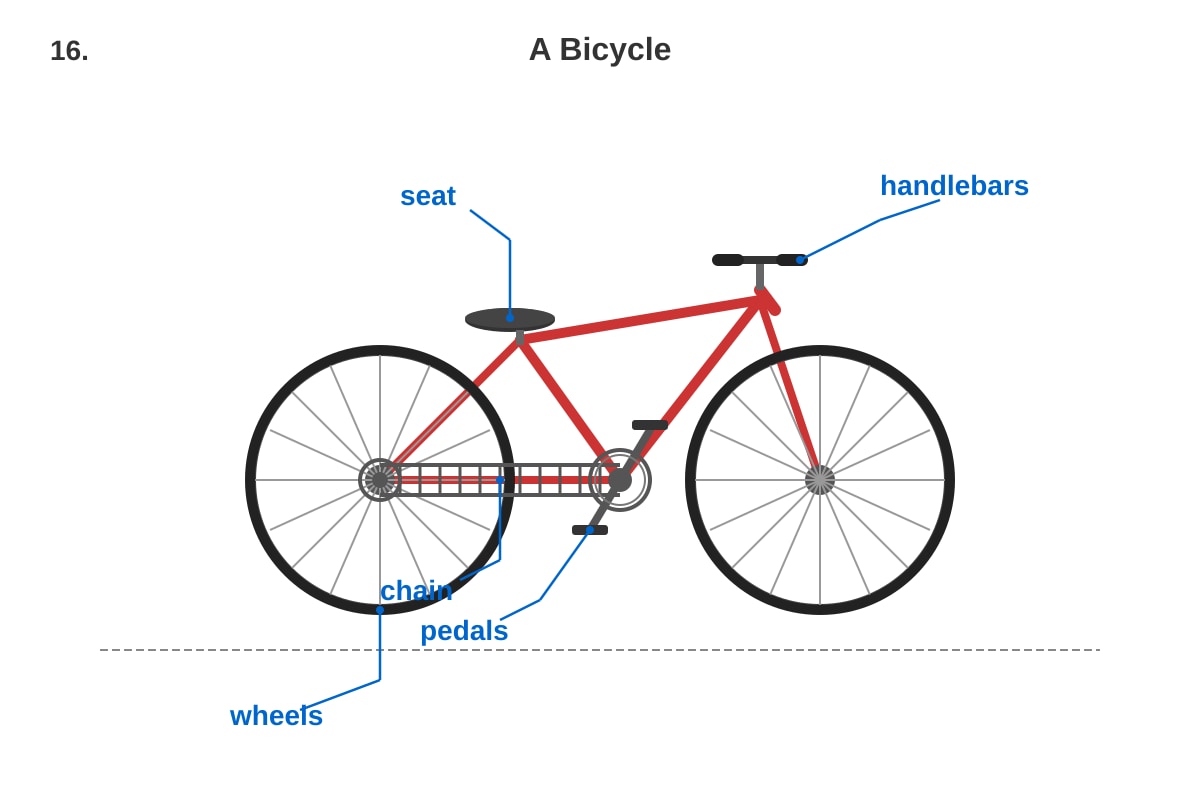
- Explanation: This is the definition of a system. For example, a bicycle has wheels, pedals, and a chain that work together to move. A system can be living (like a body system) or non-living (like a machine).
- Common mistake: Students might think a system is only a living thing or only a machine.
5. Answer: B) A pile of sand [1 mark]
- Explanation: A pile of sand is just a collection of grains. The grains do not work together to perform a function. A bicycle, the circulatory system, and a computer all have parts that work together.
- Common mistake: Students might think any collection of objects is a system.
6. Answer: C) Circulatory system [1 mark]
- Explanation: The heart is the main organ of the circulatory system. It pumps blood through blood vessels to deliver oxygen and nutrients to all parts of the body.
- Common mistake: Students might confuse the heart with the respiratory system because the heart works closely with the lungs.
7. Answer: C) To transport water and food between the roots and leaves [1 mark]
- Explanation: The stem acts like a highway for the plant. It carries water and minerals up from the roots to the leaves, and it carries food made in the leaves down to other parts of the plant.
- Common mistake: Students might think the stem makes food (that is the leaves' job) or holds the plant in the soil (that is the roots' job).
8. Answer: A) The heart pumps blood, and the lungs help us breathe [1 mark]
- Explanation: This shows the circulatory system (heart) and the respiratory system (lungs) working together. The heart pumps blood to the lungs to get oxygen, then pumps the oxygen-rich blood to the rest of the body.
- Common mistake: Students might think any two body parts working at the same time means they are a system, but the key is that they work together for a common purpose.
9. Answer: C) Its parts (wheels, pedals, chain) work together to help it move [1 mark]
- Explanation: A system is defined by parts working together. The pedals turn the chain, which turns the wheels, making the bicycle move. This cooperation of parts makes it a system.
- Common mistake: Students might focus on what the bicycle is made of (metal) or what it looks like (colours) rather than how its parts work together.
10. Answer: B) The system might not work properly or might stop working [1 mark]
- Explanation: In any system, each part has a job. If one part fails, the whole system can be affected. For example, if a bicycle chain breaks, the bicycle cannot move even though the wheels and pedals are fine.
- Common mistake: Students might think the system would work better or that nothing would change.
Section B: Fill in the Blanks (Questions 11 to 15)
11. Answer: digestive [1 mark]
- Explanation: The digestive system includes the mouth, stomach, and intestines. It breaks down food into tiny nutrients that the body can use for energy and growth.
- Spelling note: Accept "digestive" or "digestive system". Do not accept "digestion" alone.
12. Answer: transport [1 mark]
- Explanation: The transport system of a plant includes the roots (absorb water), stem (carry water and food), and leaves (make food). It moves materials around the plant.
- Acceptable alternatives: "shoot system" (if taught), but "transport system" is the expected term for P3.
13. Answer: muscular [1 mark]
- Explanation: The muscular system includes all the muscles in the body. Muscles work with bones (the skeletal system) to help us move our arms, legs, and other body parts.
- Acceptable alternatives: "musculoskeletal system" if taught, but "muscular system" is standard for P3.
14. Answer: system [1 mark]
- Explanation: This is the definition of a system. Examples include the digestive system, a bicycle system, or a computer system.
- Acceptable alternatives: None. The word "system" is the specific term being tested.
15. Answer: circulatory [1 mark]
- Explanation: The circulatory system includes the heart and blood vessels. It pumps blood around the body to deliver oxygen and nutrients and remove waste.
- Acceptable alternatives: "blood" or "cardiovascular" system (if taught), but "circulatory system" is standard for P3.
Section C: Short-Answer Questions (Questions 16 to 20)
16. Answer: [2 marks]
- A bicycle is a system because its parts work together to help it move.
- Two parts and how they work together (any two of the following):
- Pedals and chain: When you push the pedals, they turn the chain, which makes the wheels move.
- Wheels and handlebars: The wheels allow the bicycle to roll, and the handlebars help steer the wheels to change direction.
- Seat and pedals: The seat supports the rider, and the pedals allow the rider to push the bicycle forward.
Marking scheme:
- 1 mark for explaining that a bicycle is a system because its parts work together.
- 1 mark for naming two parts and describing how they work together (must show cooperation, not just listing parts).
Common mistake: Students might list parts without explaining how they work together. Encourage them to use words like "together", "helps", or "turns".
17. Answer: [2 marks] Any two body systems with one correct function each. Examples:
- Digestive system: Breaks down food into nutrients the body can use.
- Respiratory system: Helps us breathe and take in oxygen.
- Circulatory system: Pumps blood around the body.
- Muscular system: Helps us move.
- Skeletal system: Supports the body and protects organs.
Marking scheme:
- 1 mark for each correctly named system with a correct function (2 marks total).
- Accept any two systems from the list above or others taught in class.
- Must name the system AND give a function for full marks.
Common mistake: Students might name a system but give an incorrect function (e.g., "the digestive system helps us breathe"). Check for accuracy.
18. Answer: [2 marks] The main parts of a plant's transport system are:
- Roots: Absorb water and minerals from the soil.
- Stem: Carries water and minerals up to the leaves and carries food down from the leaves.
- Leaves: Make food for the plant using sunlight, water, and air.
Marking scheme:
- 1 mark for naming at least two parts (roots, stem, leaves).
- 1 mark for describing what each named part does correctly.
- Full marks require at least two parts with correct functions.
Common mistake: Students might say the leaves absorb water (they don't; roots do) or that the stem makes food (it doesn't; leaves do).
19. Answer: [2 marks] If the heart stops working:
- The circulatory system would stop working.
- Blood would not be pumped around the body.
- Other parts of the body (like the brain, muscles, and organs) would not receive oxygen and nutrients.
- The body systems would not be able to work properly, and the person would not survive.
Marking scheme:
- 1 mark for stating that the circulatory system would stop working or that blood would not be pumped.
- 1 mark for explaining the effect on other body parts (e.g., no oxygen to the brain, other systems fail).
- Must use the idea of systems working together for full marks.
Common mistake: Students might say only the heart is affected. Emphasise that systems are connected; when one part fails, the whole system and other systems are affected.
20. Answer: [2 marks] Example: A pencil sharpener (or any other appropriate system).
- Parts: The handle, the blades, and the container.
- How they work together: When you turn the handle, it spins the blades, which cut the wood of the pencil. The shavings fall into the container. All parts work together to sharpen the pencil.
Other acceptable examples: a bicycle, a computer, a fan, a tap, a pair of scissors, a school bag with straps and zippers.
Marking scheme:
- 1 mark for naming a system and its parts (at least two parts).
- 1 mark for explaining how the parts work together to perform a function.
- The system must be non-body (as specified in the question).
Common mistake: Students might name a system but only list parts without explaining cooperation. Remind them that a system requires parts to work together.