AI Generated Quiz
Primary 3 Science Systems Quiz
Free P3 Science Systems quiz, AI version, with questions, answers, and syllabus-aligned practice for Singapore students.
These static practice materials are generated from the site's syllabus and paper-generation workflow, with source and model context shown so students and parents can evaluate the material before use.
Questions
Free quiz and exam paper access
Enter your details to view this paper
Your access is remembered on this device.
Answers
Answer Key: Primary 3 Science Quiz - Systems
Total Marks: 20
Section A: Multiple Choice (Questions 1 - 5)
1. (B) The digestive system
- Marks: 1
- Explanation: A system is a group of parts that work together to perform a function. The digestive system is a group of organs (mouth, stomach, intestines) that work together to break down food. A bicycle, a computer, and a plant pot are objects, but they are not body systems. The question asks for a system in the human body.
- Common Mistake: Choosing (A) A bicycle. A bicycle is a system, but it is not a human body system.
2. (B) Help us breathe and get oxygen
- Marks: 1
- Explanation: The respiratory system includes the nose, windpipe, and lungs. Its main job is to bring oxygen into the body and remove carbon dioxide. Oxygen is needed for our cells to work.
- Common Mistake: Choosing (A) Help us move. That is the muscular system. (C) Help us digest food is the digestive system. (D) Help us think is the nervous system.
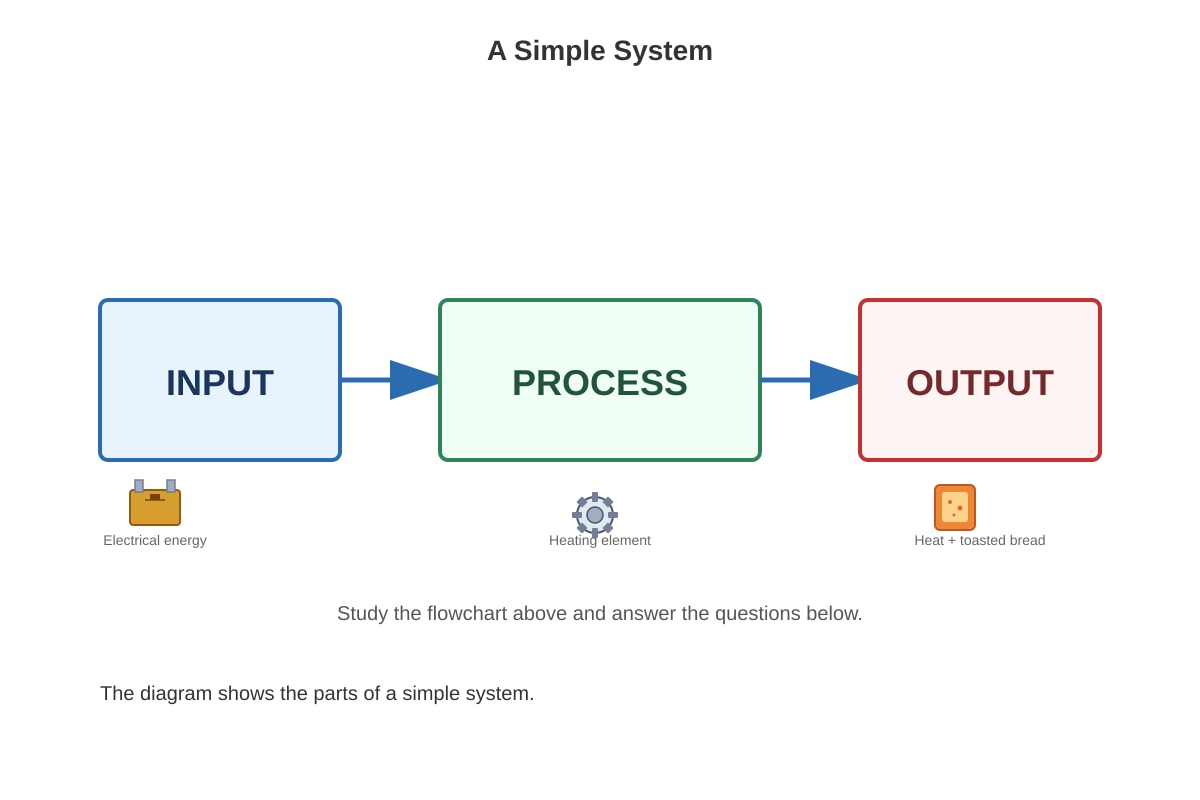
3. (A) Input, process, output
- Marks: 1
- Explanation: A simple system has three main parts: an input (what goes in), a process (what happens inside), and an output (what comes out). For example, in a toaster, the input is bread, the process is heating, and the output is toast.
- Common Mistake: Choosing (B) Start, middle, end. This describes a story, not a system.
4. (C) Digestive system
- Marks: 1
- Explanation: The digestive system breaks down food into smaller parts (nutrients) that the body can use for energy, growth, and repair. It includes the mouth, stomach, and intestines.
- Common Mistake: Choosing (A) Skeletal system. The skeletal system supports the body, it does not break down food.
5. (C) The pedals
- Marks: 1
- Explanation: The input is what starts the system working. On a bicycle, you push the pedals to make the bike move. The pedals are the input. The wheels are part of the output (they move), the chain is part of the process (it transfers the force), and the seat is for sitting, not for input.
- Common Mistake: Choosing (A) The wheels. The wheels are the output, not the input.
Section B: Fill in the Blanks (Questions 6 - 10)
6. heart
- Marks: 1
- Explanation: The heart is a muscular organ that pumps blood around the body. It is part of the circulatory system. The blood carries oxygen and nutrients to all parts of the body.
7. stomach
- Marks: 1
- Explanation: The stomach is a part of the digestive system. It is a bag-like organ that mixes food with digestive juices to break it down into a liquid.
8. skeleton
- Marks: 1
- Explanation: The skeleton is the framework of bones that supports the body, gives it shape, and protects internal organs like the heart and lungs. It is part of the skeletal system.
9. oxygen
- Marks: 1
- Explanation: Oxygen is a gas in the air that we breathe in. Our body needs oxygen to release energy from food. The respiratory system takes in oxygen.
10. waste
- Marks: 1
- Explanation: The digestive system breaks down food, absorbs the nutrients the body needs, and then removes the leftover material as waste (faeces).
Section C: Matching (Questions 11 - 15)
11. C
- Marks: 1
- Explanation: The skeletal system (the bones) supports the body and protects organs like the brain (skull) and heart (ribcage).
12. E
- Marks: 1
- Explanation: The muscular system (the muscles) helps the body move by pulling on the bones.
13. B
- Marks: 1
- Explanation: The digestive system breaks down food into nutrients that the body can use for energy.
14. A
- Marks: 1
- Explanation: The respiratory system helps us breathe. It takes in oxygen and releases carbon dioxide.
15. D
- Marks: 1
- Explanation: The nervous system (brain, spinal cord, nerves) controls all thoughts, actions, and reactions.
Section D: Short Answer Questions (Questions 16 - 20)
16. (a) Bread / A slice of bread
- Marks: 1
- Explanation: The input is what goes into the system. For a toaster, you put bread in. The bread is the input.
- Marking Note: Accept "bread" or "a slice of bread". Do not accept "electricity" as the primary input at this level, as the focus is on the material being processed.
(b) Toast / Toasted bread
- Marks: 1
- Explanation: The output is what comes out of the system after the process. After the toaster heats the bread, the output is toast.
- Marking Note: Accept "toast", "toasted bread", or "brown bread". Do not accept "heat" as the primary output.
17. System 1: Muscular system (or Muscles) System 2: Skeletal system (or Bones)
- Marks: 1 mark for naming two correct systems (0.5 marks each if partially correct)
Explanation: When you run, your muscles (muscular system) pull on your bones (skeletal system) to make your legs move. The skeletal system provides the framework and support, while the muscles provide the force to move.
- Marks: 1 mark for a clear explanation of how they work together.
- Acceptable alternatives: Respiratory system (provides oxygen to muscles) and Muscular system (uses oxygen to move). Or Circulatory system (pumps blood to muscles) and Muscular system.
- Marking Note: Award full marks for any two systems that are correctly named and have a reasonable explanation of how they work together.
18. (a) Water, minerals, sunlight, and carbon dioxide
- Marks: 1
- Explanation: The input of a plant system is what the plant takes in from its environment. The roots take in water and minerals from the soil. The leaves take in sunlight and carbon dioxide from the air.
- Marking Note: Accept any one of these: water, minerals, sunlight, carbon dioxide. Award 1 mark for at least one correct input.
(b) Food (sugar/glucose) and oxygen
- Marks: 1
- Explanation: The output of a plant system is what the plant produces. Through photosynthesis, the plant uses the inputs to make food (sugar) for itself and releases oxygen into the air.
- Marking Note: Accept "food", "sugar", "glucose", or "oxygen". Award 1 mark for at least one correct output.
19. (a) Teachers / Students / Classrooms / Principal / Books / etc.
- Marks: 1
- Explanation: A school is a system made up of many parts that work together. Any one part of the school system is acceptable.
- Marking Note: Accept any reasonable part of a school.
(b) To educate / teach students / help students learn
- Marks: 1
- Explanation: The main purpose of a school system is to provide education and help students learn and grow.
- Marking Note: Accept any answer that conveys the idea of learning or education.
20. Part 1: Mouth What it does: Chews and breaks food into smaller pieces.
- Marks: 1 mark for naming a correct part and describing its function.
Part 2: Stomach What it does: Mixes food with digestive juices to break it down further.
- Marks: 1 mark for naming a correct part and describing its function.
Acceptable alternatives:
- Oesophagus: Carries food from the mouth to the stomach.
- Small intestine: Absorbs nutrients from the digested food.
- Large intestine: Absorbs water and removes waste.
Marking Note: Award 1 mark for each correct part with a reasonable description of its function. The description does not need to be detailed, but it must show some understanding of what the part does.