AI Generated Quiz
Primary 3 Science Materials Quiz
Free P3 Science Materials quiz, Kimi2.6 AI version, with questions, answers, and syllabus-aligned practice for Singapore students.
These static practice materials are generated from the site's syllabus and paper-generation workflow, with source and model context shown so students and parents can evaluate the material before use.
Questions

Free quiz and exam paper access
Enter your details to view this paper
Your access is remembered on this device.
Answers
Primary 3 Science Quiz - Materials: ANSWER KEY
Total Marks: 40
Section A: Multiple Choice (Questions 1–8)
1. C) It conducts electricity [2 marks]
Explanation: Metals are good conductors of electricity. This means electricity can flow through them easily. This is why electrical wires are often made of metal (usually copper). The other options describe properties that are NOT typical of metals: metals do NOT break easily when bent (they are malleable), they do NOT allow light through (they are opaque, not transparent), and most metals actually sink in water because they are denser than water.
2. B) Plastic [2 marks]
Explanation: Plastic is waterproof (does not allow water through), flexible, and light. These properties make it ideal for a raincoat. Paper would get wet and tear, metal would be too heavy and uncomfortable, and glass would be dangerous and completely unsuitable for clothing.
3. B) Cotton and wood [2 marks]
Explanation: Natural materials come directly from nature. Cotton comes from cotton plants, and wood comes from trees. Plastic, glass, steel, nylon, and ceramic are all man-made materials that have been processed and changed by humans from natural raw materials.
4. C) Good conductor of heat [2 marks]
Explanation: A cooking pot needs to transfer heat from the stove to the food inside quickly. Materials that allow heat to pass through them easily are called "good conductors of heat." Metals like copper and aluminium are excellent conductors of heat, which is why they are commonly used for pots and pans.
5. B) It is brittle and breaks easily [2 marks]
Explanation: Glass is hard but brittle. This means it is strong when you press on it, but it breaks or shatters when you hit it or drop it. A hammer needs to withstand pounding and hitting without breaking, so strong, tough materials like metal are used instead. Interestingly, glass IS transparent, which is why answer D is incorrect.
6. C) Wood [2 marks]
Explanation: Wood is a poor conductor of heat (it is an insulator). This means heat does not travel through it easily. If the handle were made of metal, aluminium, or copper, it would become very hot and burn your hand when the pot is heated. Wood stays cool enough to hold safely.
Common mistake: Some students think copper or aluminium would be good because they are common metals, but forget that their good heat conductivity makes them dangerous for handles!
7. C) Waterproofness [2 marks]
Explanation: Waterproofness (being waterproof) means a material does not let water pass through it. By pouring water on materials and observing whether the water soaks in or stays on the surface, Ravi is testing if they are waterproof. A truly waterproof material will not absorb water at all.
8. B) Materials can be grouped by their properties [2 marks]
Explanation: This is a fundamental idea in learning about materials. Scientists and engineers group materials by their properties (such as flexible/rigid, transparent/opaque, conductor/insulator) to help choose the right material for a job. The other statements are all false: some man-made materials are weak (like tissue paper), materials always have multiple properties, and whether natural or man-made is "better" depends on what you need the material to do.
Section B: Fill in the Blanks and Short Answers (Questions 9–14)
9. (a) Any ONE of: wood, cotton, wool, rubber (from trees), silk, leather, stone, sand, clay [1 mark]
(b) Any ONE of: plastic, glass, steel, nylon, polyester, concrete, brick, paper (paper is processed from wood, so it is man-made) [1 mark]
Note: Accept other valid examples. The key distinction is whether the material is used directly from nature (natural) or has been processed/changed by humans (man-made).
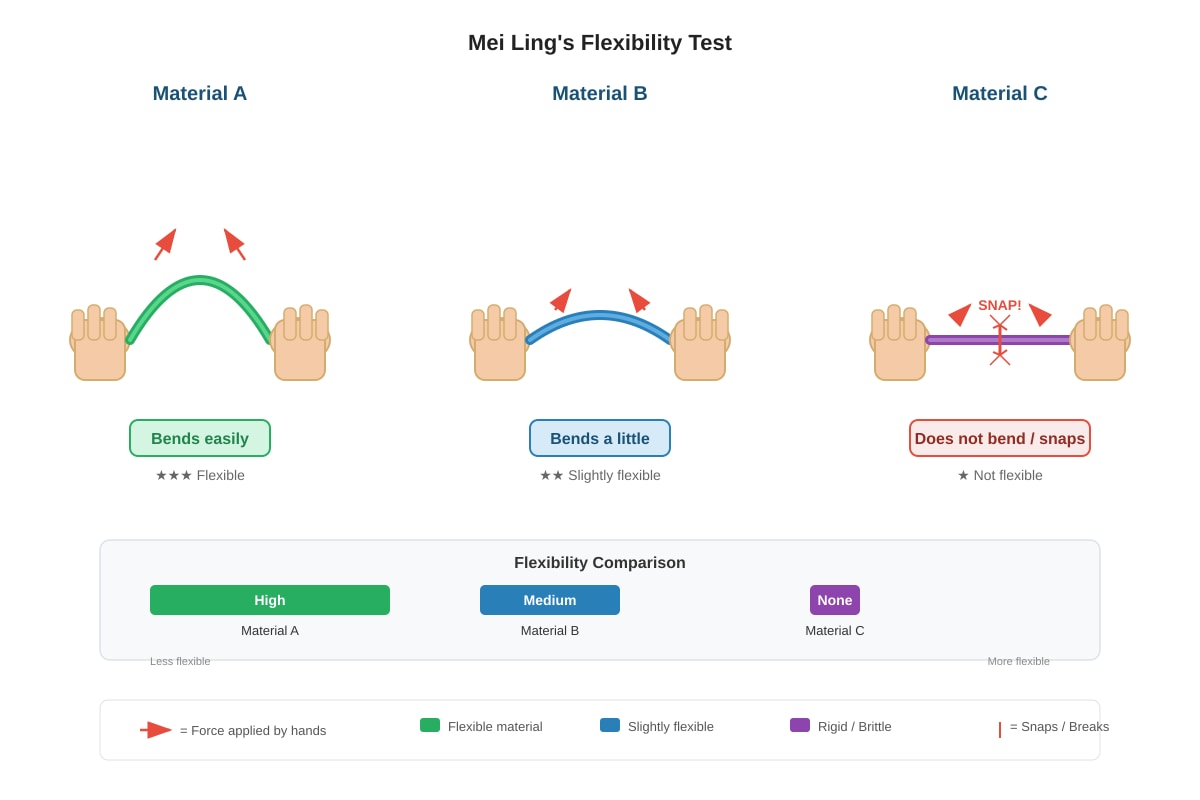
10. (a) Material A [1 mark]
Expected from image: Material A bends easily without breaking.
(b) Material A [1 mark]
(c) Material A is the most flexible / It can bend and spring back to shape / It will not break when pushed against the door [1 mark]
Key concept: Flexibility means a material can bend without breaking and can return to its original shape. A doorstop needs to be springy to push back against the door.
11. (a) Wood and Plastic circled [2 marks]
Scoring: 1 mark for each correct circle; deduct 1 mark for each extra circled material (wrong materials selected).
Explanation: Wood and plastic are less dense than water, so they float. Most metals are denser than water and sink. Glass is also denser than water and will sink.
(b) Any ONE of: waterproof, strong, durable, easy to shape [1 mark]
12. (a) Q [1 mark]
Explanation: Material Q is transparent (allows light to pass through), which is essential for window glass so we can see through it.
(b) P [1 mark]
Explanation: Material P conducts electricity AND is flexible. Electrical wires need to conduct electricity and be bendable so they can be installed around corners.
(c) P [1 mark]
Explanation: Material P is flexible and waterproof. A raincoat needs to keep water out (waterproof) and allow the wearer to move comfortably (flexible).
(d) Material S is not waterproof / Water would pass through material S / The wearer would get wet [1 mark]
Key concept: A raincoat MUST be waterproof to keep rain out. Material S lets water through, so it fails this essential requirement.
13. (a) Cardboard [1 mark]
(b) Tissue paper [1 mark]
(c) Cardboard [1 mark]
(d) Cardboard can hold the most weight before tearing / It is the strongest / It can support 800g before breaking [1 mark]
Explanation: Strength in this context means the ability to withstand force without breaking. Cardboard held 800g, which was more than any other paper type tested.
14. (a) Wax / Chocolate / Butter / Ice / Sugar / Glass (when very hot) [1 mark]
Note: Accept any material that is known to melt at moderate temperatures. Chocolate and ice are common examples that P3 students would know.
(b) Plastic / Glass / Some metals (when very hot) / Wax [1 mark]
(c) Flexibility / Flexible (accept if student writes "flexibility" or recognisable attempt) [1 mark]
Key concept: When heated, some materials become soft and can be bent, stretched, or reshaped. This property is called flexibility or, more precisely for this behaviour, "thermoplastic" property. For P3 level, "flexibility" is the expected term.
Section C: Application and Reasoning (Questions 15–20)
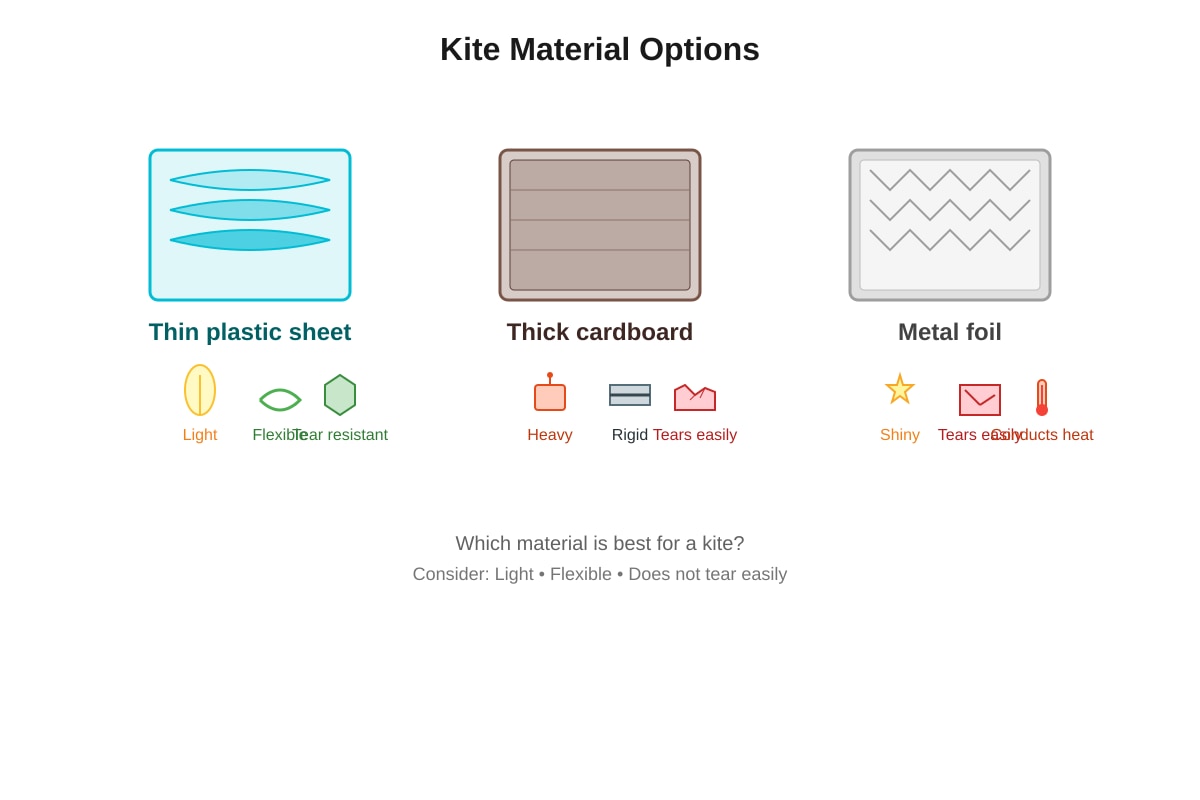
15. (a) Thin plastic sheet [1 mark]
(b) Explanation including all three properties [2 marks]
Marking breakdown:
- Mentions it is light (so the kite can fly easily) [1 mark]
- Mentions it is flexible (so it can catch the wind and move) [1 mark]
- Mentions it does not tear easily / is strong enough [1 mark]
Any two points for 2 marks: The thin plastic sheet is light so the kite can lift into the air. It is flexible so it can bend and catch the wind. It does not tear easily, so it will last when the kite is flying.
(c) [2 marks]
Thick cardboard: It is too heavy / too rigid / does not bend easily / cannot catch wind properly [1 mark]
Metal foil: It tears too easily / is not strong enough / might cut hands / is too heavy [1 mark]
16. (a) [3 marks]
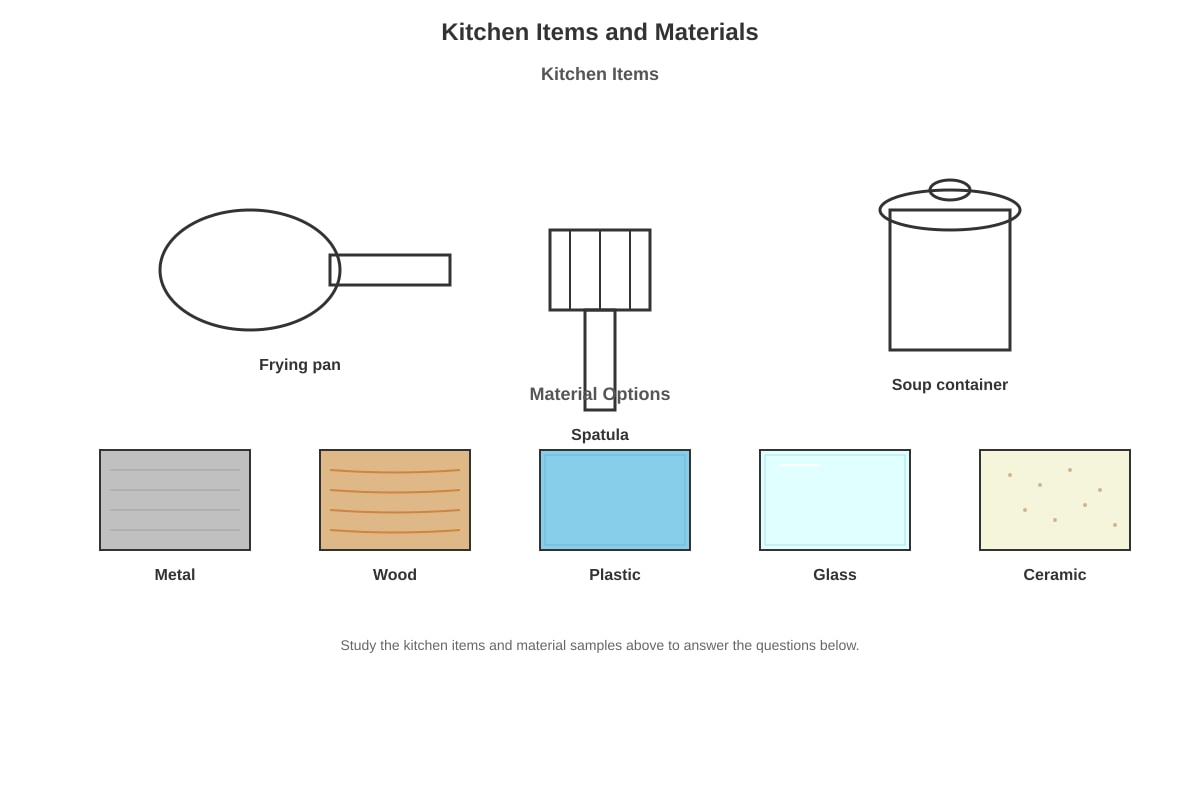
| Item | Best material | Why this material is suitable |
|---|---|---|
| Frying pan | Metal / Ceramic | Conducts heat well / can withstand high heat [1 mark] |
| Spatula | Wood / Plastic | Does not conduct heat (stays cool) / does not scratch pan [1 mark] |
| Soup container | Glass / Plastic / Ceramic | Can hold liquid / does not leak / can see contents (if glass) [1 mark] |
Accept reasonable alternatives with valid explanations.
(b) [2 marks]
- Glass is brittle / breaks easily [1 mark]
- When heated and then cooled quickly, or if dropped, glass can shatter / crack [1 mark]
- OR: Glass is a poor conductor of heat / would heat unevenly and break
Key safety concept: Glass can withstand heat if specially made (like Pyrex), but ordinary glass breaks with temperature changes and impact, making it dangerous for stovetop cooking.
17. (a) Metal [1 mark]
(b) The temperature dropped the most / from 80°C to 42°C in 20 minutes / it had the lowest temperature at each time check [1 mark]
(c) Plastic cup [1 mark]
(d) Plastic [1 mark]
(e) [2 marks]
- Plastic kept water warmest / lost heat slowest [1 mark]
- It is a good insulator / poor conductor of heat / does not let heat escape easily [1 mark]
Teaching note: This experiment demonstrates that different materials conduct heat at different rates. Metals are good conductors (heat escapes quickly), while plastics are good insulators (heat stays trapped). This is why plastic and ceramic cups are better for keeping drinks warm.
18. (a) Fabric / Cardboard [1 mark]
Fabric is the worst as it absorbs water and lets it through; cardboard also disintegrates when wet.
(b) Metal [1 mark]
Metal is extremely rigid and would not cushion the pencils; also heavy and potentially sharp edges.
(c) [3 marks]
Best material: Plastic [1 mark for correct choice]
Explanation (need 3 valid points for full marks):
| Need | How plastic meets it |
|---|---|
| Protect pencils from breaking | Plastic is strong but slightly flexible, absorbing shock [1 mark] |
| Keep water out | Plastic is waterproof / does not absorb water [1 mark] |
| Easy to open and close | Can have a zip or snap made of plastic; lightweight [1 mark] |
| Look colourful | Can be made in many colours and patterns [1 mark] |
Any 3 correct points = 3 marks. Maximum 2 marks if only 2 points given.
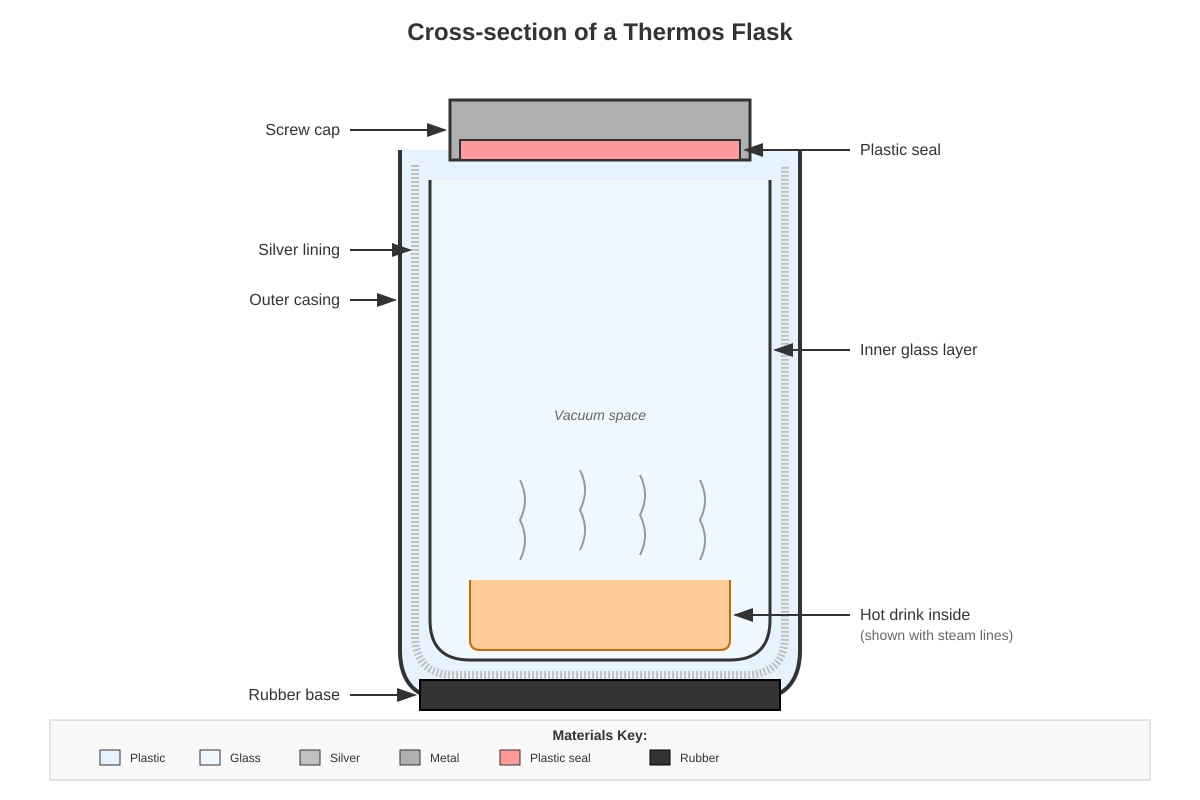
19. (a) [3 marks]
Any THREE from:
- Plastic (outer casing)
- Glass (inner layer)
- Metal/Silver (lining)
- Rubber (base)
- Another plastic (seal) [1 mark each]
(b) [2 marks]
- The silver lining reflects heat back inside [1 mark]
- This keeps the drink hotter for longer / reduces heat loss [1 mark]
OR: The glass with silver lining creates a vacuum effect / reduces heat transfer by radiation.
Key concept: Shiny, reflective surfaces bounce heat (infrared radiation) back. This is why thermos flasks stay warm.
(c) [1 mark]
- To stop leaks / to make it airtight / to prevent heat escaping through the opening / to stop the drink spilling
20. (a) [2 marks]
Working: Water absorbed = Starting water − Water left
mL [1 mark for correct working]
Answer: 15 mL [1 mark]
Common mistake: Some students might think the answer is 35 mL. Remind them: 35 mL is what is LEFT, not what was absorbed. The absorbed water went into the paper!
(b) [2 marks]
-
As the paper gets thicker, less water is absorbed / more water is left in the dish [1 mark]
-
OR: The thicker the paper, the less water it absorbs
-
The pattern shows that each extra layer absorbs less additional water / the increase in absorption slows down [1 mark]
Accept observations of the numerical pattern: 15, 8, 4, 2 mL absorbed for 1, 2, 3, 4 layers respectively.
(c) [2 marks]
Prediction: Approximately 1–2 mL (accept 1, 2, or any value up to about 3 mL) [1 mark for reasonable prediction]
Explanation: The pattern shows each extra layer absorbs LESS additional water / the amount of extra absorption is decreasing / with 4 layers nearly all absorption is blocked [1 mark]
Alternative acceptable prediction: About 50−49=1 mL left, so 1 mL absorbed, OR state that 5 layers might absorb about 1 mL or almost 0 mL.
(d) [1 mark]
Any ONE valid control:
- Use the same size of paper each time
- Use the same type of paper (same quality/brand)
- Put all dishes in the same place (same temperature)
- Leave them for exactly the same time
- Use the same amount of water (50 mL) measured carefully
- Start with water at the same temperature
Key concept of fair testing: Only ONE thing should change (the independent variable: thickness). Everything else must stay the same to make the test fair and the results reliable.
END OF ANSWER KEY