AI Generated Quiz
Primary 3 Science Magnets Quiz
Free P3 Science Magnets quiz, AI version, with questions, answers, and syllabus-aligned practice for Singapore students.
These static practice materials are generated from the site's syllabus and paper-generation workflow, with source and model context shown so students and parents can evaluate the material before use.
Questions
Free quiz and exam paper access
Enter your details to view this paper
Your access is remembered on this device.
Answers
Primary 3 Science Quiz - Magnets: Answer Key
Total Marks: 20
Section A: Multiple-Choice Questions (Questions 1 - 5)
1.
- Answer: C. A steel paperclip
- Marks: 1
- Explanation: Magnets attract objects made of magnetic materials. Steel is a magnetic material because it contains iron. Plastic, wood, and glass are non-magnetic materials and will not be attracted to a magnet.
- Common Mistake: Students may think all metals are magnetic. Only iron, steel, nickel, and cobalt are magnetic. Many metals like aluminium and copper are not magnetic.
2.
- Answer: B. North-South
- Marks: 1
- Explanation: A freely suspended bar magnet will always align itself in a north-south direction. This is because the Earth itself acts like a giant magnet, and the north pole of the magnet is attracted to the Earth's magnetic south pole (which is near the geographic North Pole).
- Common Mistake: Students may think it points East-West or any random direction.
3.
- Answer: B. They will repel each other.
- Marks: 1
- Explanation: Like poles of magnets repel each other. Since both are north poles, they will push away from each other. Unlike poles (north and south) attract each other.
- Key Concept: Remember: Like poles repel, unlike poles attract.
4.
- Answer: C. Iron or steel
- Marks: 1
- Explanation: Magnets are typically made from iron or steel because these materials can be magnetised. Plastic, wood, and rubber are non-magnetic and cannot be made into permanent magnets.
- Common Mistake: Students may think magnets can be made from any material.
5.
- Answer: C. Push or a pull
- Marks: 1
- Explanation: A magnet can exert both a push (repel) and a pull (attract) force on other objects. It can attract magnetic materials and repel other magnets with the same pole. The force acts without direct contact.
- Key Concept: Magnetic force is a non-contact force.
Section B: Fill in the Blanks (Questions 6 - 10)
6.
- Answer: poles
- Marks: 1
- Explanation: The two ends of a magnet are called its north pole and south pole. These are the points where the magnetic force is strongest.
7.
- Answer: attract
- Marks: 1
- Explanation: Unlike poles (north and south) attract each other. This means they pull towards each other.
- Key Concept: Unlike poles attract.
8.
- Answer: north-south
- Marks: 1
- Explanation: A freely suspended magnet will always point towards the north-south direction because it aligns with the Earth's magnetic field.
9.
- Answer: iron
- Marks: 1
- Explanation: Magnets attract objects made of magnetic materials. Iron and steel are the most common magnetic materials. (Note: Nickel and cobalt are also magnetic but are not required for P3 recall.)
10.
- Answer: magnetism
- Marks: 1
- Explanation: The force that a magnet exerts is called magnetism. It is an invisible force that can act at a distance.
Section C: Short Answer Questions (Questions 11 - 15)
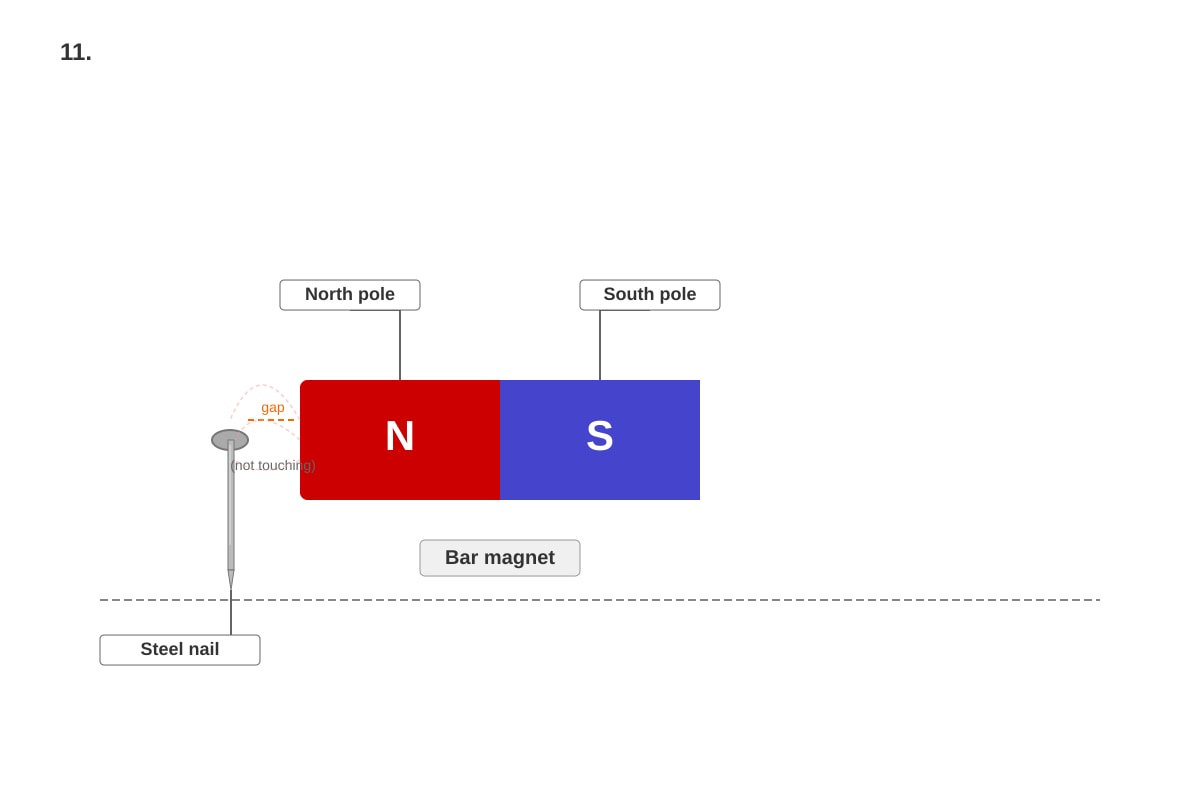
11. (2 marks)
- (a) Answer: Yes, the steel nail will be attracted to the magnet. (1 mark)
- Explanation: Steel is a magnetic material because it contains iron. The magnet exerts a magnetic force that pulls the steel nail towards it. (1 mark for correct explanation)
- (b) Answer: If the nail was made of plastic, it would not be attracted to the magnet. (1 mark)
- Explanation: Plastic is a non-magnetic material. Magnets can only attract magnetic materials like iron and steel.
- Marking Notes:
- Part (a): 1 mark for correct answer and explanation.
- Part (b): 1 mark for correct answer.
- Accept: "The plastic nail would not move" or "Nothing would happen."
12. (2 marks)
- (a) Answer: The two magnets will attract each other. (1 mark)
- (b) Explanation: Unlike poles attract each other. The north pole and south pole are opposite poles, so they pull towards each other. (1 mark)
- Marking Notes:
- Part (a): 1 mark for correct answer.
- Part (b): 1 mark for correct explanation using the concept of unlike poles attracting.
- Accept: "They will stick together" or "They will pull towards each other."
13. (2 marks)
- Answer: To make a magnet using the stroke method:
- Take a steel bar or a steel needle. (0.5 marks)
- Stroke it repeatedly in one direction (from one end to the other) using one pole of a strong magnet. (1 mark)
- Do this many times (e.g., 30-50 strokes). The steel bar will become magnetised. (0.5 marks)
- Explanation: The stroke method aligns the magnetic domains in the steel in the same direction, turning it into a magnet.
- Marking Notes:
- Accept any reasonable description that includes stroking a steel object with a magnet in one direction.
- 1 mark for mentioning the stroke method.
- 1 mark for mentioning the correct materials (steel object and a magnet).
14. (2 marks)
- Answer: Any two of the following (1 mark each):
- Compass
- Refrigerator magnet
- Magnetic door catch
- Speaker or headphones
- Magnetic toy (e.g., magnetic building blocks)
- Magnetic screwdriver
- MRI machine (for advanced students)
- Explanation: Magnets are used in many everyday objects to hold things together, show direction, or convert electrical energy into motion.
- Marking Notes:
- Accept any reasonable everyday object that uses a magnet.
- Do not accept objects that are themselves magnetic materials but do not use magnets (e.g., a steel spoon is not a use of a magnet).
15. (2 marks)
- (a) Answer: The north pole (or N-pole). (1 mark)
- (b) Explanation: The Earth acts like a giant magnet. The north pole of the magnet is attracted to the Earth's magnetic south pole, which is located near the geographic North Pole. This causes the magnet to point north-south. (1 mark)
- Marking Notes:
- Part (a): 1 mark for correct answer.
- Part (b): 1 mark for a reasonable explanation involving the Earth's magnetism.
- Accept simplified explanations like "The Earth's magnetic field pulls the magnet to point north-south."
Section D: Application and Reasoning (Questions 16 - 20)
16. (2 marks)
- Answer: She can bring a magnet close to each object. (1 mark) If the object is attracted to the magnet (moves towards it or sticks to it), then it is magnetic. If nothing happens, the object is non-magnetic. (1 mark)
- Explanation: This is a simple test using the property of magnetic attraction. Magnetic materials will be attracted to a magnet, while non-magnetic materials will not.
- Marking Notes:
- 1 mark for describing the method (using a magnet to test).
- 1 mark for correctly interpreting the results.
- Accept: "She can use a magnet to see if the objects stick to it."
17. (2 marks)
- Answer: The magnet's magnetic force is strongest at its poles. (1 mark) Iron filings that are further away from the poles or are only weakly attracted may fall off when the magnet is moved because the magnetic force is not strong enough to hold them. (1 mark)
- Explanation: The magnetic force is strongest at the poles and weaker further away. When the magnet is moved, the filings may lose contact with the strongest part of the magnetic field and fall off.
- Marking Notes:
- 1 mark for mentioning the strength of the magnetic force.
- 1 mark for explaining why some filings are not held strongly.
- Accept: "The magnet is strongest at its ends. Filings in the middle are not held as tightly."
18. (2 marks)
- Answer: She can try to pick up the other bar with one of them. (1 mark) If the bars attract each other, then one of them is a magnet. If they do not attract, then neither is a magnet. (1 mark) Alternatively, she can hang one bar from a string and see if it points north-south.
- Explanation: A magnet can attract a non-magnetic piece of iron. If both bars are non-magnetic, they will not attract each other. If one is a magnet, it will attract the other (since iron is magnetic).
- Marking Notes:
- 1 mark for describing a valid method.
- 1 mark for correctly interpreting the results.
- Accept: "She can see if one bar can pick up the other."
19. (2 marks)
- Answer: A compass contains a small, freely suspended magnet. (1 mark) This magnet aligns itself with the Earth's magnetic field, so it always points north-south. The compass needle (which is the magnet) shows the direction of north. (1 mark)
- Explanation: The Earth acts like a giant magnet. The compass's small magnet is free to rotate and aligns itself with the Earth's magnetic field, pointing towards the magnetic north pole.
- Marking Notes:
- 1 mark for mentioning the compass contains a magnet.
- 1 mark for explaining that it points north-south due to the Earth's magnetism.
- Accept: "The compass needle is a magnet that points to the North Pole."
20. (2 marks)
- (a) Answer: Magnetic force (or magnetism). (1 mark)
- Explanation: The magnetic force from the magnet pulled the steel paperclip towards it. This is a non-contact force.
- (b) Answer: The paperclip will still be attracted to the magnet and stick to it. (1 mark)
- Explanation: Steel is a magnetic material. It will be attracted to either pole of a magnet (north or south). The pole does not matter for attracting magnetic materials.
- Marking Notes:
- Part (a): 1 mark for correct answer.
- Part (b): 1 mark for correct answer.
- Common Mistake: Students may think the paperclip will be repelled by the north pole. Magnetic materials are always attracted to magnets, regardless of which pole is used.