AI Generated Quiz
Primary 3 Science Magnets Quiz
Free P3 Science Magnets quiz, AI version, with questions, answers, and syllabus-aligned practice for Singapore students.
These static practice materials are generated from the site's syllabus and paper-generation workflow, with source and model context shown so students and parents can evaluate the material before use.
Questions
Free quiz and exam paper access
Enter your details to view this paper
Your access is remembered on this device.
Answers
Answer Key: Primary 3 Science Quiz - Magnets
Total Marks: 20
Section A: Multiple-Choice Questions (Questions 1 to 5)
1. C) An iron nail
- Marks: 1
- Explanation: Magnets attract magnetic materials. Iron is a magnetic material. Wood, plastic, and glass are non-magnetic materials, so a magnet will not attract them.
- Teaching Note: Remind students that only certain metals, like iron and steel, are attracted to magnets. Not all metals are magnetic (e.g., copper, aluminium).
2. B) North and South
- Marks: 1
- Explanation: A freely suspended bar magnet will always come to rest pointing in the North-South direction. This is because the Earth itself acts like a giant magnet.
- Teaching Note: This is the principle behind a compass. The North-seeking pole of the magnet points towards the Earth's North Pole.
3. B) They will repel each other.
- Marks: 1
- Explanation: Like poles repel each other. North pole and North pole are like poles, so they will push each other away.
- Teaching Note: The rule is: Like poles repel, unlike poles attract.
4. D) Making a wooden chair
- Marks: 1
- Explanation: Magnets are used in fridge doors, compasses, and scrapyards to lift iron and steel. A wooden chair is made from wood, which is not magnetic, and does not use a magnet.
- Teaching Note: Encourage students to think about what magnets do: attract magnetic materials and point North-South.
5. C) Poles
- Marks: 1
- Explanation: The two ends of a magnet are called poles. One is the North pole and the other is the South pole.
- Teaching Note: This is a key vocabulary term. A magnet always has two poles, a North pole and a South pole.
Section B: Short-Answer Questions (Questions 6 to 15)
6. North pole and South pole.
- Marks: 2 (1 mark for each correct pole)
- Explanation: Every magnet has two poles: a North pole (N) and a South pole (S).
- Teaching Note: Even if a magnet is broken, each piece will have its own North and South pole.
7. The metal spoon will be attracted.
- Marks: 2 (1 mark for the correct spoon, 1 mark for the reason)
- Explanation: The metal spoon is likely made of steel or iron, which are magnetic materials. The plastic spoon is made of plastic, which is a non-magnetic material.
- Marking Note: Accept "metal spoon" and a reason mentioning it is made of a magnetic material (iron/steel).
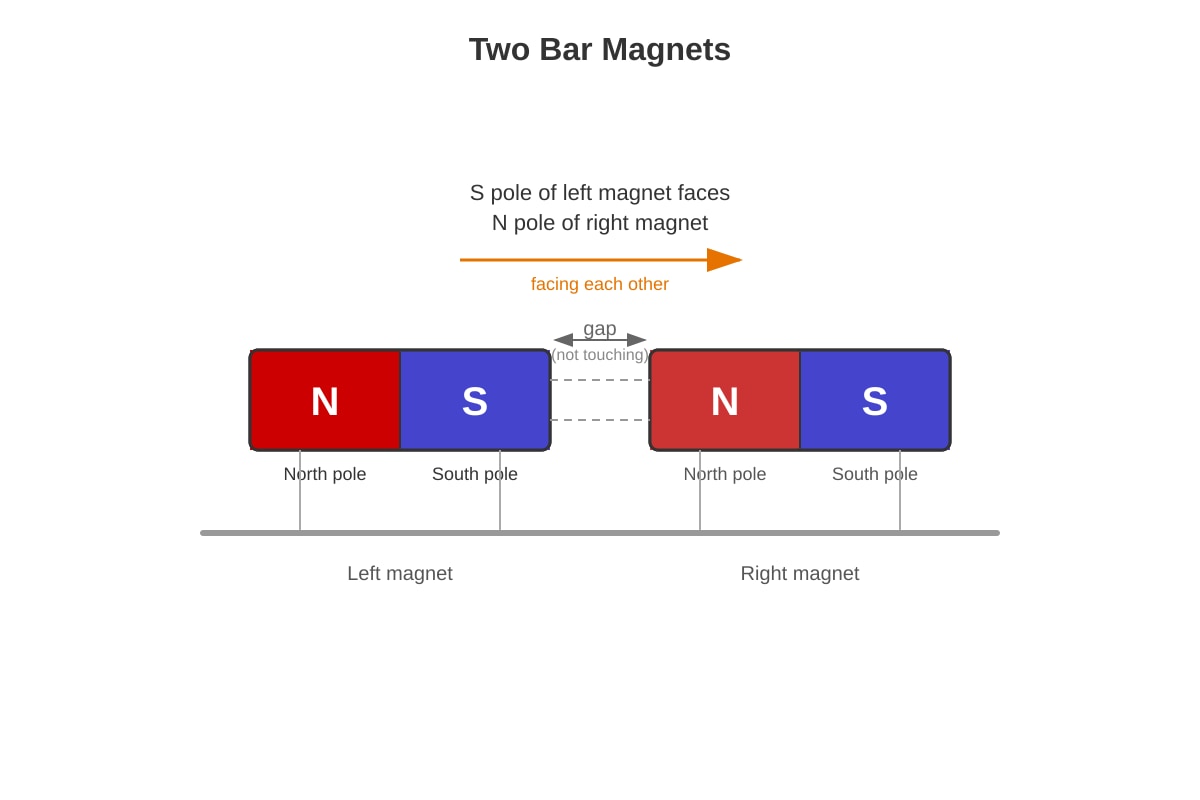
8. They will attract each other.
- Marks: 2 (1 mark for "attract", 1 mark for the explanation)
- Explanation: The South pole of the left magnet is facing the North pole of the right magnet. Unlike poles attract each other.
- Teaching Note: The rule is: Unlike poles (N and S) attract, like poles (N and N, or S and S) repel.
9. Iron is a magnetic material.
- Marks: 1
- Explanation: Iron is a magnetic material, which means it is attracted to a magnet.
- Teaching Note: Steel is also a magnetic material because it is made mostly from iron.
10. The stroke method.
- Marks: 1
- Explanation: Rubbing a steel object with a magnet in one direction repeatedly is called the stroke method of making a magnet.
- Teaching Note: The electrical method is another way to make a magnet, but it uses an electric current.
11. The needle always points to the North (and South).
- Marks: 1
- Explanation: The needle of a compass is a small magnet. It will always point towards the Earth's North and South poles.
- Teaching Note: This helps people find their direction, especially when they are lost.
12. Any one of: wood, plastic, glass, rubber, paper, cloth, copper, aluminium.
- Marks: 1
- Explanation: Magnets can only attract magnetic materials like iron and steel. They cannot attract non-magnetic materials.
- Teaching Note: Accept any correct non-magnetic material.
13. They will attract each other.
- Marks: 1
- Explanation: The North pole and South pole are unlike poles. Unlike poles attract.
- Teaching Note: This is a direct application of the rule.
14. The iron will be attracted to the magnet.
- Marks: 2 (1 mark for "attracted", 1 mark for the reason)
- Explanation: Iron is a magnetic material. A magnet will attract any magnetic material, regardless of which pole is brought near it.
- Teaching Note: Both the North and South poles of a magnet can attract magnetic materials.
15. Any one of: fridge door, compass, speaker, doorbell, toy train, purse clasp, etc.
- Marks: 1
- Explanation: Many everyday objects use magnets.
- Teaching Note: Accept any reasonable answer that correctly identifies an object that uses a magnet.
Section C: Application and Reasoning Questions (Questions 16 to 20)
16. (a) The red end and the blue end are unlike poles (one is North and the other is South).
- Marks: 1
- Explanation: Since they attract, they must be unlike poles.
- Teaching Note: We cannot tell which is North and which is South from the information given, only that they are different.
(b) They will repel each other.
- Marks: 2 (1 mark for "repel", 1 mark for the explanation)
- Explanation: When the blue magnet is turned around, its other end is now brought near the red end. Since the first blue end was unlike the red end, the other blue end must be the same pole as the red end. Like poles repel.
- Teaching Note: This tests understanding of the rule. If the blue end was South, the other end is North. If the red end was North, then North-North will repel.
17. The cars are made of steel, which is a magnetic material. The electromagnet attracts the steel, allowing it to lift the cars.
- Marks: 2 (1 mark for identifying steel as magnetic, 1 mark for explaining the attraction)
- Explanation: Steel is mostly made of iron, which is a magnetic material. The large electromagnet is strong enough to attract and lift the heavy steel cars.
- Teaching Note: An electromagnet is a magnet that can be turned on and off with electricity.
18. (a) The iron key.
- Marks: 1
- Explanation: Iron is a magnetic material.
- Teaching Note: Copper and plastic are non-magnetic.
(b) Iron is a magnetic material, so it is attracted to the magnet.
- Marks: 1
- Explanation: The key is made of iron, which is attracted to magnets.
- Teaching Note: Copper is a metal, but it is not magnetic.
19. Each piece will have two poles (a North pole and a South pole).
- Marks: 2 (1 mark for "two poles", 1 mark for the explanation)
- Explanation: When a magnet is broken, each piece becomes a new, smaller magnet. Every magnet, no matter how small, always has a North pole and a South pole.
- Teaching Note: This is a common misconception. Students may think breaking a magnet separates the poles, but it does not.
20. He can bring one end of the metal rod near the bar magnet. If the rod is a magnet, it will either attract or repel the bar magnet. If the rod is just a piece of iron, it will only be attracted to the bar magnet.
- Marks: 2 (1 mark for the method, 1 mark for the correct interpretation)
- Explanation: A magnet will attract a piece of iron. However, if the rod is a magnet, it can either attract (if unlike poles are near) or repel (if like poles are near) the bar magnet. If the rod is only iron, it will never repel the magnet.
- Teaching Note: The key is to test for repulsion. Only a magnet can repel another magnet. A piece of iron can only be attracted.
- Marking Note: Accept any method that correctly tests for repulsion to confirm the rod is a magnet.
END OF ANSWER KEY