AI Generated Quiz
Primary 3 Science Magnets Quiz
Free P3 Science Magnets quiz, AI version, with questions, answers, and syllabus-aligned practice for Singapore students.
These static practice materials are generated from the site's syllabus and paper-generation workflow, with source and model context shown so students and parents can evaluate the material before use.
Questions
Free quiz and exam paper access
Enter your details to view this paper
Your access is remembered on this device.
Answers
Primary 3 Science Quiz - Magnets (Answer Key)
Name: _________________________ Class: _________________________ Date: _________________________ Score: ________ / 20
Duration: 30 minutes Total Marks: 20
Section A: Multiple-Choice Questions (Questions 1–5)
1. Which of the following objects would a magnet attract?
- (C) A steel paperclip
Explanation: Magnets attract magnetic materials. Steel is a magnetic material because it contains iron. Plastic, wood, and glass are non-magnetic materials and are not attracted to magnets.
Marking: 1 mark for correct answer.
2. A bar magnet is freely suspended on a string. Which direction will it point?
- (B) North-South
Explanation: A freely suspended magnet aligns itself with the Earth's magnetic field. The north pole of the magnet points towards the Earth's geographic north pole, and the south pole points towards the geographic south pole. This is how a compass works.
Marking: 1 mark for correct answer.
3. Two magnets are brought near each other. The north pole of one magnet is brought close to the north pole of another magnet. What will happen?
- (B) They will repel each other
Explanation: Like poles of magnets repel each other. North pole and north pole are like poles, so they push each other away. Similarly, south pole and south pole would also repel.
Marking: 1 mark for correct answer.
4. Which of the following is NOT a magnetic material?
- (D) Aluminium
Explanation: Iron, steel, and nickel are magnetic materials. Aluminium is not magnetic. Common magnetic materials include iron, steel, nickel, and cobalt. Non-magnetic materials include aluminium, copper, plastic, wood, and glass.
Marking: 1 mark for correct answer.
5. A magnet can attract a metal object without touching it. This shows that:
- (B) Magnetic force can act at a distance
Explanation: Magnets exert a force on magnetic materials without needing to touch them. This is called "action at a distance." The magnetic field around the magnet extends into the space around it and can attract magnetic objects from a distance.
Marking: 1 mark for correct answer.
Section B: Fill in the Blanks (Questions 6–10)
6. A magnet has two ends called poles.
Explanation: Every magnet has two ends called poles: a north pole and a south pole. These are the points where the magnetic force is strongest.
Marking: 1 mark for correct answer. Accept "north and south poles" or just "poles."
7. Unlike poles of magnets attract each other.
Explanation: Unlike poles (north and south) attract each other. This means they pull towards each other. Like poles (north-north or south-south) repel each other.
Marking: 1 mark for correct answer.
8. A freely suspended magnet always points in the north-south direction.
Explanation: When a magnet is free to move, it aligns with the Earth's magnetic field. The north pole points towards the Earth's geographic north, and the south pole points towards the geographic south.
Marking: 1 mark for correct answer. Accept "north-south" or "north and south."
9. The force that a magnet exerts on magnetic materials is called magnetism or magnetic force.
Explanation: Magnetism is the invisible force that magnets exert on magnetic materials. This force can attract or repel objects.
Marking: 1 mark for correct answer. Accept "magnetism" or "magnetic force."
10. A magnet can be made by stroking a steel bar with a magnet. This method is called the stroke method.
Explanation: The stroke method involves rubbing a magnet along a steel object in one direction repeatedly. This aligns the magnetic domains in the steel, making it magnetic.
Marking: 1 mark for correct answer. Accept "stroke method" or "stroking method."
Section C: Short-Answer Questions (Questions 11–15)
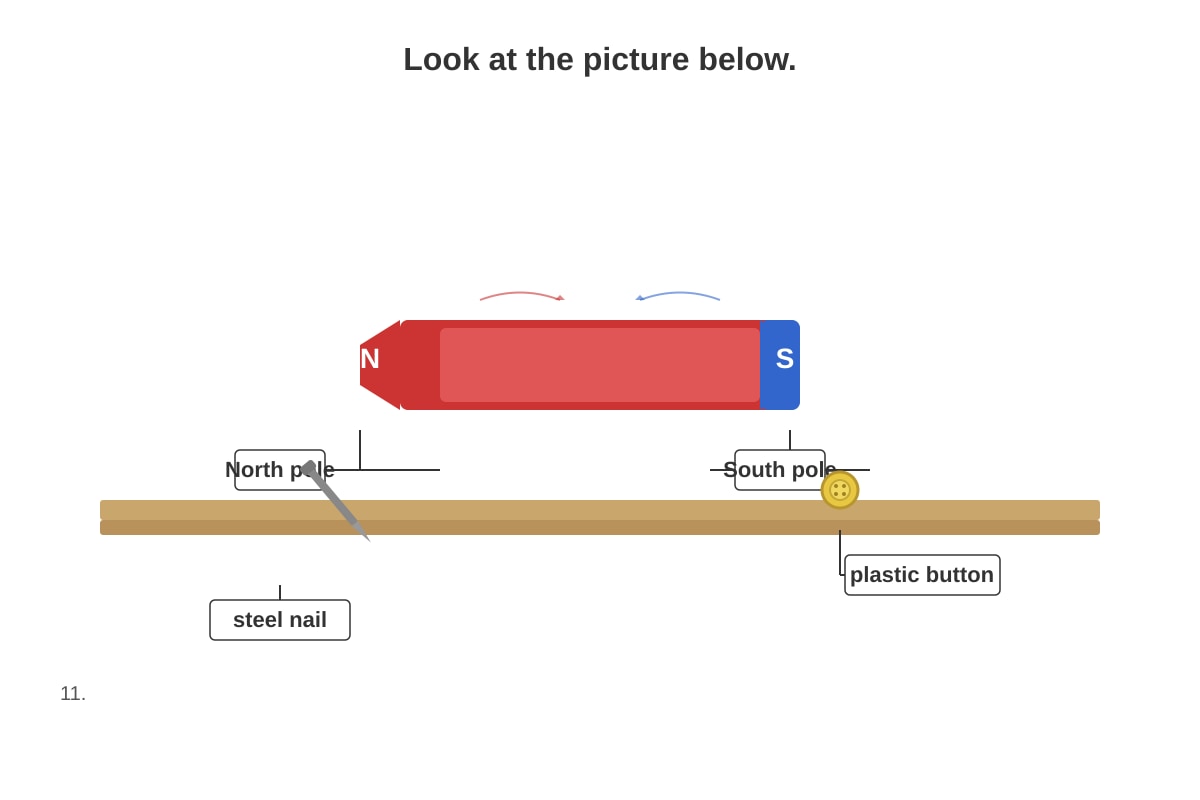
11. (a) The magnet will attract the steel nail. Steel is a magnetic material because it contains iron. (1 mark)
(b) The magnet will NOT attract the plastic button. Plastic is a non-magnetic material. (1 mark)
Explanation: Magnets only attract magnetic materials like iron, steel, nickel, and cobalt. Non-magnetic materials like plastic, wood, glass, and aluminium are not attracted to magnets.
Marking: 1 mark for each part. Accept correct identification and explanation.
12. (a) The two magnets will attract each other. (1 mark)
(b) Unlike poles attract. The north pole and south pole are unlike poles, so they pull towards each other. (1 mark)
Explanation: This is a fundamental rule of magnetism: unlike poles attract, like poles repel. North and south are unlike poles.
Marking: 1 mark for correct answer in (a). 1 mark for correct explanation in (b).
13. (a) The magnet will attract the iron nails and steel pins. (1 mark)
(b) The magnet will NOT attract the copper coins and aluminium foil. (1 mark)
Explanation: Iron and steel are magnetic materials. Copper and aluminium are non-magnetic materials.
Marking: 1 mark for each part. Must correctly identify all magnetic and non-magnetic objects.
14. (a) The student can stroke the steel paperclip with the bar magnet in one direction repeatedly. (1 mark)
(b) The student can test if the paperclip has become a magnet by bringing it near some iron filings or small steel objects to see if it attracts them. (1 mark)
Explanation: The stroke method aligns the magnetic domains in the steel, making it a temporary magnet. Testing with magnetic materials confirms if it has become magnetic.
Marking: 1 mark for a valid method in (a). 1 mark for a valid test in (b).
15. (a) When the magnet is near the iron filings, the filings are attracted to the magnet and stick to it. (1 mark)
(b) When the magnet is moved away, the iron filings fall off or are no longer attracted. (1 mark)
Explanation: Magnetic force acts at a distance. When the magnet is close, its magnetic field attracts the filings. When the magnet is moved away, the magnetic field is too weak to hold the filings.
Marking: 1 mark for each part. Accept descriptions of attraction and release.
Section D: Application and Reasoning Questions (Questions 16–20)
16. The fridge door has a magnetic strip inside it. The magnetic strip attracts the metal (usually steel) frame of the fridge. This magnetic attraction pulls the door closed and holds it shut.
Explanation: The magnetic strip is a flexible magnet that attracts the steel frame of the fridge. The force of magnetism keeps the door tightly closed.
Marking: 2 marks for a complete explanation. Award 1 mark for mentioning magnetic attraction, 1 mark for explaining how it keeps the door shut.
17. The student can tie the string to the middle of the bar magnet and suspend it freely. The magnet will rotate and eventually point in the north-south direction. The end that points towards the geographic north is the north pole of the magnet.
Explanation: A freely suspended magnet aligns with the Earth's magnetic field. This is the principle behind a compass.
Marking: 2 marks for a complete description. Award 1 mark for suspending the magnet, 1 mark for observing the direction it points.
18. (a) If the magnets are moved closer together, they will attract each other and stick together. (1 mark)
(b) If Magnet A is turned around so that its north pole faces the north pole of Magnet B, they will repel each other. (1 mark)
Explanation: Unlike poles attract (north-south), like poles repel (north-north). Moving magnets closer increases the magnetic force between them.
Marking: 1 mark for each part.
19. (a) The train will stop or be pushed back when it reaches the end of the track. (1 mark)
(b) Like poles repel. The north pole of the train magnet and the north pole of the track magnet are like poles, so they push each other away. (1 mark)
Explanation: This is an application of the rule that like poles repel. The repulsion prevents the train from hitting the end of the track.
Marking: 1 mark for each part. Accept "stop" or "be pushed back" for (a).
20. (a) The student can hold the magnet near the outside of the glass, close to where the pin is. The magnet will attract the steel pin through the glass. The student can then slide the magnet up the side of the glass to lift the pin out of the water. (1 mark)
(b) This method works because magnetic force can act through non-magnetic materials like glass and water. The steel pin is magnetic, so it is attracted to the magnet even through the glass and water. (1 mark)
Explanation: Magnetic force can pass through non-magnetic materials. Glass and water are non-magnetic, so they do not block the magnetic field.
Marking: 1 mark for a valid method in (a). 1 mark for correct explanation in (b).
End of Answer Key