AI Generated Quiz
Primary 3 Science Magnets Quiz
Free P3 Science Magnets quiz, AI version, with questions, answers, and syllabus-aligned practice for Singapore students.
These static practice materials are generated from the site's syllabus and paper-generation workflow, with source and model context shown so students and parents can evaluate the material before use.
Questions
Free quiz and exam paper access
Enter your details to view this paper
Your access is remembered on this device.
Answers
Answer Key - Primary 3 Science Quiz - Magnets
Total Marks: 40
Section A: Multiple-Choice Questions (10 marks)
1. C. An iron nail
- Marks: 1
- Explanation: Iron is a magnetic material. Magnets attract objects made of iron and steel. Wood, plastic, and glass are not magnetic materials, so they are not attracted to magnets.
- Teaching Note: Magnetic materials are materials that are attracted to a magnet. The most common magnetic materials are iron and steel. Remember that not all metals are magnetic—copper and aluminium are not magnetic.
2. B. North-South
- Marks: 1
- Explanation: A freely suspended bar magnet will always come to rest pointing in the North-South direction. This is because the Earth itself acts like a giant magnet, and the North pole of the magnet is attracted to the Earth's magnetic South pole (which is near the geographic North).
- Teaching Note: This is how a compass works! The needle of a compass is a small magnet that points North-South.
3. B. They will repel each other.
- Marks: 1
- Explanation: Like poles repel each other. North and North are like poles, so they will push each other away.
- Teaching Note: The rule is: Like poles repel, unlike poles attract. North repels North, South repels South, but North attracts South.
4. C. Steel
- Marks: 1
- Explanation: Steel is a magnetic material because it contains iron. Rubber, copper, and wood are not magnetic materials.
- Teaching Note: Steel is an alloy (a mixture) that contains iron, which is why it is magnetic. Many everyday objects like paperclips and some cans are made of steel.
5. B. Two
- Marks: 1
- Explanation: Every magnet has two poles: a North pole and a South pole.
- Teaching Note: Even if you cut a magnet in half, each piece will still have a North pole and a South pole. You can never have a magnet with only one pole.
6. C. North and South
- Marks: 1
- Explanation: Unlike poles attract each other. North and South are unlike poles, so they will pull towards each other.
- Teaching Note: This is the opposite of question 3. Remember: like poles repel, unlike poles attract.
7. B. The paperclip is made of a magnetic material.
- Marks: 1
- Explanation: Paperclips are typically made of steel, which is a magnetic material. That is why the paperclip is attracted to the magnet.
- Teaching Note: The paperclip does not have its own permanent poles unless it becomes temporarily magnetised. The key point is that it is made of a magnetic material (steel).
8. B. A refrigerator door seal
- Marks: 1
- Explanation: Refrigerator doors have a magnetic strip in the seal that helps the door close tightly. This is a common everyday use of magnets.
- Teaching Note: Other everyday uses of magnets include: compasses, speakers, electric motors, and magnetic catches on cupboards.
9. C. Bring the end of one bar near the middle of the other bar.
- Marks: 1
- Explanation: The magnetic force is strongest at the poles (ends) of a magnet and weakest at the middle. If you bring the end of one bar near the middle of the other bar:
- If the bar in your hand is the magnet, it will be attracted to the middle of the iron bar (because the iron bar is magnetic material).
- If the bar in your hand is iron, it will not be attracted to the middle of the magnet (because the middle of a magnet has very weak magnetic force).
- Teaching Note: This is a classic test to identify a magnet. The middle of a magnet has almost no magnetic pull, but the middle of an iron bar can still be attracted to a magnet's pole.
10. B. Each piece becomes a complete magnet with two poles.
- Marks: 1
- Explanation: When a magnet is cut, each piece becomes a new, smaller magnet with its own North and South poles.
- Teaching Note: You cannot isolate a single pole. Every piece of a magnet, no matter how small, will always have both a North and a South pole.
Section B: Short-Answer Questions (15 marks)
11. Marks: 3
(a) Circle: Iron nail, Steel paperclip [2 marks - 1 mark each]
(b) The plastic spoon, rubber band, and copper wire are not attracted to a magnet because they are not made of magnetic materials. [1 mark]
- Explanation: Magnetic materials are materials that are attracted to a magnet. Iron and steel are magnetic materials. Plastic, rubber, and copper are non-magnetic materials.
- Teaching Note: Copper is a metal, but it is NOT a magnetic material. This is a common misconception. Only iron, steel, and a few other metals (like nickel and cobalt) are magnetic.
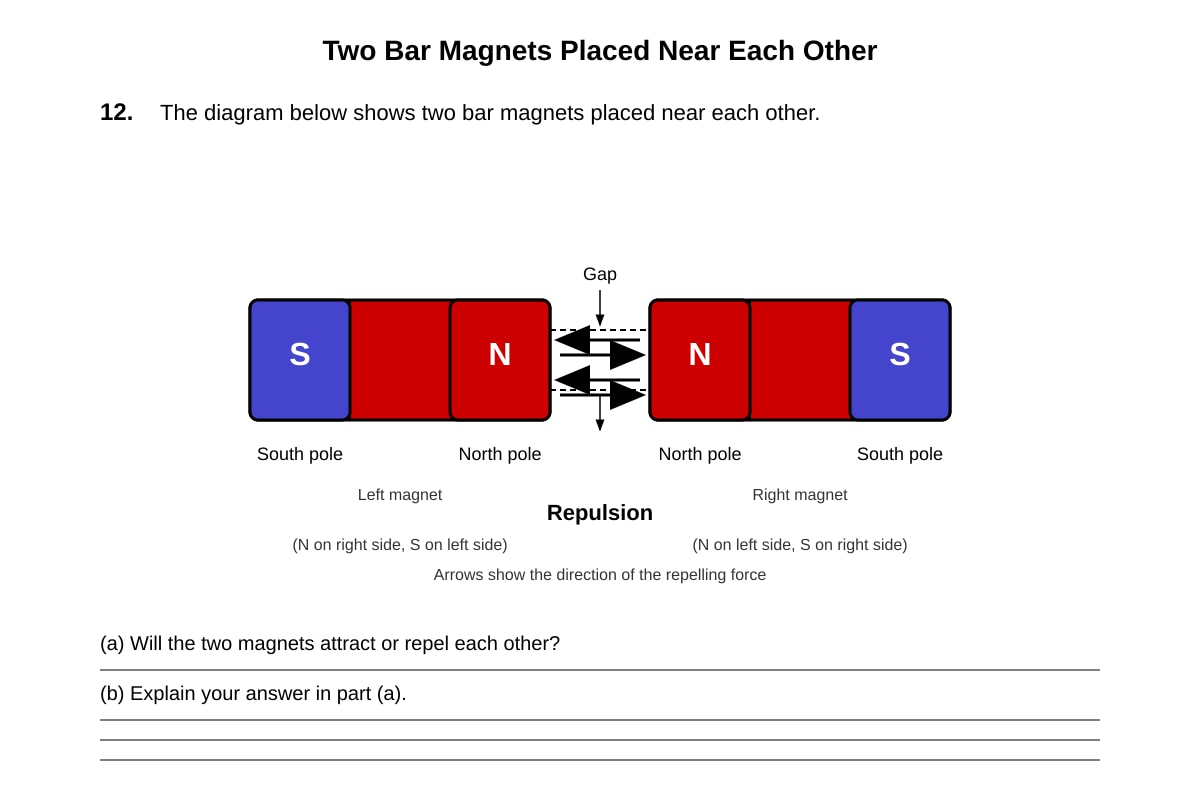
12. Marks: 3
(a) They will repel each other. [1 mark]
(b) The two North poles are facing each other. Like poles repel each other, so the two magnets will push each other away. [2 marks]
- Explanation: The diagram shows the North pole of the left magnet facing the North pole of the right magnet. Since like poles repel, the magnets will push apart.
- Marking Notes:
- 1 mark for identifying that like poles repel.
- 1 mark for correctly identifying that the two North poles are facing each other.
13. Marks: 3
(a) The North pole. [1 mark]
(b) The Earth acts like a giant magnet. The North pole of the freely suspended magnet is attracted to the Earth's magnetic South pole, which is located near the geographic North. This causes the magnet to point North-South. [2 marks]
- Explanation: A freely suspended magnet aligns itself with the Earth's magnetic field. The North pole of the magnet points towards the Earth's geographic North.
- Marking Notes:
- 1 mark for mentioning that the Earth acts like a magnet.
- 1 mark for explaining that the North pole is attracted to the Earth's magnetic South pole (or that the magnet aligns with the Earth's magnetic field).
14. Marks: 3
(a) The pattern shows the magnetic field lines of the magnet. [1 mark]
(b) The iron filings are most concentrated at the two poles (ends) of the magnet. [1 mark]
(c) Iron filings are attracted to the magnet because iron is a magnetic material. [1 mark]
- Explanation: The iron filings arrange themselves along the invisible magnetic field lines. The magnetic force is strongest at the poles, so more iron filings gather there.
- Teaching Note: This is a classic experiment to "see" the magnetic field. The pattern of iron filings shows the shape of the magnetic field around the magnet.
15. Marks: 3
(a) The steel needle becomes a magnet. [1 mark]
(b) The electrical method (wrapping a wire around the needle and connecting it to a battery). [1 mark]
(c) The needle has become a magnet because it can attract magnetic materials (the paperclips). [1 mark]
- Explanation: The stroke method is one way to make a magnet. By stroking the needle in one direction with a magnet, the magnetic domains in the needle align, turning the needle into a magnet.
- Teaching Note: The two methods to make a magnet are:
- The stroke method (rubbing a magnet along the object in one direction).
- The electrical method (using an electric current to magnetise the object).
Section C: Open-Ended Questions (15 marks)
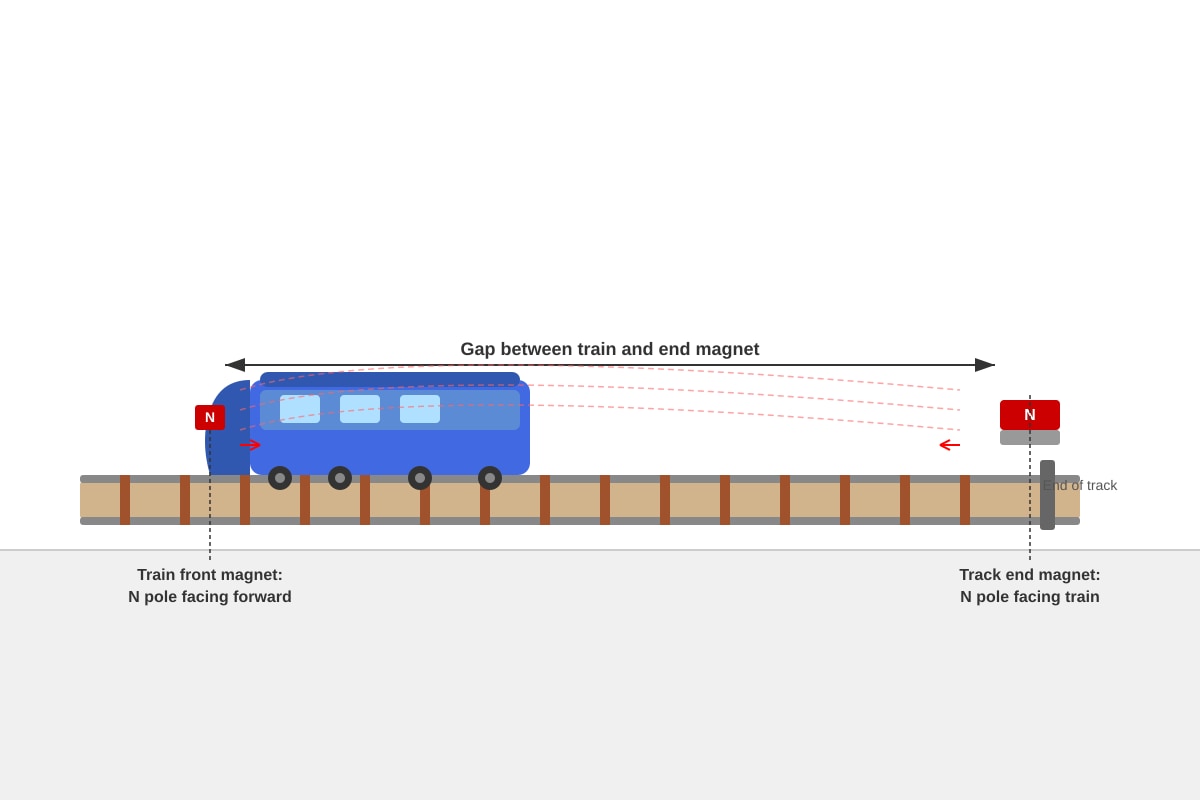
16. Marks: 3
(a) The North pole of the magnet on the train is facing the North pole of the magnet at the end of the track. Like poles repel each other, so the train is pushed back and stops before reaching the end. [2 marks]
(b) The student could turn the magnet at the end of the track around so that its South pole is facing the train. Then the North pole of the train's magnet and the South pole of the track's magnet would attract, pulling the train to the end. [1 mark]
- Explanation: This question tests the understanding of attract and repel. Like poles repel, unlike poles attract.
- Marking Notes:
- Part (a): 1 mark for identifying that like poles are facing each other, 1 mark for stating that like poles repel.
- Part (b): 1 mark for suggesting turning the magnet around (or replacing it with a magnet with its South pole facing the train).
17. Marks: 3
(a) The steel nail will be attracted to the magnet. [1 mark]
(b) The copper coin and the plastic button are not attracted to the magnet because they are not made of magnetic materials. Copper is a metal, but it is not a magnetic material. Plastic is not a metal and is not magnetic. [2 marks]
- Explanation: Steel contains iron, which is magnetic. Copper and plastic are non-magnetic materials.
- Teaching Note: This question reinforces the idea that not all metals are magnetic. Copper is a common metal that is not attracted to magnets.
18. Marks: 3
(a) The student can move the magnet over the mixture. The iron filings will be attracted to the magnet and stick to it. The student can then lift the magnet away, and the iron filings will come with it, separating them from the sand and plastic beads. [2 marks]
(b) This method works because iron is a magnetic material, while sand and plastic are not magnetic materials. [1 mark]
- Explanation: This is a practical application of magnetic attraction. The magnet attracts only the magnetic material (iron filings) and leaves the non-magnetic materials behind.
- Marking Notes:
- Part (a): 1 mark for describing moving the magnet over the mixture, 1 mark for describing the iron filings sticking to the magnet and being lifted away.
- Part (b): 1 mark for stating that iron is magnetic and the others are not.
19. Marks: 3
(a) The needle of a compass is made of a magnetic material (it is a small magnet). [1 mark]
(b) The compass needle is a freely suspended magnet. The Earth acts like a giant magnet, and the needle aligns itself with the Earth's magnetic field. The North pole of the needle points towards the Earth's geographic North. [2 marks]
- Explanation: A compass works because the needle is a small magnet that is free to rotate. It aligns with the Earth's magnetic field, always pointing North-South.
- Marking Notes:
- Part (a): 1 mark for stating it is a magnet or magnetic material.
- Part (b): 1 mark for mentioning the Earth acts like a magnet, 1 mark for explaining that the needle aligns with the Earth's magnetic field.
20. Marks: 3
(a) Repulsive force (or repulsion). [1 mark]
(b) The hanging magnet will move towards the second magnet (it will be attracted). [1 mark]
(c) The South pole of the second magnet is an unlike pole to the North pole of the hanging magnet. Unlike poles attract each other, so the hanging magnet will be pulled towards the second magnet. [1 mark]
- Explanation: This question tests the rule of attraction and repulsion. Like poles repel, unlike poles attract.
- Marking Notes:
- Part (a): 1 mark for "repel" or "repulsive force".
- Part (b): 1 mark for "attract" or "move towards".
- Part (c): 1 mark for explaining that unlike poles attract.
END OF ANSWER KEY