AI Generated Quiz
Primary 3 Science Light Quiz
Free P3 Science Light quiz, Kimi2.6 AI version, with questions, answers, and syllabus-aligned practice for Singapore students.
These static practice materials are generated from the site's syllabus and paper-generation workflow, with source and model context shown so students and parents can evaluate the material before use.
Questions
Free quiz and exam paper access
Enter your details to view this paper
Your access is remembered on this device.
Answers
Primary 3 Science Quiz - Light: Answer Key
Section A: Multiple Choice (2 marks each)
1. (b) The Sun (2 marks)
The Sun is a natural source of light because it produces its own light through nuclear reactions. A torch, lamp, and candle are all artificial sources because they are made by humans and need fuel or electricity to produce light.
2. (c) straight (2 marks)
Light travels in straight lines. This is why we can see beams of light when dust particles are in the air—the light travels in a straight path and hits the particles, making the beam visible. This property is called rectilinear propagation of light.
3. (b) The light bounces off the mirror (2 marks)
This is called reflection. When light hits a smooth, shiny surface like a mirror, it bounces back. This is why we can see ourselves in a mirror—the light from our face reflects off the mirror and back to our eyes.
4. (c) A clear glass window (2 marks)
A clear glass window is transparent, which means light passes through it easily, so we can see clearly through it. Frosted glass is translucent (light passes through but we cannot see clearly). Wood and metal are opaque (no light passes through).
5. (c) opaque (2 marks)
Opaque objects block all light. You cannot see through them at all. Examples: wood, metal, brick, your hand. Common mistake: Students sometimes confuse "opaque" with "translucent"—remember that translucent lets some light through, opaque lets none.
6. (c) blocked (2 marks)
A shadow forms when an opaque object blocks light from a light source. The light cannot pass through or around the object, so a dark area appears on the screen behind it. The three things needed for a shadow: (1) light source, (2) opaque object, (3) screen.
7. (b) A shadow of the book (2 marks)
The book is opaque, so it blocks the light from the lamp. The light cannot pass through the book, so a shadow appears on the wall behind it. The shadow will look like the shape of the book.
8. (b) low in the sky (2 marks)
When the Sun is low (morning or evening), sunlight hits you at a shallow angle, stretching your shadow out long. When the Sun is directly overhead (noon), light comes from above, making your shadow short and directly underneath you.
9. (d) A mirror (2 marks)
A mirror is NOT needed to form a shadow. You need: (1) a light source to provide light, (2) an opaque object to block the light, and (3) a screen for the shadow to fall on. A mirror is used for reflection, not shadow formation.
10. (b) translucent (2 marks)
Tracing paper is translucent because some light passes through it, but you cannot see clearly through it. The light gets scattered, so objects behind appear blurry. This is different from transparent (clear view) and opaque (no light through).
Section B: Fill in the Blanks and Short Answers (2 marks each)
11. Any two from: torch, lamp, candle, light bulb, fire, glow stick, smartphone screen, lantern (1 mark each)
Note: Must be artificial (human-made) sources. "The Sun" or "stars" would not be accepted as they are natural.
12. Answer: shorter (1 mark)
Explanation: When an object moves closer to the light source, the light rays spread out more after passing the object, making the shadow larger on the screen. Wait—let me re-read: the question asks what happens when moved CLOSER to the light source.
Correction: The answer is longer (1 mark).
Why: When the object moves closer to the light source, the light rays are blocked at a point where they have spread out more. This makes the shadow larger/longer on the screen. When the object moves closer to the screen, the shadow becomes shorter/smaller.
Marking note: Award 1 mark for correct word. If student wrote "shorter," check understanding in explanation. The explanation should mention that light spreads out from the source, so blocking it nearer the source catches more spread-out rays.
13. The shadow changes position because the Sun appears to move across the sky during the day (1 mark). As the Sun's position changes, the direction of light rays hitting the stick changes (1 mark). This changes the direction in which the shadow falls on the sundial face.
Key concept: The Earth rotates, making the Sun seem to move from east to west. Light always travels in straight lines, so when the light source direction changes, the shadow direction changes too.
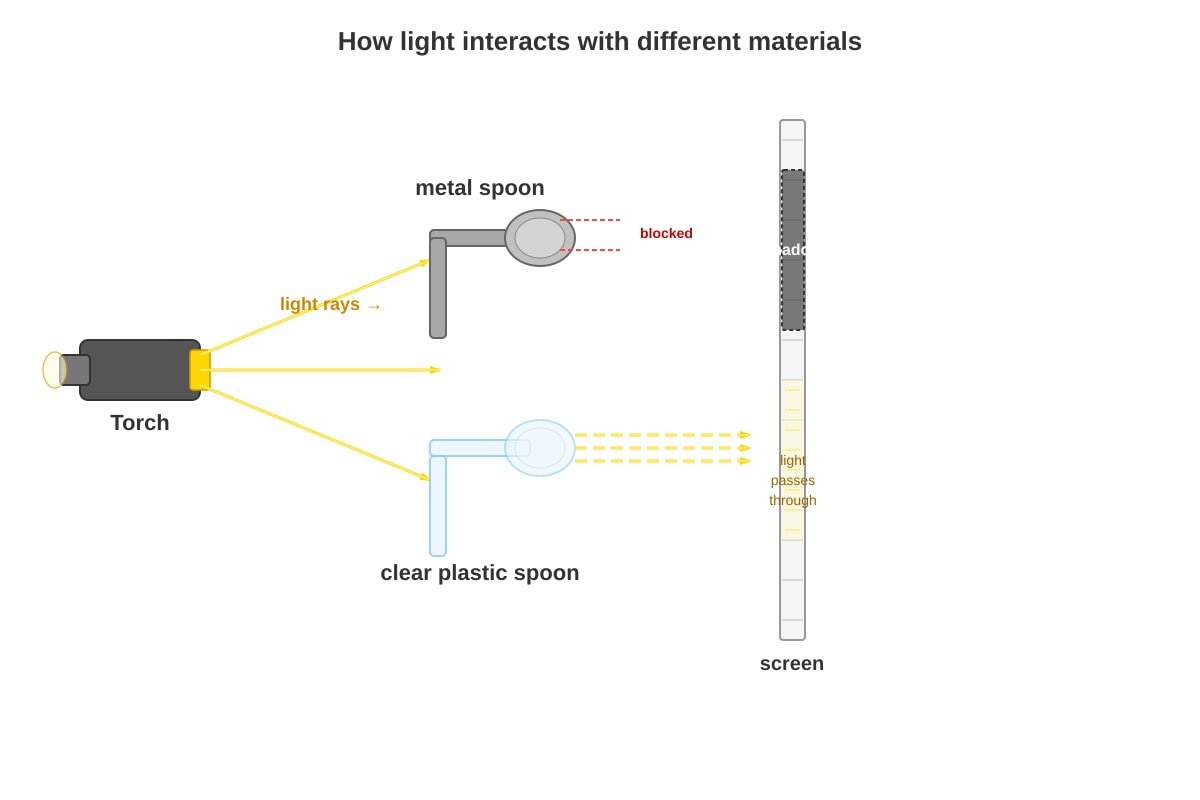
14. (a) The metal spoon (1 mark)
(b) The metal spoon is opaque—it does not allow light to pass through (1 mark). The light from the torch is blocked by the metal spoon, so a shadow forms on the screen behind it. The clear plastic spoon lets light through, so no shadow forms.
15. The blanket is opaque (1 mark)—it blocks all light from passing through (1 mark). Even with the torch, the blanket stops most light from escaping, and any light that gets through is too dim for reading. For reading, Jane needs the light to reach the book and reflect back to her eyes.
Section C: Application and Reasoning (4 marks each)
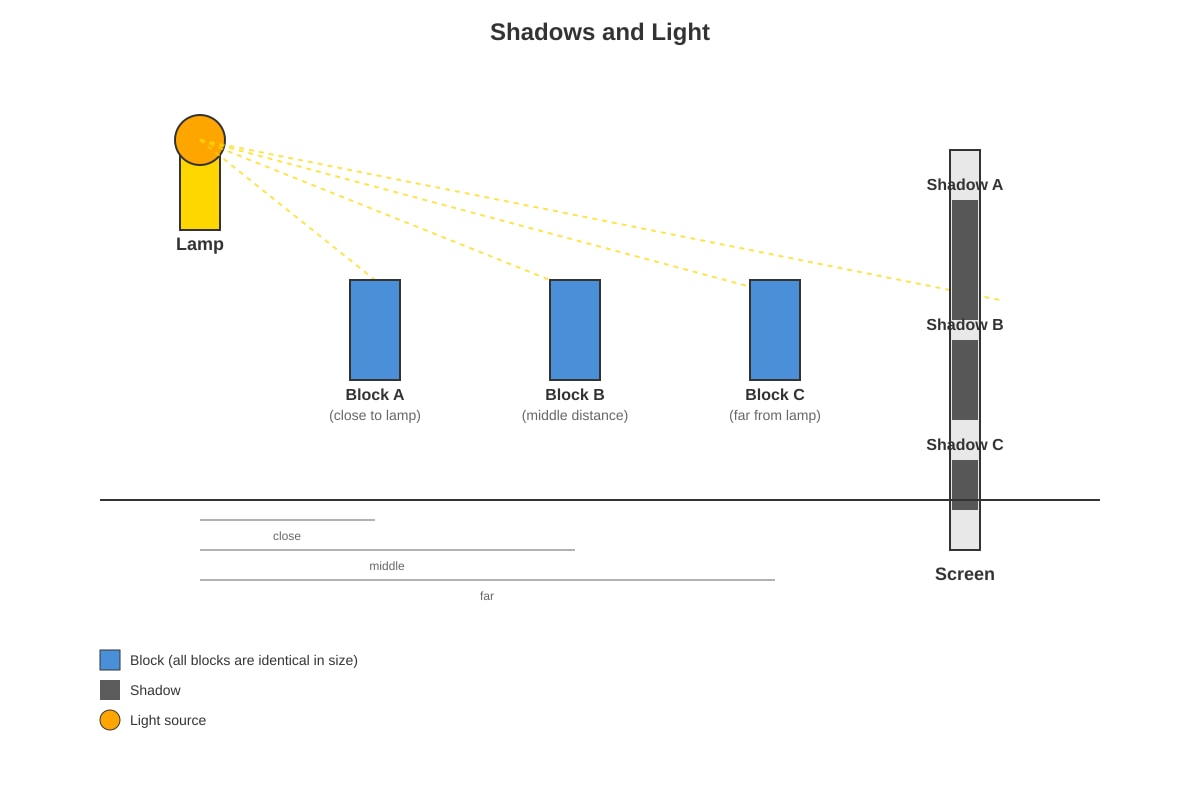
16. (a) Largest: A (Shadow A); Middle: B (Shadow B); Smallest: C (Shadow C) (2 marks: 1 for order correct, 1 for correct assignment)
Visual check from image placeholder: Block A is closest to lamp, so shadow is largest. Block C is farthest from lamp (closest to screen), so shadow is smallest.
(b) The shadows are different sizes because the blocks are at different distances from the light source (1 mark). Block A is closest to the lamp, so light rays spread out more after passing it, making a larger shadow (0.5 mark). Block C is farthest from the lamp (closest to screen), so light rays are less spread out, making a smaller shadow (0.5 mark).
Key principle: The closer an object is to the light source, the larger its shadow. The closer an object is to the screen, the smaller its shadow.
17. (a) Cardboard (1 mark)
(b) Two reasons (1 mark each):
- Cardboard is opaque—it blocks all light, making a clear, dark shadow
- Cardboard is stiff/strong—it keeps its shape when moved, making the puppet easy to control
(c) If tracing paper were used: the shadow would be faint/unclear/very light (0.5 mark) because tracing paper is translucent and lets some light pass through instead of blocking it completely (0.5 mark).
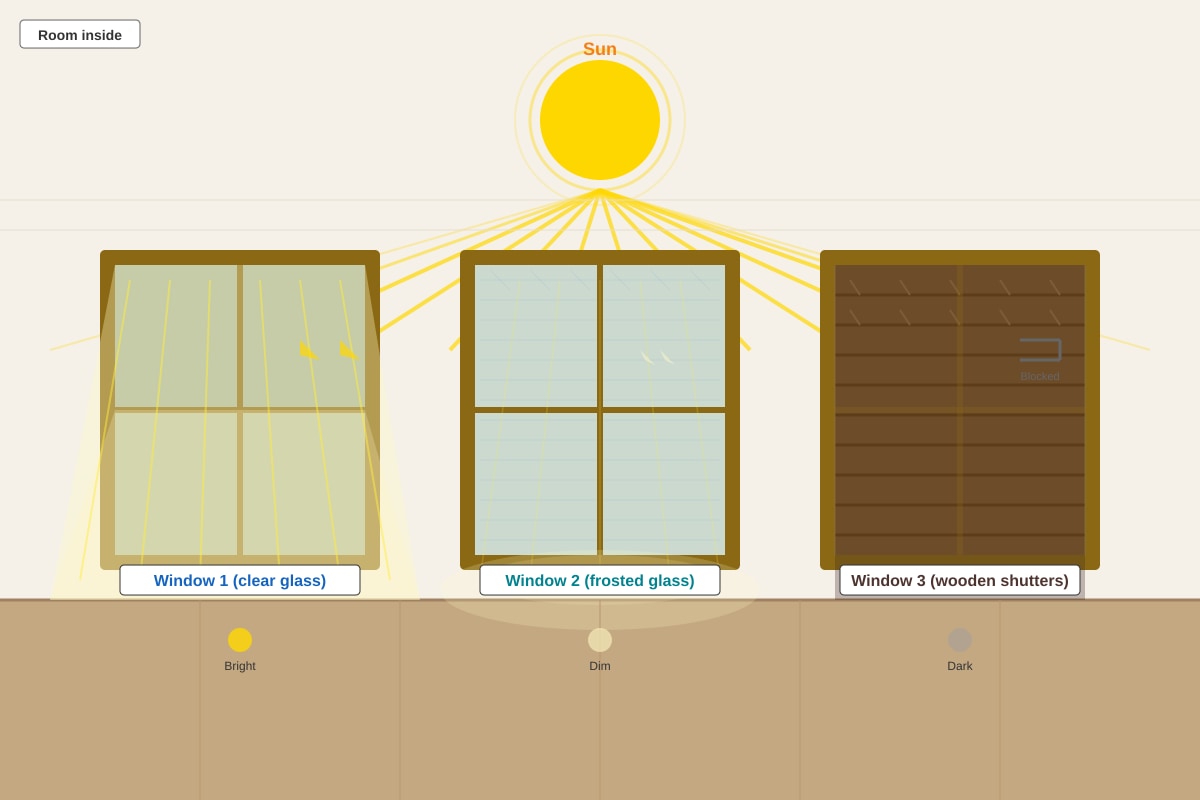
18. (a) Room with Window 1 (clear glass window) (1 mark)
(b) Room with Window 3 (wooden shutters) (1 mark)
(c) Clear glass is transparent—light passes through it easily, so you can see clearly through it (1 mark). Frosted glass is translucent—light passes through it but gets scattered, so you cannot see clearly through it (1 mark). This is why the clear glass room is brighter—more light passes through directly.
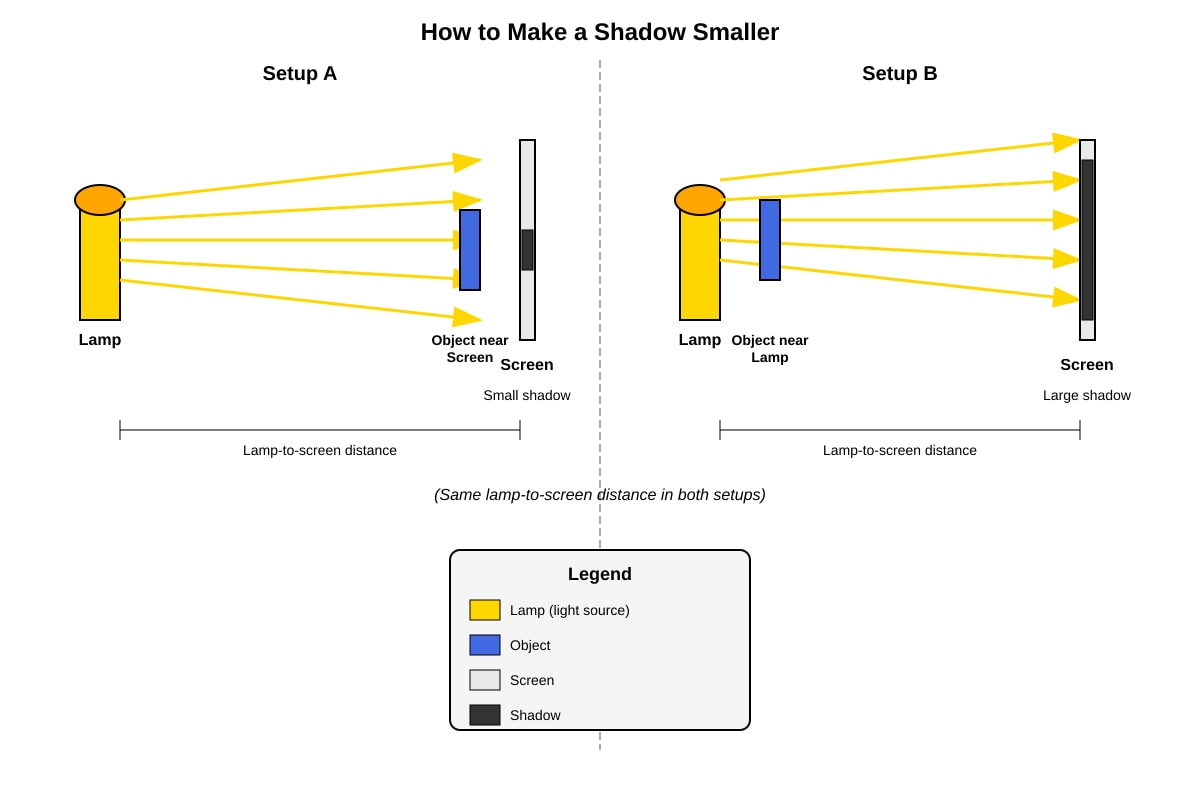
19. (a) Sarah's method—move the object closer to the screen (1 mark)
(b) In Setup A (object near screen), the light rays have less distance to spread out after passing the object, so the shadow is smaller (1 mark). In Setup B (object near lamp), the light rays spread out more before hitting the object, so the shadow is larger (1 mark).
Alternative acceptable explanation: When the object is near the screen, the blocked area on the screen is small because the light rays haven't spread much. When near the lamp, the same object blocks more spread-out rays.
(c) Move the light source farther away from the object (1 mark). OR Use a smaller light source. OR Make the object smaller.
20. Fair test design (1 mark per valid point, must include all components):
- Keep the same: Same size of paper squares; same light source (same torch, same distance); same screen; same distance from light to paper to screen; same room darkness (1 mark for any two controlled variables with fair test reasoning)
- Change: The colour of the paper (e.g., black, red, blue, white, yellow) (1 mark)
- Measure/observe: How dark the shadow is on the screen, OR compare shadows by eye, OR use consistent descriptions (very dark, dark, light, very light) (1 mark)
- How to know: The paper that makes the darkest shadow blocks the most light. Black paper should make the darkest shadow because dark colours absorb more light. White paper would make the lightest shadow as it reflects more light (1 mark)
Marking descriptor: Award full marks only if the answer shows understanding of controlling variables. A good answer mentions that everything except colour must stay the same so the test is fair.
END OF ANSWER KEY