AI Generated Quiz
Primary 3 Science Life Cycles Quiz
Free AI-Generated Qwen3.7 Plus Primary 3 Science Life Cycles quiz with questions and answers for Singapore students. This page is rendered as a direct URL so the questions and answers can be discovered without pressing in-page buttons.
These static practice materials are generated from the site's syllabus and paper-generation workflow, with source and model context shown so students and parents can evaluate the material before use.
Questions
Primary 3 Science Quiz - Life Cycles
Name: __________________________
Class: __________________________
Date: __________________________
Score: ______ / 30
Duration: 45 minutes
Total Marks: 30
Instructions to Candidates:
- This quiz consists of four sections: A, B, C, and D.
- Answer all questions.
- Write your answers in the spaces provided.
- For questions requiring diagrams, refer to the descriptions provided.
Section A: Multiple Choice Questions (10 marks)
For each question, four options are given. Choose the correct answer and write its number (1, 2, 3, or 4) in the bracket provided. Each question carries 1 mark.
-
Which of the following is the correct order of the life cycle of a butterfly? (1) Egg Larva Pupa Adult (2) Egg Pupa Larva Adult (3) Larva Egg Pupa Adult (4) Adult Larva Pupa Egg Answer: ( ______ )
-
How is the young of a mammal different from the young of an insect? (1) The young mammal looks like its parents, but the young insect does not. (2) The young mammal does not look like its parents, but the young insect does. (3) Both young mammals and young insects look exactly like their parents. (4) Neither young mammals nor young insects look like their parents. Answer: ( ______ )
-
Which stage in the life cycle of a mosquito lives in water? (1) Egg only (2) Larva and Pupa (3) Pupa and Adult (4) Egg, Larva, and Pupa Answer: ( ______ )
-
Look at the life cycle of a plant below.
Seed Young Plant Adult Plant Fruit with Seeds
What is the main function of the fruit in this cycle? (1) To make food for the plant (2) To protect the seeds and help them spread (3) To absorb water from the soil (4) To hold the plant firmly in the ground Answer: ( ______ )
-
Which of the following animals goes through a three-stage life cycle? (1) Cockroach (2) Butterfly (3) Frog (4) Mosquito Answer: ( ______ )
-
Why do living things reproduce? (1) To grow bigger (2) To find food (3) To ensure their kind does not become extinct (4) To move from one place to another Answer: ( ______ )
-
In the life cycle of a bean plant, which part of the flower develops into the fruit? (1) Petal (2) Stamen (3) Ovary (4) Sepal Answer: ( ______ )
-
Which statement about the pupa stage of a butterfly is true? (1) It feeds on leaves actively. (2) It can fly to find a mate. (3) It does not feed and remains attached to a twig. (4) It lays eggs on the underside of leaves. Answer: ( ______ )
-
A tadpole breathes using gills. How does an adult frog breathe? (1) Using gills only (2) Using lungs and moist skin (3) Using lungs only (4) Using moist skin only Answer: ( ______ )
-
Which of the following is NOT a stage in the life cycle of a human? (1) Baby (2) Adolescent (3) Pupa (4) Adult Answer: ( ______ )
Section B: Structured Questions (8 marks)
Answer all questions in the spaces provided. The number of marks for each question or part is given in brackets [ ].
-
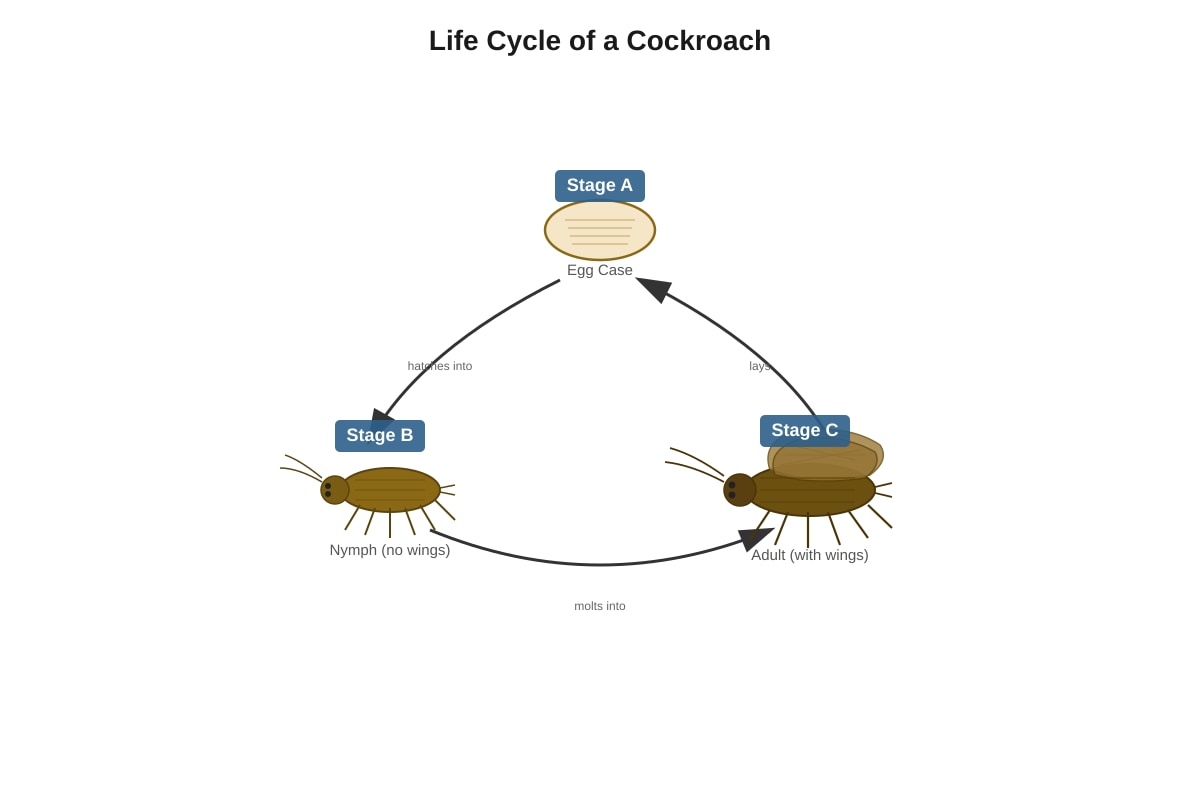
The diagram below shows the life cycle of a cockroach.
<image_placeholder> id: Q11-fig1 type: diagram linked_question: Q11 description: A circular diagram showing three stages of a cockroach life cycle. Stage A shows a small oval object. Stage B shows a small insect that looks like a miniature adult but without wings. Stage C shows a larger insect with wings. Arrows point from A to B, B to C, and C back to A. labels: Stage A, Stage B, Stage C values: None must_show: Distinct visual difference between the wingless nymph (B) and winged adult (C). </image_placeholder>
(a) Name Stage A and Stage B. [2]
Stage A: __________________________
Stage B: __________________________
(b) State one similarity between Stage B and Stage C. [1]
(c) Does the cockroach undergo metamorphosis? Explain your answer. [2]
-
Study the life cycle of a frog shown below.
<image_placeholder> id: Q12-fig1 type: diagram linked_question: Q12 description: A four-stage life cycle diagram. Stage 1: Cluster of jelly-like eggs in water. Stage 2: Tadpole with a long tail and no legs. Stage 3: Froglet with four legs and a short tail. Stage 4: Adult frog with no tail. labels: Stage 1, Stage 2, Stage 3, Stage 4 values: None must_show: Clear progression of leg growth and tail shrinkage. </image_placeholder>
(a) In which stage does the frog have a tail but no legs? [1]
Stage ______
(b) How does the breathing method change from Stage 2 to Stage 4? [2]
Stage 2 breathes using: __________________________
Stage 4 breathes using: __________________________
Section C: Structured Questions (6 marks)
Answer all questions in the spaces provided. The number of marks for each question or part is given in brackets [ ].
-
Ali planted a seed in a pot with soil. He watered it every day. After two weeks, a young plant emerged.
(a) What is the process called when the seed starts to grow into a young plant? [1]
(b) Name two conditions needed for the seed to germinate. [2]
(c) Why do seeds not need sunlight to germinate? [1]
-
-
The table below compares the life cycles of a butterfly and a grasshopper.
Feature Butterfly Grasshopper Number of stages 4 3 Young looks like adult? No Yes Feeding stage Larva and Adult Nymph and Adult (a) Based on the table, why is the young butterfly called a larva and not a nymph? [1]
(b) Both the butterfly larva and the grasshopper nymph moult. What is moulting? [1]
Section D: Open-Ended Questions (6 marks)
Answer all questions in the spaces provided. The number of marks for each question or part is given in brackets [ ].
-
Siti observed two insects in her garden. Insect X has a life cycle with 4 stages. Insect Y has a life cycle with 3 stages.
(a) Identify Insect X and Insect Y from the list below: [2] Housefly, Cockroach, Bee, Cricket
Insect X could be: __________________________
Insect Y could be: __________________________
(b) Explain why the life cycle of Insect X is different from Insect Y in terms of the appearance of the young. [2]
-
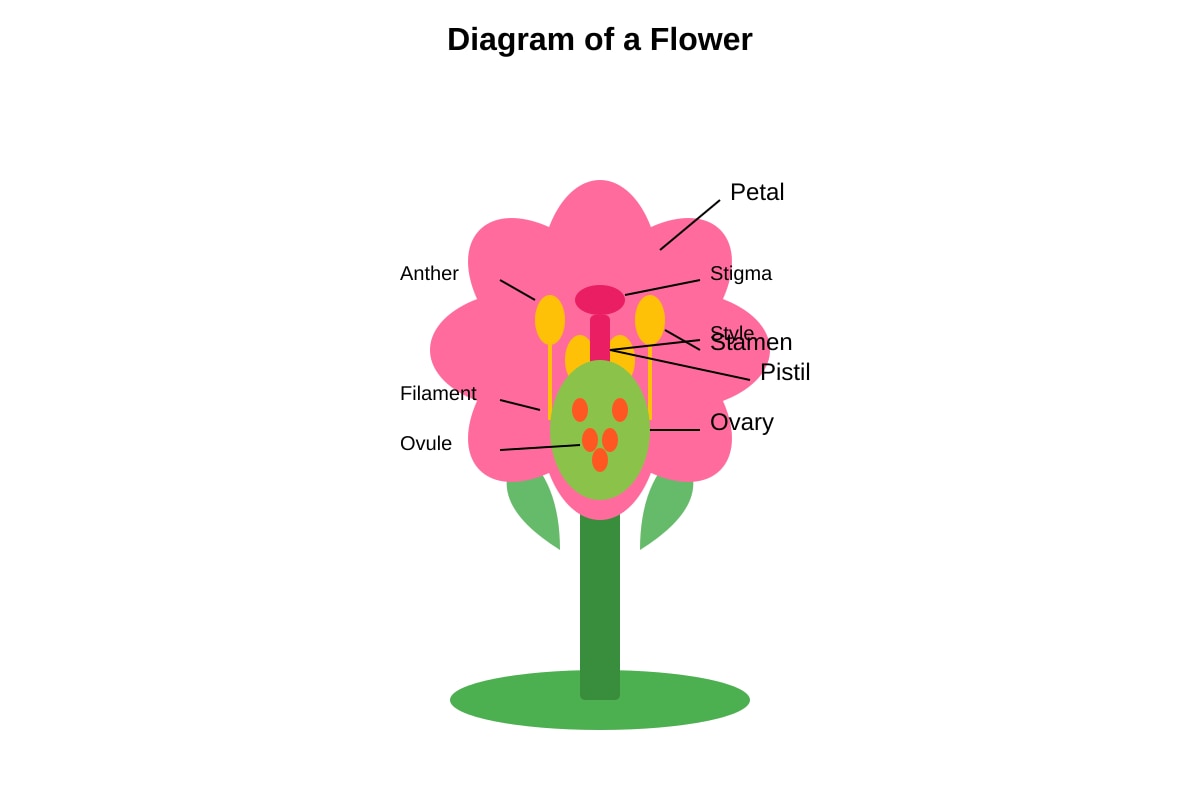
Look at the diagram of a flower below.
<image_placeholder> id: Q16-fig1 type: diagram linked_question: Q16 description: A labelled diagram of a flower. Labels point to Petal, Stamen (Anther and Filament), Pistil (Stigma, Style, Ovary). The Ovary contains small ovules. labels: Petal, Stamen, Pistil, Ovary, Ovule values: None must_show: Clear internal structure of the ovary showing ovules. </image_placeholder>
(a) Which part of the flower contains the ovules? [1]
(b) After pollination and fertilisation, what do the ovules develop into? [1]
-
Humans do not undergo metamorphosis.
(a) What does it mean when we say humans do not undergo metamorphosis? [1]
(b) Describe one physical change that happens to a human during adolescence. [1]
-
Why must the female frog lay many eggs in Stage 1 of its life cycle? [1]
-
Give one reason why insects need to moult. [1]
-
If Insect X (from Question 15) is a pest to farmers, which stage of its life cycle causes the most damage to crops? Explain why. [2]
Answers
Primary 3 Science Quiz - Life Cycles (Answer Key)
Section A: Multiple Choice Questions
-
(1)
Explanation: The life cycle of a butterfly consists of four stages: Egg, Larva (caterpillar), Pupa (chrysalis), and Adult. The larva hatches from the egg, turns into a pupa, and emerges as an adult. -
(1)
Explanation: Mammals (like humans, cats) give birth to young that look like smaller versions of the parents. Insects like butterflies have young (larvae) that look completely different from the adults. -
(4)
Explanation: Mosquitoes lay eggs in water. The eggs hatch into larvae (wrigglers) which live in water. The larvae turn into pupae (tumblers) which also live in water. Only the adult mosquito flies in the air. -
(2)
Explanation: The fruit develops from the ovary of the flower. Its main role is to protect the seeds inside and often helps in seed dispersal (e.g., by being eaten by animals). -
(1)
Explanation: The cockroach has a 3-stage life cycle: Egg Nymph Adult. Butterflies, frogs, and mosquitoes have 4-stage life cycles. -
(3)
Explanation: Reproduction ensures that new individuals are produced to replace old ones that die, preventing the species from becoming extinct. -
(3)
Explanation: After fertilisation, the ovary swells and develops into the fruit, while the ovules inside develop into seeds. -
(3)
Explanation: The pupa is a resting stage. It is usually attached to a twig or leaf and does not feed. Inside the pupa, the body of the larva changes into the adult form. -
(2)
Explanation: Tadpoles live in water and use gills. Adult frogs live on land and in water; they breathe using lungs and also through their moist skin. -
(3)
Explanation: Pupa is a stage in the life cycle of insects like butterflies and mosquitoes. Humans go through stages like Baby, Child, Adolescent, and Adult.
Section B: Structured Questions
-
(a) Stage A: Egg [1]
Stage B: Nymph [1]
(b) Similarity: Both have six legs / Both have three body parts (head, thorax, abdomen) / Both look similar in shape. [1]
(c) No. [1] The young (nymph) looks like the adult, just smaller and without wings. There is no drastic change in body form. [1] -
(a) Stage 2 [1]
(b) Stage 2: Gills [1]
Stage 4: Lungs and moist skin [1]
Section C: Structured Questions
-
(a) Germination [1]
(b) Water [1] and Warmth (or Air/Oxygen) [1]
(Note: Sunlight is NOT required for germination)
(c) The seed contains stored food in the cotyledons which provides energy for the initial growth until leaves form. [1] -
(a) Because the young butterfly does not look like the adult, whereas a nymph looks like the adult. [1]
(b) Moulting is the shedding of the old outer skin (exoskeleton). [1]
Section D: Open-Ended Questions
-
(a) Insect X: Housefly or Bee [1] (Any 4-stage insect)
Insect Y: Cockroach or Cricket [1] (Any 3-stage insect)
(b) The young of Insect X (larva) looks very different from its parent, while the young of Insect Y (nymph) looks like a smaller version of its parent. [2] -
(a) Ovary [1]
(b) Seeds [1] -
(a) It means the young human looks like the adult and does not go through distinct stages with drastic changes in body form (like larva/pupa). [1]
(b) Growth spurts (increase in height) / Development of secondary sexual characteristics (e.g., voice deepening in boys, breast development in girls) / Onset of menstruation in girls. [1] (Any valid physical change during adolescence) -
To increase the chance of survival because many eggs/young will be eaten by predators or die due to environmental conditions. [1]
-
Because the exoskeleton is hard and cannot grow, so the insect must shed it to grow bigger. [1]
-
The larva stage. [1] Because the larva feeds actively on leaves/plants to store energy for growth and metamorphosis, causing damage to crops. [1]