AI Generated Quiz
Primary 3 Science Life Cycles Quiz
Free P3 Science Life Cycles quiz, Kimi2.6 AI version, with questions, answers, and syllabus-aligned practice for Singapore students.
These static practice materials are generated from the site's syllabus and paper-generation workflow, with source and model context shown so students and parents can evaluate the material before use.
Questions



Free quiz and exam paper access
Enter your details to view this paper
Your access is remembered on this device.
Answers
Primary 3 Science Quiz - Life Cycles: Answer Key
Total Marks: 40
Section A: Multiple Choice (Questions 1-10)
2 marks each
1. Answer: B (2 marks)
Explanation: All living things need water to survive. Water is essential for transporting substances in the body, chemical reactions, and maintaining life processes. While many living things need food (but not all make their own), and air is needed, water is the fundamental need shared by ALL living things. Not all living things can fly (A is wrong), not all are green (C is wrong - only plants with chlorophyll are green), and not all can make their own food (D is wrong - only plants can do this; animals must eat other organisms).
2. Answer: B (2 marks)
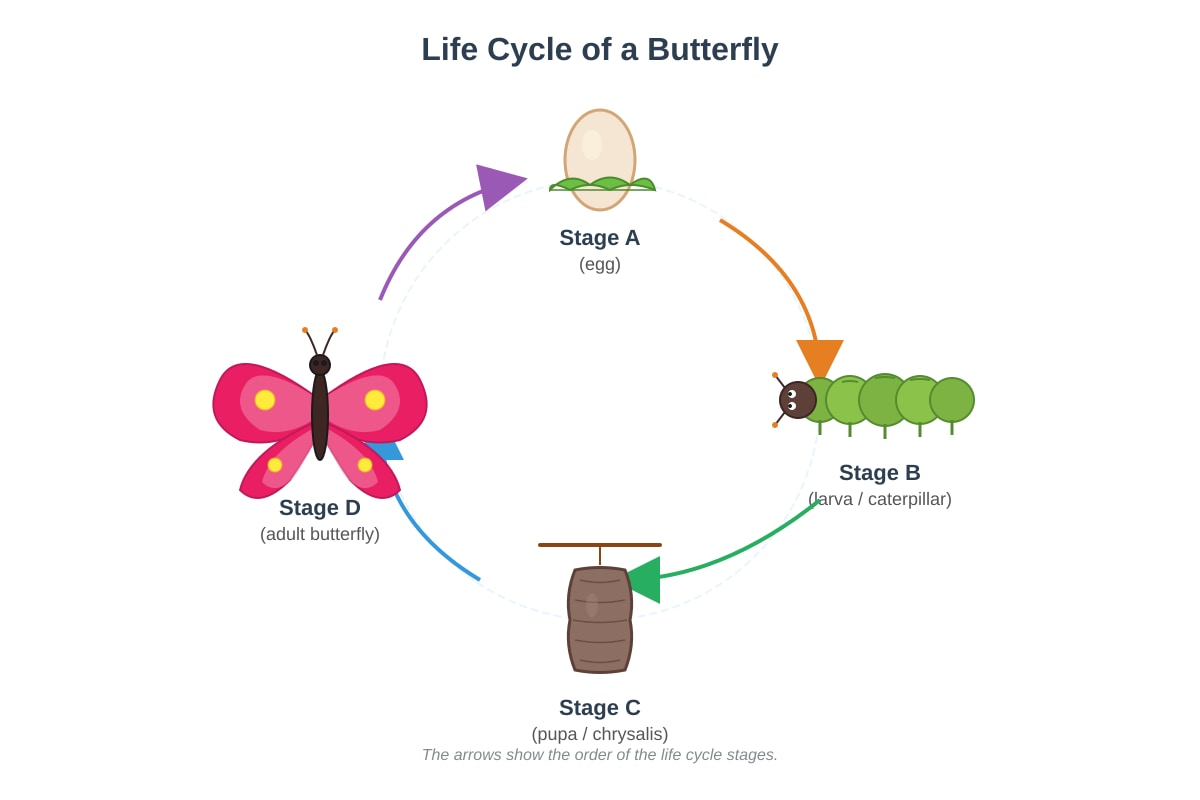
Explanation: The butterfly undergoes complete metamorphosis with four distinct stages. The correct order is:
- Egg → tiny, laid on leaves
- Larva (caterpillar) → hatches from egg, eats and grows rapidly
- Pupa (chrysalis) → larva forms a protective case and transforms inside
- Adult butterfly → emerges with wings, can fly and reproduce
The word "metamorphosis" means "change in form." The butterfly's life cycle is remarkable because the larva looks completely different from the adult and has a totally different lifestyle (eating leaves vs. drinking nectar).
3. Answer: C (2 marks)
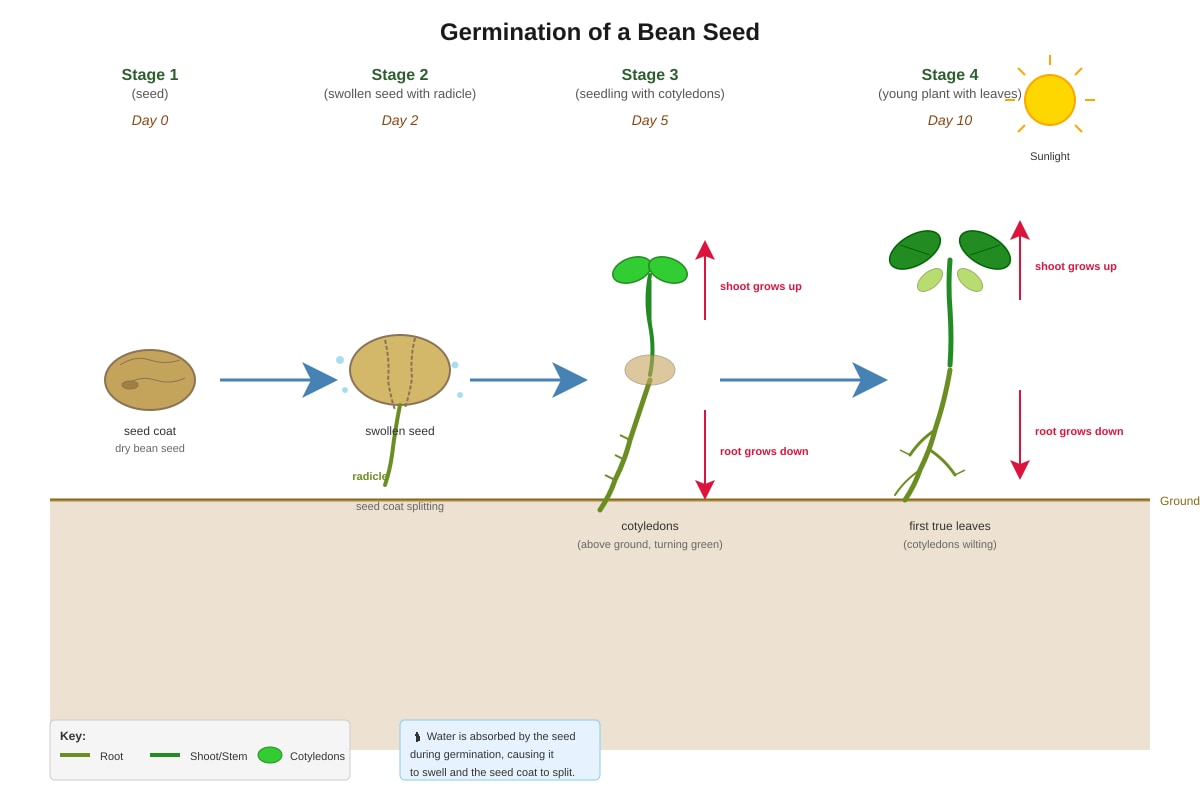
Explanation: A seed needs air, water, and warmth to germinate. It does NOT need soil initially. Many seeds can germinate on damp cotton wool or paper towels in a science experiment. The seed contains its own food store (in the cotyledons or endosperm) to fuel early growth. Soil becomes important later when the seedling needs nutrients, anchorage, and water retention as it grows into a mature plant.
Common mistake: Students often think soil is essential because they usually see plants growing in soil, but germination itself only requires the three conditions mentioned.
4. Answer: C (2 marks)
Explanation: The frog undergoes complete metamorphosis — a four-stage life cycle where the young looks completely different from the adult and there is a resting/changing stage (pupa in insects, but for frogs the tadpole undergoes dramatic changes).
Key changes in a frog's life cycle:
- Eggs in water → jelly-like clusters
- Tadpole: has tail, breathes with gills, lives in water, eats algae
- Tadpole with legs: hind legs first, then front legs, tail shrinks, lungs develop
- Adult frog: four legs, no tail, breathes with lungs and skin, lives on land and water
Option D is incorrect because "incomplete metamorphosis" (like grasshoppers) has no dramatic resting/changing stage — the young just grows larger with each moult.
5. Answer: A (2 marks)
Explanation: Pot A in the sunny place will have the healthier plant. Plants need sunlight to carry out photosynthesis — the process by which plants make their own food using light energy, water, and carbon dioxide from air. Without sunlight, the plant in Pot B cannot make food and will become pale, weak, and eventually die. This experiment shows that light is a necessary condition for healthy plant growth.
Both pots have water and air, so these are controlled variables. The only difference is light, making this a fair test of whether plants need light.
6. Answer: B (2 marks)
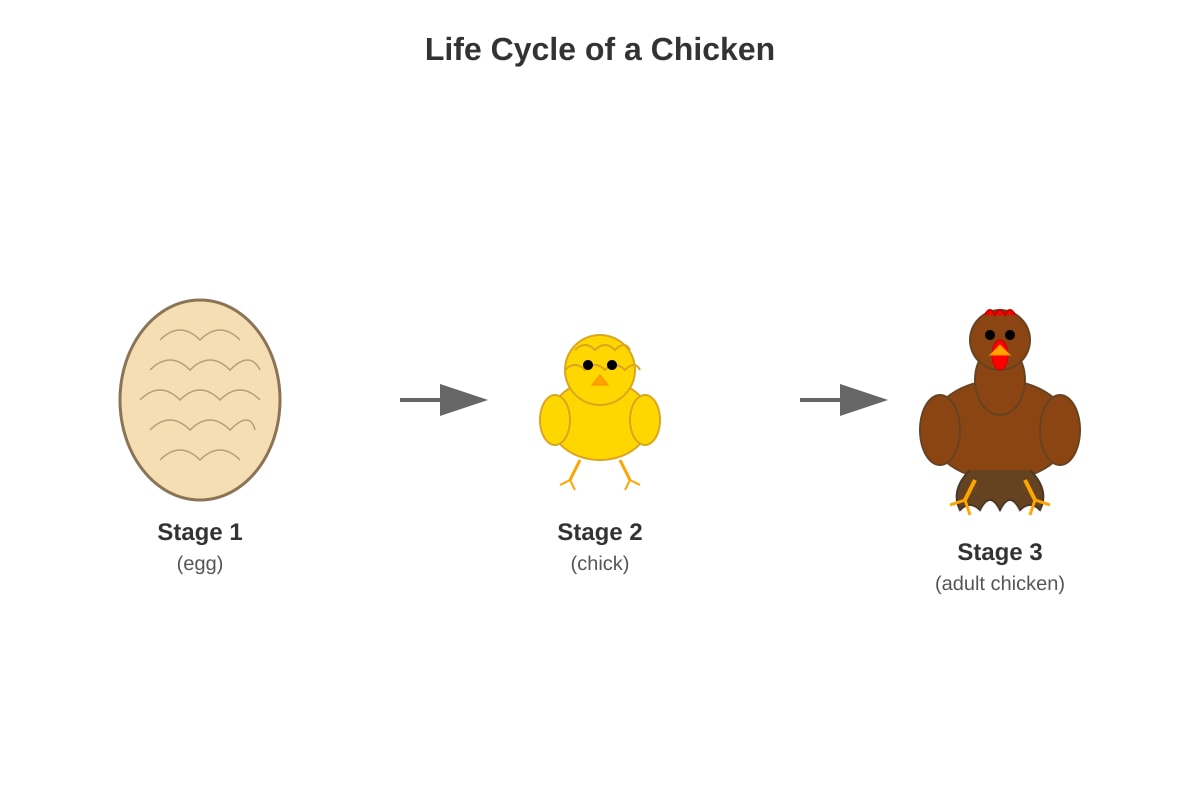
Explanation: This is the key difference between complete and incomplete metamorphosis. The chicken shows incomplete metamorphosis — the chick hatches looking like a smaller version of the adult, just without full feathers and size. It gradually grows and develops feathers, but there is no dramatic change in body form.
In contrast, the butterfly shows complete metamorphosis: the caterpillar (larva) looks completely different from the butterfly — it has no wings, many legs, different mouthparts, and different habitat/food source. The pupa stage allows the complete rebuilding of the body.
Both start from eggs (so C is wrong), and lifespan is not what defines the type of life cycle (so D is wrong).
7. Answer: C (2 marks)
Explanation: A dog is a mammal, and mammals reproduce by giving birth to live young (viviparous reproduction). The mother's body nourishes the developing baby through a placenta, and after birth, the mother produces milk to feed the puppies.
- P (produces seeds) = plants
- Q (lays eggs in water) = frogs, fish, some insects
- R (gives birth to live young) = mammals like dogs, cats, humans
- S (produces spores) = fungi, ferns, mosses, bacteria
8. Answer: C (2 marks)
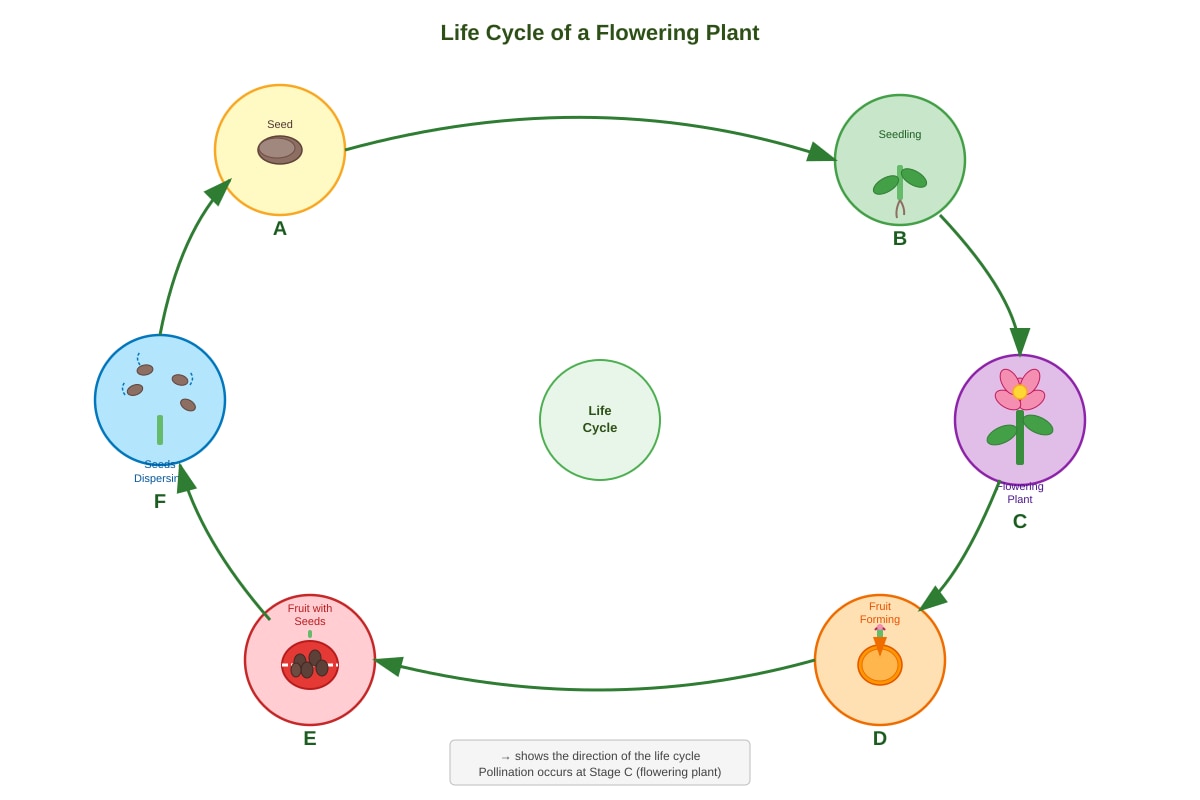
Explanation: Pollination occurs at Stage C — when the plant has flowers. Pollination is the transfer of pollen grains from the male part of a flower (anther) to the female part (stigma), either of the same flower or another flower of the same species.
After pollination and fertilization, the flower develops into a fruit (Stage D and E). The stages in order are:
- A: Seed (dormant, waiting to grow)
- B: Seedling/young plant (growing, making leaves)
- C: Mature flowering plant (ready for pollination)
- D: Fruit forming (after successful pollination and fertilization)
- E: Fruit with seeds (mature fruit)
- F: Seeds dispersed (new cycle begins)
9. Answer: B (2 marks)
Explanation: Fruits have two main functions related to seeds:
- Protection: The fleshy or hard fruit wall protects the developing seeds from damage, pests, and harsh conditions.
- Dispersal: Fruits help spread seeds away from the parent plant so that new plants have space, light, water, and nutrients to grow. Different fruits use different methods — wind, water, animals, or explosive splitting.
Plants make their food in leaves through photosynthesis, not in fruits (A is wrong). While animals do eat fruits, this is a means to an end (seed dispersal through droppings), not the reason plants produce fruits (C is wrong). Plants don't actively try to look attractive to other plants (D is wrong).
10. Answer: B (2 marks)
Explanation: Wind-dispersed seeds have special structures that catch the wind and allow them to float or glide through the air:
- Dandelion (Seed X): Feathery pappus acts like a parachute, catching breeze
- Maple (Seed Y): Wing-like samara acts like a helicopter blade, spinning as it falls
- Cotton (Seed Z): Fluffy hairs trap air, making seeds buoyant and able to drift long distances
These seeds are typically light, not heavy (A is wrong). They are not wet and sticky — that would be for animal dispersal (C is wrong). Bright colours attract birds/animals for animal dispersal, not wind dispersal (D is wrong).
Section B: Fill in the Blanks and Short Answers
11. (3 marks total, 1 mark each)
| Need | Why it is important |
|---|---|
| Water | Helps transport nutrients and keeps the organism (a) hydrated / alive / healthy |
| (b) Sunlight / Light | Needed for making food in plants; provides warmth |
| Air | Contains (c) oxygen which is needed for breathing |
(a) moist / hydrated / functioning properly (1 mark) — accept any reasonable answer about maintaining body processes or preventing drying out
(b) Light / Sunlight (1 mark)
(c) oxygen (1 mark) — must be specific; "air" alone is not enough as air contains multiple gases
Teaching note: These are the three basic needs of all living things (with light being essential specifically for plants, and warmth affecting metabolic rates). Oxygen is the specific gas needed for cellular respiration — the process that releases energy from food.
12. (3 marks total)
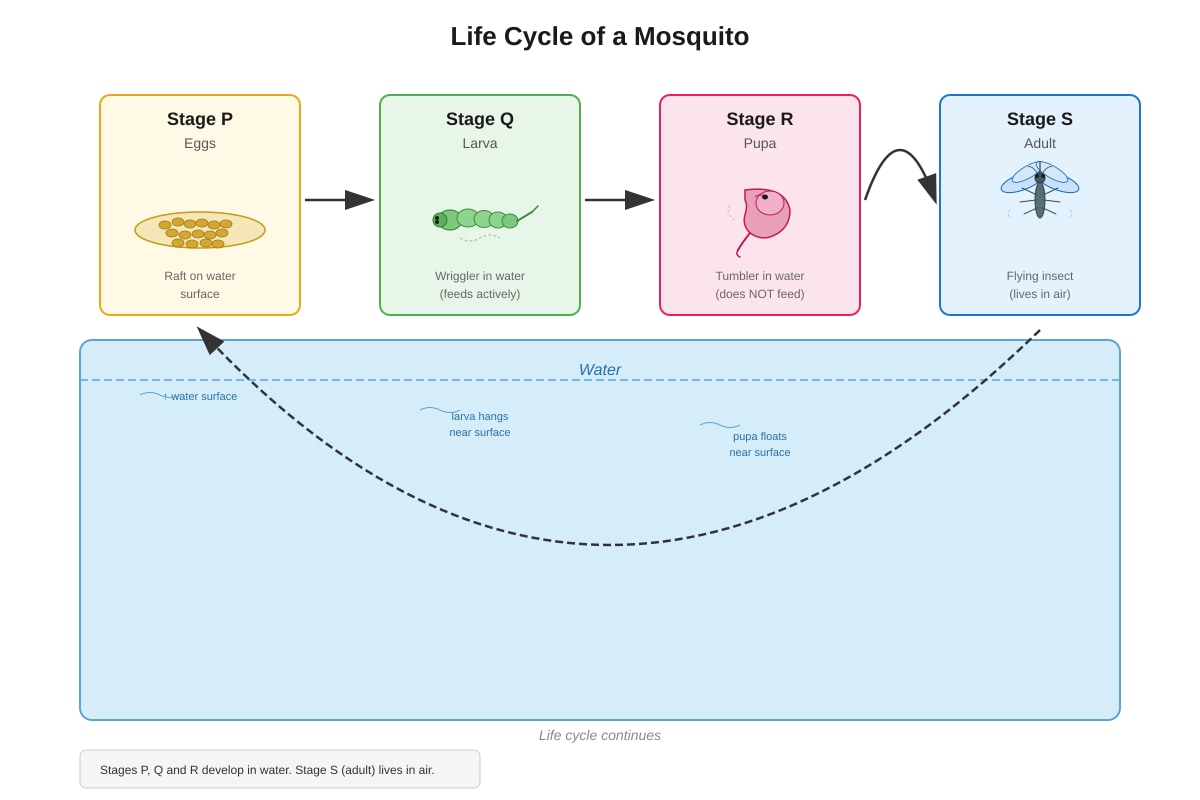
(a) Pupa / Stage R / The pupa stage (1 mark)
Explanation: During the pupa stage, the mosquito is encased and undergoes transformation from larva to adult. It does not feed actively — it is a resting, changing stage where the body is reorganized. This is a characteristic of complete metamorphosis.
(b) (2 marks) — need two valid points
Sample answer: Stagnant water provides a place for mosquitoes to lay their eggs (1 mark) and for the larvae and pupae to develop (1 mark). Removing stagnant water prevents mosquitoes from breeding, which helps control diseases like dengue fever that mosquitoes spread.
Alternative acceptable points:
- Mosquitoes need water for their early life stages
- Eggs hatch in water
- Larvae live in water and feed there
- This breaks the life cycle of the mosquito
13. (3 marks total)
(a) It splits open / cracks / breaks apart / softens and splits (1 mark)
Explanation: The seed coat protects the seed but must break to allow the radicle (embryo root) to emerge and for water and air to enter more easily. The coat softens as it absorbs water.
(b) (2 marks)
It grows downwards / into the soil / towards the ground. (1 mark)
This is because the root needs to absorb water and minerals from the soil / anchor the plant / gravity pulls it downward (geotropism/positive geotropism). (1 mark)
Teaching note: The root shows positive geotropism (growth towards gravity) and positive hydrotropism (growth towards water). These tropisms ensure the root finds its essential resources in the soil. The shoot, in contrast, grows upwards (negative geotropism) towards light.
14. (3 marks total, 1 mark each)
(a) Pollen (grains) (1 mark)
Explanation: Pollen grains are the male reproductive cells of flowering plants. They are produced in the anther (male part) and must reach the stigma (female part) for fertilization to occur.
(b) Bee(s) or butterfly / butterflies (1 mark) — either or both acceptable; must match passage
(c) Fruit (1 mark) — "fruit with seeds inside" is also acceptable
Teaching note: After pollination, the pollen grain grows a tube down to the ovary, fertilization occurs, and then the ovary swells and becomes the fruit while the ovules become seeds. This is why we find seeds inside fruits.
15. (4 marks total, 1 mark each)
| Feature | Grasshopper | Butterfly |
|---|---|---|
| Number of stages | (a) Three / 3 | Four |
| Young looks like adult? | Yes, similar but smaller and without wings | (b) No, very different / The young is a caterpillar |
| Name of young | Nymph | (c) Larva / Caterpillar |
| Type of change | (d) Incomplete metamorphosis | Complete metamorphosis |
(a) Three / 3 (1 mark)
(b) No / Very different / It is a caterpillar (1 mark) — must indicate the dramatic difference in appearance
(c) Larva / Caterpillar (1 mark) — both acceptable; "caterpillar" is the common name
(d) Incomplete metamorphosis (1 mark)
Teaching note: Incomplete metamorphosis (hemimetabolism) has three stages: egg → nymph → adult. The nymph resembles a small adult without wings and gains wings gradually through moulting. Complete metamorphosis (holometabolism) has four stages with a pupa as the "rebuilding" stage, allowing the adult to have a completely different lifestyle from the larva — this reduces competition for food and habitat between young and adults.
16. (3 marks total)
(a) Animal dispersal / Dispersal by animals (1 mark) — accept "by animals eating the fruit"
(b) (2 marks)
The wing-like structure / flattened extension helps the seed to catch the wind / glide through the air / spin as it falls (1 mark)
This allows the seed to travel farther from the parent plant / float over a larger area, so it has more space, light, and nutrients to grow (1 mark)
Specific teaching note for Fruits A, B, and C:
- A (exploding pod): Explosive / self-dispersal — pod dries and splits suddenly, flinging seeds outward
- B (fleshy fruit): Animal dispersal — animals eat the fleshy part, seeds pass through digestive system unharmed, deposited with droppings (which also act as fertilizer!)
- C (winged seed): Wind dispersal — flat wing creates air resistance, allowing seed to helicopter or glide down slowly, traveling horizontal distance
Section C: Application and Reasoning
17. (5 marks total)
(a) Whether the seeds germinate / whether plants grow / which seeds grow better / the height of seedlings (1 mark) — any reasonable observable change related to plant growth
(b) Amount of water / type of soil / type of seeds / size of pots / temperature (1 mark) — any one valid control variable
(c) (3 marks) — prediction and explanation required
Prediction: Seeds in Pot X will germinate and grow healthy green seedlings, but seeds in Pot Y will not germinate / will germinate but become pale and weak / will die. (1 mark for correct prediction)
Explanation for Pot X: With light, the seedlings can photosynthesize and make their own food. (1 mark)
Explanation for Pot Y: Without light, the seedlings cannot make food / will run out of stored food in the seed / become etiolated (pale and long). (1 mark)
Teaching note: This is a classic fair test experiment. The independent variable (what Jason changes) is light availability. The dependent variable (what he measures) is plant growth/germination. Controlled variables (kept the same) include water, soil, seeds, pot size, and temperature. This ensures any difference is caused by light, not other factors.
18. (5 marks total)
(a) Complete metamorphosis (1 mark)
Explanation: The ladybird has four distinct life stages: egg → larva → pupa → adult, with a dramatic change in form between larva and adult.
(b) (2 marks)
The larva and adult have different lifestyles / feed on different things / live in different ways (1 mark)
This reduces competition for food and space between the young and the adult / allows them to use different resources in the same habitat (1 mark)
Specific detail: Ladybird larvae are elongated, segmented, and very active predators of aphids. Adult ladybirds are the familiar round, spotted beetles that also eat aphids but have different movement and shelter needs.
(c) (2 marks)
The pupa protects the developing adult inside (1 mark) — hard case shields from predators and weather
OR It allows the body to be completely reorganized / broken down and rebuilt from larval form to adult form (1 mark)
OR It is a resting stage that does not need to feed, surviving on stored energy (1 mark)
19. (6 marks total, 2 marks each: 1 for T/F, 1 for correction)
(a) False (1 mark)
Correction: Not all living things can move from place to place. Plants are living things but most cannot move from place to place (they are rooted) / OR Some animals like sponges and corals remain fixed to one place. (1 mark)
Explanation: Movement is a characteristic of living things, but "movement" includes:
- Movement of the whole body (locomotion): animals walking, swimming, flying
- Movement of parts: plants bending towards light, leaves folding, roots growing
- Internal movement: blood circulating, cytoplasm streaming
(b) False (1 mark)
Correction: A seed is living / will grow into a plant when given water, air, and warmth (1 mark)
Explanation: A seed is a living thing in a dormant (resting) state. It contains a tiny embryo plant inside that is alive but waiting for the right conditions to germinate. It is NOT dead or non-living — it can respire slowly, and given the right conditions, it will show all characteristics of living things (growing, eventually making its own food, reproducing when mature).
Common misconception: Students think if something doesn't move or breathe obviously, it must be non-living. Seeds challenge this — they need careful observation over time to reveal their liveliness.
(c) True (2 marks—1 for T/F, 1 for explanation that this is correct)
Explanation: All living things need oxygen for respiration — the process that releases energy from food. Plants need oxygen for respiration too, even though they produce oxygen during photosynthesis. Animals breathe in oxygen and breathe out carbon dioxide. Plants use oxygen day and night for respiration, though during the day they produce more oxygen than they use through photosynthesis.
20. (4 marks total)
(a) (2 marks — need two valid differences)
Any two from:
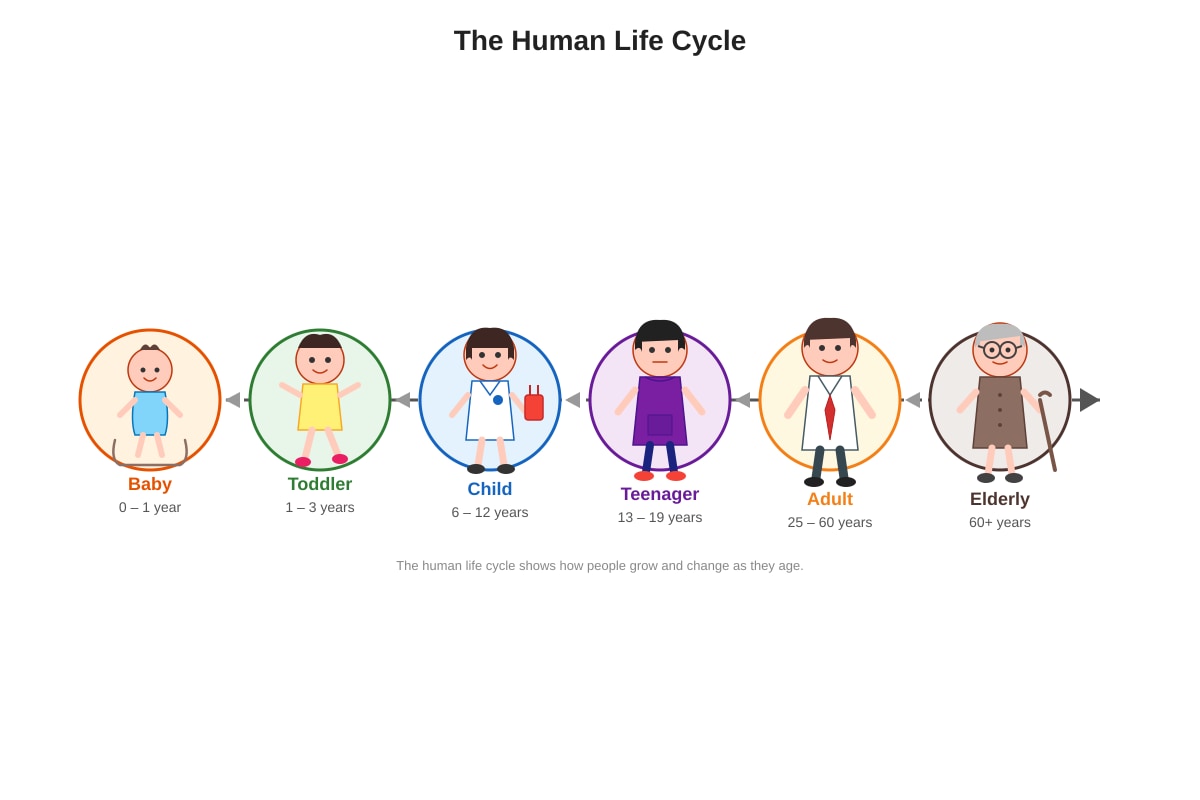
- Teenagers are taller / bigger in size (1 mark)
- Teenagers show physical changes of puberty (e.g., development of body hair, changes in voice for boys, broader shoulders for boys, developing hips for girls) (1 mark)
- Teenagers can reproduce / are sexually mature (1 mark)
- Teenagers have more developed thinking / reasoning skills (1 mark) — cognitive development
Note: "Teenagers go to secondary school" is a social difference, not a biological one. Accept only biological/physical differences for full marks, or note the distinction.
(b) (2 marks)
Humans do not undergo metamorphosis / Humans show direct development / The young human looks like a smaller version of the adult (1 mark)
There is no need for a complete body reorganization — humans grow gradually through childhood without a dramatic transformation stage (1 mark)
OR The human baby/child gradually develops and grows larger, gaining skills and size, but does not change body form completely like a caterpillar becoming a butterfly.
Teaching note: This contrast helps students understand that "life cycle" is a broad term. Some organisms (insects with complete metamorphosis) need a pupa because their larval and adult forms are radically different in structure, habitat, and food source. Humans and other mammals show direct development where the newborn resembles the adult in basic body plan and simply grows and matures.
Marking Summary
| Section | Marks |
|---|---|
| Section A (Q1-10) | 20 marks |
| Section B (Q11-16) | 14 marks |
| Section C (Q17-20) | 16 marks |
| Total | 40 marks |
Time check: Estimated 35-38 minutes working time + 2-5 minutes review = 40 minutes total ✓