AI Generated Quiz
Primary 3 Science Heat Quiz
Free AI-Generated Qwen3.7 Plus Primary 3 Science Heat quiz with questions and answers for Singapore students. This page is rendered as a direct URL so the questions and answers can be discovered without pressing in-page buttons.
These static practice materials are generated from the site's syllabus and paper-generation workflow, with source and model context shown so students and parents can evaluate the material before use.
Questions
Primary 3 Science Quiz - Heat
Name: __________________________
Class: __________________________
Date: __________________________
Score: ________ / 20
Duration: 30 minutes
Total Marks: 20
Instructions:
- Read each question carefully.
- Write your answers in the spaces provided.
- For multiple-choice questions, write the number (1, 2, 3, or 4) in the brackets provided.
Section A: Multiple-Choice Questions (10 marks)
For each question, four options are given. Choose the correct answer and write its number in the brackets provided.
1. Which of the following is a source of heat?
(1) A mirror
(2) The Sun
(3) A glass of water
(4) A wooden table
Answer: (____) [1]
2. Ali touched a cup of hot Milo and quickly pulled his hand away. What does this show about living things?
(1) They need air.
(2) They can grow.
(3) They respond to changes.
(4) They need food.
Answer: (____) [1]
3. Which of these objects is likely to be the hottest?
(1) An ice cube
(2) A bottle of cold milk
(3) A bowl of hot soup
(4) A packet of biscuits
Answer: (____) [1]
4. Why do we wear thick woolen sweaters in cold weather?
(1) To keep our body heat from escaping.
(2) To make us look taller.
(3) To absorb heat from the wind.
(4) To let cold air enter our bodies.
Answer: (____) [1]
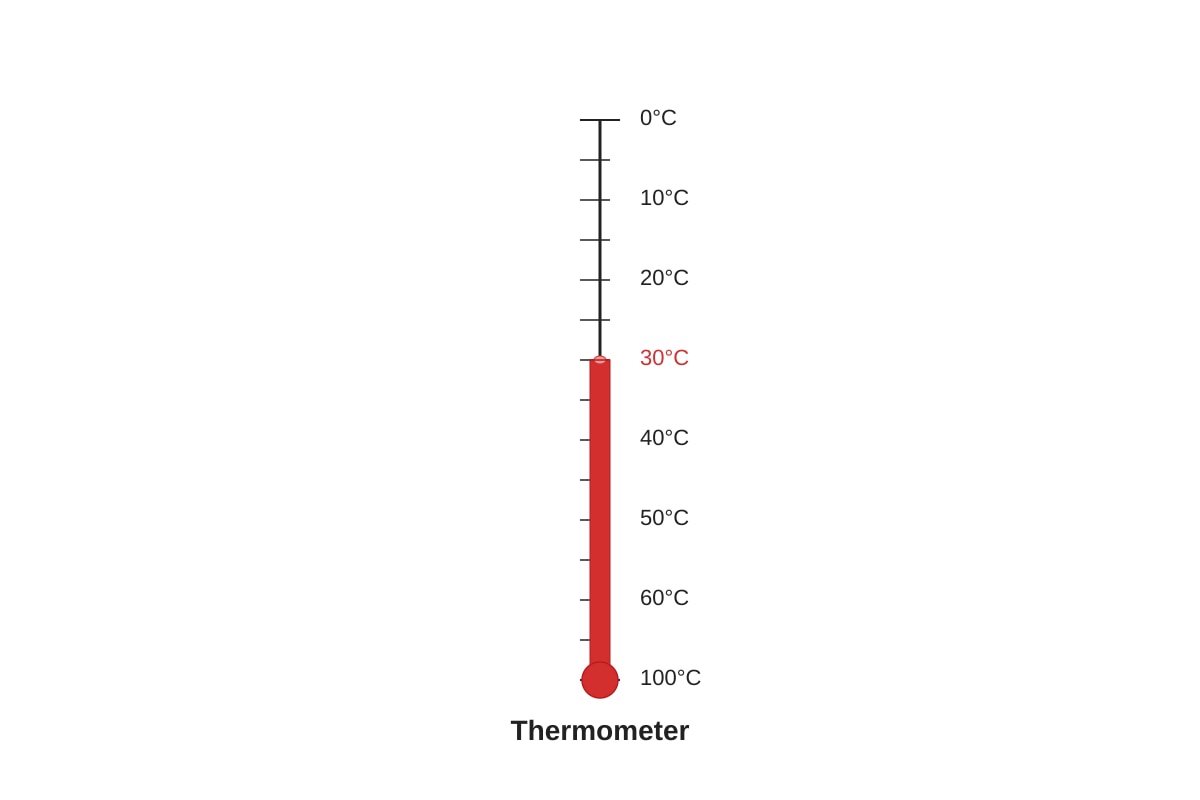
5. Look at the thermometer below.
<image_placeholder> id: Q5-fig1 type: diagram linked_question: Q5 description: A standard laboratory thermometer showing the red liquid level. labels: Scale marked from 0°C to 100°C in increments of 10. values: The red liquid column stops exactly at the line marked 30. must_show: The meniscus of the red liquid aligning with the 30°C mark. </image_placeholder>
What is the temperature shown on the thermometer?
(1) 20°C
(2) 30°C
(3) 40°C
(4) 100°C
Answer: (____) [1]
6. Which of the following will melt the fastest if left in the Sun?
(1) A stone
(2) A block of ice
(3) A plastic toy
(4) A metal spoon
Answer: (____) [1]
7. Siti placed a metal spoon and a plastic spoon in a cup of hot tea. After 2 minutes, she touched the handles. Which statement is true?
(1) The plastic spoon handle is hotter.
(2) The metal spoon handle is hotter.
(3) Both handles are the same temperature.
(4) Neither handle is warm.
Answer: (____) [1]
8. What happens to water when it is heated for a long time?
(1) It turns into ice.
(2) It turns into steam.
(3) It becomes heavier.
(4) It changes colour.
Answer: (____) [1]
9. Which of these is NOT a way to keep cool on a hot day?
(1) Drinking cold water.
(2) Standing under a fan.
(3) Wearing a dark, thick jacket.
(4) Taking a shower.
Answer: (____) [1]
10. Why are cooking pots usually made of metal?
(1) Metal is cheap.
(2) Metal allows heat to pass through easily.
(3) Metal is light to carry.
(4) Metal does not break easily.
Answer: (____) [1]
Section B: Structured Questions (10 marks)
Answer the following questions in the spaces provided.
11. Study the picture below.
<image_placeholder> id: Q11-fig1 type: diagram linked_question: Q11 description: Two cups, Cup A and Cup B, sitting on a table. labels: Cup A contains steaming hot coffee. Cup B contains iced lemon tea with condensation on the outside. values: N/A must_show: Visible steam rising from Cup A. Water droplets on the outer surface of Cup B. </image_placeholder>
(a) From which cup is heat being lost to the surroundings?
_________________________________________________________________________ [1]
(b) Give one reason for your answer in (a).
_________________________________________________________________________ [1]
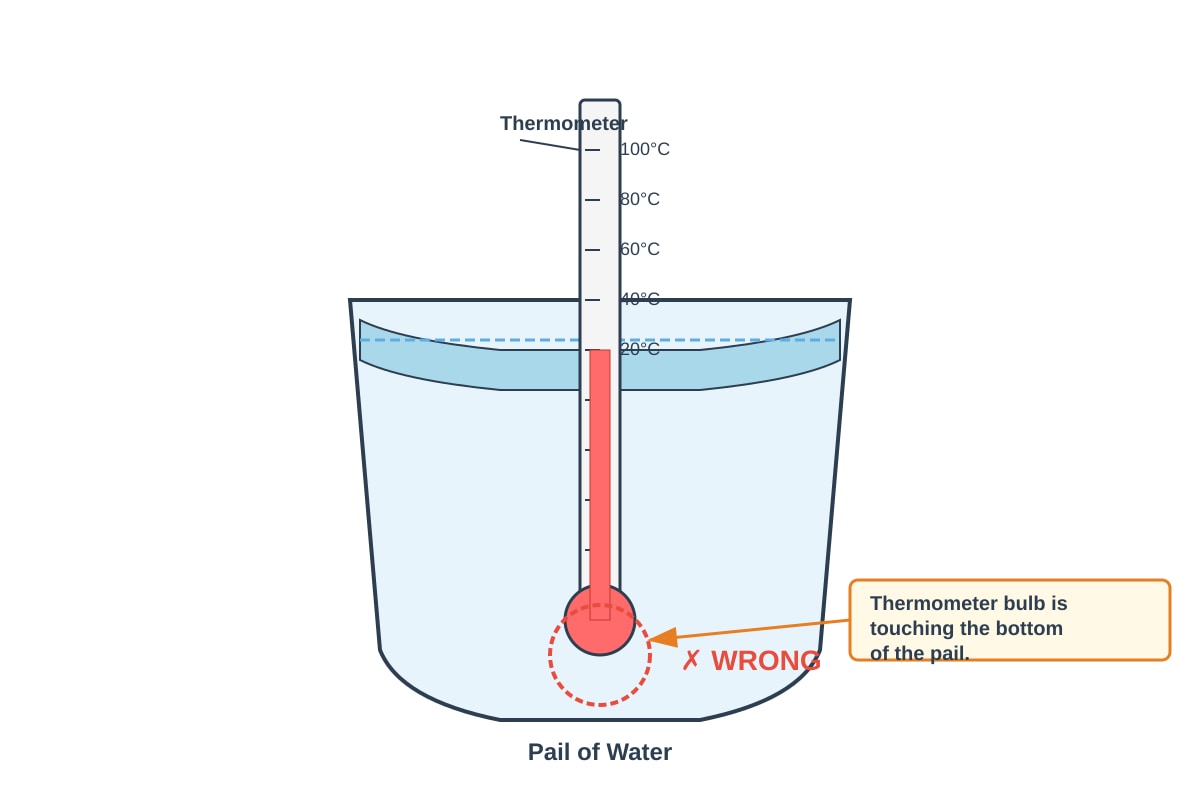
12. Ben wants to measure the temperature of a pail of water. He uses a thermometer.
<image_placeholder> id: Q12-fig1 type: diagram linked_question: Q12 description: A thermometer placed incorrectly in a pail of water. labels: Thermometer bulb is touching the bottom of the pail. values: N/A must_show: The glass bulb of the thermometer resting directly on the bottom surface of the container, not floating in the water. </image_placeholder>
(a) What is wrong with the way Ben is using the thermometer?
_________________________________________________________________________ [1]
(b) Why is this method incorrect?
_________________________________________________________________________ [1]
13. Look at the objects below.
- Object A: Rubber eraser
- Object B: Copper coin
- Object C: Wooden ruler
- Object D: Steel nail
(a) Which two objects are good conductors of heat?
Answer: _________ and _________ [1]
(b) Why are these objects good conductors of heat?
_________________________________________________________________________ [1]
14. Mrs. Tan made a pot of soup. She left the pot on the stove with the fire turned off. The soup was hot at first, but after 1 hour, it became cold.
(a) Where did the heat from the soup go?
_________________________________________________________________________ [1]
(b) If Mrs. Tan wants to keep the soup hot for longer, what should she do?
_________________________________________________________________________ [1]
15. Raju left a chocolate bar on his desk near the window on a sunny afternoon. When he returned, the chocolate had changed shape.
(a) What caused the chocolate to change shape?
_________________________________________________________________________ [1]
(b) What is the process called when a solid turns into a liquid due to heat?
_________________________________________________________________________ [1]
16. Which of the following materials is the best insulator of heat?
(1) Copper
(2) Iron
(3) Styrofoam
(4) Aluminium
Answer: (____) [1]
17. Why do railway tracks have small gaps between them?
(1) To save money on materials.
(2) To allow the tracks to expand when heated.
(3) To allow rain water to drain away.
(4) To make the train ride bumpier.
Answer: (____) [1]
18. A glass of cold water is left on a table on a hot day. Water droplets form on the outside of the glass. Where did these water droplets come from?
(1) Inside the glass leaking out.
(2) Water vapour in the air condensing.
(3) The glass sweating.
(4) Ice melting on the outside.
Answer: (____) [1]
19. Which action will make a wet towel dry the fastest?
(1) Folding it neatly.
(2) Hanging it in a shady, cool place.
(3) Spreading it out in the sun and wind.
(4) Putting it in a plastic bag.
Answer: (____) [1]
20. Why are handles of cooking pots often made of plastic or wood?
(1) They are good conductors of heat.
(2) They are poor conductors of heat.
(3) They are cheaper than metal.
(4) They look more colourful.
Answer: (____) [1]
Answers
Primary 3 Science Quiz - Heat (Answer Key)
Total Marks: 20
Section A: Multiple-Choice Questions
1. (2)
Explanation: The Sun is a natural source of heat and light. Mirrors, water, and tables do not produce their own heat.
2. (3)
Explanation: Living things respond to changes in their environment. Ali’s hand pulling away is a response to the stimulus of heat to prevent injury.
3. (3)
Explanation: Hot soup has a high temperature. Ice is cold, cold milk is cool, and biscuits are usually at room temperature.
4. (1)
Explanation: Woolen sweaters are insulators. They trap air and prevent body heat from escaping into the cold surroundings, keeping us warm.
5. (2)
Explanation: The red liquid level aligns with the mark labelled 30. The unit for temperature is degrees Celsius (°C).
6. (2)
Explanation: Ice is a solid that melts into water when it gains heat from the Sun. Stone, plastic, and metal do not melt at typical outdoor temperatures.
7. (2)
Explanation: Metal is a good conductor of heat, so heat travels quickly from the hot tea to the handle. Plastic is a poor conductor (insulator), so heat travels slowly.
8. (2)
Explanation: When water is heated strongly, it gains enough heat to change from a liquid to a gas (steam). This process is called boiling.
9. (3)
Explanation: Dark, thick jackets trap heat and absorb more heat from the Sun, making the wearer hotter. The other options help remove heat or cool the body.
10. (2)
Explanation: Metals are good conductors of heat. This allows heat from the stove to pass through the pot quickly to cook the food inside.
Section B: Structured Questions
11.
(a) Cup A [1]
(b) Cup A contains hot coffee. Heat always moves from a hotter object to a cooler surrounding. Steam is visible, showing heat is escaping. [1]
Note: Accept "Heat is lost from the hot coffee to the cooler air."
12.
(a) The bulb of the thermometer is touching the bottom of the pail. [1]
(b) The bottom of the pail might be hotter or colder than the water itself (especially if on a stove or cold table). The thermometer must measure the water temperature, not the container's temperature. [1]
13.
(a) Object B (Copper coin) and Object D (Steel nail) [1]
Note: Both must be correct for the mark.
(b) They are made of metal, and metals are good conductors of heat. [1]
14.
(a) The heat moved from the hot soup to the cooler surrounding air. [1]
(b) She should put a lid on the pot or wrap the pot with a towel/insulator to reduce heat loss. [1]
15.
(a) The heat from the Sun warmed the chocolate. [1]
(b) Melting. [1]
16. (3)
Explanation: Styrofoam is a poor conductor of heat (insulator), which means it does not allow heat to pass through easily. Copper, iron, and aluminium are metals and are good conductors.
17. (2)
Explanation: Solids expand when heated. The gaps allow the metal tracks to expand into the space without bending or breaking when the temperature rises on hot days.
18. (2)
Explanation: The cold surface of the glass cools the surrounding air. Water vapour in the air loses heat and condenses into liquid water droplets on the outside of the glass.
19. (3)
Explanation: Spreading the towel increases the surface area exposed to air. The sun provides heat, and the wind helps remove the water vapour, speeding up evaporation.
20. (2)
Explanation: Plastic and wood are poor conductors of heat (insulators). This prevents heat from the hot pot from traveling to the handle, so we can hold it without burning our hands.