AI Generated Quiz
Primary 3 Science Heat Quiz
Free P3 Science Heat quiz, Kimi2.6 AI version, with questions, answers, and syllabus-aligned practice for Singapore students.
These static practice materials are generated from the site's syllabus and paper-generation workflow, with source and model context shown so students and parents can evaluate the material before use.
Questions

Free quiz and exam paper access
Enter your details to view this paper
Your access is remembered on this device.
Answers
Primary 3 Science Quiz - Heat: Answer Key
Total Marks: 40 marks
Section A: Multiple Choice (Questions 1–8)
1. (c) Burning candle (1 mark)
Explanation: A burning candle produces heat from the chemical reaction of burning wax. Ice cubes, snow, and wet towels are all cool or cold objects that do not produce heat. Remember: heat sources are objects that give out or produce heat.
2. (b) Conduction (1 mark)
Explanation: Conduction is the transfer of heat through a material without the material itself moving. The metal spoon heats up because heat energy travels through the metal from the hot soup to your hand. Metals are good conductors. Radiation does not need a material but is not the main way the spoon heats up here. Convection involves the movement of the material itself (like hot water rising), which doesn't happen in a solid spoon.
3. (c) Copper (1 mark)
Explanation: Copper is a metal, and metals are generally very good conductors of heat. This is why copper and other metals are used to make pots and pans. Wood, plastic, and air are insulators—they do not conduct heat well. Plastic handles on pans are safe to touch because plastic is a poor conductor (good insulator).
4. (b) Plastic is an insulator of heat (1 mark)
Explanation: Plastic is an insulator, meaning it does not allow heat to pass through it easily. The heat from the hot pan stays mostly in the metal part and does not travel quickly to your hand through the plastic handle. If plastic conducted heat well, the handle would become too hot to hold!
5. (b) Hot air is lighter than cold air (1 mark)
Explanation: When air is heated, the particles move faster and spread out, making the hot air less dense (lighter) than the cold air around it. The lighter hot air rises above the heavier cold air. This is called convection. As the hot air rises, cooler air moves in to take its place, gets heated, and rises too—creating a convection current.
6. (a) Laboratory thermometer (1 mark)
Explanation: A laboratory thermometer can measure a wide range of temperatures, typically from about -10°C to 110°C or higher, which is suitable for very hot oven air. A clinical thermometer only measures around 35°C to 42°C (body temperature range) and would break or give wrong readings. A room thermometer doesn't go high enough either.
7. (b) Metal conducts heat better than wood (1 mark)
Explanation: Both the metal slide and wooden bench receive the same amount of heat from the sun. However, metal is a much better conductor of heat than wood. This means heat from Meera's hand can travel quickly through the metal, making it feel hotter. Wood is an insulator, so heat does not travel away from her hand as quickly, making it feel cooler. This is about how heat feels, not just the actual temperature.
8. (c) It decreases (1 mark)
Explanation: Ice cubes are much colder than the warm water (ice is at 0°C or below). Heat from the warm water transfers to the ice cubes, causing the ice to melt. As the water loses heat energy to the ice, its own temperature decreases. The system moves toward a middle temperature as heat flows from hotter to colder objects.
Section B: Fill in the Blanks and Short Answers (Questions 9–15)
9. Radiation (1 mark)
Explanation: The three methods of heat transfer are conduction (through solids), convection (through fluids—liquids and gases), and radiation (through electromagnetic waves, can travel through empty space). Remember: radiation does not need any material to travel through, which is how heat from the sun reaches Earth.
10. Any TWO of the following: (2 marks, 1 mark each)
| Feature | Why it matters |
|---|---|
| Has a constriction (kink) in the tube | Prevents the mercury or alcohol from falling back down after removal, so you can read the temperature away from the patient |
| Measures a narrow range (about 35°C–42°C) | Designed specifically for human body temperature; laboratory thermometers have a much wider range |
| Has a bulb with thinner walls for faster response | Quicker to reach body temperature; more sensitive to small changes |
Common mistake: Do not say "it measures temperature"—both thermometers do that! The differences are in the design features and purpose.
11. A woollen blanket keeps you warm because: (2 marks)
- Wool is a poor conductor of heat / good insulator (1 mark)
- The wool traps air between its fibres, and air is also a poor conductor of heat (1 mark)
Full explanation: Woollen blankets keep you warm by reducing heat loss from your body to the colder air outside. The wool fibres themselves are poor conductors, and they also trap pockets of air. Since trapped air is an excellent insulator, very little heat can escape from your body through the blanket. This does not mean the blanket produces heat—your body produces heat, and the blanket helps keep it in.
12. (a) A, then B, then C, then D (or: A → B → C → D) (1 mark)
(b) Heat travels from the heat source along the metal rod by conduction (1 mark). Point A is closest to the heat source, so it gets hot first and the wax melts first. Point D is farthest from the heat source, so it gets hot last (1 mark).
Explanation: Metal is a good conductor. Heat energy moves through the metal from particle to particle, gradually spreading along the rod. The temperature decreases with distance from the heat source. Wax melts at a specific temperature, so the drops melt in order of their distance from the heat.
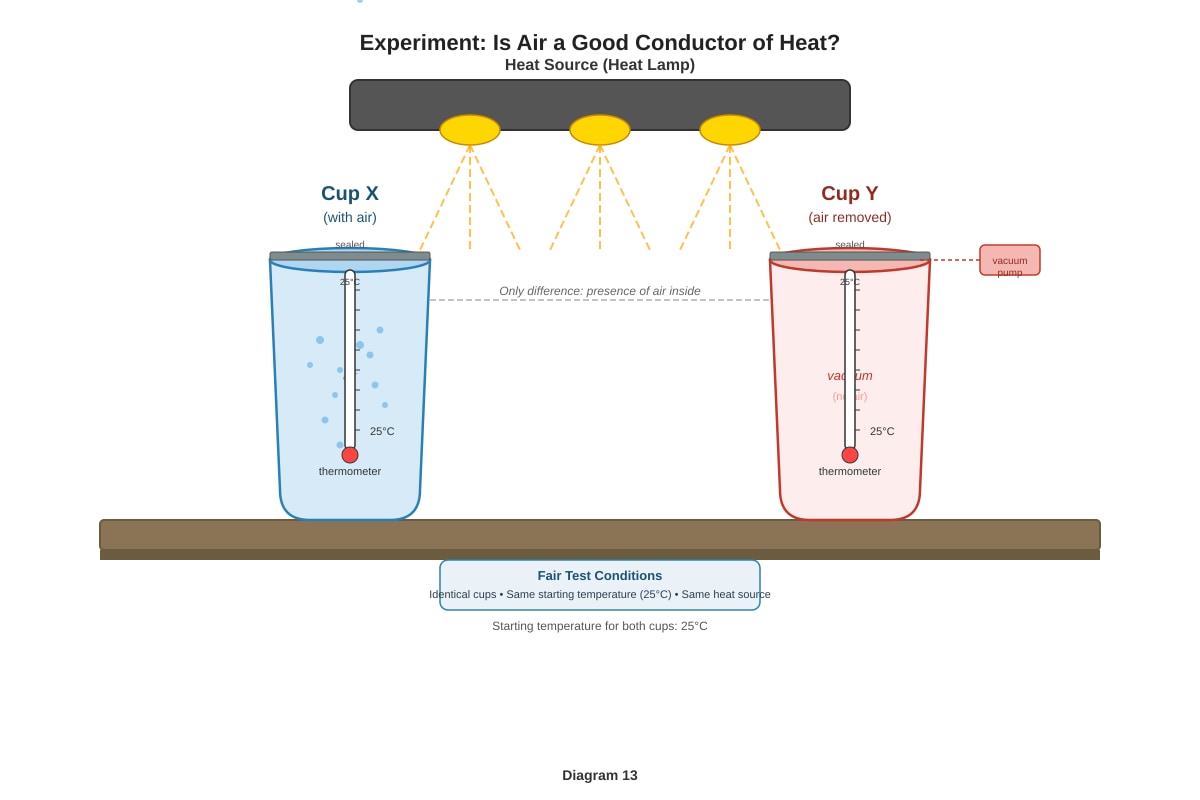
13. (a) The temperature inside each cup over time OR how quickly the temperature rises (1 mark)
(b) Cup X (with air) will show a faster temperature increase (1 mark). This is because air conducts heat (poorly, but better than a vacuum), so some heat energy can travel through the air to the thermometer. In Cup Y, with air removed, there are almost no particles to transfer heat energy by conduction or convection (1 mark).
Teaching note: This experiment demonstrates that conduction and convection both need particles (matter) to transfer heat. In a vacuum, only radiation can transfer heat, which is much slower for this setup.
14. (3 marks)
When water at the bottom of the pot is heated:
- It becomes less dense (lighter) and rises to the top (1 mark)
- Cooler, denser water at the top sinks to the bottom to take its place (1 mark)
- This creates a convection current—a continuous cycle of rising hot water and sinking cool water—which gradually heats all the water evenly (1 mark)
Explanation: Convection happens in fluids (liquids and gases) because the heated part expands, becomes less dense, and rises. The cooler part is denser and sinks. This creates a circular movement called a convection current.
15. (a) All three spoons have been in the same room for the same amount of time, so they have reached thermal equilibrium with the room temperature (1 mark). Everything in the same environment eventually reaches the same temperature.
(b) The metal spoon feels colder because metal is a better conductor of heat than wood or plastic (1 mark). When you touch the metal spoon, heat from your warmer hand flows quickly away into the metal, making your skin feel cold. Wood and plastic are insulators, so heat from your hand does not flow away as quickly, and they don't feel as cold (1 mark).
Important concept: The spoons are all at the same actual temperature (25°C). The difference in how they feel is due to different conductivity, not different temperatures. This is a common misconception to watch for!
Section C: Application and Reasoning (Questions 16–20)
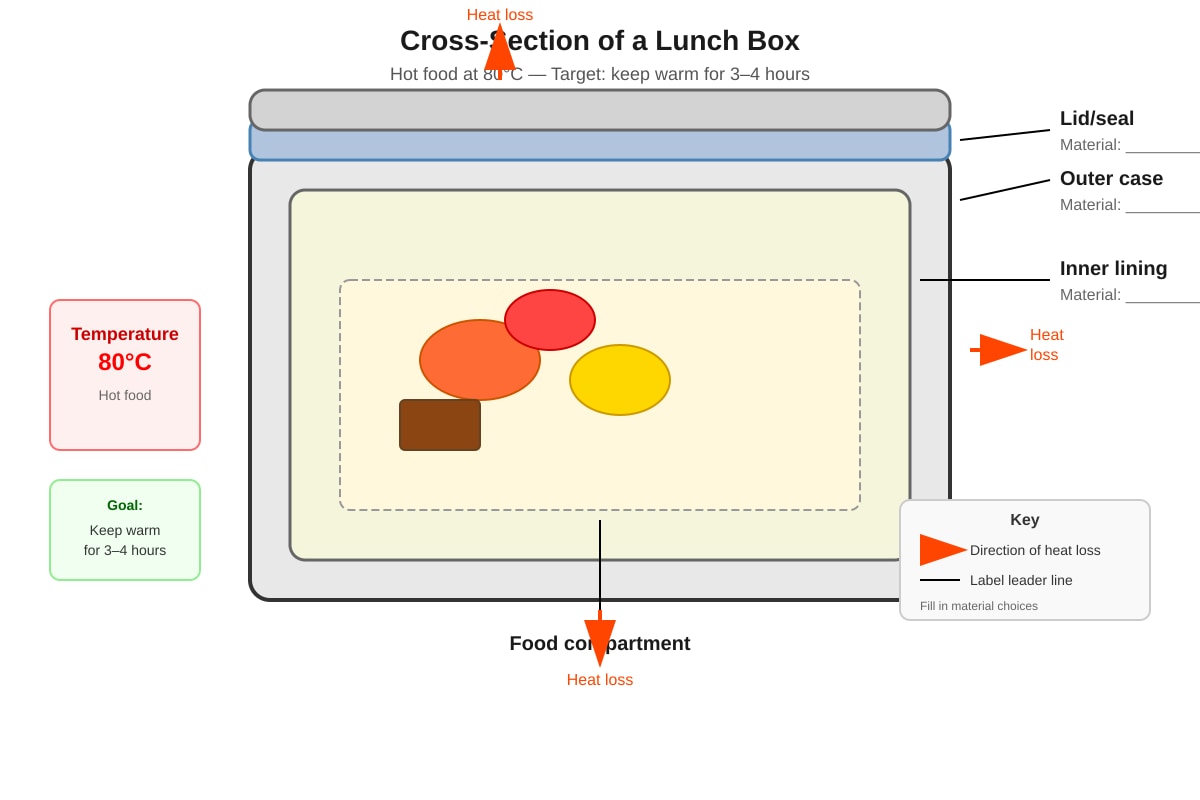
16. (a) Suggest a suitable material: Plastic, styrofoam, or glass (any suitable insulator) (1 mark)
Explanation: These materials are poor conductors of heat / good insulators (1 mark). This means heat from the hot food cannot easily escape through the lining, keeping the food warm for longer.
(b) A tight-fitting lid:
- Prevents hot air from escaping (convection) (1 mark)
- Traps warm air inside and prevents cooler outside air from entering, maintaining the warm temperature (1 mark)
Alternative valid answer: It reduces heat loss by convection (air movement) and evaporation (steam escaping).
17. (3 marks)
- The large ears have thin skin with many blood vessels near the surface (1 mark)
- Heat from the warm blood travels to the surface of the ears by conduction through the thin tissue (1 mark)
- At the surface, heat is lost to the cooler air by radiation (and some convection/conduction to air) (1 mark)
Alternative explanation: Blood flowing through the ears is cooled by the air. The cooled blood then flows back to the body, helping to reduce overall body temperature. Large surface area and thinness maximise heat loss—like a natural cooling system!
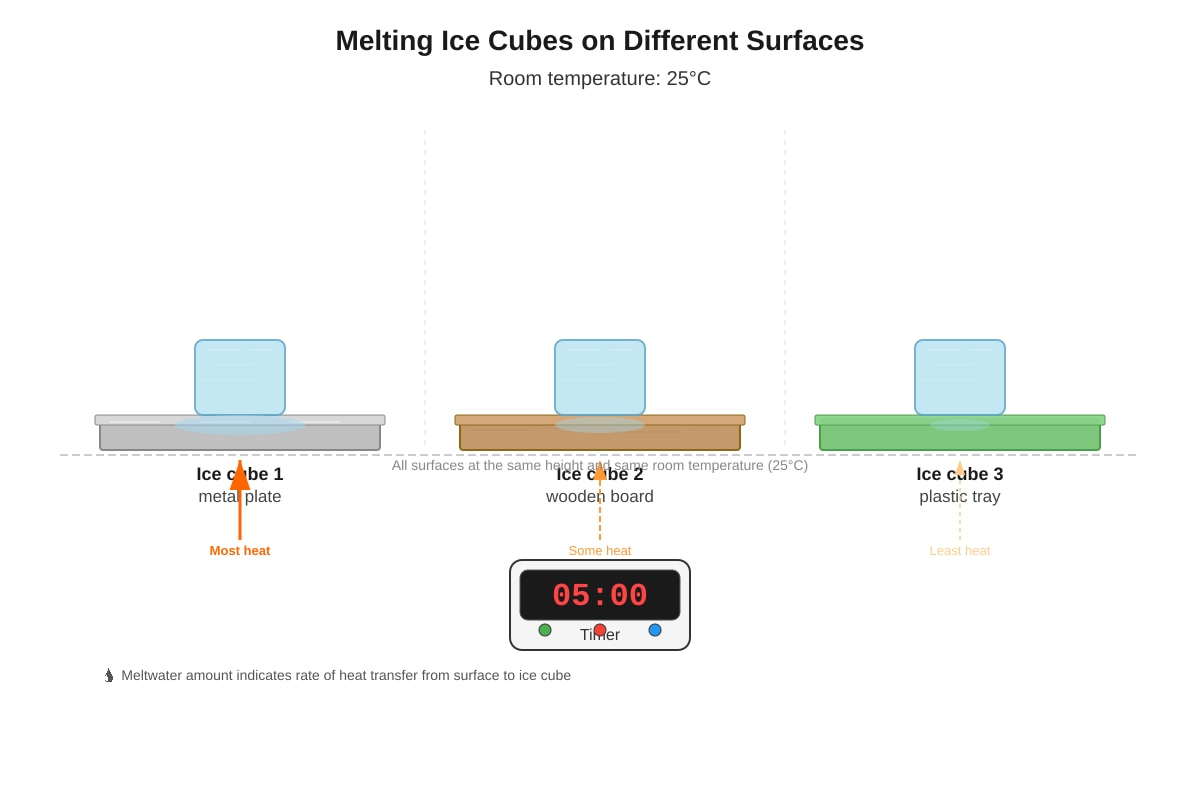
18. (a) First to melt: Ice cube on metal plate (1 mark) Last to melt: Ice cube on plastic tray (or wooden board—both are insulators, very similar) (1 mark)
(b) Explanation: (2 marks)
- Metal is a good conductor of heat (1 mark). Even at room temperature (25°C), the metal conducts heat energy from the surrounding air to the ice cube efficiently, making it melt faster.
- Wood and plastic are insulators (poor conductors) (1 mark). They do not conduct heat energy well to the ice cube, so it melts more slowly.
Note: Some may argue wood vs. plastic—both are insulators with similar poor conductivity. Either order for "last" is acceptable with valid reasoning.
19. (a) (2 marks)
- Air near the ceiling is warmer because hot air is less dense and rises (1 mark)
- This is due to convection: warm air from heaters, lights, and people rises to the top of the room (1 mark)
(b) (2 marks)
- Cool air from the air-conditioner is denser and sinks downward (1 mark)
- As it sinks, it pushes warmer air up to be cooled, creating a convection current that gradually cools the whole room (1 mark)
20. Experiment design: (3 marks, 1 mark for each valid component included)
| Component | Example Answer |
|---|---|
| Variable changed (independent) | The colour of the bottle (e.g., black, white, red, blue, silver) |
| Variables kept constant (fair test) | Same size and type of bottle; same amount and initial temperature of water; same environment/room; same time period for measurement |
| What to measure (dependent) | The temperature of the water after a fixed time (e.g., 30 minutes), OR how long the water stays above a certain temperature |
| Prediction | The black or dark-coloured bottle will keep water warmest longest, because dark colours absorb more heat radiation (and therefore lose less heat outward if the outside is cooler); OR silver/white if considering reflection keeping heat in—either prediction acceptable with valid reasoning |
Marking guidance: Award 1 mark for each of: changed variable, constant variables, dependent variable, and prediction (maximum 3 marks). Must have all three categories covered + prediction. Accept either direction of prediction if reasoning is scientifically valid.
END OF ANSWER KEY