AI Generated Quiz
Primary 3 Science Heat Quiz
Free P3 Science Heat quiz, HY3 AI version, with questions, answers, and syllabus-aligned practice for Singapore students.
These static practice materials are generated from the site's syllabus and paper-generation workflow, with source and model context shown so students and parents can evaluate the material before use.
Questions
Primary 3 Science Quiz - Heat
Name: ___________________________
Class: _________
Date: ____________
Score: _______ / 20
Duration: 40 minutes
Total Marks: 20
Instructions:
- This quiz has 20 questions on the topic of Heat.
- Answer all questions in the spaces provided.
- Section A: 10 multiple-choice questions (1 mark each).
- Section B: 6 short-answer questions (1 mark each).
- Section C: 4 structured questions (1 mark each, some with parts).
- Use a pencil to write your answers.
Section A: Multiple Choice (1 mark each)
1. Which of the following is a source of heat?
A) A wooden chair
B) The Sun
C) A book
D) A plastic cup
2. When you touch a metal spoon that has been left in a hot bowl of soup, the spoon feels hot because
A) metal makes heat
B) heat travels from the soup to the spoon
C) the spoon absorbs cold
D) the soup is cold
3. Which material is a good conductor of heat?
A) Wood
B) Plastic
C) Metal
D) Cloth
4. We use a thermometer to measure
A) length
B) temperature
C) weight
D) time
5. Which of these is NOT a way heat can be produced?
A) Burning wood
B) Rubbing hands together
C) Freezing water
D) Using an electric heater
6. A boy wants to keep his soup warm. Which container is best?
A) A metal bowl with no cover
B) A styrofoam cup with a lid
C) An open glass plate
D) A thin plastic bag
7. What happens to most liquids when they are heated?
A) They freeze
B) They become colder
C) They become warmer
D) They turn into solid
8. Which of the following shows heat moving from a hotter object to a cooler one?
A) Ice cooling a drink
B) A fan blowing air
C) A light bulb glowing
D) A plant growing
9. Why are cooking pot handles often made of plastic or wood?
A) They are cheaper
B) They do not conduct heat well
C) They look nice
D) They are heavier
10. What is the normal temperature of a healthy human body about?
A) 0∘C
B) 37∘C
C) 100∘C
D) 50∘C
Section B: Short Answer (1 mark each)
11. Name one everyday object that uses electricity to produce heat.
12. Fill in the blank: Heat always flows from a _________ object to a cooler object.
13. Name one material that is a poor conductor of heat.
14. What do we call the instrument used to measure how hot or cold something is?
15. Write one word: The Sun gives us light and _________.
16. True or False: A woollen sock keeps your foot warm by making heat.
Section C: Structured Questions (1 mark each)
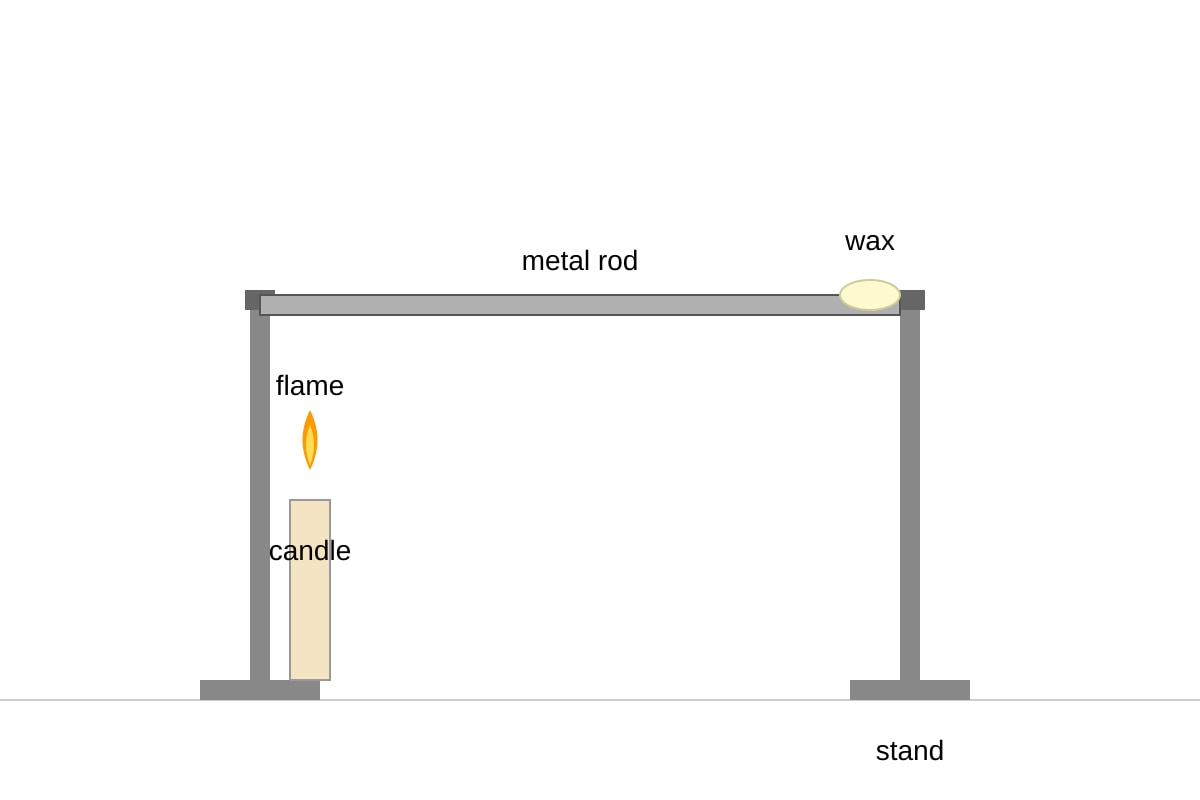
17. Look at the picture below. A candle is lit under a metal rod. At the other end, a small piece of wax is attached.
Image pending generation: experimental_setup for Q17.
(a) What will happen to the wax after some time?
(b) Why does this happen?
18. Mrs Tan puts three spoons (metal, wood, plastic) into a cup of hot water.
(a) Which spoon will feel hottest to touch after 1 minute?
(b) Which spoon will feel coolest?
19. Read the sentence: "We wear light-coloured clothes in hot weather because they keep us cool."
(a) Is this a good practice? (Yes / No)
(b) Give one reason.
20. A boy records the temperature of water:
| Time | Temperature |
|---|---|
| Start | 30∘C |
| After 5 min in sun | 45∘C |
(a) Did the water get hotter or colder?
(b) By how many degrees did it rise?
Answers
Primary 3 Science Quiz - Heat (Answer Key)
Total Marks: 20
Topic: Heat (syllabus-first; no past-year exam evidence used)
Section A: Multiple Choice
1. B) The Sun [1]
Teaching note: The Sun is a natural source of heat and light. A chair, book, and cup do not produce heat by themselves.
2. B) heat travels from the soup to the spoon [1]
Teaching note: Heat moves from hotter things to cooler things. The hot soup passes heat into the metal spoon.
3. C) Metal [1]
Teaching note: Metal is a good conductor of heat. Wood, plastic, and cloth are poor conductors.
4. B) temperature [1]
Teaching note: A thermometer measures temperature (how hot or cold). Length is measured by ruler, weight by scale, time by clock.
5. C) Freezing water [1]
Teaching note: Freezing removes heat; it does not produce heat. Burning, rubbing, and heaters produce heat.
6. B) A styrofoam cup with a lid [1]
Teaching note: Styrofoam is a poor conductor and the lid traps heat, keeping soup warm.
7. C) They become warmer [1]
Teaching note: Heating adds heat energy, so liquids become warmer, not colder or frozen.
8. A) Ice cooling a drink [1]
Teaching note: Heat from the drink flows to the colder ice, cooling the drink. This shows heat flow hot → cold.
9. B) They do not conduct heat well [1]
Teaching note: Plastic/wood are poor conductors, so handles stay safe to touch.
10. B) 37∘C [1]
Teaching note: Healthy human body is about 37∘C. 0∘C is freezing, 100∘C is boiling.
Section B: Short Answer
11. Example: electric iron / toaster / heater / kettle [1]
Teaching note: Any appliance that uses electricity to make heat is accepted.
12. hotter [1]
Teaching note: Heat flows from hotter to cooler objects.
13. Example: wood / plastic / cloth / rubber [1]
Teaching note: Poor conductors do not let heat pass easily.
14. thermometer [1]
Teaching note: Instrument for measuring temperature.
15. heat [1]
Teaching note: Sun provides light and heat.
16. False [1]
Teaching note: Woollen sock traps body heat, it does not make new heat.
Section C: Structured
17. (a) The wax will melt. [1]
(b) Heat from candle travels along metal rod to the wax, melting it. [1]
Teaching note: Metal conducts heat; the rod carries heat from flame to wax.
18. (a) Metal spoon [1] b) Wood or plastic spoon [1]
Teaching note: Metal conducts heat from water to hand; wood/plastic do not.
19. (a) Yes [1]
(b) Light colours reflect heat/sun, keeping us cool. [1]
Teaching note: Light colours absorb less heat than dark colours.
20. (a) Hotter [1]
(b) 15∘C [1]
Working: 45∘C−30∘C=15∘C rise.
Teaching note: Subtract start from end to find increase.
Free quiz and exam paper access
Enter your details to view this paper
Your access is remembered on this device.