AI Generated Quiz
Primary 3 Science Diversity Quiz
Free P3 Science Diversity quiz, Kimi2.6 AI version, with questions, answers, and syllabus-aligned practice for Singapore students.
These static practice materials are generated from the site's syllabus and paper-generation workflow, with source and model context shown so students and parents can evaluate the material before use.
Questions
Free quiz and exam paper access
Enter your details to view this paper
Your access is remembered on this device.
Answers
Primary 3 Science Quiz - Diversity: Answer Key
Total Marks: 40 marks
Section A: Living and Non-Living Things
1. [2 marks]
Answer: (b) A potted plant
Explanation: A potted plant is a living thing because it can grow, needs water and sunlight, and can reproduce (make seeds). The other options are non-living: a plastic chair, a stone, and a toy car cannot grow, reproduce, or respond to changes.
Marking: 2 marks for correct answer.
2. [2 marks]
Answer: Any two from:
- They can grow
- They can reproduce (make young ones)
- They can move by themselves
- They can respond to stimuli (respond to changes around them)
- They need water, food, and air to survive
Explanation: These are the five main characteristics of living things. Students need to name any two correctly.
Marking: 1 mark for each correct characteristic (max 2 marks).
3. [2 marks]
Answer: No, Timmy is not correct.
Explanation: Although a robot can move, it is not a living thing. The robot cannot grow bigger, cannot reproduce (make baby robots by itself), and does not need food or water. It moves because someone built it and programmed it, or because of batteries. Living things move by themselves using their own energy from food.
Marking: 1 mark for "No/Not correct"; 1 mark for explanation mentioning that the robot cannot grow/reproduce/needs electricity not food.
4. [2 marks]
Answer:
- Reproduce: Make young ones / babies
- Respond to stimuli: React to changes around them / detect and react to things
Explanation: "Reproduce" means living things can make more of their own kind. "Respond to stimuli" means they can notice changes in their surroundings and react—for example, a plant bending towards light, or you pulling your hand away from something hot.
Marking: 1 mark for each correct match.
5. [2 marks]
Answer:
| Object | L or N? |
|---|---|
| Butterfly | L |
| Rock | N |
| Mushroom | L |
| Water bottle | N |
Explanation: A butterfly and mushroom are living things. A butterfly can fly, eat, grow, and reproduce. A mushroom (fungus) can grow and reproduce using spores. A rock and water bottle are non-living—they cannot grow, reproduce, or respond to changes.
Marking: 0.5 mark for each correct answer (total 2 marks).
6. [3 marks]
(a) [1 mark] Answer: Goldfish and cactus plant
(b) [1 mark] Answer: It can swim/move by itself / it needs food / it can grow / it can reproduce (any one)
(c) [1 mark] Answer: It cannot grow / it cannot reproduce / it does not need food or water (any one)
Explanation: The goldfish and cactus are living things; the wooden block and rubber ball are non-living. Even though the wooden block came from a tree (which was living), the block itself cannot grow or show any life processes.
Marking: As indicated above.
7. [2 marks]
Answer: True
Explanation: All living things need water, food, and air to survive. Water helps transport substances in the body and keeps cells working. Food provides energy for growth and movement. Air (oxygen) is needed for breathing. Without any of these, living things will die.
Marking: 1 mark for "True"; 1 mark for correct explanation.
8. [1 mark]
Answer: (b) They can fly
Explanation: Not all living things can fly. Fish swim, snakes slither, and plants stay in one place. Only some animals like birds and insects can fly. All living things can grow, reproduce, and respond to changes, but flying is not a universal characteristic.
Marking: 1 mark for correct answer.
Section B: Classifying Living Things
9. [2 marks]
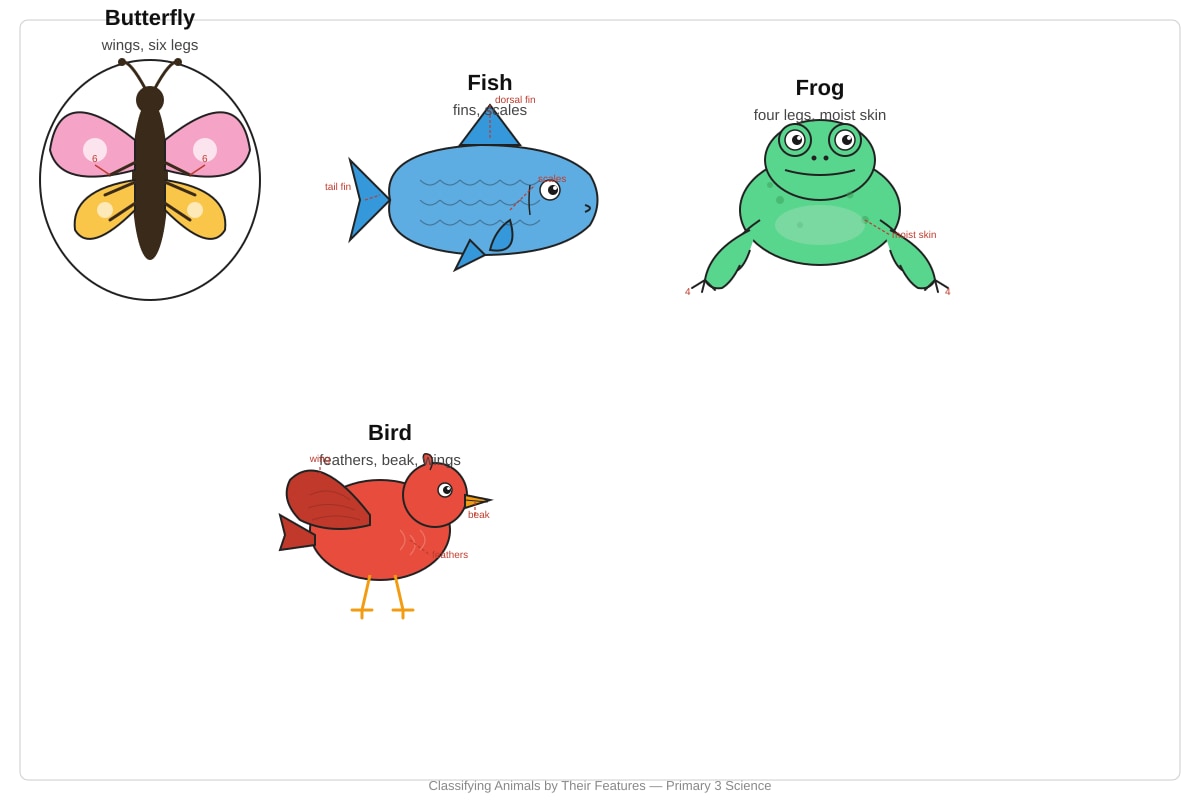
(a) [1 mark] Answer: Butterfly
(b) [1 mark] Answer: Butterfly and bird / Butterfly, fish, frog, bird / Any two correct from butterfly, fish, frog, bird (all four lay eggs)
Explanation: A butterfly is an insect because it has six legs and three body parts (head, thorax, abdomen). All four animals shown—butterfly, fish, frog, and bird—lay eggs. This makes them different from mammals, which give birth to live young.
Marking: As indicated.
10. [2 marks]
Answer:
- Flowering plant: Rose / Hibiscus / Orchid / Sunflower / Any suitable example
- Non-flowering plant: Fern / Moss / Cycad / Any suitable example
Explanation: Flowering plants produce flowers and seeds. Non-flowering plants reproduce using spores instead of seeds and flowers. Singapore has many examples of both in our parks and gardens.
Marking: 1 mark for each correct example.
11. [2 marks]
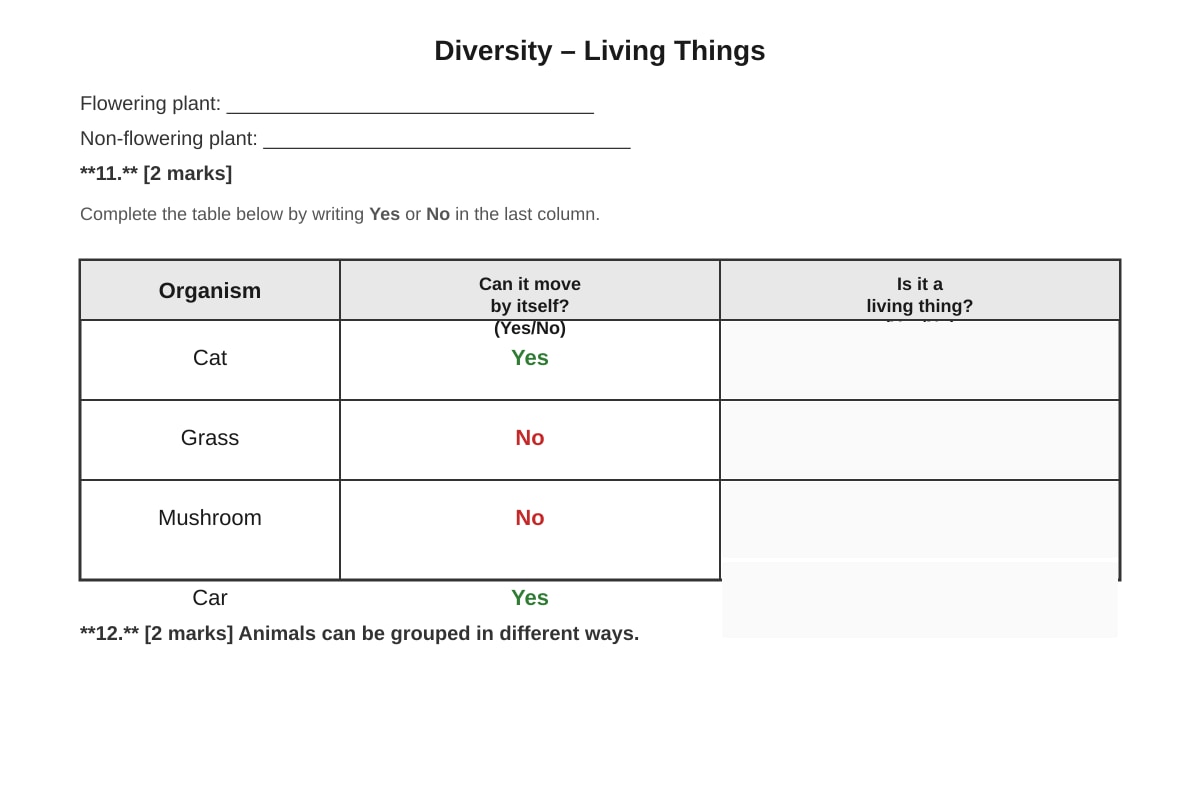
Answer:
| Organism | Can it move by itself? (Yes/No) | Is it a living thing? (Yes/No) |
|---|---|---|
| Cat | Yes | Yes |
| Grass | No | Yes |
| Mushroom | No | Yes |
| Car | Yes | No |
Explanation: The table shows that moving by itself is NOT enough to decide if something is living. The car can move but is not living. Grass and mushrooms cannot move by themselves but are living—they can grow and reproduce. A cat can move AND is living.
Marking: 0.5 mark for each correct answer (total 2 marks).
12. [2 marks]
Answer:
| Animals with feathers | Animals with scales |
|---|---|
| Eagle | Snake |
| Penguin | Salmon |
(Note: The order within columns does not matter)
Explanation: Eagles and penguins are birds—they have feathers and lay eggs. Snakes are reptiles with scales. Salmon is a fish with scales. Whales are mammals with smooth skin (not scales).
Marking: 1 mark for each correct column (all animals correct in each column).
13. [2 marks]
Answer: Any two from:
- Fungi cannot make their own food (plants can photosynthesize)
- Fungi do not have green leaves / chlorophyll
- Fungi feed on dead things / absorb nutrients from surroundings
Explanation: Plants can make their own food using sunlight, water, and carbon dioxide (photosynthesis). Fungi cannot do this—they get their food by absorbing nutrients from dead or decaying matter. Fungi also do not have true roots, stems, or leaves like plants do.
Marking: 1 mark for each correct difference.
14. [2 marks]
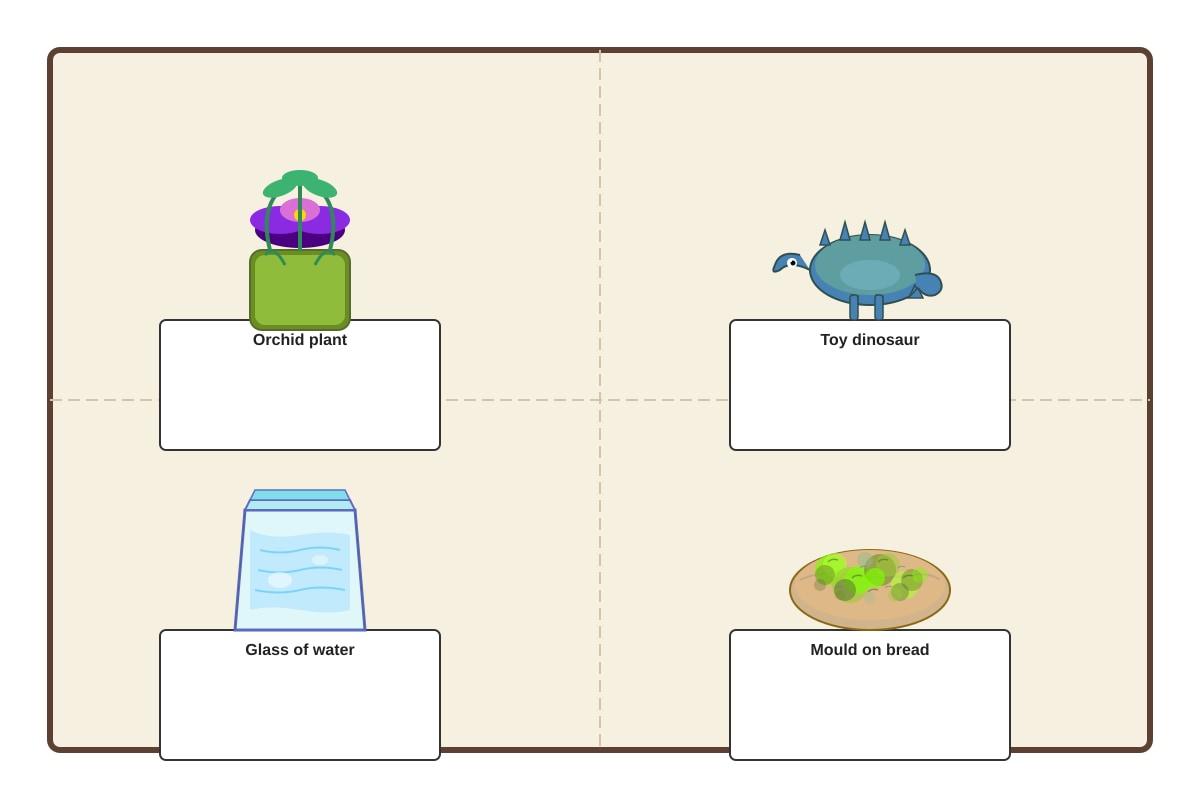
(a) [1 mark] Answer: Orchid plant / Mould on bread
(b) [1 mark] Answer: Wooden block (if visible) / OR accept "none clearly shown" with explanation
Note: Based on described image with potted orchid, toy dinosaur, glass of water, mould on bread:
Answer for (b): The plastic toy dinosaur was made from oil, which came from living things long ago; OR the mould is on bread which was made from wheat (living plant). However, the most direct answer is that none of the non-living things shown were clearly once living—the toy is plastic, the water is not living. Accept reasoned answers.
Revised precise answer: The mould on bread is living; for (b), there is no clear "once-living" non-living item among those shown. The toy dinosaur is plastic (not from living things directly), water is never living. This question tests careful observation.
Clarified marking for (b): Accept "plastic toy dinosaur" if student explains plastic comes from oil from ancient living things; OR accept "bread" if student identifies bread as from wheat plant (but bread itself is not shown as separate label). Most expected answer: There is no correct item / the question is tricky.
Teacher note: This question checks for the misconception that "plastic comes from living things." It does not directly. Water is never living.
Marking: (a) 1 mark for orchid OR mould; (b) 1 mark for water bottle with explanation that water was never living, OR reasoned answer about dinosaur.
15. [2 marks]
(a) [1 mark] Answer: A microscope
(b) [1 mark] Answer: Any one from: in the air / in soil / in water / on our skin / in our mouth / on food / everywhere around us
Explanation: Bacteria are microorganisms—living things too small to see without help. A microscope magnifies them so we can observe them. Bacteria are found almost everywhere, including places that look clean.
Marking: 1 mark each.
Section C: Applying What You Know
16. [2 marks]
Answer: Yes, it was a living thing (or "Yes, the baby snail inside was a living thing").
Explanation: The hard shell with a baby snail coming out shows that it was a snail egg. The egg was living because it could develop and grow into a baby snail. The fact that a living snail emerged after two weeks shows growth and reproduction—characteristics of living things. The shell itself is not living, but it was part of a living thing's life cycle.
Marking: 1 mark for "Yes"; 1 mark for explanation using evidence about the baby snail emerging/growing/developing.
17. [2 marks]
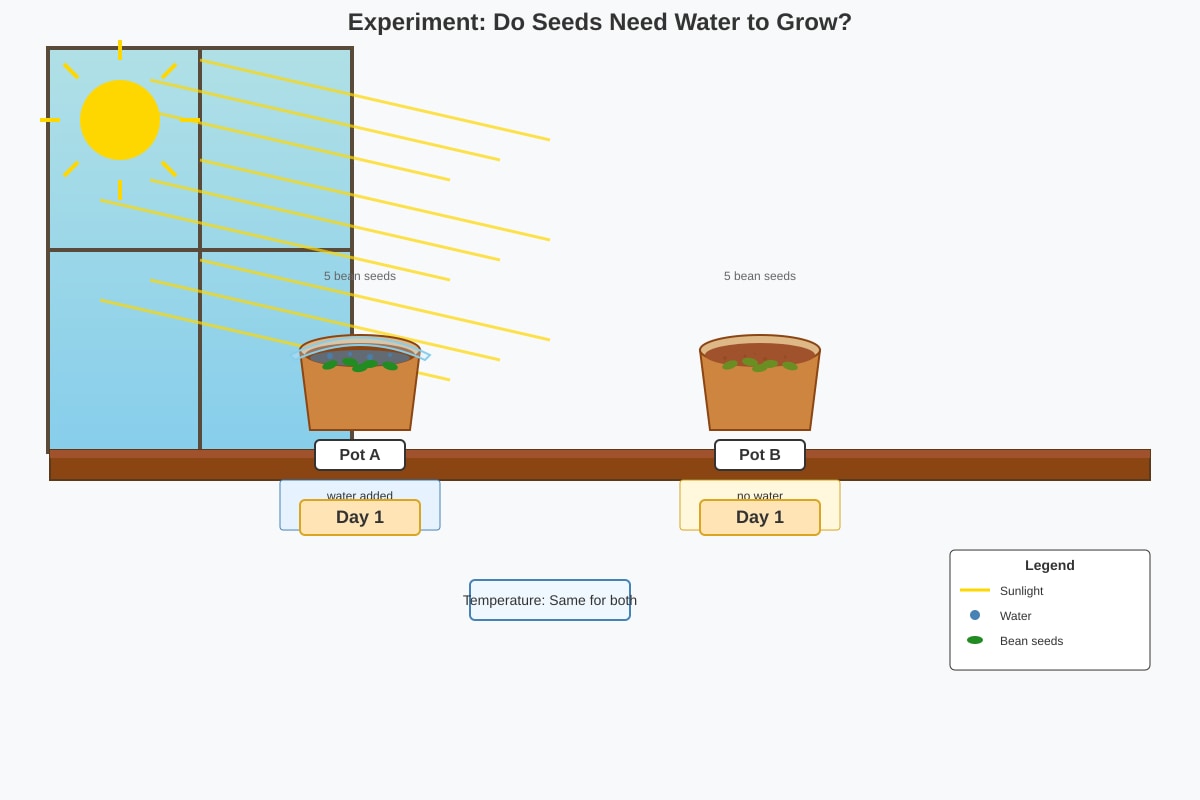
(a) [1 mark] Answer: The seeds will grow / sprout / show roots and shoots / seedlings will appear
(b) [1 mark] Answer: For comparison / To show what happens without water / To show that water is needed for growth (the control)
Explanation: This is a fair test. Pot A has water (the changed variable), Pot B has no water. Everything else is the same—same seeds, same soil, same sunlight, same temperature. This makes it a fair comparison. We expect seeds in Pot A to grow because they have water, warmth, and air. Seeds in Pot B will not grow, showing water is necessary.
Marking: 1 mark each.
18. [2 marks]
Answer:
| Object | Living or Non-living? | One characteristic shown |
|---|---|---|
| Monitor lizard | Living | Can move by itself (pre-filled) |
| Angsana tree | Living | Can grow / Needs water, air, light |
| Park bench | Non-living | Cannot grow (pre-filled) |
| Plastic water bottle | Non-living | Cannot move by itself / Cannot grow / Cannot reproduce |
Explanation: The angsana tree is living—it can grow taller and wider, and makes seeds. The park bench and plastic bottle are non-living. The bottle cannot do anything by itself; it just floats because of water movement.
Marking: 0.5 mark for each correct cell (4 cells to complete = 2 marks total).
19. [2 marks]
Answer:
- A balloon does not grow by itself—someone has to blow air into it. Living things grow using food and water, not because someone puts air in.
- A balloon cannot reproduce—two balloons cannot make a baby balloon.
- A balloon does not need food or water.
- When the air is let out, the balloon gets smaller, but this is not "dying" because it was never alive.
(Any two reasons)
Explanation: The key idea is that living things grow using their own body processes, absorbing nutrients. A balloon getting bigger is just air filling space—there is no cell growth, no food being used, no life process.
Marking: 1 mark for each valid reason (max 2 marks).
20. [2 marks]
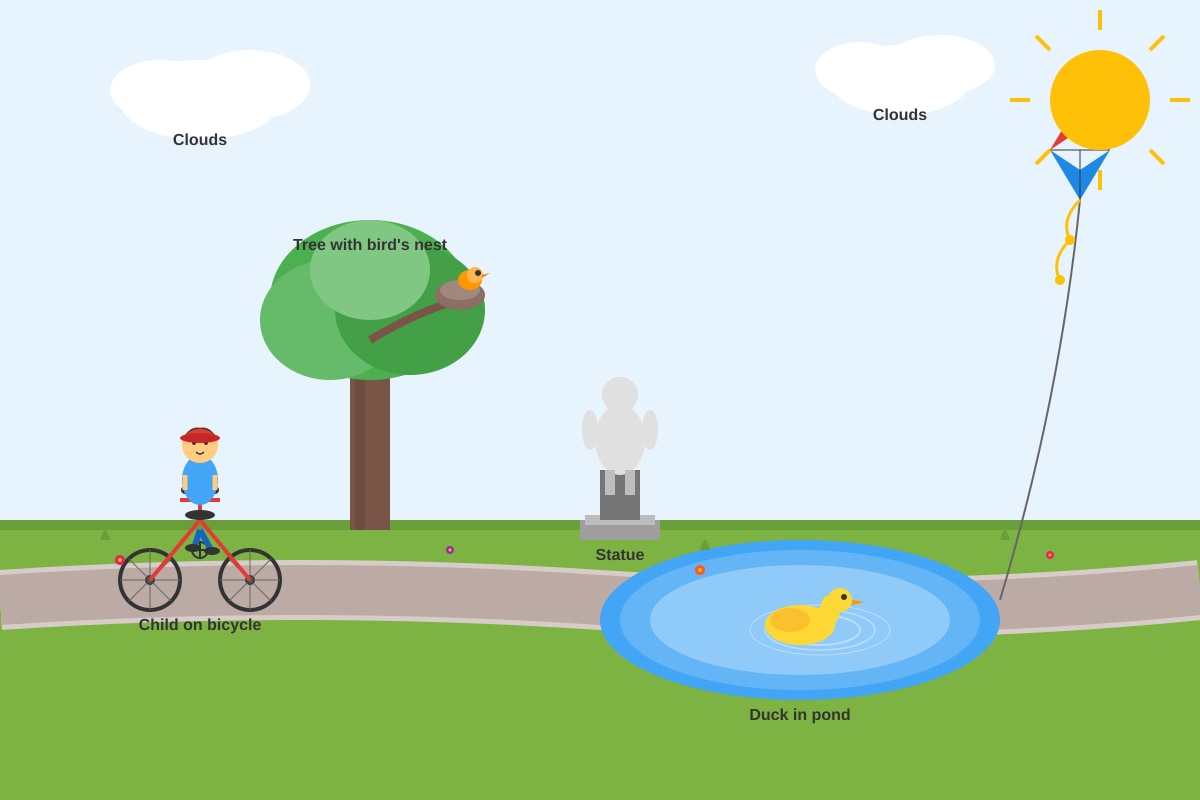
(a) [1 mark] Answer: Any two from: child, duck, bird in nest (not "bird's nest" alone—the nest is non-living)
(b) [1 mark] Answer: The statue / The kite / The clouds
Explanation with expected answer: The statue looks like a person (living thing shape) but is non-living because it cannot move by itself, cannot grow, and does not need food or water. The kite is also non-living—some people might think it's "flying" like a bird, but it needs wind and a person holding the string; it cannot fly by itself or reproduce.
Marking: (a) 1 mark for two correct animals; (b) 1 mark for correct identification plus explanation mentioning cannot grow/cannot reproduce/cannot move by itself/does not need food.
End of Answer Key