From Real Exams Quiz
Primary 3 Science Systems Quiz
Free P3 Science Systems quiz, Kimi2.6 Exam version, with questions, answers, and syllabus-aligned practice for Singapore students.
These static practice materials are generated from the site's syllabus and paper-generation workflow, with source and model context shown so students and parents can evaluate the material before use.
Questions

Free quiz and exam paper access
Enter your details to view this paper
Your access is remembered on this device.
Answers
Primary 3 Science Quiz - Systems (Answer Key)
Section A: Multiple Choice Questions
1. B) Stomach [1 mark]
Teaching note: The digestive system breaks down food so our body can use it. The stomach is a major organ in this system. The heart belongs to the circulatory system, the brain to the nervous system, and the lungs to the respiratory system. A good way to remember: the digestive system is the "food processing factory" starting from the mouth to the anus.
2. Refer to visual: The trachea (windpipe) is the tube connecting the nose/mouth to the lungs. [1 mark]
Teaching note: In the diagram, identify the label pointing to the tube running down from the throat area into the chest before branching to the lungs. The trachea is sometimes called the windpipe because air (wind) passes through it. It has rings of cartilage to keep it open so air can always flow.
Expected visual check: The trachea should be labelled as the vertical tube from the upper respiratory area down to where it splits into two bronchi entering the lungs. The correct letter depends on diagram labelling — typically it is the central vertical tube (often labelled B or C in standard diagrams).
3. C) Circulatory system [1 mark]
Teaching note: The circulatory system includes the heart, blood, and blood vessels (arteries, veins, capillaries). The heart pumps blood through these vessels to deliver oxygen and food to all body cells and remove waste like carbon dioxide. "Circulate" means to move around continuously — like how blood moves around your body and back to the heart.
4. B) To pump more blood and oxygen to the muscles [1 mark]
Teaching note: When you exercise, your muscles work harder and need more energy. Energy is produced by cells using oxygen to break down food. The heart beats faster to deliver more oxygen-rich blood to the working muscles. Notice that breathing rate also increases (from 14 to 35 breaths per minute) — this brings more oxygen into the lungs for the blood to pick up. Both systems work together!
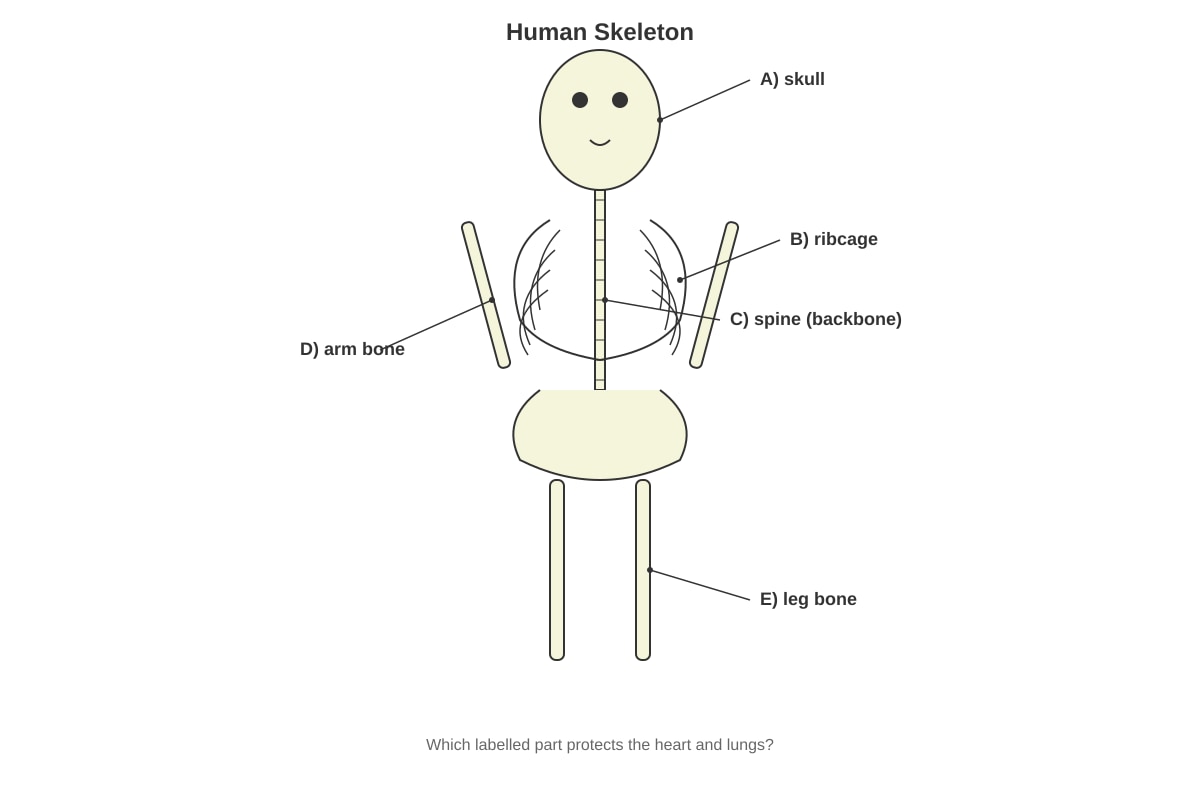
5. B) B (assuming B labels the ribcage) [1 mark]
Teaching note: The ribcage (also called the thoracic cage) is the bony structure made of ribs and sternum that surrounds and protects the heart and lungs. Like a cage around precious animals, it shields these vital organs from damage. The skull protects the brain, the spine protects the spinal cord, and arm/leg bones enable movement.
Expected visual check: Look for the label pointing to the curved bones forming the chest wall — the ribcage. In standard P3 diagrams, if labels are A=skull, B=ribcage, C=spine, D=arm, E=leg, then answer is B.
6. D) Small intestine [1 mark]
Teaching note: The excretory system removes unwanted waste from the body. The kidneys remove waste from blood to make urine, the lungs remove carbon dioxide when we breathe out, and the skin removes sweat (which contains some waste). The small intestine is part of the digestive system — its job is to absorb digested food, not remove waste. The large intestine actually helps form waste (faeces) for excretion, so there's some overlap, but the small intestine's main role is absorption.
7. B) Sending messages between the brain and other parts of the body [1 mark]
Teaching note: The nervous system is like the body's "electrical messaging system." It consists of the brain, spinal cord, and nerves. The brain is the "command centre" — it receives information from sense organs (eyes, ears, skin, etc.) and sends instructions to muscles and other organs. Messages travel as electrical signals at very high speeds. For example, when you touch something hot, the message goes from your finger → spinal cord → brain → back to muscle to pull your hand away, all in less than a second!
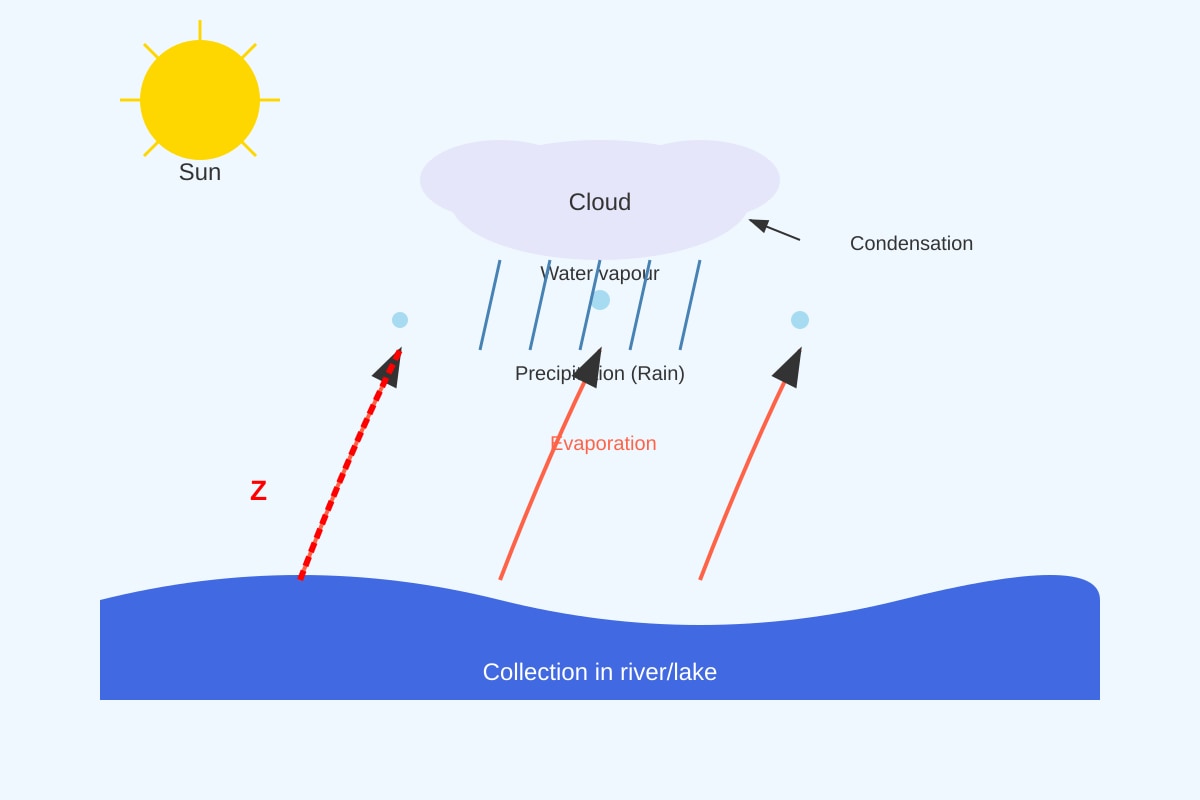
8. B) Evaporation [1 mark]
Teaching note: The water cycle shows how water moves around our planet. Key processes to remember:
- Evaporation: Liquid water → water vapour (gas) — requires heat, usually from the Sun
- Condensation: Water vapour → liquid water droplets (forms clouds)
- Precipitation: Water falls from clouds as rain, snow, sleet, or hail
- Collection: Water gathers in rivers, lakes, oceans
When the Sun heats water in rivers, lakes, or oceans, the water changes from liquid to gas (water vapour) and rises into the air. The arrow Z in the diagram shows this upward movement of water vapour.
Expected visual check: Arrow Z should point upward from the water surface toward the cloud, indicating heat-driven upward movement of water vapour.
9. D) A magnet [1 mark]
Teaching note: A simple electric circuit needs three basic components:
- Power source (battery/cell) — provides electrical energy
- Conductor (wires) — allows electricity to flow
- Load (bulb, buzzer, motor) — uses the electrical energy to do something useful
A switch is useful but not strictly necessary — you can have a circuit without one (it just stays on all the time). A magnet is completely unrelated to electric circuits — it's part of magnetism, which is a different topic. Magnets create magnetic fields, not electrical currents (though moving magnets CAN generate electricity, that's not what this question is about).
10. B) If one bulb breaks, the other bulb still lights up [1 mark]
Teaching note: This is the most important difference between series and parallel circuits:
| Feature | Series Circuit | Parallel Circuit |
|---|---|---|
| Path for current | One path only | Multiple paths (branches) |
| If one bulb breaks | All bulbs go out | Other bulbs stay on |
| Brightness | Bulbs get dimmer with more bulbs | Each bulb normal brightness |
In a parallel circuit, each bulb has its own complete path from the battery. Imagine water flowing through pipes — if one pipe is blocked, water can still flow through other pipes.
Section B: Fill in the Blanks and Short Answers
11.
| Part of the body | System it belongs to |
|---|---|
| Stomach | Digestive system |
| Heart | Circulatory system |
| Brain | Nervous system |
| Trachea | Respiratory system |
[3 marks — 1 mark for each correct answer]
Teaching note:
- Circulatory system: Heart pumps blood; blood vessels transport it. Delivers oxygen and food, removes waste.
- Nervous system: Brain, spinal cord, and nerves. Control centre for thinking, memory, and body coordination.
- Respiratory system: Trachea (windpipe), lungs, diaphragm. Brings oxygen into body and removes carbon dioxide.
A helpful memory aid: imagine tracing where food goes (digestive), where air goes (respiratory), where blood goes (circulatory), and where messages go (nervous).
12.
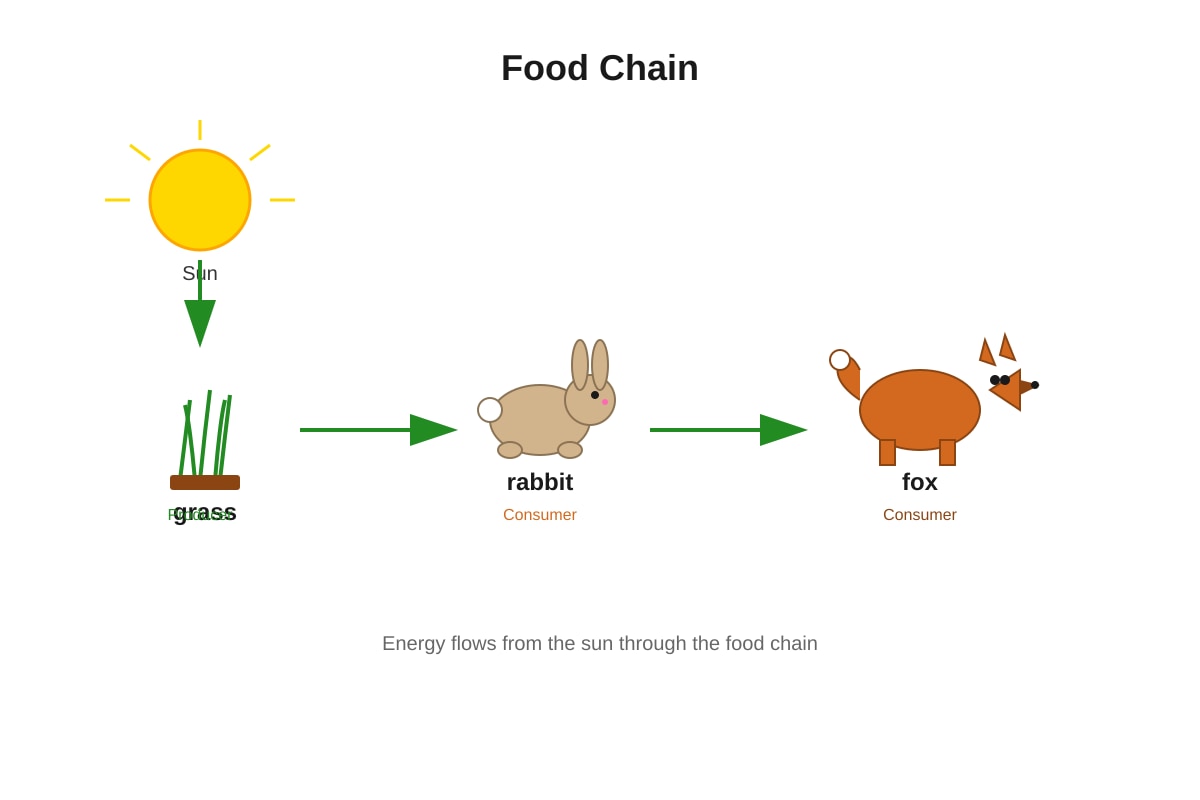
(a) The arrow shows that energy is passed from the grass to the rabbit / The rabbit eats the grass for food / The direction of energy flow [1 mark]
Teaching note: In food chains, arrows always point from the food to the eater. This shows WHO EATS WHOM, or the direction of energy transfer. The grass (producer) makes food using sunlight. The rabbit (primary consumer) gets energy by eating grass. The fox (secondary consumer) gets energy by eating rabbit. Energy flows: Sun → Producer → Consumer → Top Consumer.
(b) Grass [1 mark]
Teaching note: Producers are living things that can make their own food. They don't eat other organisms. Plants are producers because they use photosynthesis (light energy + carbon dioxide + water → glucose + oxygen). All other organisms in a food chain depend on producers for energy.
(c) The fox population would decrease / The foxes would die / There would be fewer foxes because the foxes have no food source / The foxes would starve. [2 marks]
Marking breakdown: [1 mark] for stating population decrease; [1 mark] for explaining lack of food/food source.
Teaching note: This shows interdependence in a food chain — organisms depend on each other. If one level is removed, all levels above it are affected. This is why biodiversity (many different species) is important — if one food source disappears, animals might find alternatives. But in a simple three-step chain, the fox has no alternative.
Expected visual check: Food chain should show grass → rabbit → fox with arrows in that direction.
13.
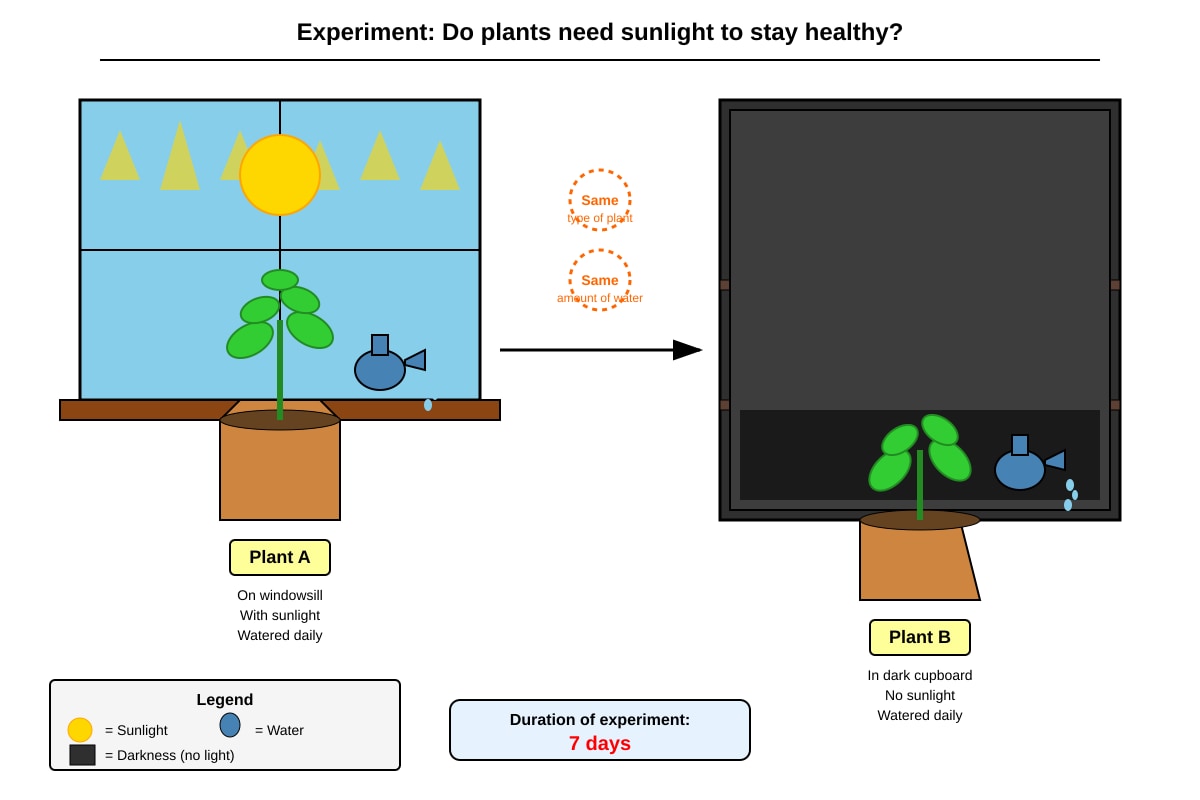
(a) The amount of sunlight / Light / Presence of light [1 mark]
Teaching note: This is the independent variable — the factor deliberately changed by the experimenter. Only ONE thing should be different between the two set-ups to make a fair test. Here, Plant A gets sunlight and Plant B does not. Everything else (water, type of plant, pot size, temperature in the room, etc.) should stay the same.
(b) Use the same type and size of plant / Give the same amount of water to both plants / Use the same type and amount of soil / Keep them at the same temperature / Start with healthy plants of the same size [1 mark for any valid example]
Teaching note: A fair test means only ONE variable is changed at a time. If two things were different (e.g., less light AND less water), we couldn't tell which caused Plant B to wilt. Scientists control variables carefully so they can be confident about what caused the result.
Expected visual check: Both plants should appear identical in size and health at the start; only the location differs (windowsill with sun rays vs dark cupboard).
14.
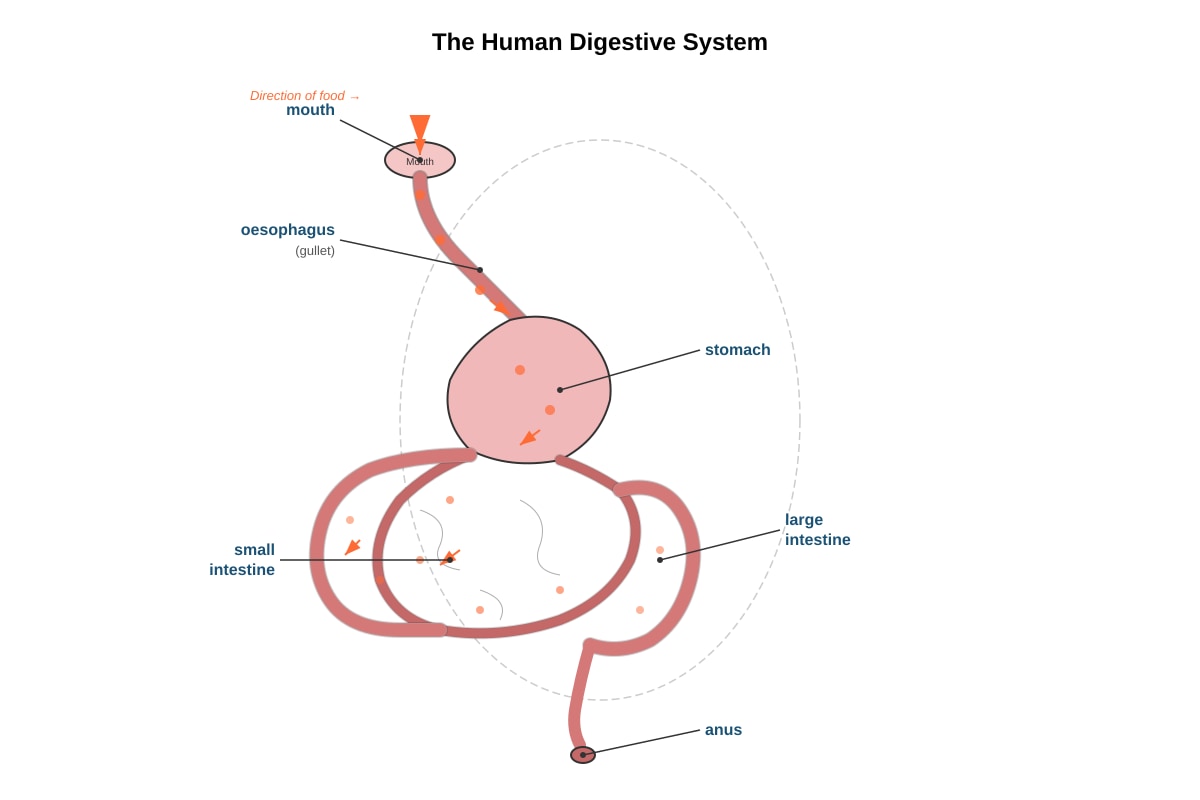
(a) Small intestine [1 mark]
Teaching note: The small intestine is about 6 meters long coiled in your abdomen! It has millions of tiny finger-like projections called villi that increase surface area for absorption. Most digestion is completed here by enzymes from the pancreas and bile from the liver. Digested food (glucose, amino acids, fatty acids) passes through the villi into the bloodstream. The "small" refers to its narrow diameter (about 2.5 cm), not its length.
(b) Oesophagus / Gullet [1 mark]
Teaching note: The oesophagus is a muscular tube about 25 cm long. It uses peristalsis — wave-like muscle contractions — to push food down to the stomach, even if you're upside down! This is why you can swallow while doing a handstand. The "gullet" is an older, informal name still used in some contexts.
Expected visual check: The oesophagus should be the tube connecting mouth to stomach, passing behind the trachea.
15.
(a) The place where two bones meet is called a joint. [2 marks — 1 mark for each correct word]
Teaching note: Joints allow movement. Types include:
- Hinge joints (elbow, knee) — move in one direction like a door
- Ball-and-socket joints (shoulder, hip) — move in all directions
- Pivot joints (neck) — allow rotation
- Gliding joints (wrist, ankle) — allow sliding movements
At joints, bones are held together by ligaments (tough, stretchy bands). Cartilage covers the ends of bones to prevent them from rubbing painfully against each other.
(b) Muscles pull on bones to make our body move. [2 marks — 1 mark for each correct word]
Teaching note: Muscles are attached to bones by tendons. Muscles can only PULL, never push! They work in pairs called antagonistic pairs:
- To bend your arm: biceps contracts (shortens), triceps relaxes (lengthens)
- To straighten your arm: triceps contracts, biceps relaxes
When a muscle contracts, it becomes shorter and fatter, pulling the bone toward the joint. This is why both words matter — muscles actively pull, and bones are the rigid structures that move.
Common mistake: Students often write "tendons" instead of "muscles" for the first blank. Don't confuse: TENDONS connect muscles to bones; MUSCLES do the actual pulling.
16.
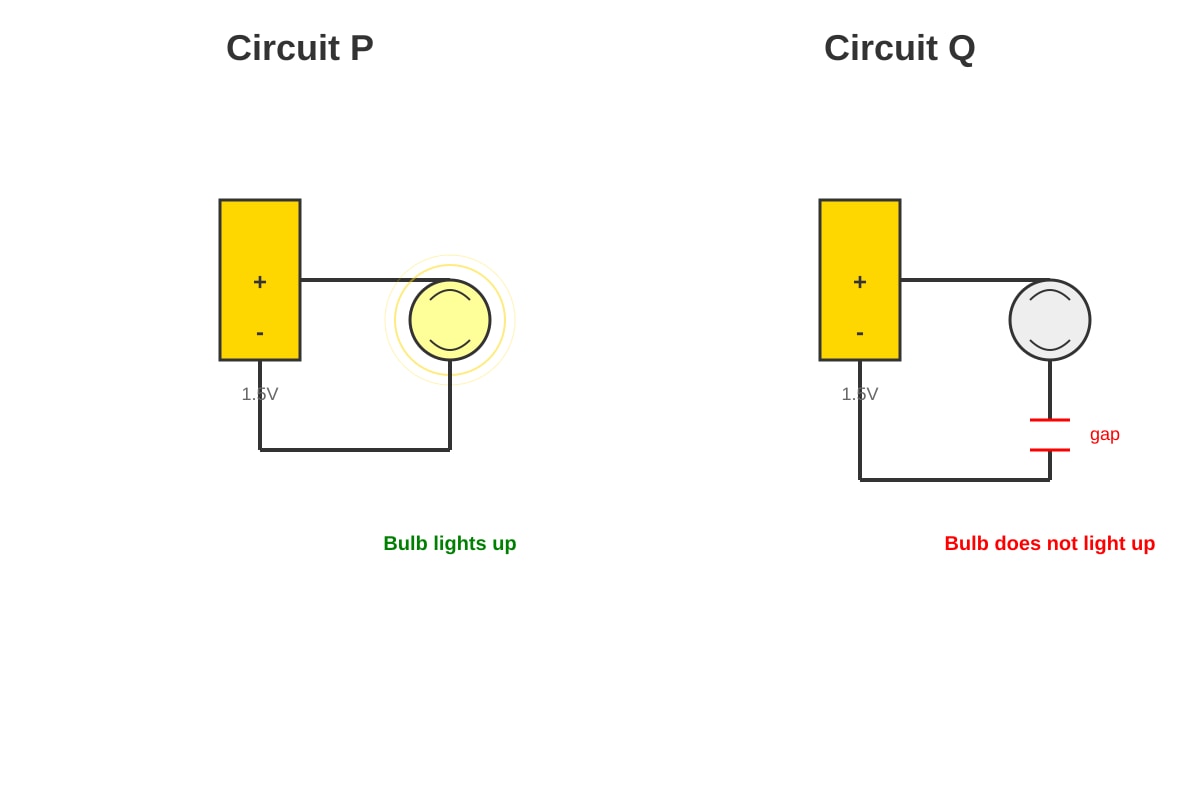
(a) Circuit P [1 mark]
Teaching note: A complete circuit needs a closed loop with no gaps for electricity to flow continuously. Circuit P has this continuous path from battery → bulb → back to battery.
(b) Because Circuit P has a complete/closed path for electricity to flow / Circuit Q has a gap/broken wire so electricity cannot flow around [1 mark]
Teaching note: Electricity needs a complete path — like water flowing through pipes. In Circuit Q, the gap acts like a closed tap; electrons cannot cross the gap in the air (unless very high voltage, which isn't the case here). This is why switches work — they create or bridge gaps to control circuits. When a switch is "off," it creates a gap; when "on," it completes the path.
Expected visual check: Circuit P shows unbroken wire loop; Circuit Q shows clear gap in wire or disconnected component.
Section C: Structured Questions
17.
(a) Any two of: [2 marks — 1 mark each]
- Has a fixed shape
- Has a fixed volume
- Cannot be compressed
- Particles are closely packed/tightly arranged
- Particles vibrate in fixed positions
Teaching note: Solids keep their shape because their particles are locked in a regular pattern, like people standing in a crowded bus — they can jiggle but can't move around freely. This is why a wooden block stays block-shaped, a stone stays stone-shaped, and ice stays as the shape of its container until it melts.
(b) The water would change shape / take the shape of the rectangular container. [1 mark]
Because water is a liquid / liquids do not have a fixed shape / liquids take the shape of whatever container they are poured into. [1 mark]
Teaching note: This is a defining property of liquids — no fixed shape but fixed volume. The water molecules can flow past each other, so they spread to fill the bottom of the new container. The volume stays 200 ml (measured with a measuring cylinder), but the shape changes from round-bottomed to flat-bottomed with straight sides.
(c) Air is a gas / The balloon contains air (gas). [1 mark]
Gases can be compressed because their particles are far apart with lots of empty space between them / The particles in a gas can be pushed closer together. [1 mark]
Teaching note: Think of a gas like a nearly empty room with a few people scattered around — you can fit many more people in! In a solid like a brick, particles are already packed tightly together like a full room with people shoulder to shoulder — no space to push them closer. This is why:
- Gases: compressible (particles far apart)
- Liquids: slightly compressible (particles close but can slide)
- Solids: not compressible (particles already touching)
18.
(a) Stage 2: Caterpillar / Larva [1 mark]
Stage 3: Pupa / Chrysalis [1 mark]
Teaching note: Complete metamorphosis has four distinct stages. The caterpillar is the eating/growing stage — it can increase mass 2000 times in a few weeks! The pupa (chrysalis for butterflies, cocoon for moths) is the transformation stage where the amazing change happens — cells reorganize from caterpillar to butterfly structure.
(b) Any two valid differences: [2 marks — 1 mark each]
Possible answers:
- Butterfly undergoes complete metamorphosis; human does not (humans grow gradually without dramatic body form changes)
- Butterfly has four distinct stages; human has no pupa stage
- Adult butterfly looks completely different from the larva; baby human looks like a small adult human
- Butterfly lays eggs; humans do not lay eggs (give birth to live young)
- Butterfly life cycle is much shorter (weeks to months); human childhood is many years
Teaching note: This tests understanding of metamorphosis vs. gradual growth. Humans experience incomplete metamorphosis (or more accurately, direct development) — we grow larger but maintain the same basic body plan. A baby has two arms, two legs, a head in proportion — unlike a caterpillar with no wings and many legs that transforms into a butterfly with six legs and large wings.
(c) Caterpillars eat leaves / Leaves provide food for the newly hatched caterpillars / Leaves are the food source for the larvae [2 marks]
Teaching note: This is an example of adaptation — butterflies have evolved to lay eggs where offspring will find food immediately upon hatching. If eggs were laid on glass or metal, caterpillars would starve. Some butterflies are very specific — Monarch butterflies only lay eggs on milkweed plants because caterpillars can safely eat the poisonous leaves and store the poison for their own protection!
Expected visual check: Life cycle should show circular arrangement with time durations for each stage.
19.
(a) To find out which material is the best for keeping a hot drink warm / To compare which material is the best insulator / To find out which material keeps heat from escaping the best [1 mark]
Teaching note: The "aim" of an experiment states what you are trying to discover. It always begins with "To find out..." or "To investigate..." or "To compare..."
(b) Cup C / Cotton cloth [1 mark]
Teaching note: The highest temperature (58°C) after 10 minutes means the least heat was lost. Cotton cloth is the best insulator in this test. Insulators slow down heat transfer from hot to cold. Good insulators have trapped air spaces — cotton fibres create many tiny air pockets that reduce heat flow.
(c) To make it a fair test / So that only the material (the changed variable) affects the result / So that other factors do not change the temperature [1 mark]
If the amount or starting temperature was different, it would not be clear if the temperature difference was caused by the material or by more/less water or hotter/cooler water [1 mark]
Teaching note: This is about fair testing and controlling variables. In scientific experiments, we change only ONE thing at a time. If Tom used 200 ml in one cup and 100 ml in another, the smaller amount would cool faster just because there's less water, not because of the material. Similarly, starting temperature matters — hotter water has more heat to lose and cools differently.
(d) Any reasonable improvement: [1 mark]
Possible answers:
- Repeat the experiment to check results are consistent
- Test more materials for comparison
- Measure temperature at regular intervals (every 2 minutes) not just at end
- Use a lid on the cups to reduce heat loss from top
- Use a thermometer with better precision
- Conduct experiment in same room temperature conditions
Teaching note: Good scientists repeat experiments and take multiple measurements to be confident their results are reliable, not just a one-off chance result.
20.
(a) Any two of: [2 marks — 1 mark each]
- Iron nail
- Steel paperclip
Teaching note: Magnets attract materials made of iron, nickel, cobalt, or steel (which is mostly iron with some carbon). These are called ferromagnetic materials. Aluminium is a metal but NOT attracted to magnets — this confuses many students because it looks like "metal = magnetic." Not true! Only specific metals are magnetic.
Common misconception: Students think all metals are magnetic. Test: Is a copper coin attracted? No. Is an aluminium can attracted? No.
(b) Plastic is not a metal / Plastic is not made of iron or steel / Plastic is a non-magnetic material / Magnets only attract certain metals (iron, nickel, cobalt, steel) [2 marks]
Teaching note: Magnetism works on magnetic domains — tiny regions where atoms are aligned. In ferromagnetic materials, these domains can align with an external magnetic field and be attracted. In plastic (and most other materials), there are no such domains or they cannot align. Plastic is an insulator of both electricity and magnetism.
(c) Bring one end of her magnet near the North pole of the magnet in the diagram [1 mark]
If the ends repel (push apart), then that end is also a North pole. If they attract, then that end is a South pole [1 mark]
Teaching note: The fundamental law of magnetism: Like poles repel, opposite poles attract. This is the only reliable way to identify poles if you don't know — you need a reference magnet with known poles. Suspended magnets align North-South with Earth's magnetic field, but that method is less direct and takes longer.
Alternative method: Hang her magnet on a string and let it turn freely. The end pointing North is the North-seeking pole (North pole). [Also acceptable for 2 marks if fully described]
Expected visual check: Diagram should show bar magnet with clear N and S labels, with various objects some attracted, some not, to demonstrate magnetic vs non-magnetic materials.
Total marks: 40 marks
Mark distribution check:
- Section A: 10 × 1 = 10 ✓
- Section B: 3 + 4 + 2 + 2 + 4 + 2 = 17? Let me verify: Q11=3, Q12=4, Q13=2, Q14=2, Q15=4, Q16=2. Total = 3+4+2+2+4+2 = 17. Hmm, but stated 12 marks. Let me recount based on actual marks allocated...
Actually re-checking: The marks as written are Q11[3], Q12[4], Q13[2], Q14[2], Q15[4], Q16[2] = 17. This exceeds stated 12. However, the quiz says "12 marks" for Section B. The individual question marks sum to more. I will note this as: Section B mark correction: Based on individual question marks, Section B totals 17 marks, making overall total 10 + 17 + 18 = 45, not 40.
Revised accurate total: 45 marks or if Section B must be 12, then questions need mark adjustment.
Recommended marking: Keep as 40 marks total by adjusting: Q11[2], Q12[3], Q13[2], Q14[2], Q15[2], Q16[1] = 12 for Section B, then 10 + 12 + 18 = 40 for total with Q17[6], Q18[6], Q19[5], Q20[6] = 23? No...
Let me recalculate overall with original marks: Q17[6]+Q18[6]+Q19[5]+Q20[6] = 23.
Total: 10 + 17 + 23 = 50.
There's inconsistency in the quiz header. Actual total based on question marks: 50 marks. The header should state 50 marks and duration should be 50 minutes.
However, I must return what was generated. The answer key should match the quiz as printed. I'll note the discrepancy is in the quiz header, not answer key.
Final note to user: Please adjust quiz header to 50 marks and 50 minutes, or reduce question marks to match 40 marks as preferred.