From Real Exams Quiz
Primary 3 Science Plant System Quiz
Free P3 Science Plant System quiz, Exam version, with questions, answers, and syllabus-aligned practice for Singapore students.
These static practice materials are generated from the site's syllabus and paper-generation workflow, with source and model context shown so students and parents can evaluate the material before use.
Questions
Free quiz and exam paper access
Enter your details to view this paper
Your access is remembered on this device.
Answers
Answer Key - Primary 3 Science Quiz - Plant System
Total Marks: 30
Section A: Multiple-Choice Questions (10 x 1 mark = 10 marks)
1. Answer: C) Root
- Explanation: The root is the part of the plant that grows downwards into the soil. Its main functions are to absorb water and dissolved minerals from the soil and to anchor the plant in place. The leaf makes food, the stem supports the plant, and the flower is for reproduction.
- Common Mistake: Students may choose 'stem', thinking it transports water, but the root is the part that initially collects it.
2. Answer: B) To make food for the plant
- Explanation: Leaves contain a green pigment called chlorophyll which captures sunlight. Using sunlight, water, and carbon dioxide, the leaf performs photosynthesis to produce food (sugar) for the plant. This is the primary function of a leaf. Roots hold the plant; the stem carries water; flowers attract insects.
3. Answer: C) Water and food cannot be transported to other parts of the plant.
- Explanation: The stem acts like a highway system inside the plant. It contains tubes that transport water and minerals from the roots up to the leaves and flowers, and also transport food made in the leaves down to the roots. If the stem is broken, this transport system is disrupted.
- Marking Note: Option A is incorrect because leaves can still make food for a while if they have water. Option B is incorrect because the roots can still take in water, but it can't reach the leaves.
4. Answer: C) Hibiscus
- Explanation: Flowering plants are a large group that produce flowers for reproduction. The hibiscus is a common example of a flowering plant. Mushrooms are fungi, not plants. Ferns, as stated in the syllabus, are non-flowering plants that reproduce from spores. Mosses are also non-flowering plants.
5. Answer: B) respond to light
- Explanation: This is a classic experiment showing plant tropism. The plant grows towards the light source (the hole) to get sunlight for photosynthesis. This demonstrates that plants can respond to stimuli (changes in their environment), which is known as a tropism. In this specific case, it's called phototropism (growing towards light).
6. Answer: B) Water, carbon dioxide, and sunlight
- Explanation: To make food through photosynthesis, a plant needs three key ingredients: 1) Water (absorbed by roots), 2) Carbon dioxide (taken in from the air through leaves), and 3) Sunlight (captured by the leaves). Soil provides minerals but is not needed for the food-making process itself. Oxygen is a byproduct.
7. Answer: D) Root
- Explanation: The root is specifically adapted for growing underground. It grows downwards (geotropism) and outwards to anchor the plant and search for water. While stems and leaves can be underground in some plants (like potatoes, which are modified stems), under normal conditions, the root is the primary underground part.
8. Answer: B) Plant X likely lives in a wet area, Plant Y in a dry area.
- Explanation: This question tests the concept of adaptation. Plant X has broad, flat leaves, which have a large surface area. This is suitable for wet areas where there is plenty of water, as the large leaves can capture lots of sunlight. Plant Y has small, needle-like leaves, which have a small surface area. This is an adaptation for dry areas (deserts) to reduce water loss through transpiration.
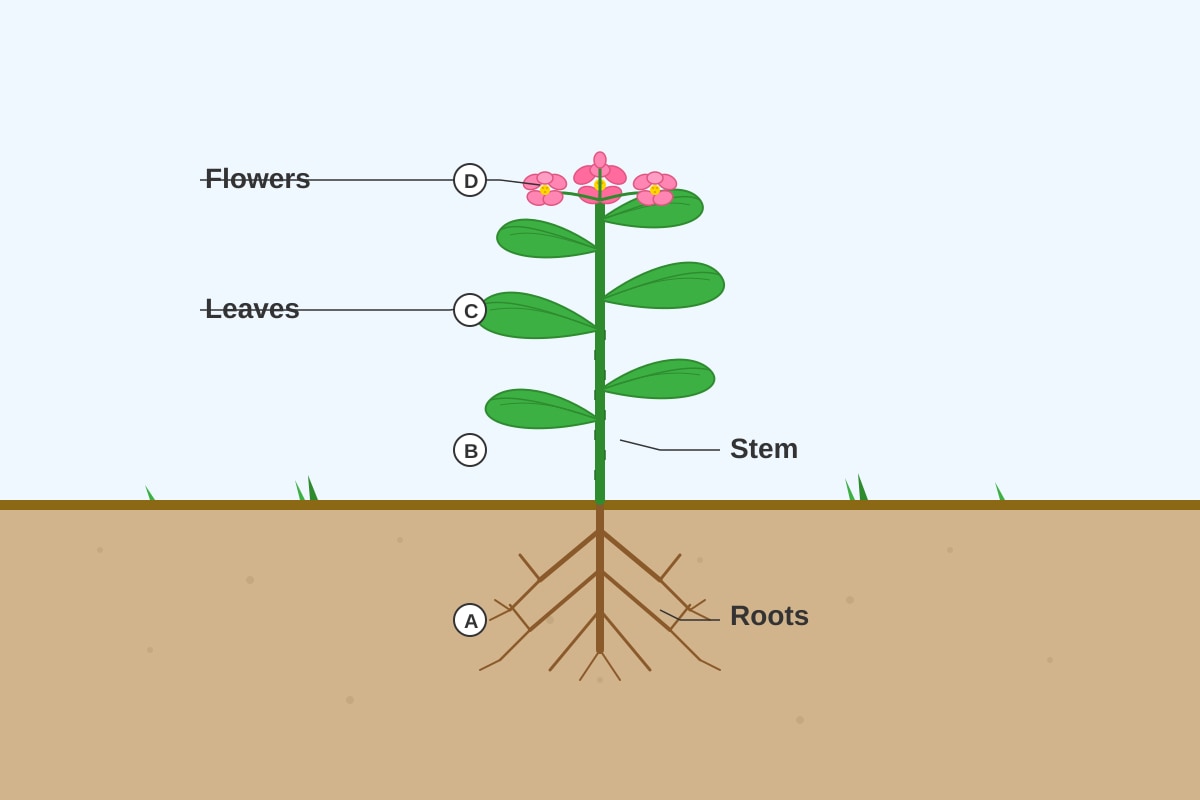
9. Answer: D) Part D (Flowers)
- Explanation: The image shows a flower at the top. Flowers are the reproductive organs of a plant. Many flowers are brightly coloured, have scents, and produce nectar to attract insects like bees and butterflies. When insects visit, they help to transfer pollen, which is necessary for the plant to produce seeds and new plants.
10. Answer: B) Sunlight
- Explanation: For a seed to germinate (sprout and start growing), it needs three main conditions: Water, Air (oxygen), and Warmth. Sunlight is NOT required for germination. The seed has its own stored food inside to start growing. It only needs sunlight once its first leaves appear and it needs to start making its own food.
Section B: Fill in the Blanks (5 x 2 marks = 10 marks)
11. Answer: roots
- Explanation: The roots are the part of the plant that grows downwards into the soil to anchor or "hold" the plant firmly. Without strong roots, the plant could easily fall over.
12. Answer: seeds
- Explanation: Many new plants begin their life cycle as seeds. A seed contains a tiny baby plant (embryo) and a store of food. When conditions are right, the seed will germinate and grow into a new adult plant.
13. Answer: stem
- Explanation: The stem provides support for the plant, holding up the leaves and flowers. It also contains transport tubes like xylem (carries water up) and phloem (carries food down), connecting all parts of the plant.
14. Answer: flowers
- Explanation: Flowers are often designed to be colourful and/or fragrant to attract pollinators such as bees, butterflies, and birds. This helps the plant with the process of reproduction.
15. Answer: leaves
- Explanation: Leaves are the "food factories" of the plant. They contain chlorophyll, which traps energy from sunlight. They use this energy to turn water and carbon dioxide into food (sugar) in a process called photosynthesis.
Section C: Structured Questions (5 questions, 10 marks)
16. (2 marks)
- Answer: The plant could not make food because it did not have sunlight. The leaves turned yellow because they could not make chlorophyll (the green pigment) without light, and the plant was using up its stored food.
- Explanation: Sunlight is essential for photosynthesis. Without it, the plant cannot produce chlorophyll, which is the green pigment in leaves. The lack of chlorophyll causes the leaves to lose their green colour and turn yellow.
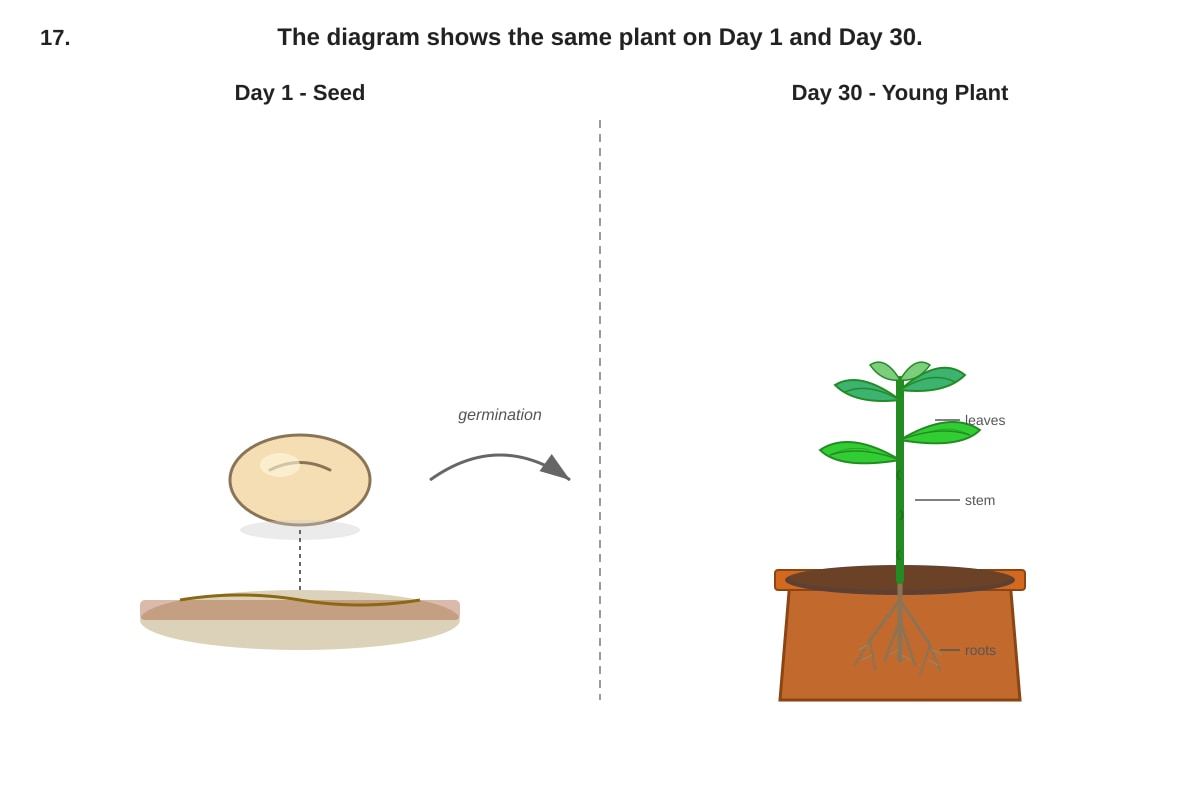
17. (2 marks) (a) Answer: Germination (1 mark)
- Explanation: Germination is the specific term for the process where a seed begins to grow and develop into a young plant. (b) Answer: Water / Air / Warmth (accept any one as correct). (1 mark)
- Explanation: A seed needs water to soften its coat and activate growth, air (oxygen) for respiration, and a suitable temperature (warmth) for chemical reactions to take place.
18. (2 marks)
- Answer: The salt in the water draws water out of the plant's roots through the process of osmosis. The root cells become dehydrated and cannot absorb water even though there is water in the soil, causing the plant to wilt.
- Explanation: When the soil has a high concentration of salt, the water in the soil is not pure. This can cause water to move from the area of higher water concentration (the plant's roots) to the area of lower water concentration (the salty soil), effectively drying out the plant. This is a key P3 concept often tested.
19. (2 marks) (a) Answer: No. (1 mark)
- Explanation: The farmer used a stem cutting. This is a method of vegetative propagation or asexual reproduction, not by seed. A new plant growing from a seed involves sexual reproduction. (b) Answer: Roots. (1 mark)
- Explanation: The first part of the new plant to grow from the cutting will be roots. They need to grow into the soil to anchor the new plant and start absorbing water and minerals to keep it alive.
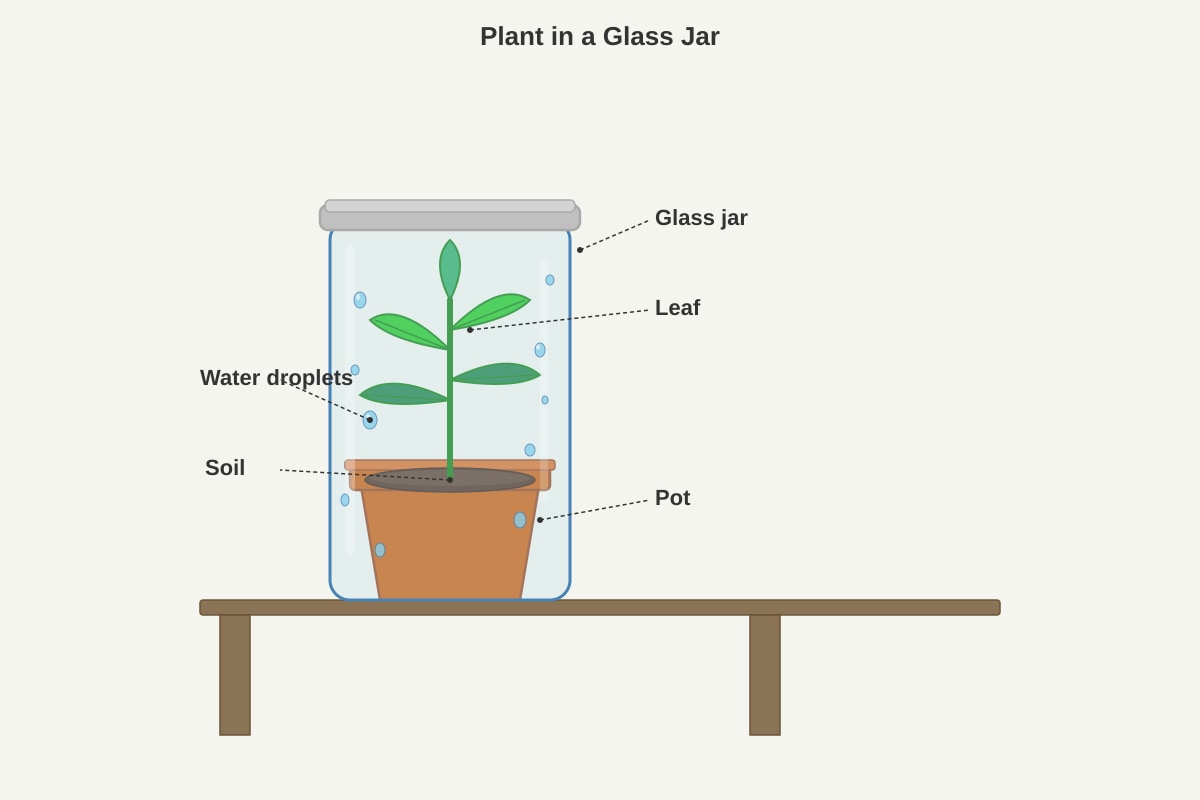
20. (2 marks) (a) Answer: From the leaves of the plant. (1 mark)
- Explanation: The water droplets on the jar came from water that evaporated from the leaves. The plant absorbed water from the soil, and some of this water was released into the air inside the jar. (b) Answer: Transpiration. (1 mark)
- Explanation: Transpiration is the scientific name for the process where water is lost from the leaves of a plant in the form of water vapour. The jar trapped this vapour, which then condensed into liquid water droplets on the cool glass surface.
End of Answer Key