From Real Exams Quiz
Primary 3 Science Plant System Quiz
Free P3 Science Plant System quiz, Exam version, with questions, answers, and syllabus-aligned practice for Singapore students.
These static practice materials are generated from the site's syllabus and paper-generation workflow, with source and model context shown so students and parents can evaluate the material before use.
Questions
Free quiz and exam paper access
Enter your details to view this paper
Your access is remembered on this device.
Answers
Answer Key - Primary 3 Science Quiz - Plant System
Total Marks: 20
Section A: Multiple-Choice Questions (Questions 1 to 10)
Each question carries 1 mark.
1. D) Fur
- Explanation: Fur is a characteristic of some animals (like mammals), not a part of a plant. The main parts of a plant are roots, stem, leaves, flowers, fruits, and seeds.
- Marking: 1 mark for circling D.
2. B) To absorb water and minerals from the soil
- Explanation: Roots grow down into the soil. Their main job is to take in water and dissolved minerals that the plant needs to survive and grow. Roots also anchor the plant in place.
- Marking: 1 mark for circling B.
3. C) Transport water and food to different parts of the plant
- Explanation: The stem acts like a highway system. It contains tubes (xylem and phloem) that carry water and minerals up from the roots to the leaves, and food made in the leaves down to other parts of the plant.
- Marking: 1 mark for circling C.
4. C) Leaf
- Explanation: Leaves contain a green pigment called chlorophyll. Chlorophyll captures energy from sunlight, which the plant uses to turn water and carbon dioxide into food (sugar) through a process called photosynthesis.
- Marking: 1 mark for circling C.
5. C) Soil
- Explanation: Plants need sunlight (energy), water, and carbon dioxide (from the air) to make food through photosynthesis. Soil provides support and minerals, but it is not directly used in the food-making process.
- Marking: 1 mark for circling C.
6. B) Photosynthesis
- Explanation: Photosynthesis is the process where plants use sunlight, water, and carbon dioxide to produce their own food (glucose) and oxygen. The word comes from "photo" (light) and "synthesis" (putting together).
- Marking: 1 mark for circling B.
7. C) Fern
- Explanation: Flowering plants (like roses, orchids, and sunflowers) reproduce using flowers and seeds. Non-flowering plants like ferns do not produce flowers or seeds; they reproduce using spores.
- Marking: 1 mark for circling C.
8. C) To help the plant reproduce
- Explanation: Flowers are the reproductive organs of a plant. They produce seeds (after pollination and fertilisation) that can grow into new plants. The bright colours and scents of flowers attract insects and birds that help with pollination.
- Marking: 1 mark for circling C.
9. D) Fruit
- Explanation: After a flower is pollinated and fertilised, it develops into a fruit. The fruit grows to protect the developing seeds and helps to disperse them (e.g., animals eat the fruit and drop the seeds elsewhere).
- Marking: 1 mark for circling D.
10. C) Creeper
- Explanation: Creepers are plants with weak, thin stems that cannot stand upright. They grow along the ground or climb on other structures for support. Examples include watermelon and pumpkin plants.
- Marking: 1 mark for circling C.
Section B: Fill in the Blanks (Questions 11 to 15)
Each question carries 1 mark.
11. roots
- Explanation: Roots grow downwards into the soil. They anchor the plant firmly so it does not fall over, and they also absorb water and minerals.
- Marking: 1 mark for correct spelling.
12. stem
- Explanation: The stem grows upwards and supports the leaves, flowers, and fruits. It holds the leaves up so they can get sunlight for photosynthesis.
- Marking: 1 mark for correct spelling.
13. leaves
- Explanation: Leaves are the main food-making factories of the plant. They contain chlorophyll to capture sunlight and perform photosynthesis.
- Marking: 1 mark for correct spelling.
14. fruit
- Explanation: The fruit develops from the flower after pollination. It contains and protects the seeds until they are ready to be dispersed.
- Marking: 1 mark for correct spelling.
15. flower
- Explanation: The flower is the reproductive part of the plant. It produces pollen and ovules, which combine to form seeds.
- Marking: 1 mark for correct spelling.
Section C: Open-Ended Questions (Questions 16 to 20)
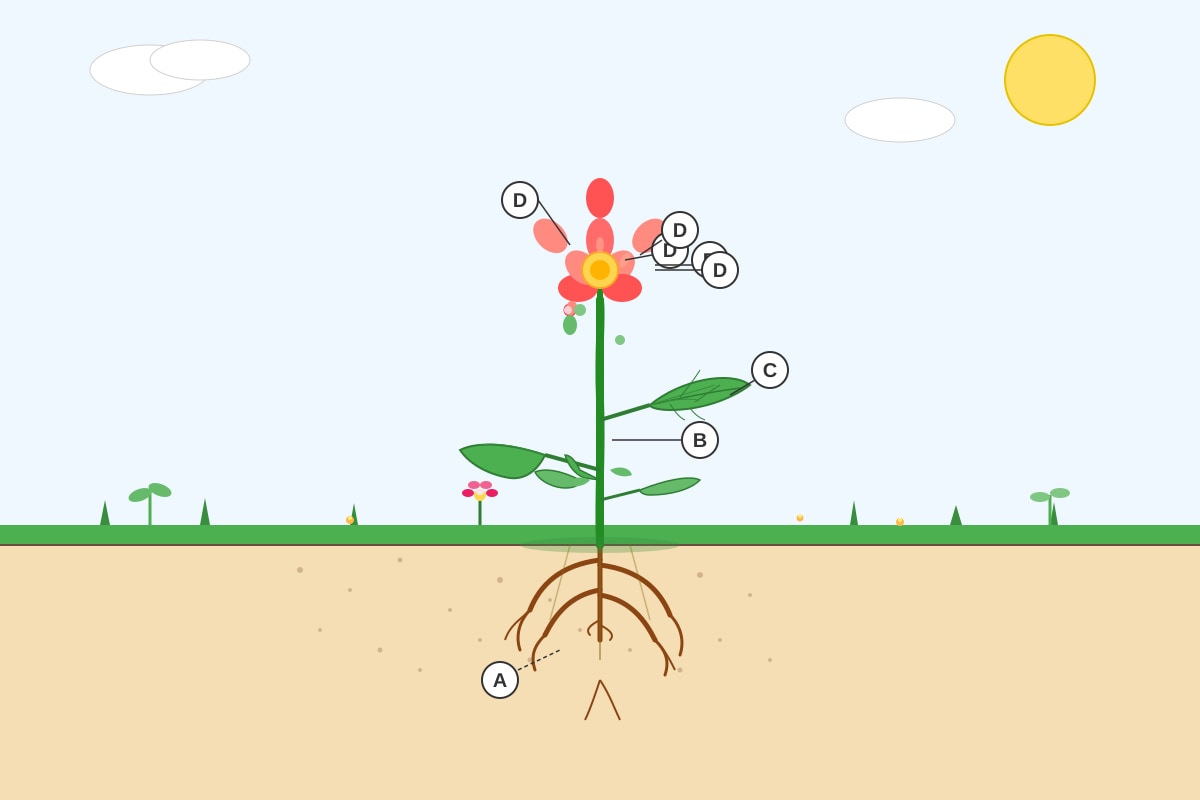
16. (2 marks) (a) (1 mark) A: Roots B: Stem C: Leaf D: Flower
- Explanation: These are the four main parts of a flowering plant. Roots are underground, the stem connects the roots to the leaves and flower, leaves are usually broad and flat, and the flower is often colourful.
- Marking: Award 1 mark for all four correctly named. Award 0.5 marks if 2-3 are correct.
(b) (1 mark) C (Leaf)
- Explanation: The leaf contains chlorophyll and is the main site of photosynthesis, where the plant makes its food.
- Marking: 1 mark for C.
17. (2 marks) (a) (1 mark) Phototropism (or "response to light" / "growing towards light")
- Explanation: Plants respond to stimuli in their environment. The growth of a plant towards light is called phototropism. This helps the plant get more sunlight for photosynthesis.
- Marking: Accept "growing towards light" or "response to light". Award 1 mark.
(b) (1 mark) To get more sunlight for photosynthesis / to make more food.
- Explanation: Sunlight is essential for photosynthesis. By growing towards the light, the plant's leaves can capture more sunlight, allowing it to produce more food and grow better.
- Marking: Award 1 mark for any answer that mentions getting sunlight for making food.
18. (2 marks) (a) (1 mark) Stem cutting (or "cutting" / "vegetative propagation")
- Explanation: This is a method of asexual reproduction where a piece of the parent plant (like a stem) is cut and planted to grow into a new plant. The new plant is genetically identical to the parent.
- Marking: Accept "cutting" or "stem cutting". Award 1 mark.
(b) (1 mark) From seeds (or "from spores" / "from bulbs" / "from runners")
- Explanation: Plants can reproduce in many ways. Flowering plants usually reproduce from seeds. Non-flowering plants like ferns reproduce from spores. Some plants grow from bulbs (like onions) or runners (like strawberry plants).
- Marking: Accept any one correct method of plant reproduction. Award 1 mark.
19. (2 marks) (a) (1 mark) Plant X is a tree. Reason: It has a hard and thick stem (trunk), grows very tall (15 metres), and lives for many years.
- Explanation: Trees are large plants with a single, hard, woody stem called a trunk. They are usually tall and can live for many years.
- Marking: Award 1 mark for identifying Plant X and giving at least one correct reason from the table.
(b) (1 mark) Plant Y is a herb. Reason: It has a soft and thin stem, is short (30 centimetres), and lives for only one year.
- Explanation: Herbs are small plants with soft, non-woody stems. They usually have a short lifespan (one year or less).
- Marking: Award 1 mark for identifying Plant Y and giving at least one correct reason from the table.
20. (2 marks) (a) (1 mark) The plant in Pot B would be wilted, droopy, or dead. (Accept: "It would not grow well", "It would be smaller", "Its leaves would turn yellow/brown".)
- Explanation: Water is essential for plants. It is used in photosynthesis, to transport nutrients, and to keep cells firm (turgid). Without water, a plant cannot carry out these functions and will wilt and eventually die.
- Marking: Award 1 mark for any reasonable observation that indicates the plant is unhealthy due to lack of water.
(b) (1 mark) To make the experiment fair / to ensure that only the amount of water is different.
- Explanation: A fair test (controlled experiment) requires that only one variable is changed at a time. By using identical seedlings, the students ensure that any difference in the plants' growth is due to the amount of water they received, not because the plants were different to begin with.
- Marking: Award 1 mark for any answer that mentions fairness or controlling variables.
END OF ANSWER KEY