From Real Exams Quiz
Primary 3 Science Plant System Quiz
Free P3 Science Plant System quiz, Exam version, with questions, answers, and syllabus-aligned practice for Singapore students.
These static practice materials are generated from the site's syllabus and paper-generation workflow, with source and model context shown so students and parents can evaluate the material before use.
Questions
Free quiz and exam paper access
Enter your details to view this paper
Your access is remembered on this device.
Answers
Primary 3 Science Quiz - Plant System (Answer Key)
Name: _________________________ Class: _________________________ Date: _________________________ Score: ________ / 30
Section A: Multiple-Choice Questions (Questions 1 - 5)
1. C) Root
- Marks: 1
- Explanation: Roots are the part of the plant that typically grow downwards into the soil. They are usually hidden underground. Leaves, flowers, and stems are usually above ground.
2. B) Making food for the plant
- Marks: 1
- Explanation: Leaves contain a green pigment called chlorophyll. Using sunlight, water, and carbon dioxide, leaves make food for the plant through a process called photosynthesis. This is the main job of the leaf.
3. C) The root
- Marks: 1
- Explanation: Roots anchor the plant firmly in the soil. They also absorb water and minerals, but their structural role is to hold the plant in place so it doesn't fall over.
4. C) To transport water and food around the plant
- Marks: 1
- Explanation: The stem acts like a transport system. It carries water and minerals from the roots up to the leaves and flowers, and it carries food made in the leaves to other parts of the plant.
5. A) Water, air, and warmth
- Marks: 1
- Explanation: For a seed to germinate (start growing), it needs water, air (oxygen), and warmth. Soil is not strictly necessary for germination itself, though it provides support and nutrients for the young plant later.
Section B: Fill in the Blanks (Questions 6 - 10)
6. seed
- Marks: 1
- Explanation: A seed contains a tiny baby plant (embryo) inside it. When conditions are right, the seed germinates and grows into a new plant.
7. roots
- Marks: 1
- Explanation: Roots are the part of the plant that grow into the soil. They absorb water and dissolved minerals from the soil, which are needed for the plant to survive and grow.
8. stem
- Marks: 1
- Explanation: The stem supports the plant and holds it upright. It also positions the leaves so they can receive sunlight and the flowers so they can be pollinated.
9. flower
- Marks: 1
- Explanation: The flower is the reproductive part of a plant. After pollination and fertilisation, the flower develops into fruits which contain seeds.
10. leaves
- Marks: 1
- Explanation: Leaves are the "food factories" of the plant. They absorb sunlight and carbon dioxide from the air and use water from the soil to make food through photosynthesis.
Section C: Short Answer Questions (Questions 11 - 15)
11. A thick, woody stem helps the plant stand upright and support its weight, allowing it to grow tall and reach more sunlight.
- Marks: 1
- Explanation: A strong stem provides support. This is especially important for tall plants or trees. It allows the plant to hold up its leaves and flowers. Without a strong stem, the plant might fall over.
- Marking Note: Accept any reasonable answer about support, standing upright, or holding up leaves/flowers.
12. Germination
- Marks: 1
- Explanation: Germination is the process where a seed begins to grow into a young plant. The seed absorbs water, swells, and the embryo inside starts to grow, producing a root and a shoot.
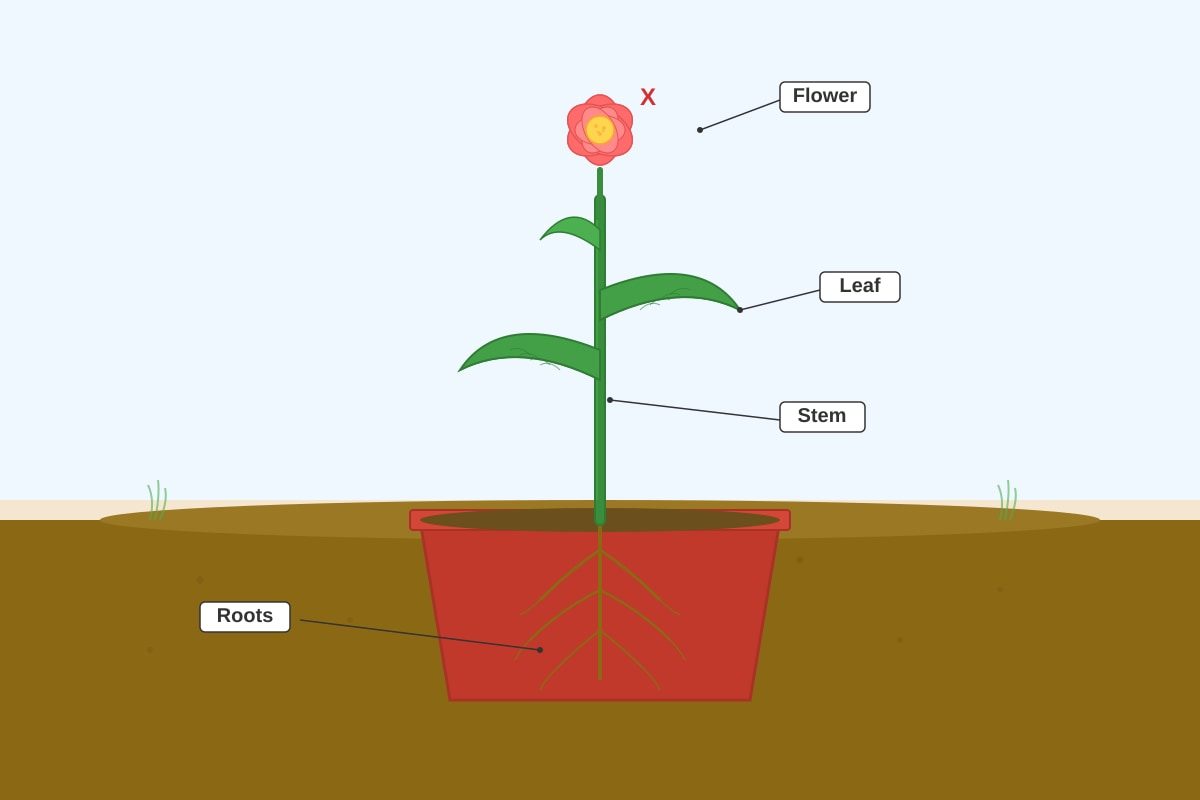
13. Stem
- Marks: 1
- Explanation: The diagram shows a typical flowering plant. The part labelled X is the main upright structure that connects the roots to the leaves and flower. This is the stem.
- Marking Note: The image placeholder must clearly label the stem as X.
14. The broad and flat shape of the leaf gives it a large surface area. This allows the leaf to capture more sunlight, which is needed to make food.
- Marks: 2
- Explanation:
- (1 mark) The broad, flat shape gives a large surface area.
- (1 mark) This large surface area helps the leaf absorb/capture more sunlight for making food.
- Marking Note: Award marks for the idea of "large surface area" and "capture more sunlight for photosynthesis/making food."
15. The plant's leaves will turn yellow and the plant may not grow well.
- Marks: 2
- Explanation:
- (1 mark) The leaves will turn yellow / the plant will not be healthy / the plant may die.
- (1 mark) Because without sunlight, the plant cannot make food (photosynthesis).
- Marking Note: Accept "the leaves will become pale/yellow" or "the plant will not be able to make food." Award the second mark for explaining that sunlight is needed for making food.
Section D: Application and Reasoning (Questions 16 - 20)
16. From the results of Seed A and Seed B, we can conclude that water is needed for a seed to germinate.
- Marks: 2
- Explanation:
- (1 mark) Seed A germinated because it had water, air, and warmth.
- (1 mark) Seed B did not germinate because it had no water. Since all other conditions were the same, the only difference is water, so water is necessary for germination.
- Marking Note: The answer must clearly state that water is needed for germination. A simple "water is needed" is acceptable for full marks.
17. The cutting from the stem can grow into a new plant because the stem contains cells that can grow into new roots and shoots. This is a form of reproduction where a new plant grows from a part of the parent plant.
- Marks: 2
- Explanation:
- (1 mark) The stem cutting can grow new roots.
- (1 mark) It can then grow into a new, complete plant.
- Marking Note: Accept answers that mention the stem can grow roots and become a new plant. This is an example of vegetative reproduction.
18. A plant with very small roots might not be able to absorb enough water and minerals from the soil. It may also not be held firmly in the ground and could be easily uprooted.
- Marks: 2
- Explanation:
- (1 mark) It may not get enough water and minerals.
- (1 mark) It may not be held firmly in the soil / may fall over easily.
- Marking Note: Award one mark for each valid problem mentioned.
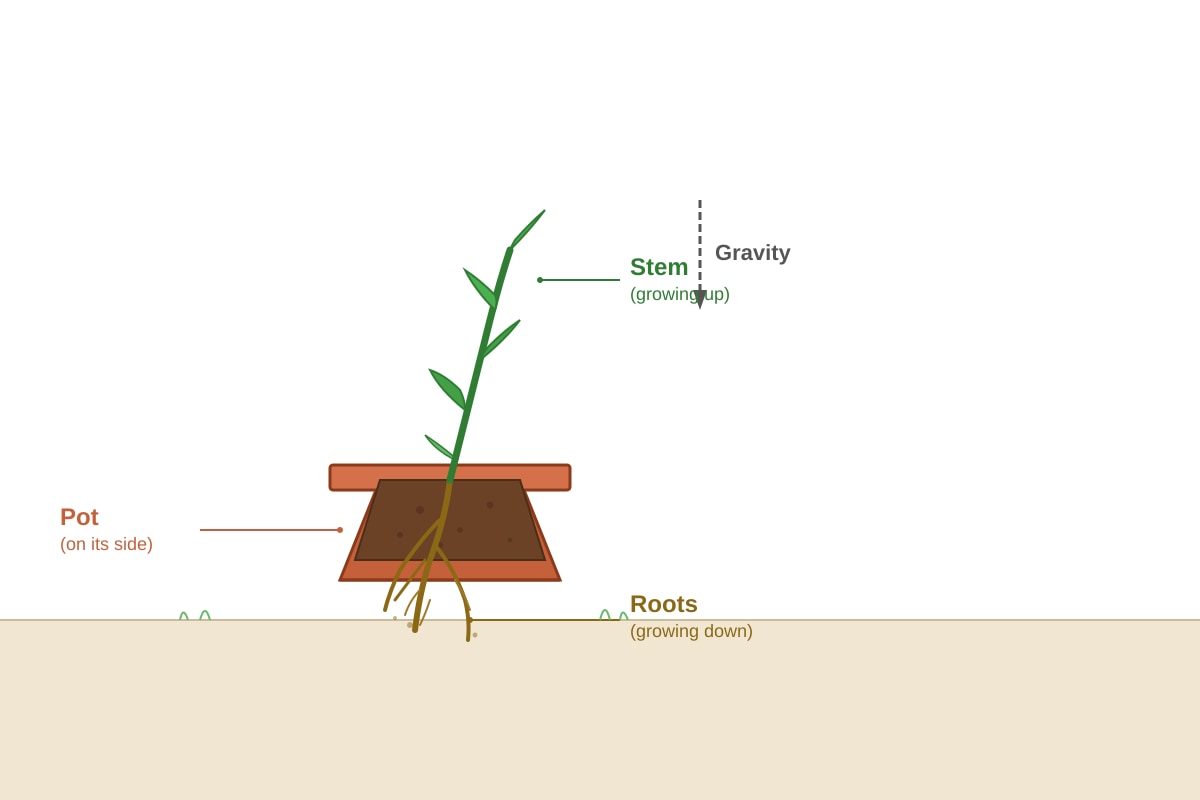
19. The stem has grown upwards (against gravity) and the roots have grown downwards (with gravity).
- Marks: 2
- Explanation:
- (1 mark) The stem grows upward (towards the light/away from gravity).
- (1 mark) The roots grow downward (towards gravity).
- Marking Note: This demonstrates that plants respond to stimuli (gravity and light). The stem grows up to reach sunlight, and the roots grow down to find water and anchor the plant.
20. Large, colourful flowers attract insects and birds, which help in pollination. This helps the plant produce seeds.
- Marks: 2
- Explanation:
- (1 mark) Large, colourful flowers attract insects/birds.
- (1 mark) These animals help in pollination, which leads to the production of seeds.
- Marking Note: Accept answers about attracting pollinators. The second mark is for linking this to pollination or seed production.
END OF ANSWER KEY