From Real Exams Quiz
Primary 3 Science Materials Quiz
Free P3 Science Materials quiz, Kimi2.6 Exam version, with questions, answers, and syllabus-aligned practice for Singapore students.
These static practice materials are generated from the site's syllabus and paper-generation workflow, with source and model context shown so students and parents can evaluate the material before use.
Questions


Free quiz and exam paper access
Enter your details to view this paper
Your access is remembered on this device.
Answers
Primary 3 Science Quiz - Materials: Answer Key
Total Marks: 40
Section A: Multiple Choice Questions
1. (b) It is transparent [2 marks]
Explanation: Glass is transparent, which means light can pass through it so we can see through it. Glass does not bend easily (it is rigid), it does not always float on water, and it does not soak up water (it is waterproof). Being transparent is a very useful property of glass that makes it suitable for windows and bottles.
2. (c) Plastic [2 marks]
Explanation: Plastic is waterproof, which means water cannot pass through it. This makes it ideal for a raincoat because it keeps rain out. Cotton and paper absorb water and would get wet. Wood is also not suitable as it would absorb water and become heavy.
3. (c) Copper and aluminium [2 marks]
Explanation: Copper and aluminium are both metals. Metals are good conductors of heat, which means heat can travel through them easily. This is why metal pots heat up quickly. Wood, plastic, rubber, and cloth are poor conductors (insulators) – they do not let heat pass through easily.
4. (c) R [2 marks]
Explanation: Material R is metal (most likely). Metal does not absorb water, does not let light through (it is opaque), and is not flexible (it is rigid). The properties match: no water absorption, no light passing through, and cannot bend. Clay or metal could have these properties, but metal is the common answer for this pattern.
5. (b) Clay allows air and water to pass through [2 marks]
Explanation: Clay pots have tiny holes that allow air and water to pass through. This is good for plants because their roots need air to grow, and excess water can drain out. Plastic does not allow this, so plant roots might not get enough air in a plastic pot.
6. (c) Plastic [2 marks]
Explanation: The handle of a cooking pot needs to be a poor conductor of heat (an insulator) so it does not get hot and burn your hand. Iron, copper, and aluminium are all metals that conduct heat very well. Plastic is a good insulator, so it stays cool enough to hold safely.
**7. (b) waterproof [2 marks]
Explanation: Waterproof means water cannot pass through a material. If something is absorbent, it soaks up water. Flexible means it can bend. Transparent means light can pass through. An umbrella needs to be waterproof to keep rain off.
8. (c) Glass sheet [2 marks]
Explanation: Glass is rigid, which means it cannot bend without breaking. A rubber band, cotton string, and plastic sheet are all flexible – they can bend or stretch without breaking. Glass will crack or shatter if you try to bend it.
Section B: Fill in the Blanks and Short Answer
9. [4 marks total]
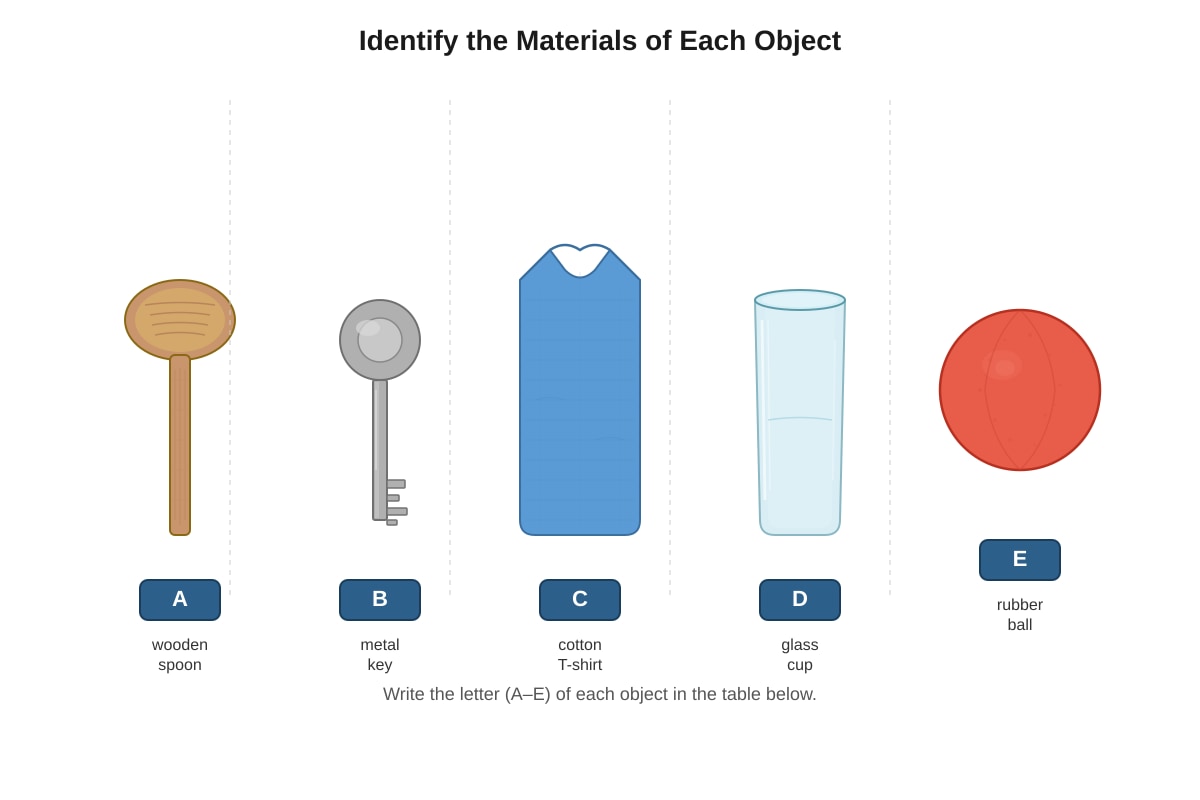
Expected answers: (a) Flexible objects: C (cotton T-shirt) and E (rubber ball) [2 marks: 1 mark each, either order]
(b) Not flexible objects: B (metal key) and D (glass cup) [2 marks: 1 mark each, either order; accept A (wooden spoon) as not flexible too]
Explanation: Flexible materials can bend or be stretched without breaking. Cotton fabric can bend and fold. A rubber ball can be squeezed and returns to shape. Metal keys and glass cups are rigid – they keep their shape and do not bend easily. Wood is also rigid though less hard than glass.
Common mistake: Some students think wood is flexible because trees bend, but processed wood (like a spoon) is rigid.
10. [3 marks total]
(a) Waterproof (or: does not absorb water / water cannot pass through) [1 mark]
(b) Material: Plastic (or: nylon, PVC, oilcloth, waxed cotton) [1 mark] Explanation: [1 mark for any of these acceptable reasons]
- Plastic is waterproof, so rain cannot pass through
- It does not absorb water, so it stays dry
- Water forms beads and runs off instead of soaking in
Explanation: An umbrella's main job is to keep rain off. The material must block water. Plastic is commonly used because it is waterproof, lightweight, and cheap to make. Waxed cotton or special waterproof fabrics also work.
11. [2 marks total]
(a) Sponge (absorbed 95 ml out of 100 ml, so only 5 ml left) [1 mark]
(b) Nylon (water left: 95 ml, so only absorbed 5 ml) [1 mark]
Working: To find water absorbed, subtract water left from starting amount (100 ml):
- Cotton: 100 − 20 = 80 ml absorbed
- Wool: 100 − 35 = 65 ml absorbed
- Nylon: 100 − 95 = 5 ml absorbed
- Sponge: 100 − 5 = 95 ml absorbed
Explanation: The material with the most water absorbed = least water remaining. The material with the least water absorbed = most water remaining. Sponge is designed with lots of air spaces to soak up water. Nylon is a synthetic material that repels water.
12. [3 marks total]
(a) Transparent (or: lets light through / see-through) [1 mark]
(b) Material: Glass (or: clear plastic / acrylic) [1 mark] Explanation: [1 mark] Glass is transparent, so light can pass through it. This allows Mei Ling to see inside her model house.
Explanation: A window needs to let light through. Transparent materials allow light to pass through so we can see through them. Clear plastic also works but may scratch more easily. Glass is the traditional window material because it is rigid, waterproof, and stays clear.
13. [4 marks total]
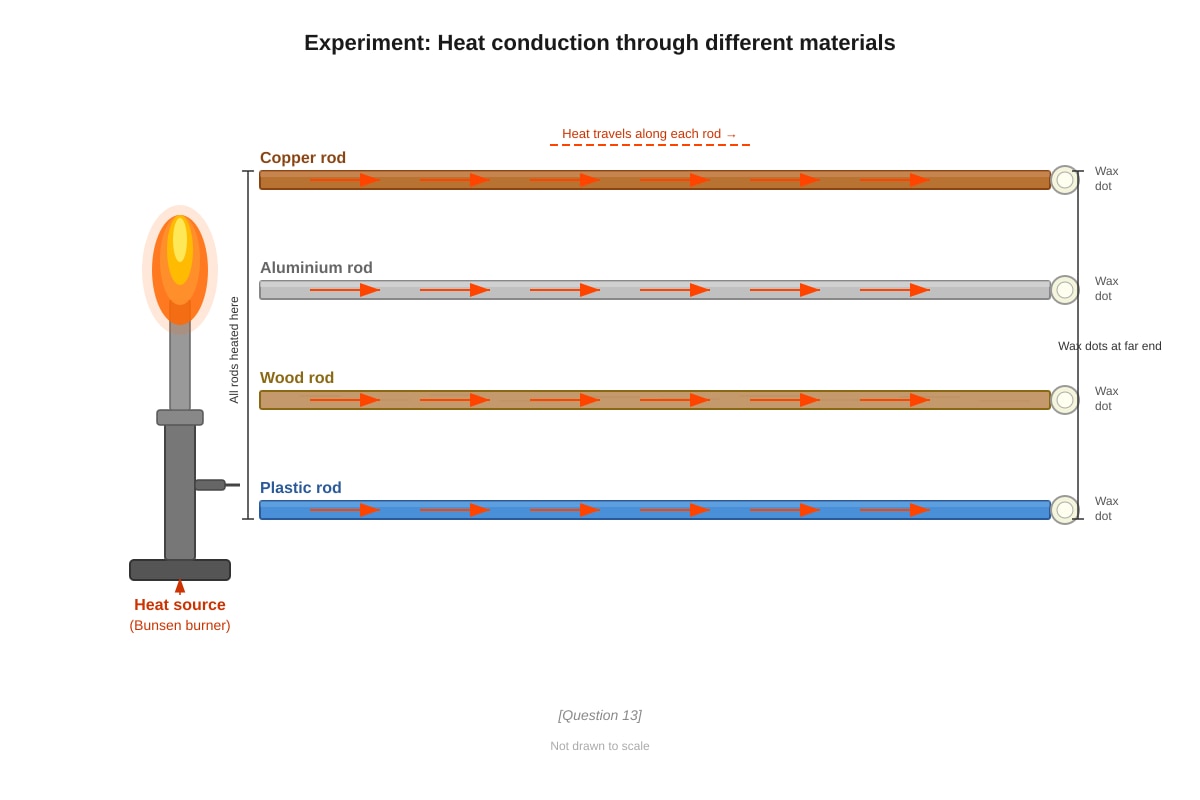
(a) The wax dots melt (or: soften, drop off) [1 mark]
(b) Copper and aluminium [1 mark for both correct] Explanation: [2 marks] Copper and aluminium are metals. Metals are good conductors of heat [1 mark]. Heat travels quickly through them to the far end, so the wax melts first [1 mark]. Wood and plastic are poor conductors (insulators), so heat travels slowly and the wax takes longer to melt.
Explanation: This experiment tests thermal conductivity. Metals have free electrons that help transfer heat quickly. The wax dot acts as a temperature indicator – when enough heat arrives, the wax melts. The order of melting typically is: copper first (best conductor), then aluminium, then wood/plastic (much slower).
14. [2 marks total]
(a) Iron nail and steel paperclip [1 mark for both; order not important]
(b) Iron (or: steel, nickel, cobalt) [1 mark]
Explanation: Only iron, steel, nickel, and cobalt are magnetic among common materials. Iron and steel contain iron, so they are attracted to magnets. Aluminium, copper, and plastic are not magnetic – a magnet will not pull them. The mystery object being attracted to a magnet suggests it contains iron or steel.
Common mistake: Students sometimes think all metals are magnetic. Only some metals are magnetic!
Section C: Application and Process Skills
15. [4 marks]
Recommended answer: Choose plastic [1 mark] Explanation: [up to 3 marks]
- Plastic is a poor conductor of heat (insulator), so it keeps food warm by slowing heat loss [1 mark]
- Plastic stays cool on the outside, so it is safe to touch without burning hands [1 mark]
- Plastic is waterproof and easy to wipe clean [1 mark]
Alternative acceptable answer: Choose ceramic [1 mark]
- Ceramic is a poor conductor of heat (insulator), keeping food warm [1 mark]
- Ceramic stays relatively cool outside if it has thick walls [1 mark]
- Ceramic is easy to wash and clean [1 mark]
Not recommended: Metal [0 marks for material choice]
- Metal conducts heat well, so food cools quickly and the outside gets hot [explanation would not earn marks]
Marking breakdown:
- Correct material choice with reason: 1 mark
- Each valid property linked to requirement: 1 mark each (max 3)
16. [4 marks total]
(a) Flexible / not flexible OR Natural / man-made (synthetic) OR Can be stretched / cannot be stretched [2 marks]
Acceptable answers:
- If using flexible: Glass and rubber are both flexible? No – this doesn't work. So flexible is NOT correct for this grouping.
- Correct property: Waterproof / not waterproof? No – cotton and wood both absorb water, but rubber is waterproof and glass is waterproof. So glass and rubber = waterproof; cotton and wood = not waterproof. This works!
- OR: Natural / synthetic: Cotton and wood are natural; glass and rubber... glass is natural (made from sand) but processed; rubber can be natural or synthetic. This is ambiguous.
- Best answer: Waterproof / absorbent (or not waterproof): Glass and rubber do not absorb water; cotton and wood absorb water. [2 marks]
(b) [2 marks]
- Glass and rubber: Both do not absorb water / both repel water / water forms beads on them / both are waterproof [1 mark]
- Cotton and wood: Both absorb water / both have tiny holes that let water in / water soaks into them [1 mark]
Explanation: Grouping by a single property requires finding one characteristic that two pairs share within each pair but differ between pairs. Waterproof vs absorbent is clearest here. Other valid properties might exist but check consistency.
17. [4 marks total]
(a) Wood [1 mark]
(b) Plastic and Metal (either or both) [1 mark]
(c) Plastic or Metal [1 mark] Explanation: [1 mark] Plastic and metal are both waterproof, so water does not absorb into them. Water forms beads and can be wiped off easily, making cleaning simple.
Marking note: If student chose metal, explain that metal is waterproof and durable, though it might be colder/noisier. Plastic is the most practical kitchen table surface in reality.
18. [4 marks total]
(a) Plastic [1 mark]
(b) [3 marks] Reason 1: Plastic is waterproof (or: does not absorb water), so the label will not get wet and fall off when the bottle gets wet [1–2 marks depending on explanation depth] Reason 2: Plastic is durable (or: strong, does not tear easily), so the label will last a long time without damage [1–2 marks]
Full marks for: Two distinct properties with clear links to the label staying on a wet bottle.
19. [4 marks total]
(a) Nylon [1 mark] (holds 400 g before breaking)
(b) Rubber [1 mark] (holds only 50 g)
(c) Nylon [1 mark] Explanation: [1 mark] Nylon can hold the most mass (400 g) before breaking, so it is the strongest. A climber needs a strong rope that will not snap when holding their weight.
Explanation: Nylon is used for many strong materials including ropes, parachutes, and some clothing because of its high strength. Cotton and silk are weaker natural fibres. Rubber elastic bands are designed to stretch but cannot hold heavy loads. The graph shows strength under tension – a critical property for safety equipment.
20. [4 marks total]
(a) Cotton [1 mark] – water soaked through in only 15 seconds [1 mark]
Explanation: A baby's bib needs to keep the baby dry. If water soaks through quickly, the baby's clothes underneath get wet. Cotton absorbs water very fast but also lets it pass through to the other side.
(b) Nylon [1 mark] – because water did not soak through even after 5 minutes [1 mark]
Explanation: Nylon repels water, keeping the baby dry. The data shows nylon resists water penetration longest. Polyester is second best at 2 minutes 30 seconds. For a practical bib, complete waterproofing may be too much (water runs off onto other things), but based on data, nylon best meets "keep baby dry" criterion.
Alternative acceptable answer: Polyester – with explanation that it delays water better than cotton/wool and is more comfortable than nylon.
END OF ANSWER KEY