From Real Exams Quiz
Primary 3 Science Materials Quiz
Free P3 Science Materials quiz, HY3 Exam version, with questions, answers, and syllabus-aligned practice for Singapore students.
These static practice materials are generated from the site's syllabus and paper-generation workflow, with source and model context shown so students and parents can evaluate the material before use.
Questions
Free quiz and exam paper access
Enter your details to view this paper
Your access is remembered on this device.
Answers
Primary 3 Science Quiz - Materials: Answer Key
Total Marks: 40
Topic: Materials
Section A: Multiple Choice
-
B) Plastic [1 mark]
Teaching note: Plastic is waterproof, so rain cannot pass through it. Paper and cotton absorb water; wood is not flexible for a coat. -
C) Cotton [1 mark]
Teaching note: Cotton comes from the cotton plant (natural). Glass, plastic, nylon are man-made. -
B) Transparent [1 mark]
Teaching note: Transparent means most light passes through. Opaque blocks light; flexible/waterproof are other properties. -
B) A wooden block [1 mark]
Teaching note: Wood is less dense than water and floats. Metal, ceramic, stone are denser and sink. -
B) Flexible and waterproof [1 mark]
Teaching note: Shoe soles bend (flexible) and keep feet dry (waterproof). Rubber is not transparent or absorbent.
Section B: Short Answer
-
Transparent (or allows light through) [2 marks: 1 for property, 1 for linking to windows]
Teaching note: Glass is transparent so we can see outside through windows. -
Natural [2 marks]
Teaching note: Wood comes from trees, which are natural. Man-made means made by people from other materials. -
Metal is strong / conducts heat well [2 marks]
Teaching note: Pans need to be strong and pass heat to cook food. Metal does both.
| Material | Flexible? | Waterproof? |
|---|---|---|
| Plastic | Yes | Yes |
| [2 marks: 1 for each correct] | ||
| Teaching note: Plastic bends and does not absorb water. |
-
Fabric; because it is flexible/stretchy [2 marks: 1 material, 1 reason]
Teaching note: Hair bands need to stretch; fabric (or rubber) is flexible, rubber also works but fabric was option. -
Brittle / not flexible (breaks easily) [2 marks]
Teaching note: Ceramic breaks on drop, showing it is hard but brittle. -
Natural comes from nature (plants/animals); man-made is made by people [2 marks]
Teaching note: Example: wood natural, plastic man-made. -
Rubber may smell / not clear / not usual for cups (or absorbs? no, rubber waterproof) — better: Rubber is not transparent and not typical; but correct: Rubber is flexible but not used as cup because not rigid/holds shape poorly. Accept: "Rubber is too soft to hold liquid well." [2 marks]
Teaching note: Cups need to keep shape; rubber bends too much. -
Waterproof [2 marks]
Teaching note: Waterproof means water cannot pass through. -
Glass, clear plastic [2 marks: 1 each]
Teaching note: Both let light through.
Section C: Application & Explanation
-
Wood floats because it is less dense / has air; metal coin sinks because dense. [2 marks: 1 each point]
Teaching note: Floating depends on material density vs water. Wood naturally floats; coin is heavy metal. -
Plastic umbrella; paper absorbs water and breaks, plastic is waterproof. [2 marks: 1 choice, 1 reason]
Teaching note: Rain needs waterproof material. -
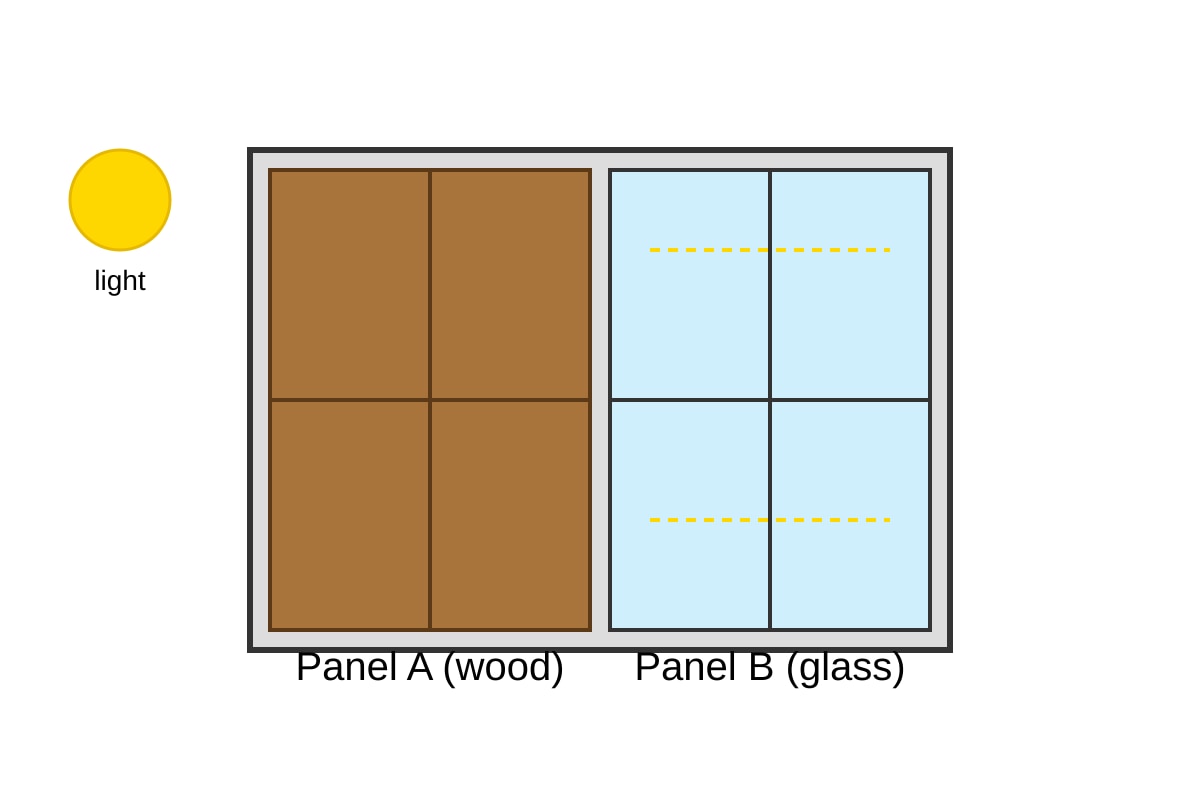
Panel B (glass); glass is transparent and lets light through. [2 marks: 1 panel, 1 reason]
Image note: Diagram shows A=wood (opaque), B=glass (transparent). Student picks B. -
Fabric; soft and flexible (light, comfortable). [2 marks: 1 choice, 2 reasons but 2 marks total]
Teaching note: Metal is hard, heavy, not soft; fabric is soft for toy. -
Fabric absorbed water; it is not waterproof (unlike plastic/glass). [2 marks: 1 material, 1 reason]
Teaching note: Fabric soaks water; plastic/glass stay dry.