From Real Exams Quiz
Primary 3 Science Materials Quiz
Free P3 Science Materials quiz, Exam version, with questions, answers, and syllabus-aligned practice for Singapore students.
These static practice materials are generated from the site's syllabus and paper-generation workflow, with source and model context shown so students and parents can evaluate the material before use.
Questions
Free quiz and exam paper access
Enter your details to view this paper
Your access is remembered on this device.
Answers
Answer Key: Primary 3 Science Quiz - Materials
Total Marks: 20
Section A: Multiple-Choice Questions (Questions 1 to 5)
Each question carries 1 mark.
1. Answer: C) Wood
- Explanation: Natural materials come from plants, animals, or the ground. Wood comes from trees (plants). Plastic, glass, and nylon are all man-made materials created by humans.
- Common mistake: Students may think glass is natural because it is made from sand, but it is processed by humans, so it is man-made.
2. Answer: B) Transparent
- Explanation: A transparent material allows most light to pass through it, so you can see clearly through it. Examples include clear glass and clear plastic.
- Common mistake: Students may confuse "transparent" with "translucent" (allows some light through) or "opaque" (allows no light through). The P3 syllabus focuses on "transparent" and "opaque" only.
3. Answer: C) Rubber
- Explanation: A raincoat needs to be waterproof to keep the person dry. Rubber is a waterproof material. Cotton and paper absorb water, and wood is not flexible enough for a raincoat.
- Common mistake: Students may choose cotton because it is soft, but cotton absorbs water, so it is not suitable for a raincoat.
4. Answer: B) Conductor of heat
- Explanation: A conductor of heat allows heat to pass through it easily. When you touch a metal spoon, heat from your hand moves quickly into the metal, making it feel cold. Metal is a good conductor of heat.
- Common mistake: Students may think the spoon is cold because it is made of a cold material. In fact, it feels cold because it conducts heat away from your hand quickly.
5. Answer: C) Plastic
- Explanation: Man-made materials are created by humans through chemical processes. Plastic is made from petroleum (oil) and is not found naturally. Wool, cotton, and leather all come from animals or plants.
- Common mistake: Students may think leather is man-made because it is processed, but it comes from animal skin, so it is a natural material.
Section B: Matching and Classification (Questions 6 to 10)
Each question carries 1 mark.
6. Answer:
-
Rubber band → Flexible
-
Glass → Transparent
-
Metal → Hard and strong
-
Wood → Waterproof
-
Explanation:
- A rubber band can be stretched and bent without breaking, so it is flexible.
- Glass allows light to pass through, so it is transparent.
- Metal is difficult to break or bend, so it is hard and strong.
- Wood does not absorb water easily, so it is waterproof.
-
Marking note: Award 1 mark for all four correct matches. Award 0.5 marks if three matches are correct.
7. Answer:
| Natural Materials | Man-made Materials |
|---|---|
| A) A wooden chair | B) A plastic bottle |
| C) A cotton t-shirt | D) A glass window |
- Explanation:
- Wood comes from trees (natural). Cotton comes from the cotton plant (natural).
- Plastic is made from chemicals (man-made). Glass is made from sand that is melted and processed (man-made).
- Marking note: Award 1 mark for all four correct classifications. Award 0.5 marks if three are correct.
8. Answer: B) Wood
- Explanation: Wood is a material that floats on water because it is less dense than water. Metal and glass are heavy and sink. Rubber can float, but wood is a common and suitable material for making a toy boat.
- Common mistake: Students may choose metal because it is strong, but metal sinks in water.
9. Answer: waterproof
- Explanation: A waterproof material does not let water pass through it. Examples include plastic, rubber, and metal.
- Common mistake: Students may confuse "waterproof" with "absorbent" (which soaks up water).
10. Answer: C) A metal rod
- Explanation: A flexible material can bend without breaking. A rubber band, a piece of string, and a plastic ruler can all bend. A metal rod is hard and rigid; it does not bend easily.
- Common mistake: Students may think a plastic ruler is not flexible, but a thin plastic ruler can bend slightly.
Section C: Short-Answer Questions (Questions 11 to 15)
Each question carries 2 marks.
11. Answer:
- Metal is a good conductor of heat, so heat from the fire can pass through the pot to cook the food.
- Metal is strong and hard, so the pot can hold heavy food without breaking.
- Explanation: The two key properties of metal that make it suitable for cooking pots are its ability to conduct heat and its strength.
- Marking scheme:
- 1 mark for stating that metal conducts heat (or that it heats up quickly/evenly).
- 1 mark for stating that metal is strong/hard/durable.
- Common mistake: Students may say "metal is waterproof" – while true, this is not the most important property for cooking.
12. Answer: Glass is brittle (or hard but not strong).
- Explanation: Brittle materials break easily when hit or dropped. Glass is hard, but it is not strong enough to withstand impact, so it shatters.
- Marking scheme:
- 1 mark for stating that glass is brittle or breaks easily.
- 1 mark for a clear explanation.
- Common mistake: Students may say "glass is weak" – while true, the specific term "brittle" is more accurate. Accept "glass is hard but breaks easily."
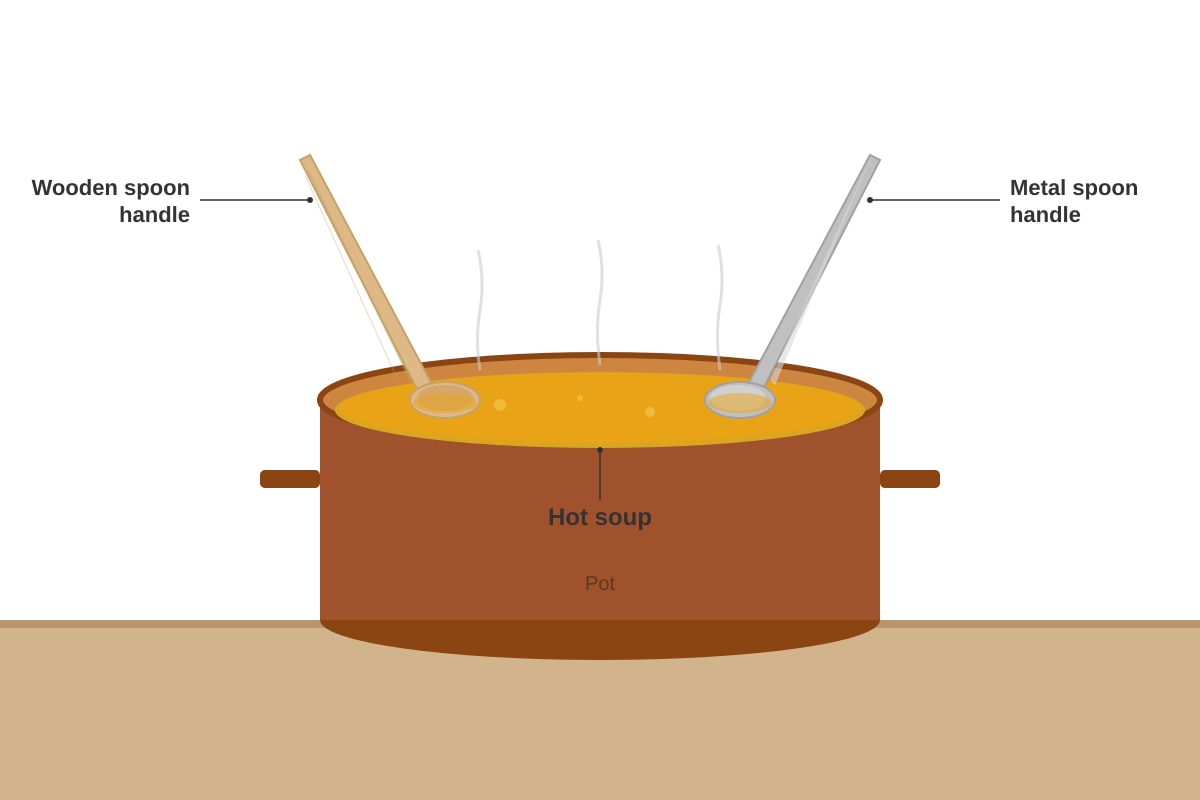
13. Answer: Metal is a good conductor of heat, so heat from the hot soup travels quickly up the metal spoon handle, making it feel hot. Wood is a poor conductor of heat (an insulator), so heat does not travel easily up the wooden spoon handle, so it stays cool.
- Explanation: This question tests the concept of heat conduction. Metal conducts heat well, while wood insulates against heat.
- Marking scheme:
- 1 mark for stating that metal is a good conductor of heat.
- 1 mark for stating that wood is a poor conductor of heat (or an insulator).
- Common mistake: Students may say "the wooden spoon is cooler" without explaining why.
14. Answer:
| Material | Property |
|---|---|
| 1. Glass | Transparent (allows light to pass through so we can see outside) |
| 2. Wood/Metal/Plastic (for the frame) | Strong (holds the glass in place and supports the window) |
- Explanation: Windows need to let light in (transparent glass) and be sturdy (strong frame).
- Marking scheme:
- 1 mark for naming two suitable materials.
- 1 mark for stating one correct property for each material.
- Acceptable answers: Any combination of glass (transparent), wood (strong), metal (strong), plastic (waterproof/strong).
15. Answer: The plastic bag is more waterproof. Paper absorbs water, so it is not waterproof. Plastic does not let water pass through, so it is waterproof.
- Explanation: Waterproof materials repel water and do not absorb it. Paper is absorbent, while plastic is waterproof.
- Marking scheme:
- 1 mark for correctly identifying the plastic bag.
- 1 mark for explaining that paper absorbs water and plastic does not.
- Common mistake: Students may say "paper is waterproof" because they have seen wax paper, but regular paper is absorbent.
Section D: Application and Explanation (Questions 16 to 20)
Each question carries 2 marks.
16. Answer:
-
Best choice: Metal
-
Explanation: Metal is strong, so it can support the weight of the roof and withstand wind and rain. Metal is also waterproof, so it will not let rainwater leak through.
-
Explanation: A roof must be both strong (to hold its own weight and withstand weather) and waterproof (to keep rain out). Metal has both properties.
-
Marking scheme:
- 1 mark for choosing metal.
- 1 mark for explaining that metal is both strong and waterproof.
-
Common mistake: Students may choose wood because it is also strong and waterproof, but metal is generally stronger and more durable for roofing.
17. Answer:
- Plastic is lightweight, so the toy car is easy to carry and move.
- Plastic is strong and durable, so the toy car will not break easily when dropped.
- Explanation: Plastic is a good material for toys because it is light, strong, waterproof, and can be moulded into different shapes.
- Marking scheme:
- 1 mark for each correct reason (any two of: lightweight, strong, durable, waterproof, flexible, cheap).
- Common mistake: Students may say "plastic is soft" – while some plastics are soft, toy cars are usually made of hard plastic.
18. Answer:
-
Better material: Thin plastic sheet
-
Explanation: A kite needs to be lightweight so it can fly easily. A thin plastic sheet is much lighter than cardboard. Plastic is also waterproof, so the kite will not get damaged if it gets wet.
-
Explanation: The key properties for a kite are being lightweight and waterproof (or at least water-resistant).
-
Marking scheme:
- 1 mark for choosing the plastic sheet.
- 1 mark for explaining that it is lightweight (and/or waterproof).
-
Common mistake: Students may choose cardboard because it is stronger, but strength is not the most important property for a kite.
19. Answer:
| Object | Material | Property |
|---|---|---|
| A frying pan | Metal | Good conductor of heat / Strong |
| A rubber band | Rubber | Flexible / Stretchy |
- Explanation:
- A frying pan needs to conduct heat well to cook food, so metal is suitable.
- A rubber band needs to stretch and return to its original shape, so flexibility is important.
- Marking scheme:
- 1 mark for each row with correct material and property.
- Acceptable answers: For the frying pan, "metal" (aluminium, steel, iron) and "conducts heat" or "strong". For the rubber band, "rubber" and "flexible" or "stretchy".
20. Answer: No, I do not agree. A material can be hard but not strong. For example, glass is hard (you cannot scratch it easily), but it is not strong because it breaks easily when dropped.
- Explanation: "Hard" means difficult to scratch or dent. "Strong" means difficult to break. These are different properties. Glass is hard but brittle (breaks easily).
- Marking scheme:
- 1 mark for stating disagreement.
- 1 mark for providing a correct example (e.g., glass, ceramic, chalk).
- Common mistake: Students may agree with the statement because they think hard and strong mean the same thing.
End of Answer Key