From Real Exams Quiz
Primary 3 Science Materials Quiz
Free P3 Science Materials quiz, Exam version, with questions, answers, and syllabus-aligned practice for Singapore students.
These static practice materials are generated from the site's syllabus and paper-generation workflow, with source and model context shown so students and parents can evaluate the material before use.
Questions
Free quiz and exam paper access
Enter your details to view this paper
Your access is remembered on this device.
Answers
Answer Key: Primary 3 Science Quiz - Materials
Section A: Multiple-Choice Questions
Q1. C) Plastic sheet [1]
- Explanation: A raincoat must be waterproof to keep the toy bear dry. Plastic is waterproof, meaning it does not absorb water. Cotton cloth and paper absorb water, and wood is too stiff and heavy for a raincoat.
- Common mistake: Choosing cotton cloth because it is soft. However, cotton absorbs water, making it unsuitable for a raincoat.
Q2. B) A rubber band [1]
- Explanation: Flexibility is the ability to bend easily without breaking. A rubber band can be stretched and bent easily. A metal spoon, glass bottle, and wooden block are rigid and do not bend easily.
- Common mistake: Choosing a metal spoon because it can be bent with force. However, at P3 level, metal is generally considered rigid compared to rubber.
Q3. C) Material Z is opaque. [1]
- Explanation: An opaque material does not allow any light to pass through. Since light does not pass through Material Z at all, it is opaque. Material X is transparent (all light passes through), and Material Y is translucent (some light passes through).
- Note: The terms transparent, translucent, and opaque are not required for recall, but this question uses them in a simple context to test understanding of light passing through.
Q4. B) A cotton t-shirt [1]
- Explanation: Cotton is a natural material that comes from the cotton plant. Plastic, glass, and nylon are man-made materials. Glass is made from sand but is processed by humans, so it is considered man-made.
- Common mistake: Choosing glass because it comes from sand. However, glass requires a manufacturing process, making it man-made.
Q5. B) Wood [1]
- Explanation: Wood is strong and can hold heavy loads without breaking, making it suitable for building the frame of a house. Rubber is flexible, fabric is soft, and paper is weak.
- Common mistake: Choosing metal because it is also strong. However, wood is a common building material for house frames and is the best answer among the options given.
Section B: Matching and Short-Answer Questions
Q6. Matching [2]
| Material | Property |
|---|---|
| Glass | Allows light to pass through |
| Sponge | Absorbs water |
| Metal | Strong and hard |
| Rubber | Can be bent easily without breaking |
- Explanation:
- Glass is transparent, so it allows light to pass through.
- A sponge is absorbent, meaning it soaks up water.
- Metal is strong and hard, able to withstand heavy loads.
- Rubber is flexible, able to bend easily without breaking.
- Marking: 1 mark for each correct pair, up to 2 marks.
Q7. Any one suitable property: [1]
-
Waterproof (does not absorb water)
-
Strong (can withstand wind and rain)
-
Flexible (can be folded/opened)
-
Explanation: An umbrella must keep the user dry, so it must be waterproof. It also needs to be strong enough to withstand wind and flexible enough to open and close.
-
Marking: Accept any one correct property.
Q8. [2]
(a) Metal key [1]
- Explanation: The metal key sinks, which means it is denser than water. The wooden block and plastic ball float, meaning they are less dense than water.
(b) They are less dense than water / They are able to float. [1]
- Explanation: Objects float when they are less dense than the liquid they are placed in. The wooden block and plastic ball are less dense than water, so they float.
- Marking: Accept "less dense than water" or "they float because they are light for their size."
Q9. [2]
(a) Cotton, Leather (and Rubber, if circled) [1]
- Explanation: Cotton comes from the cotton plant, leather comes from animal skin, and rubber comes from rubber trees. These are natural materials. Plastic and glass are man-made.
- Marking: Award 1 mark if at least two natural materials are circled correctly. If rubber is also circled, it is still correct.
(b) Glass is made by humans from sand / Glass is manufactured / Glass is not found naturally in that form. [1]
- Explanation: Although glass is made from sand (a natural material), the process of heating and shaping it into glass is done by humans. Therefore, glass is classified as a man-made material.
- Marking: Accept any answer that states glass is made by humans or is manufactured.
Q10. Metal is suitable for a cooking pan because it is strong and can withstand high heat without melting or breaking. It also conducts heat well, allowing food to cook evenly. [2]
- Explanation: A cooking pan needs to be strong to hold food and withstand high temperatures. Metal is strong and hard, and it is a good conductor of heat, meaning heat passes through it easily to cook the food.
- Marking:
- 1 mark for stating metal is strong/hard.
- 1 mark for stating metal can withstand heat or conducts heat well.
Section C: Application and Explanation Questions
Q11. [3]
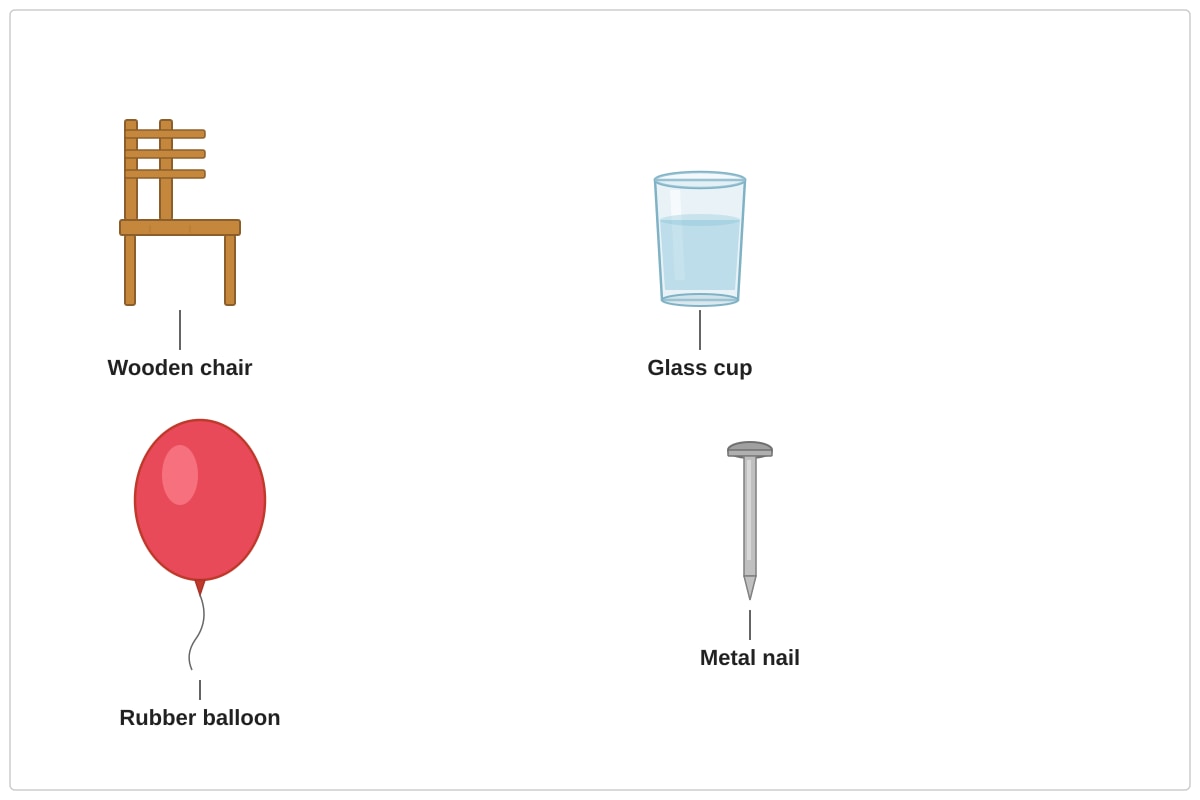
(a) Glass cup [1]
- Explanation: The glass cup is transparent, meaning light can pass through it, so we can see through it.
(b) Rubber balloon [1]
- Explanation: The rubber balloon is flexible, meaning it can be stretched and bent easily without breaking.
(c) Wooden chair or Metal nail [1]
- Explanation: Both wood and metal are strong and hard materials. The wooden chair is strong enough to hold a person's weight, and the metal nail is hard and strong.
- Marking: Accept either wooden chair or metal nail.
Q12. [3]
(a) The piece of cloth [1]
- Explanation: Cloth is made of woven fibres that have tiny gaps between them, allowing it to absorb water.
(b) Cloth is absorbent because it has tiny spaces/holes that trap water. Wax paper and aluminium foil are waterproof and do not absorb water. [2]
- Explanation: Absorbent materials have tiny spaces that soak up and hold water. Wax paper has a waxy coating that repels water, and aluminium foil is a metal sheet that does not absorb water.
- Marking:
- 1 mark for stating cloth is absorbent.
- 1 mark for stating wax paper and aluminium foil are waterproof/do not absorb water.
Q13. [2]
Material: Plastic (or wood) [1]
Explanation: Plastic is waterproof and light, so it will not absorb water and will float easily. (Or: Wood is less dense than water, so it floats.) [1]
- Explanation: A toy boat must float, so the material must be less dense than water. It should also be waterproof so it does not become waterlogged and sink.
- Marking: Award 1 mark for a suitable material and 1 mark for a correct explanation linking the property to the use.
Q14. [4]
(a) Material X [1]
Explanation: Material X is waterproof and flexible. A raincoat must be waterproof to keep the wearer dry and flexible so the person can move easily. [1]
- Marking: 1 mark for identifying Material X, 1 mark for explaining both properties.
(b) Material Z [1]
Explanation: Material Z is transparent, meaning light can pass through it, allowing us to see through the window. It is also waterproof, which is good for a window. [1]
- Marking: 1 mark for identifying Material Z, 1 mark for explaining the transparent property.
Q15. Yes, the student is correct. [1]
Explanation: Waterproof means a material does not absorb water. Glass does not absorb water, so it is waterproof. Water will run off the surface of the glass instead of soaking in. [1]
- Explanation: The key property here is water absorption. A waterproof material is one that does not let water pass through or soak into it. Glass fits this definition.
- Marking: 1 mark for agreeing with the statement, 1 mark for explaining that glass does not absorb water.
Section D: Investigation and Data-Based Questions
Q16. [2]
(a) Stone (or Metal nail) [1]
- Explanation: The stone sinks, which means it is denser than water. The metal nail also sinks, so either answer is acceptable. However, the stone is the clearest example of a dense material.
(b) Any one property: [1]
-
Waterproof (does it absorb water?)
-
Flexibility (can it bend?)
-
Transparency (does light pass through?)
-
Strength (can it withstand heavy loads?)
-
Explanation: These are all physical properties of materials that can be tested through simple investigations.
-
Marking: Accept any one correct property.
Q17. [3]
(a) The type of material [1]
- Explanation: The independent variable is the thing that the student changes on purpose. In this experiment, she changes the material placed over the cup.
(b) The amount of water that passes through the material [1]
- Explanation: The dependent variable is the thing that is measured as a result of the change. She measures how much water passes through each material.
(c) Paper towel [1]
- Explanation: Paper towel is highly absorbent, meaning it will soak up water and let it pass through. Cotton cloth is also absorbent, but paper towel is more absorbent. Plastic sheet and aluminium foil are waterproof and will not let water pass through.
- Marking: Accept paper towel or cotton cloth.
Q18. [2]
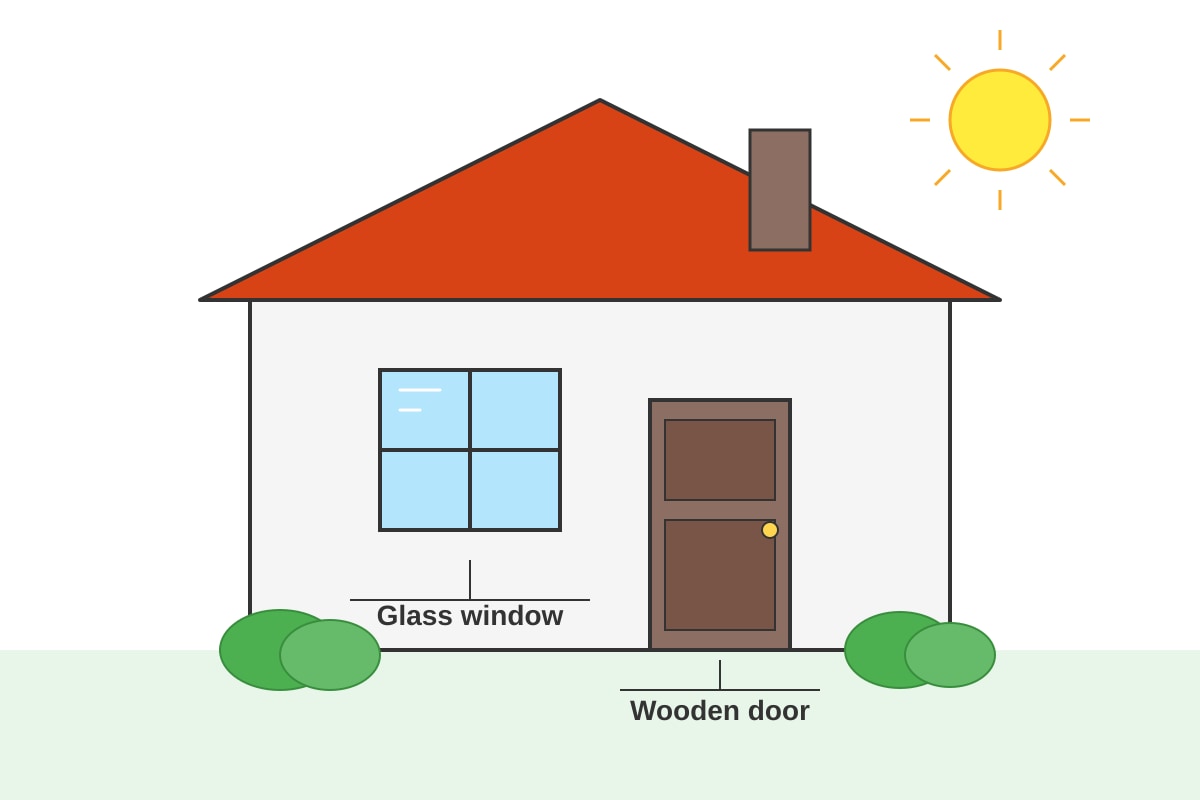
(a) Glass is transparent, so it allows light to pass through, making the room bright. [1]
- Explanation: Windows are made of glass so that we can see through them and let sunlight into the house.
(b) Wood is strong and hard, so it can protect the house and keep it secure. [1]
- Explanation: A door needs to be strong to provide security and withstand force. Wood is a strong and hard material.
- Marking: Accept any correct property of wood that relates to its use as a door (strong, hard, durable).
Q19. [2]
(a) Rubber band [1]
- Explanation: The rubber band can be bent easily without breaking, while the wooden block is rigid and will break if bent.
(b) Flexibility [1]
- Explanation: Flexibility is the ability of a material to bend easily without breaking. Rubber is a flexible material.
- Marking: Accept "flexible" or "flexibility."
Q20. [3]
(a) Metal [1]
- Explanation: Metal is strong and waterproof. It can withstand heavy loads and does not absorb water, making it ideal for a lunchbox.
(b) Cotton cloth is not waterproof (it absorbs water). Paper is not strong and is not waterproof. Sponge is not waterproof (it absorbs water) and is not strong. [2]
- Explanation: The lunchbox must be waterproof and strong. Cotton cloth and sponge absorb water, making them unsuitable. Paper is weak and will tear easily, and it also absorbs water.
- Marking:
- 1 mark for explaining why cotton cloth or sponge is unsuitable (absorbs water).
- 1 mark for explaining why paper is unsuitable (not strong/absorbs water).
Total Marks: 30