From Real Exams Quiz
Primary 3 Science Magnets Quiz
Free P3 Science Magnets quiz, Exam version, with questions, answers, and syllabus-aligned practice for Singapore students.
These static practice materials are generated from the site's syllabus and paper-generation workflow, with source and model context shown so students and parents can evaluate the material before use.
Questions
Free quiz and exam paper access
Enter your details to view this paper
Your access is remembered on this device.
Answers
Answer Key: Primary 3 Science Quiz - Magnets
Section A: Multiple Choice
1.
- Answer: C (A steel paperclip)
- Mark: 1
- Explanation: Magnets attract magnetic materials. Steel contains iron, which is magnetic. Plastic, wood, and glass are not magnetic materials, so they are not attracted to magnets.
- Common mistake: Some students may think all metals are magnetic. Only iron, steel, cobalt, and nickel (in the syllabus) are magnetic. Aluminium is a metal but not magnetic.
2.
- Answer: D (North and South)
- Mark: 1
- Explanation: Every magnet has two ends called poles. These are known as the North (N) pole and the South (S) pole. The names come from the direction they point when the magnet is freely suspended.
- Teaching note: The poles are where the magnetic force is strongest.
3.
- Answer: B (They will repel each other.)
- Mark: 1
- Explanation: The rule of magnets is: like poles repel, unlike poles attract. Since both are north poles (like poles), they push (repel) each other away.
- Key concept: "Like poles repel" is a fundamental rule.
4.
- Answer: C (North)
- Mark: 1
- Explanation: A freely suspended magnet will align itself with the Earth's magnetic field. The red end is usually marked as the north pole, and it will point towards the Earth's geographic North.
- Teaching note: This is how a compass works. The Earth acts like a giant magnet.
5.
- Answer: C (Aluminium can)
- Mark: 1
- Explanation: Aluminium is a non-magnetic metal. The syllabus focuses on iron and steel as common magnetic materials. Cobalt is mentioned in the syllabus notes as non-essential, but the correct answer here is aluminium, which is the only non-magnetic option listed.
6.
- Answer: B (Cube)
- Mark: 1
- Explanation: Common magnet shapes used in Primary 3 lessons are bar magnets (rectangular), horseshoe magnets (U-shaped), and ring magnets (donut-shaped). Cube magnets are not a standard teaching shape at this level.
7.
- Answer: B (Pull only)
- Mark: 1
- Explanation: When a magnet attracts a magnetic object like a paperclip, it pulls the object towards it. The force is a pulling force. While magnets can also push (when repelling), in this specific case of attraction, it is a pull.
8.
- Answer: B (Magnetic force can act at a distance.)
- Mark: 1
- Explanation: Magnets do not need to touch an object to exert a force on it. This is called "acting at a distance." The invisible magnetic field extends out from the magnet and affects magnetic materials within it.
- Key concept: Magnetic force is a non-contact force.
9.
- Answer: A (The two magnets are attracting.)
- Mark: 1
- Explanation: For the train to move forward without touching the track magnet, there must be a force pulling it. That force is attraction (pull) between the unlike poles of the magnets. Repulsion would push the train away.
10.
- Answer: C (A magnet has a north pole and a south pole.)
- Mark: 1
- Explanation: This is the defining characteristic of a magnet. Option (A) is wrong because not all metals are magnetic (e.g., gold, aluminium). Option (B) is wrong because magnets also attract objects made of magnetic materials, not just metal (e.g., steel is a metal alloy, but the idea is broader). Option (D) is wrong because the force is strongest at the poles, not the centre.
Section B: Fill in the Blanks & True/False
11.
- Answer: North-South (or south-north, but "north-south" is the standard phrase)
- Mark: 2
- Explanation: A freely suspended magnet always comes to rest in a north-south direction. This is because it aligns with the Earth's magnetic field.
- Scoring: Both "north-south" are required for the mark. "North" or "South" alone is not sufficient.
12.
- Answer: False
- Mark: 2
- Explanation: Like poles (North-North or South-South) repel each other. They push away. Unlike poles (North-South) attract each other.
- Scoring: The student must circle "False" for 2 marks.
13.
- Answer: Iron
- Mark: 2
- Explanation: The primary magnetic materials in the P3 syllabus are iron and steel (which contains iron). Cobalt is also mentioned but not essential. Iron is the most common and best-known example.
- Common mistake: Students might write "metal," but the specific correct answer is "iron" based on the syllabus.
14.
- Answer: True
- Mark: 2
- Explanation: The magnetic field is strongest at the poles of a magnet. This is why most of the iron filings stick to the ends of a bar magnet when it is dipped in them.
- Teaching note: The centre of a bar magnet has the weakest magnetic force.
15.
- Answer: Stroke (or stroking)
- Mark: 2
- Explanation: The "stroke method" is a common P3 investigation where a steel object (like a needle) is rubbed repeatedly in one direction with a magnet to make it magnetic.
- Scoring: "Stroking" or "Stroke" is acceptable.
Section C: Short Answer & Explanation
16.
- Answer: Tom would use a magnet. He would move the magnet over the bag. The iron nails and steel pins (magnetic items) would be attracted to the magnet and stick to it, separating them from the copper coins and plastic buttons (non-magnetic items).
- Mark: 3
- Marking scheme:
- 1 mark for identifying the tool as a magnet.
- 1 mark for stating that the magnetic items will be attracted/stick.
- 1 mark for explaining how this separates them from the non-magnetic items.
- Explanation: This question links the property of magnetic attraction to a practical application of separation. The core concept is that magnets attract magnetic materials (iron, steel) but not non-magnetic ones.
17.
- Answer: The fridge door is made of a magnetic material so that fridge magnets can stick to it. This allows people to attach notes or pictures to the fridge using magnets.
- Mark: 3
- Marking scheme:
- 1 mark for stating the door is magnetic (or contains a magnetic material).
- 1 mark for stating that this allows fridge magnets to stick/attract.
- 1 mark for giving a practical use (e.g., holding notes, pictures).
- Explanation: This is a real-world application question. Not all fridge doors are magnetic (some are stainless steel, which is not magnetic), but the common design for magnetic doors uses steel.
- Common mistake: Students might say the door itself is a magnet. It is not; it is simply made of a material that is attracted to magnets.
18.
- Answer: The magnets will attract each other and stick together. This is because the north pole of Magnet A is facing the south pole of Magnet B. Unlike poles attract.
- Mark: 3
- Marking scheme:
- 1 mark for stating the magnets will attract/pull together.
- 1 mark for stating that unlike poles attract (or North-South attract).
- 1 mark for applying the rule to this specific scenario.
- Explanation: This question tests the application of the "unlike poles attract" rule.
19. (a)
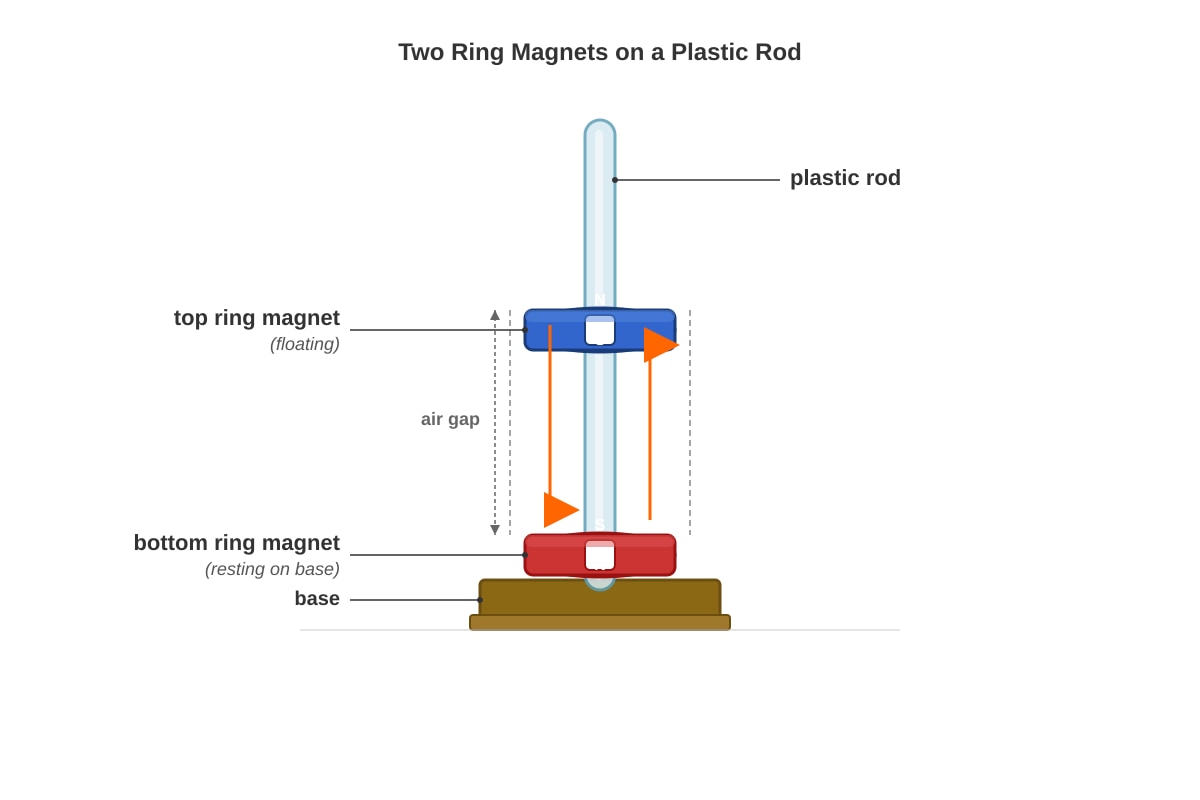
- Answer: The two poles facing each other are the same pole (e.g., North facing North, or South facing South). They are like poles.
- Mark: 1
- Explanation: The magnets repel, so the poles facing each other must be like poles. It is impossible to tell which pole it is from the diagram, but the polarity is the same on both faces.
(b)
- Answer: You could use stronger magnets, or you could add another ring magnet below with the same pole facing up to push the top magnet even higher.
- Mark: 2
- Marking scheme:
- 1 mark for "use stronger magnets."
- 1 mark for any other valid method (e.g., adding another ring magnet below).
- Explanation: A stronger magnetic repulsion force will push the top magnet higher. Adding another magnet with the same pole facing up increases the total repulsive force.
- Common mistake: Students might say "flip one magnet," which would cause them to attract and stick, not float higher.
20. (a)
- Answer: No, it did not attract the iron filings. Because the nail was not a magnet, it was just a normal piece of steel before being attracted to the permanent magnet.
- Mark: 1
- Explanation: A non-magnetic piece of steel (like a nail) will not attract other magnetic materials. It only becomes a temporary magnet after being in contact with (or very close to) a permanent magnet.
(b)
- Answer: The nail became a temporary magnet when it was attracted to the permanent magnet. This process is called magnetic induction. The nail then had its own magnetic poles and could attract the iron filings.
- Mark: 2
- Marking scheme:
- 1 mark for stating the nail became a (temporary) magnet.
- 1 mark for explaining that this allowed it to attract the iron filings.
- Explanation: This is a key P3 concept. A magnetic material (like steel/iron) can be magnetised by being in a magnetic field. This is how you make a temporary magnet. The effect is lost when the permanent magnet is removed (for soft iron, but steel retains some magnetism).
--- End of Answer Key ---