From Real Exams Quiz
Primary 3 Science Magnets Quiz
Free P3 Science Magnets quiz, Exam version, with questions, answers, and syllabus-aligned practice for Singapore students.
These static practice materials are generated from the site's syllabus and paper-generation workflow, with source and model context shown so students and parents can evaluate the material before use.
Questions
Free quiz and exam paper access
Enter your details to view this paper
Your access is remembered on this device.
Answers
Answer Key: Primary 3 Science Quiz - Magnets
Total Marks: 30
Section A: Multiple-Choice Questions (10 x 1 mark = 10 marks)
1. C. Iron
- Explanation: Iron is a magnetic material. Magnets attract objects made of iron and steel. Wood, plastic, and glass are not magnetic materials.
- Common Mistake: Students may think all metals are magnetic. Only some metals like iron, steel, nickel, and cobalt are magnetic. Copper and aluminium are not magnetic.
2. B. North-South
- Explanation: A freely suspended bar magnet acts like a compass. Its north pole points towards the Earth's geographic North Pole, and its south pole points towards the geographic South Pole. This is because the Earth itself acts like a giant magnet.
- Common Mistake: Students may think it points East-West or in a random direction.
3. B. They will repel each other.
- Explanation: Like poles (North-North or South-South) repel each other. Unlike poles (North-South) attract each other. Since both are north poles, they will push away from each other.
- Common Mistake: Students often confuse the rule and think all poles attract.
4. C. A steel paperclip
- Explanation: Steel is a magnetic material because it contains iron. Magnets attract objects made of iron or steel. Plastic, wood, and glass are non-magnetic materials.
- Common Mistake: Students may think a magnet attracts all shiny or metallic objects.
5. B. Poles
- Explanation: The two ends of a magnet are called its north pole and south pole. The magnetic force is strongest at the poles.
- Common Mistake: Students may use general terms like "ends" or "sides" instead of the specific scientific term "poles."
6. C. Cutting a piece of paper
- Explanation: Magnets are used to hold things (like notes on a fridge), close cupboard doors (magnetic catches), and pick up magnetic materials (like iron filings). A magnet cannot cut paper; scissors or a blade is needed for that.
- Common Mistake: Students may not think of everyday uses of magnets.
7. B. Magnetism
- Explanation: Magnetism is the invisible force that a magnet exerts. It can attract or repel other magnets and attract magnetic materials.
- Common Mistake: Students may confuse magnetism with gravity or friction.
8. B. Through a distance
- Explanation: A magnet can attract a magnetic object without touching it. This shows that magnetic force can act at a distance. The force is strongest when the object is close to the magnet.
- Common Mistake: Students may think a magnet must touch an object to attract it.
9. C. Steel
- Explanation: Steel is a magnetic material. It can be magnetised by methods like stroking or using electricity. Copper, aluminium, and rubber are not magnetic and cannot be made into magnets.
- Common Mistake: Students may think any metal can be magnetised.
10. A. North pole
- Explanation: Unlike poles attract. Since the south pole of magnet X is attracted to one end of magnet Y, that end must be the north pole (South attracts North).
- Common Mistake: Students may think like poles attract.
Section B: Fill in the Blanks (5 x 2 marks = 10 marks)
11. south
- Explanation: A magnet has two poles: the north pole and the south pole.
- Marking: 1 mark for the correct word.
12. attract and repel
- Explanation: Unlike poles (north and south) attract each other. Like poles (north-north or south-south) repel each other.
- Marking: 1 mark for each correct word (2 marks total).
13. north-south
- Explanation: A freely suspended bar magnet will always align itself in the north-south direction. This is how a compass works.
- Marking: 1 mark for the correct direction. Accept "north and south" or "north-south."
14. magnetic
- Explanation: Materials that are attracted to a magnet are called magnetic materials. Examples include iron and steel.
- Marking: 1 mark for the correct word.
15. stroking
- Explanation: The stroking method is one way to make a magnet. You stroke a steel bar with one pole of a magnet in one direction repeatedly.
- Marking: 1 mark for the correct word.
Section C: Short-Answer Questions (5 x 2 marks = 10 marks)
16. Answer: The metal paperclip will be attracted to the magnet. The plastic toy car will not be attracted. Explanation: The metal paperclip is likely made of steel, which is a magnetic material. Plastic is a non-magnetic material, so it will not be attracted to a magnet. Marking:
- 1 mark for correctly identifying the paperclip.
- 1 mark for explaining that it is made of a magnetic material (steel/iron).
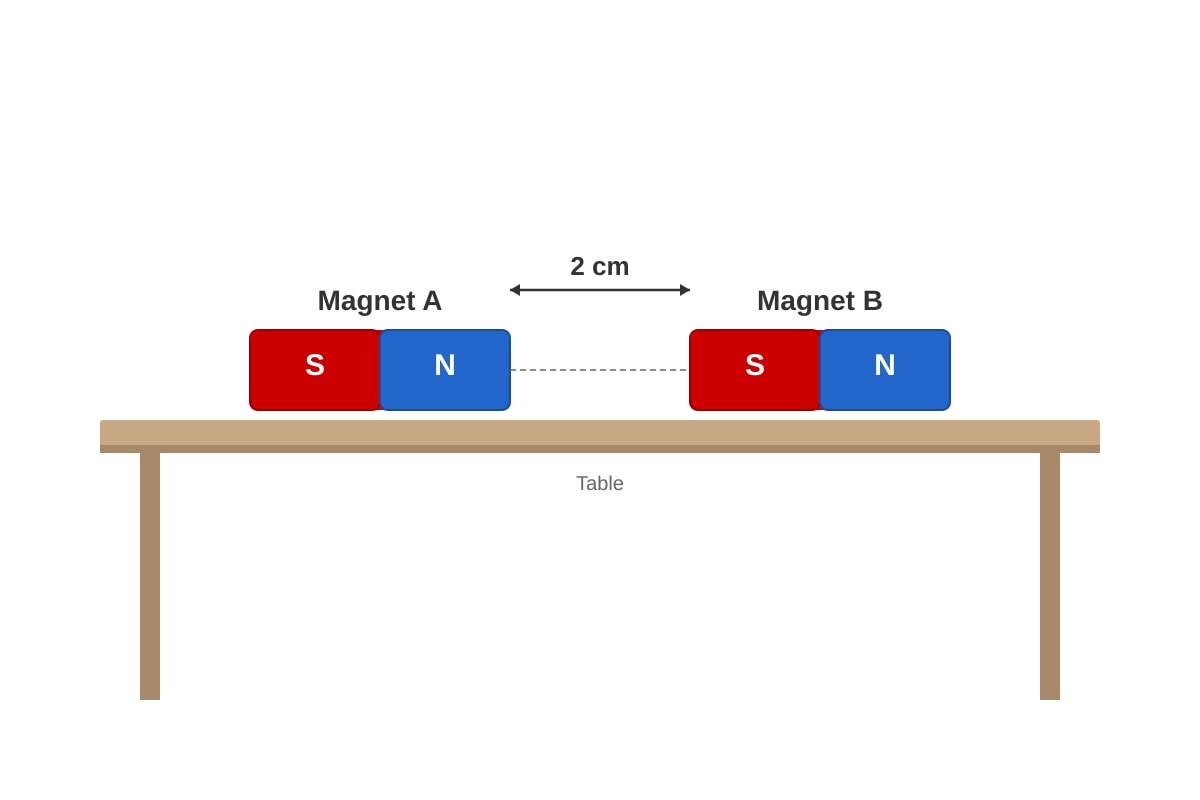
17. Answer: The two magnets will attract each other. Explanation: The north pole of Magnet A is facing the south pole of Magnet B. Unlike poles attract each other. Marking:
- 1 mark for stating "attract."
- 1 mark for explaining that unlike poles (north and south) attract.
18. Answer: (Accept any reasonable example, such as:)
- Using a magnet to hold notes on a refrigerator door.
- Using a magnetic catch to keep a cupboard door closed.
- Using a compass (which has a magnetic needle) to find directions.
- Using a magnet to pick up iron filings or spilled paperclips. Marking:
- 1 mark for a clear example of a magnet being used.
- 1 mark for stating where it is used (classroom or home). Accept a general example without specifying location.
19. Answer: The iron nail and the steel paperclip. Explanation: Iron and steel are magnetic materials. Copper and plastic are not magnetic. Marking:
- 1 mark for each correct object (2 marks total). Must name both objects correctly.
20. Answer: (Accept any one correct step, such as:)
- Stroke the steel needle with one pole of the bar magnet in one direction repeatedly (e.g., 50 times).
- OR: Rub the magnet along the needle from one end to the other, always in the same direction.
- OR: Place the needle in a coil of wire connected to a battery (electrical method). Explanation: The stroking method aligns the magnetic domains in the steel needle, turning it into a temporary magnet. Marking:
- 1 mark for describing a correct method (stroking or electrical).
- 1 mark for including a key detail (e.g., "in one direction," "repeatedly," or "using a battery").
- Accept any reasonable description of a valid method.
End of Answer Key