From Real Exams Quiz
Primary 3 Science Light Quiz
Free P3 Science Light quiz, Kimi2.6 Exam version, with questions, answers, and syllabus-aligned practice for Singapore students.
These static practice materials are generated from the site's syllabus and paper-generation workflow, with source and model context shown so students and parents can evaluate the material before use.
Questions

Free quiz and exam paper access
Enter your details to view this paper
Your access is remembered on this device.
Answers
Primary 3 Science Quiz - Light — Answer Key
Total marks: 30
Section A: Multiple Choice (Questions 1–10)
1. (b) Light from the object or reflected by the object — [1 mark]
Teaching note: We see objects when light enters our eyes. This light can come directly from a light source (like the Sun or a bulb) or can be reflected off objects. Without light reaching our eyes, we cannot see anything. This is why we cannot see in a completely dark room.
2. (b) there was no light to reflect off the block — [1 mark]
Teaching note: The wooden block is opaque, so it does not produce its own light. In a dark room with no light source, there is no light to reflect off the block and enter Jenny's eyes. The block still exists, but Jenny cannot see it. A common mistake is thinking opaque objects are invisible in the dark; they are not invisible—they just have no light to reflect.
3. (c) The Sun — [1 mark]
Teaching note: Natural sources of light occur in nature without human-made technology. The Sun is a star that produces its own light through nuclear reactions. A torch, candle, and light bulb are all artificial (human-made) sources of light. Fire from candles is also natural in origin but the candle itself is manufactured. The Sun is the clearest answer for a purely natural source.
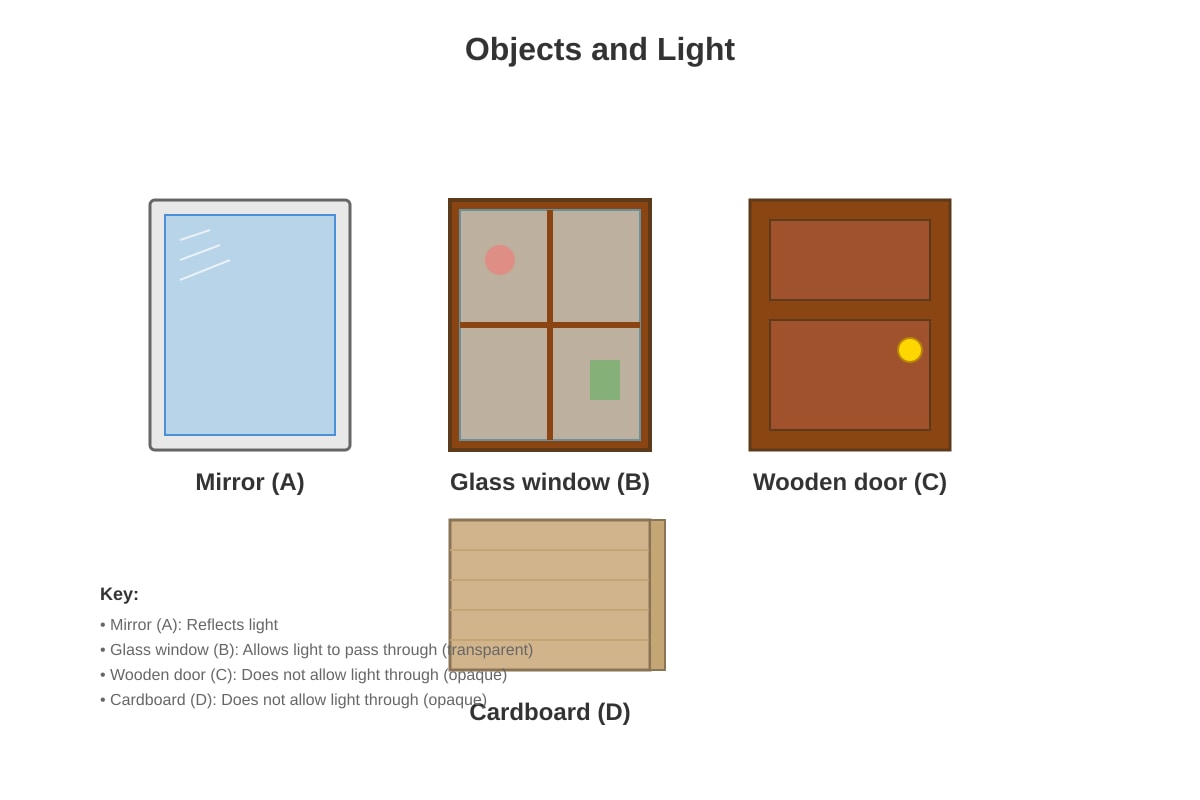
4. (b) B (Glass window) — [1 mark]
Teaching note: Transparent materials allow light to pass through so we can see clearly through them. Glass is transparent. A mirror reflects light rather than transmitting it. A wooden door and cardboard are opaque—they block light completely. Students sometimes confuse "shiny" with "see-through"; mirrors are shiny but not transparent.
5. (c) blocked by an opaque object — [1 mark]
Teaching note: Shadows form when an opaque object blocks light from a light source. The light cannot pass through or around the object, so a dark area (shadow) appears on the surface behind. Refraction is bending of light, reflection is bouncing back, and transparent objects do not block light—they let it pass through.
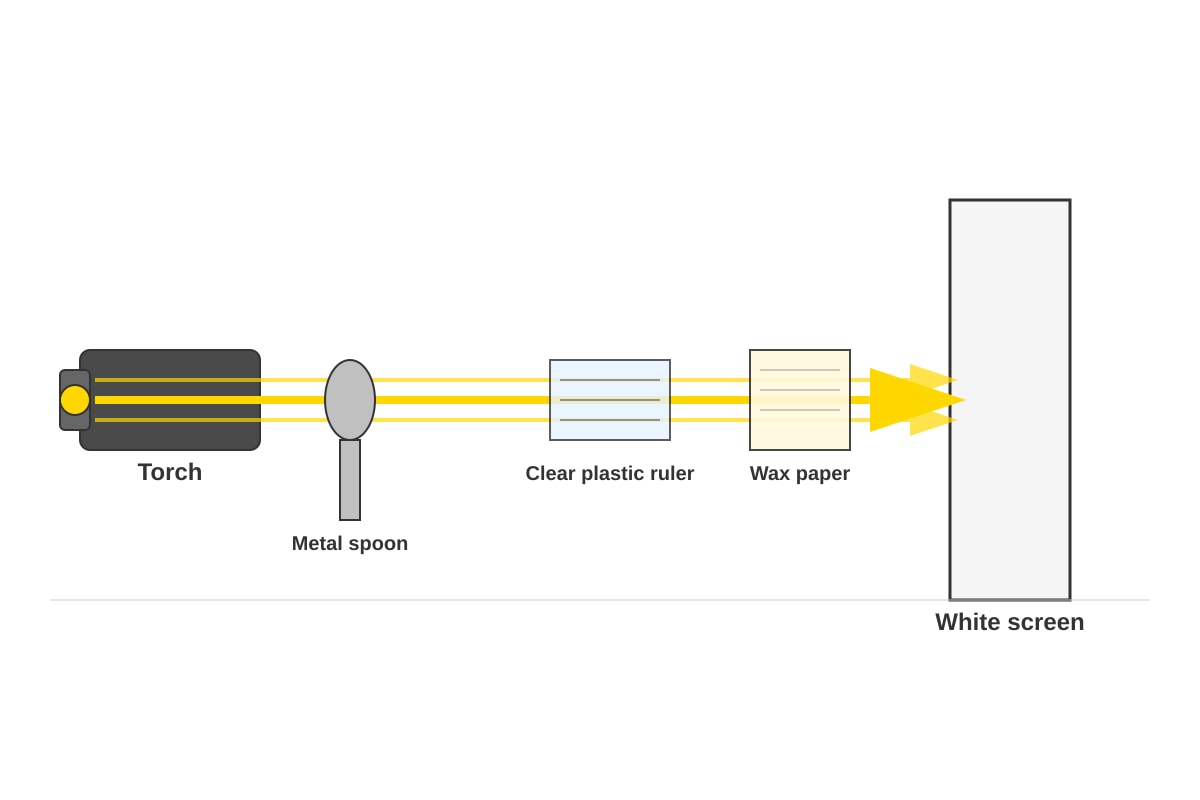
6. (b) The clear plastic ruler — [1 mark]
Teaching note: The clear plastic ruler is transparent, so light passes through it almost completely without being blocked. It will either cast no shadow or a very faint one. The metal spoon is opaque and blocks all light. Wax paper is translucent—some light passes through but it is scattered, so it will cast a faint shadow. The question tests understanding that transparency means light goes through, not around.
7. (b) the Moon blocks light from reaching Earth — [1 mark]
Teaching note: A solar eclipse demonstrates the same principle as shadow formation. The Moon is opaque and moves between the Sun (light source) and Earth (screen). The Moon's shadow falls on Earth, blocking sunlight. This is direct evidence that light travels in straight lines and opaque objects create shadows.
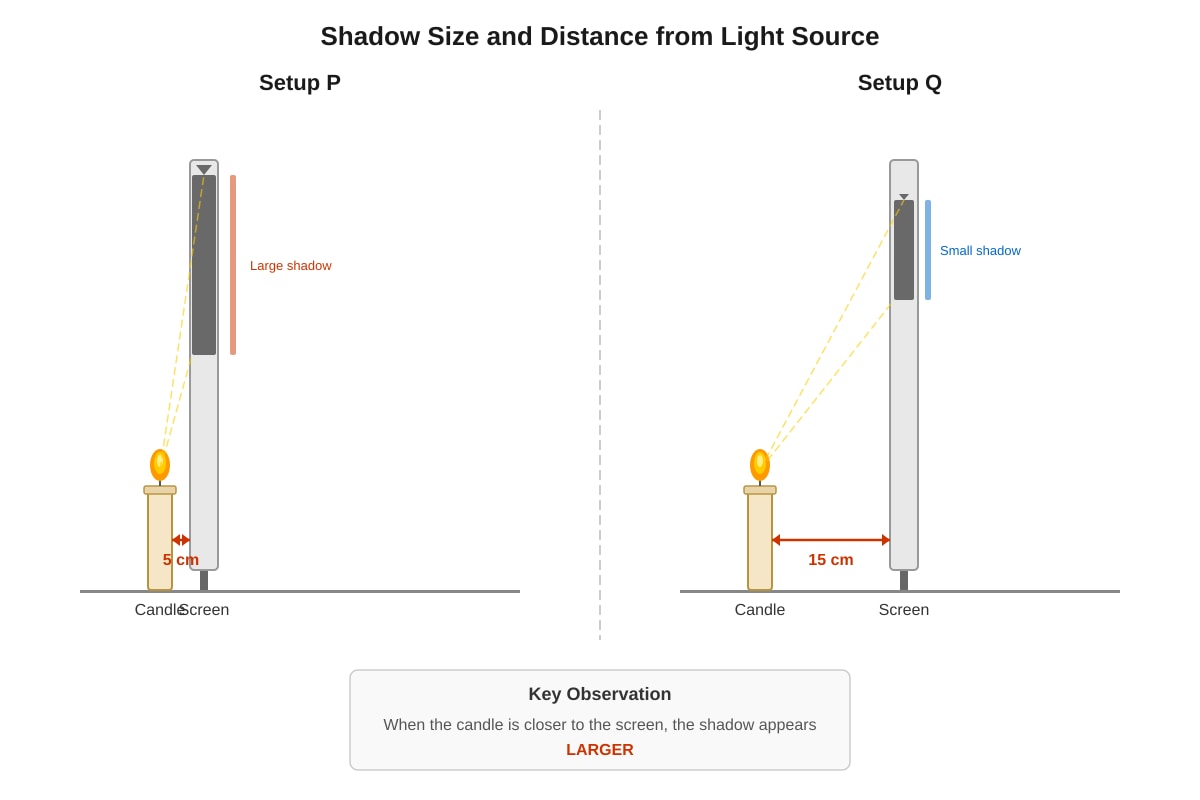
8. (b) Setup Q only — [1 mark]
Teaching note: In Setup Q, the candle is further from the screen but closer to the implied light source (or the setup suggests the torch is fixed and the candle is between torch and screen). Actually, re-reading: the candle is the object blocking light from a fixed torch. When an object is closer to the light source, its shadow is larger; when further from the light source (closer to the screen), its shadow is smaller.
Correction with careful reading: The diagram shows candle-to-screen distance only. Assuming a fixed torch position: in Setup P, candle is 5 cm from screen (so likely further from torch, shadow smaller); in Setup Q, candle is 15 cm from screen (so closer to torch, shadow larger). The shadow is larger when the object is closer to the light source. Setup Q shows larger shadow.
9. (c) Light travels in straight lines and cannot pass through opaque objects — [1 mark]
Teaching note: This is a fundamental property of light in the P3 syllabus. Light travels in straight lines called "rays." It cannot bend around corners (this is why shadows have sharp edges). Opaque objects completely block light. Transparent and translucent objects allow some light through to different degrees. Option (a) is wrong—light does not speed around corners; (b) is wrong—light does not bend through opaque objects; (d) is wrong—light passes through transparent objects.
10. (b) Whether light passes through clearly, diffusely, or not at all — [1 mark]
Teaching note: This is the complete definition test:
- Transparent: light passes through clearly, sharp images
- Translucent: light passes through diffusely, blurry/no images
- Opaque: no light passes through
The other options test unrelated properties (heat, colour change, sound).
Section B: Fill in the Blanks and Matching (Questions 11–15)
11. (a) transparent — [1 mark]; (b) translucent — [1 mark]
Teaching note: Clear glass is the classic transparent example—objects behind can be seen clearly. Frosted glass has a rough surface that scatters light, making it translucent. Objects behind appear blurry or indistinct. These two are often confused: remember "transparent" = "can see through," "translucent" = "light through but not clear."
12. Matching: — [2 marks, 0.5 each]
| Object | Matches to | Description |
|---|---|---|
| Mirror | ↔ | Light is bounced back |
| Clear glass | ↔ | Light passes through completely |
| Brick wall | ↔ | No light passes through |
| Tracing paper | ↔ | Light is partly scattered through |
Teaching note:
- Mirror: Special opaque surface that reflects light in an organised way, giving clear images.
- Clear glass: Transparent—classic example.
- Brick wall: Opaque—heavy, dense blocks all light.
- Tracing paper: Translucent—used in art to copy through, but blurry.
13. The Sun was lower in the sky in the morning, so sunlight hit David at a shallower angle, making his shadow longer. At noon, the Sun was directly overhead, so the shadow was shorter. — [2 marks]
Marking breakdown:
- [1 mark] Sun's position changes (lower in morning vs. overhead at noon)
- [1 mark] Link to shadow length (lower angle = longer shadow; higher/direct = shorter shadow)
Teaching note: This connects light travelling in straight lines with daily Sun motion. When the Sun is low, light rays arrive at a shallow angle, stretching shadows across the ground. At noon near the equator (Singapore), the Sun is almost directly overhead, making shadows very short or beneath objects. This is practical, observable science for P3 students.
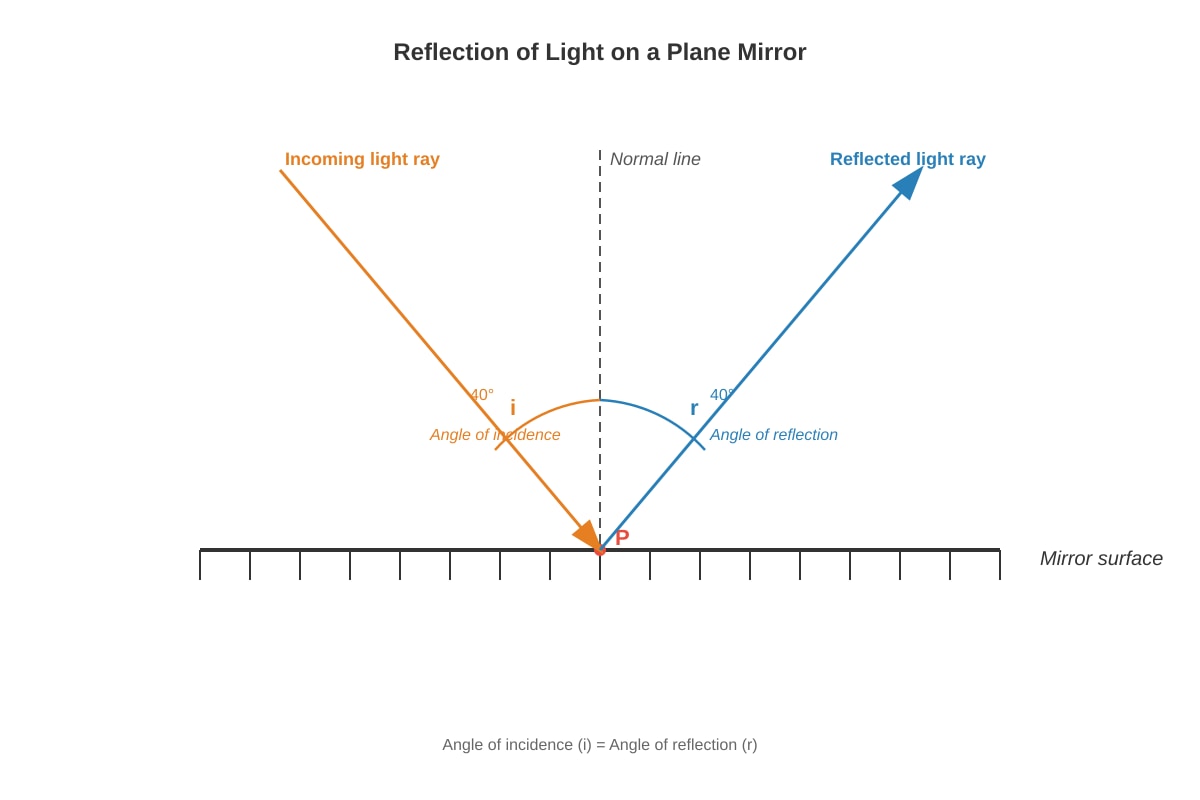
14. (a) Normal — [1 mark]
(b) 40° (or "equal to the angle of incidence" / "40 degrees") — [1 mark]
Teaching note: The normal is an imaginary line perpendicular (at 90°) to the surface where light hits. The law of reflection states: angle of incidence = angle of reflection. Both angles are always measured from the normal, not from the mirror surface. A common error is measuring from the mirror surface (would give 50°), which is wrong.
15. (a) An upside-down (inverted) image of the candle flame — [1 mark]
(b) Light travels in straight lines. Light from the top of the flame passes through the pinhole and hits the bottom of the screen. Light from the bottom of the flame passes through the hole and hits the top of the screen. This crosses over, making the image upside down. — [2 marks]
Marking breakdown:
- [1 mark] Light travels in straight lines (stated or implied)
- [1 mark] Crossover explanation—top→bottom, bottom→top (or equivalent clear description)
Teaching note: The pinhole camera has no lens—just a tiny hole. Each point on the object sends light in all directions, but only a narrow beam passes through the pinhole. These straight beams cross at the hole, inverting the image. This is a classic P3 demonstration of light's straight-line travel. The image is also dim because so little light gets through.
Section C: Short Answer and Application (Questions 16–20)
16. (a) Position A — [1 mark]
(b) Position A is in direct sunlight, so the most light reaches it. Positions B, C, and D are in shadow (shaded areas where light is blocked), so less light reaches them. More light means easier reading. — [2 marks]
Marking breakdown:
- [1 mark] Identifies A receives most/direct light
- [1 mark] Explains others are in shadow/blocking occurs; links to seeing/reading
Teaching note: This applies the transparent/opaque/shadow concepts to daily life. Direct sunlight = maximum illumination. Shade = reduced light, possible eyestrain. Corner D might seem cozy but is too dim. Middle C receives some ambient light but no direct beam.
17. (a) Thick red velvet — [1 mark]
(b) — [2 marks, 0.5 each]
| Material | Classification |
|---|---|
| Thin white cotton | transparent (or accept: mostly transparent) |
| Thick red velvet | opaque |
| Yellow plastic sheet | translucent |
| Green mesh fabric | translucent (or accept: partially transparent/opaque depending on interpretation; "translucent" preferred) |
Teaching note:
- Thin white cotton: very little fiber density, quite see-through = transparent
- Thick red velvet: dense, dark, blocks all light = opaque
- Yellow plastic sheet: light through but blurry = translucent
- Green mesh fabric: holes let light through, but overall blurry image = best classified as translucent
Alternative for green mesh: Some may argue "not uniformly any category"—but the holes create blurry patterns, fitting translucent's "light passes but no clear image."
(c) Thick red velvet is opaque and blocks all light. In a bathroom, you want some natural light to enter during the day so you can see without using electricity, but velvet would make it too dark. — [2 marks]
Marking breakdown:
- [1 mark] Velvet is opaque/blocks all light
- [1 mark] Need some light for visibility/seeing without artificial light (or privacy with light as alternative valid point: allows light in but blocks view—accept frosted glass purpose)
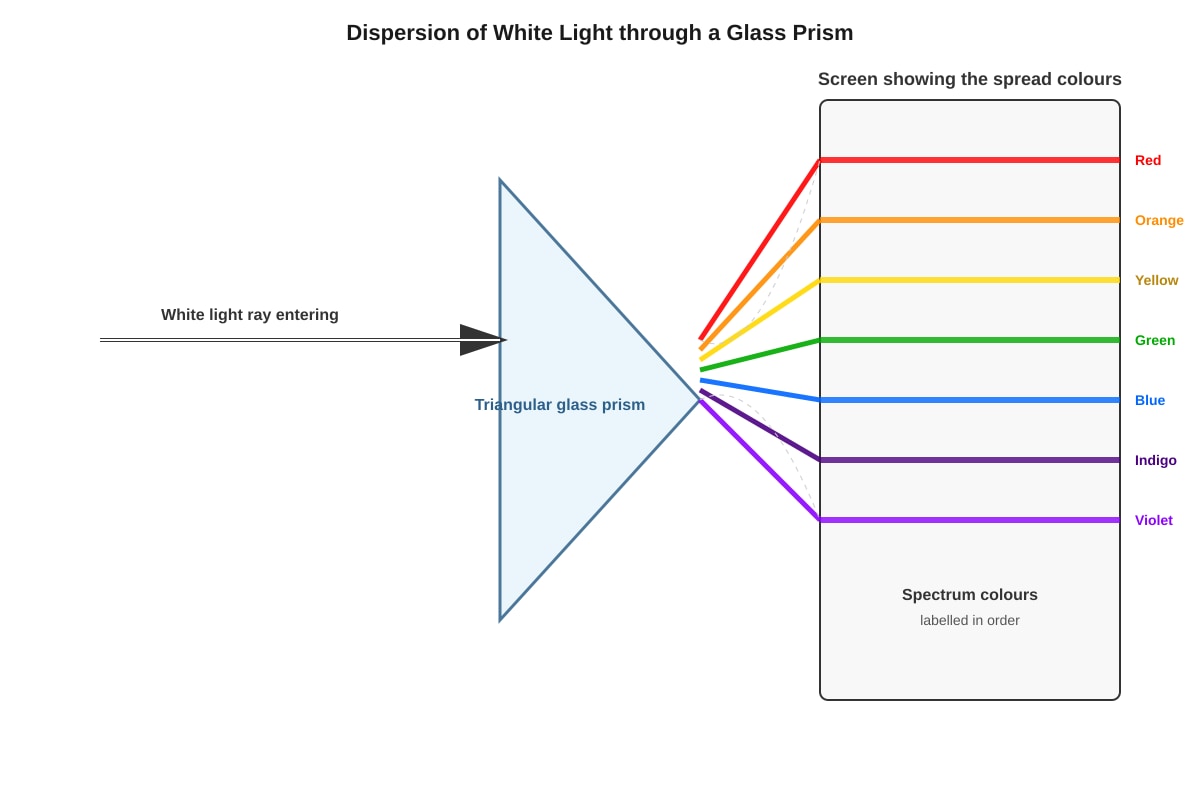
18. (a) Spectrum (or "visible spectrum" / "colour spectrum") — [1 mark]
(b) Red, orange, yellow, green, blue, indigo, violet — [2 marks, 0.5 marks off per error; must be in correct order)
Alternative mnemonic aid: ROY G BIV
(c) White light is not a single colour. It is made up of many different colours mixed together. The prism separates (splits) these colours because each colour bends by a different amount. — [2 marks]
Marking breakdown:
- [1 mark] White light contains many colours/made of spectrum colours
- [1 mark] Prism separates them / different colours bend differently / splits white light
Teaching note: This is Newton's classic experiment. The prism refracts (bends) each wavelength (colour) by a slightly different angle, spreading white light into its components. Red bends least, violet bends most. P3 level does not need "wavelength" or "refraction" terminology—the conceptual understanding that white light = many colours is sufficient.
19. (a) The shadow gets smaller (or "decreases in size" / "becomes smaller") — [1 mark]
(b) No, Jason is not correct. — [1 mark for identification; explanation below continues]
The pattern shows that as the distance increases, the shadow gets smaller (10 cm → 8 cm, 20 cm → 5 cm, 30 cm → 3 cm). At 40 cm, the shadow would be even smaller than 3 cm, not bigger than 8 cm. — [1 mark for correct reasoning with data]
Teaching note: This is pattern recognition from data with inverse relationship. When the object moves away from the light source (toward screen), the shadow shrinks. Jason incorrectly predicted the opposite trend. Students should use the data trend, not guess. The relationship: object closer to source = bigger shadow; object closer to screen = smaller shadow.
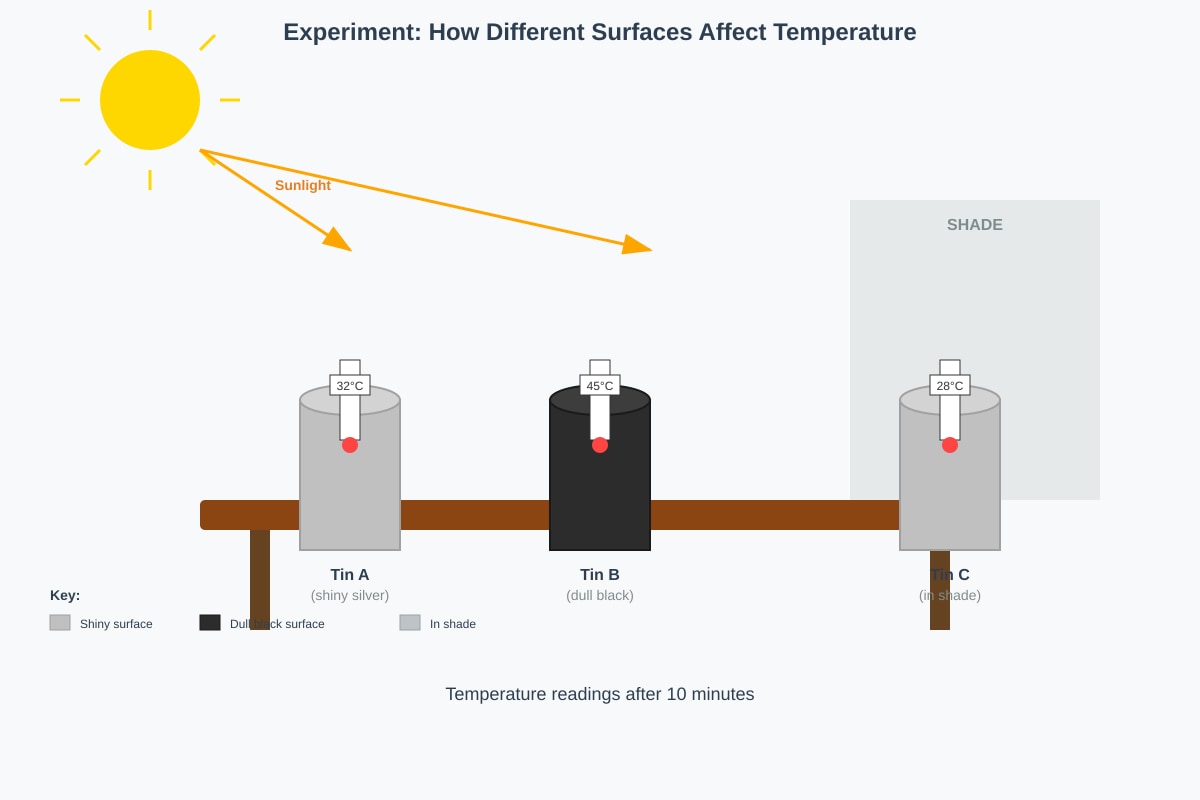
20. (a) Dull black surfaces absorb more light (and heat) than shiny silver surfaces. Shiny silver reflects most light away, so less heat is absorbed. The absorbed light energy becomes heat energy, making Tin B hotter. — [2 marks]
Marking breakdown:
- [1 mark] Black/dull surfaces absorb more light/heat (or shiny surfaces reflect more)
- [1 mark] More absorption leads to more heating / temperature rise; or links colour to temperature difference
(b) Paint the roof white or silver / use shiny reflective materials on windows / plant trees for shade / use light-coloured walls — [1 mark]
Teaching note: This connects to real-world energy efficiency in tropical Singapore. Dark surfaces (black roofs, dark roads) absorb solar radiation and heat up, contributing to urban heat island effect. Light/shiny/reflective surfaces reduce cooling loads and save energy. Any practical application of "reflective/light colours stay cooler" is acceptable.
END OF ANSWER KEY