From Real Exams Quiz
Primary 3 Science Light Quiz
Free P3 Science Light quiz, GLM5.3 Exam version, with questions, answers, and syllabus-aligned practice for Singapore students.
These static practice materials are generated from the site's syllabus and paper-generation workflow, with source and model context shown so students and parents can evaluate the material before use.
Questions
Free quiz and exam paper access
Enter your details to view this paper
Your access is remembered on this device.
Answers
Primary 3 Science Quiz - Light: Answer Key
Total Marks: 50
Answer 1.
(c) the Sun — 2 marks. Teaching note: A light source makes its own light. The Sun makes its own light and is found in nature, so it is a natural source. The torch, candle and table lamp also make light, but people made them, so they are man-made sources.
Answer 2.
(b) Light travels in straight lines. — 2 marks. Teaching note: Light always moves in straight lines until it is blocked by an object or bounces off a mirror. This is why shadows have sharp shapes. Curved or zigzag paths are impossible for light in air.
Answer 3.
(b) a clear glass window — 2 marks. Teaching note: Clear glass lets almost all the light pass through. Wood, metal and thick cardboard block the light, so little or no light passes through them. Look for the material you can see through most easily.
Answer 4.
(b) Her hand blocked the light from the torch. — 2 marks. Teaching note: A shadow forms when an object blocks light. Light travels in straight lines, so it cannot bend around the hand. The area behind the hand on the wall receives no light and appears dark — that dark area is the shadow. Common mistake: choosing (a); hands do not make their own light.
Answer 5.
(c) the Moon — 2 marks. Teaching note: The Moon looks bright, but it does not make its own light. It only reflects (bounces back) sunlight towards us. Fireflies, burning candles and stars all produce their own light. Common mistake: thinking anything bright is a light source.
Answer 6.
Any correct pair — 1 mark each.
- Natural source: the Sun, a star, or a firefly.
- Man-made source: torch, table lamp, candle, street lamp, phone screen light. Marking note: Accept any reasonable example. Do not accept the Moon as a natural light source (it only reflects light).
Answer 7.
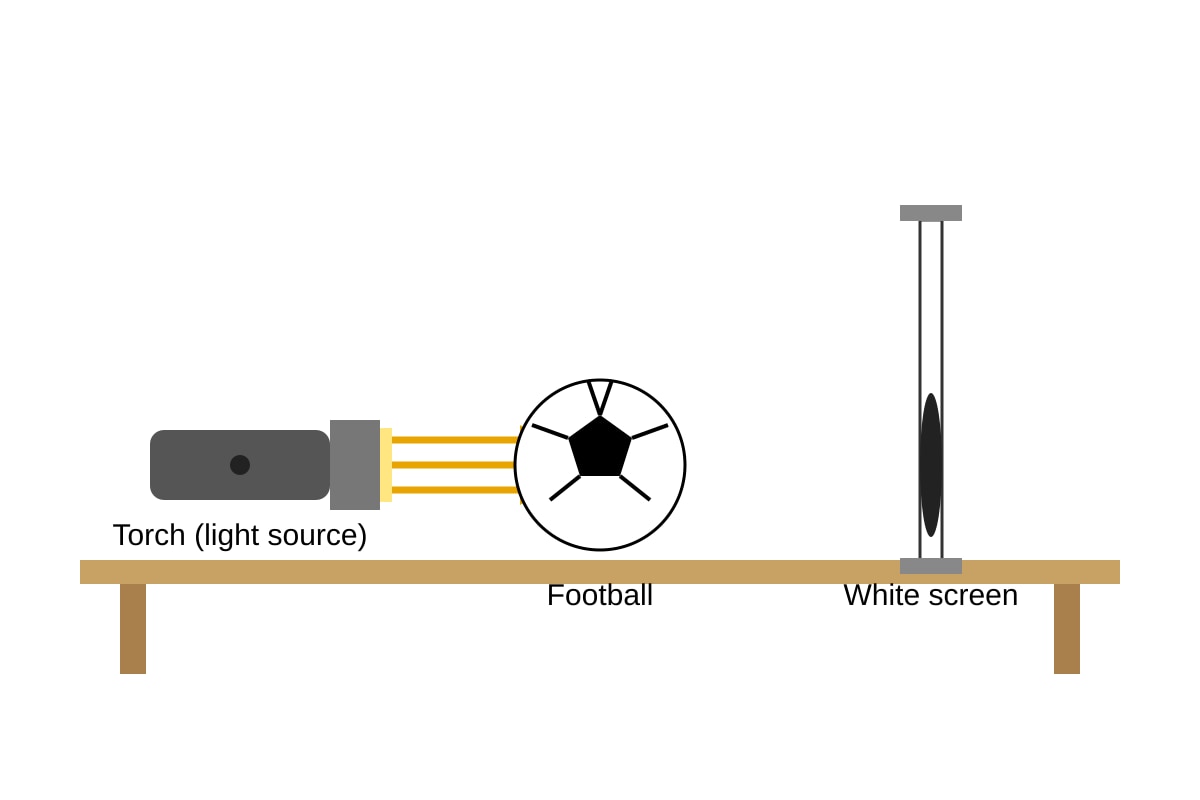
The dark shape is a shadow (1 mark). The football blocked the light from the torch (1 mark). Teaching note: Light from the torch travels in straight lines towards the screen. The football is in the way, so light cannot pass through it. The area behind the football gets no light, so a dark round shadow appears on the screen. Expected visual (Q7-fig1): straight arrows from torch stop at the football; dark circle on the screen behind it.
Answer 8.
½ mark per correct tick (total 2 marks).
- (a) False — the Moon reflects sunlight;
<stage3_quiz_answers_md>
Primary 3 Science Quiz - Light: Answer Key
Total Marks: 50
Answer 1.
(c) the Sun — 2 marks. Teaching note: A natural light source makes its own light and is found in nature. The torch, candle and table lamp also make light but people made them, so they are man-made sources.
Answer 2.
(b) Light travels in straight lines. — 2 marks. Teaching note: Light always moves in straight lines until it is blocked by an object or bounces off a mirror. This is why shadows have sharp shapes matching the object.
Answer 3.
(b) a clear glass window — 2 marks. Teaching note: Clear glass lets almost all the light pass through. Wood, metal and thick cardboard block the light, so little or no light passes through them.
Answer 4.
(b) Her hand blocked the light from the torch. — 2 marks. Teaching note: A shadow forms when an object blocks light. Light travels in straight lines, so it cannot bend around the hand. The area behind the hand receives no light and appears dark. Common mistake: choosing (a); hands do not make their own light.
Answer 5.
(c) the Moon — 2 marks. Teaching note: The Moon looks bright but does not make its own light; it only reflects sunlight towards us. Fireflies, burning candles and stars all produce their own light. Common mistake: thinking anything bright is a light source.
Answer 6.
Any correct pair — 1 mark each.
- Natural source: the Sun, a star or a firefly.
- Man-made source: torch, table lamp, candle, street lamp or phone screen light. Marking note: Do not accept the Moon as a natural light source (it only reflects light).
Answer 7.
The dark shape is a shadow (1 mark). The football blocked the light from the torch (1 mark). Teaching note: Light travels in straight lines towards the screen. The football is in the way, so light cannot pass through it. The area behind the football gets no light, so a dark round shadow appears on the screen.
Answer 8.
½ mark per correct tick (total 2 marks).
- (a) False — the Moon reflects sunlight; it does not make its own light.
- (b) True — light always travels in straight lines.
- (c) True — mirrors bounce light back, which is reflection.
- (d) False — brick walls are opaque; no light passes through.
Answer 9.
½ mark per correctly placed item (total 2 marks).
- Gives out its own light: torch, star, candle.
- Does not give out its own light: mirror, storybook, metal spoon. Marking note: A switched-on torch counts as giving out its own light. A mirror only reflects light from other sources.
Answer 10.
Light from the classroom lamps (or sunlight) shines onto the book and reflects (bounces off) the book into Aminah's eyes, so she can see it — 2 marks. Teaching note: We see non-luminous objects when they reflect light into our eyes. The book itself gives out no light.
Answer 11.
1 mark per correct row, 1 mark for final blank (total 3 marks).
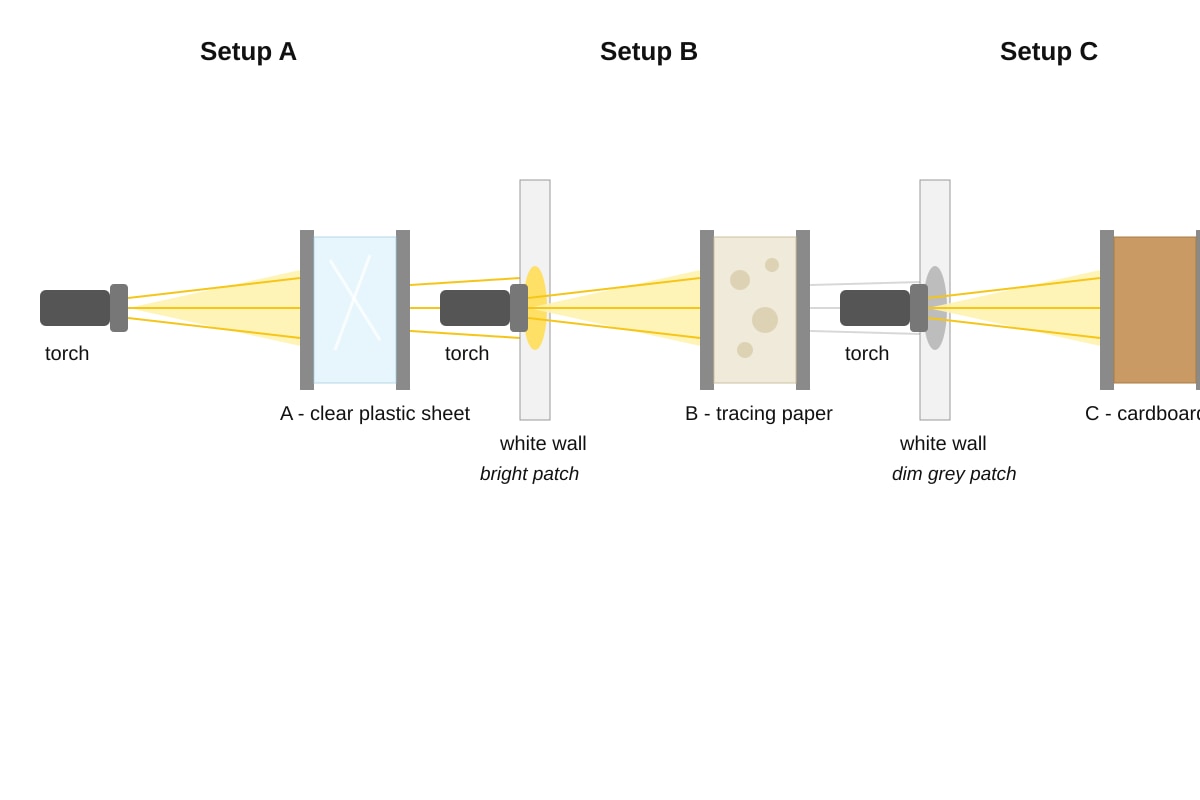
| Sheet | How much light passes through? | Shadow on the wall |
|---|---|---|
| A - clear plastic sheet | most | very light |
| B - tracing paper | some | light |
| C - cardboard sheet | none | dark |
Sheet allowing no light through: C - cardboard sheet. Teaching note: Clear materials let most light through; cloudy materials let some through; opaque materials let none through and cast the darkest shadows.
Answer 12.
(a) Square (the same shape as the card) — 1 mark. (b) Light travels in straight lines and cannot bend around the card, so the parts of the screen behind the card receive no light, forming a square shadow — 2 marks.
Answer 13.
The shadow becomes bigger (1 mark). When the toy cow moves nearer to the lamp, it blocks light from more of the lamp's rays, so the blocked area reaching the screen is larger (2 marks). Teaching note: Object nearer to light source → bigger shadow; object nearer to screen → smaller shadow.
Answer 14.
1 mark each (total 3 marks).
- clear glass → (a) allows most light to pass through
- frosted (cloudy) glass → (b) allows some light to pass through
- tin sheet → (c) allows no light to pass through
Answer 15.
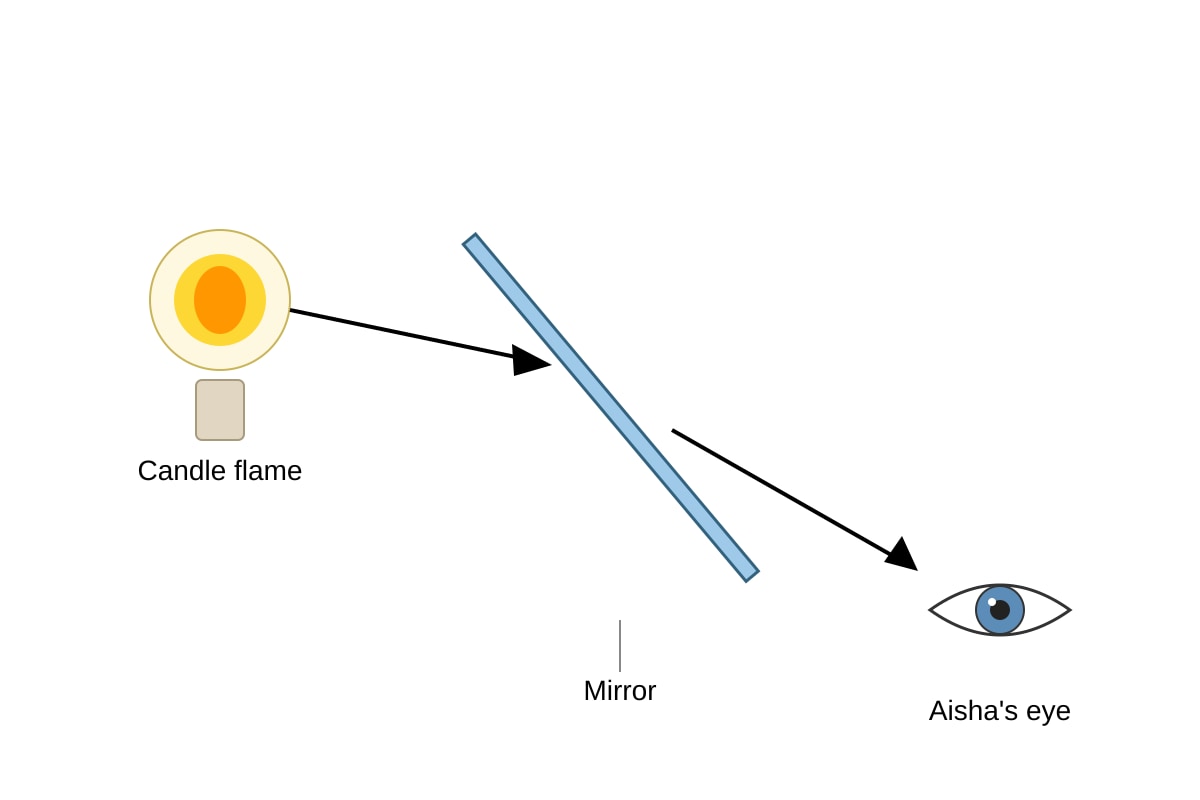
1 mark per blank (total 3 marks). Light from the flame travels to the mirror, bounces off it, and enters Aisha's eye. The bouncing of light off the mirror is called reflection. Teaching note: The diagram shows two straight arrows: flame → mirror, then mirror → eye.
Answer 16.
There is no source of light in the dark bedroom (all lamps are off), so no light is blocked and no shadow can be seen — 2 marks. Teaching note: Shadows need three things: a light source, an object to block the light, and a surface/screen. Without light, a shadow cannot form.
Answer 17.
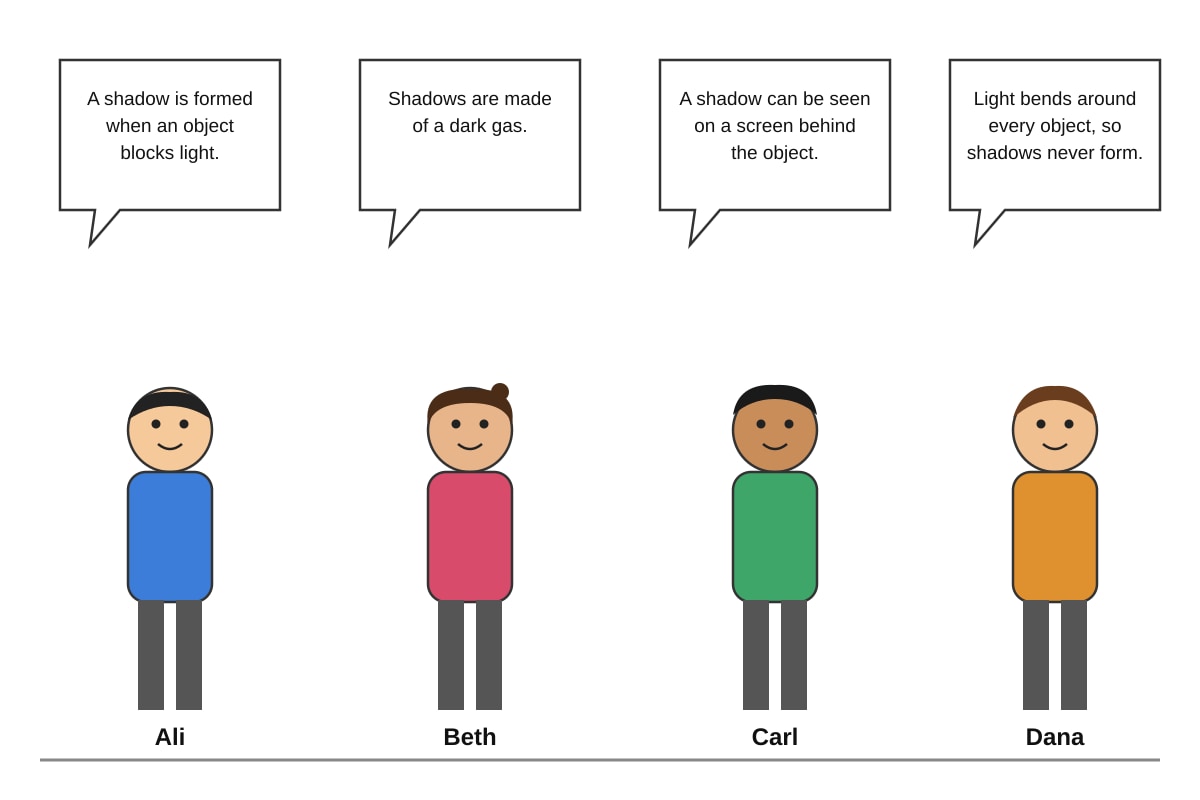
(a) Ali and Carl — 1 mark. (b) Dana is wrong because light travels in straight lines and cannot bend around objects. When an object blocks light, the area behind it gets no light, so a shadow does form — 2 marks. Marking note: Beth is also wrong; a shadow is a dark area where light is blocked, not a gas.
Answer 18.
Priya should choose the raincoat material (1 mark). From the table, raincoat material lets no light pass through (1 mark). Curtains made from it would block the strong morning sunlight completely, keeping the bedroom dark (2 marks). Marking note: Cotton lets some light through and net curtain cloth lets most light through, so both would still let sunlight into the room.
Answer 19.
Amir can move the paper puppet nearer to the torch (1 mark). When the puppet is closer to the light source, it blocks light over a larger area, so the shadow formed on the bedsheet becomes bigger (2 marks). Marking note: Accept any answer that moves the puppet closer to the torch without moving the torch or bedsheet.
Answer 20.
Any one correct example with explanation — 1 mark for example, 2 marks for explanation. Examples:
- A car's side/rear-view mirror: it reflects light from vehicles behind the driver into the driver's eyes, so the driver can see cars that are not directly in front.
- A dentist's mirror: it reflects light from inside the mouth so the dentist can see the back of the teeth.
- Corner mirrors at blind bends: they reflect light from the hidden road so drivers can see oncoming traffic. Teaching note: The key idea is that the mirror reflects light from an object that cannot be seen directly into the person's eyes.
End of answer key. Total: 50 marks.