From Real Exams Quiz
Primary 3 Science Light Quiz
Free P3 Science Light quiz, Exam version, with questions, answers, and syllabus-aligned practice for Singapore students.
These static practice materials are generated from the site's syllabus and paper-generation workflow, with source and model context shown so students and parents can evaluate the material before use.
Questions
Free quiz and exam paper access
Enter your details to view this paper
Your access is remembered on this device.
Answers
Answer Key: Primary 3 Science Quiz - Light
Total Marks: 30
Section A: Multiple-Choice Questions (10 marks)
1. (c) A candle flame
- Marks: 1
- Explanation: A source of light is an object that produces its own light. A candle flame produces light when it burns. A mirror, the Moon, and a white wall only reflect light; they do not produce their own light.
- Common mistake: Students may think the Moon is a light source because it appears bright at night. The Moon reflects sunlight.
2. (b) Light from the lamp reflects off the book into our eyes.
- Marks: 1
- Explanation: We see objects because light from a source (like a lamp) hits the object and then bounces off (reflects) into our eyes. The book does not produce its own light, and our eyes do not produce light.
- Key concept: Light must enter our eyes for us to see.
3. (c) A clear glass window
- Marks: 1
- Explanation: A clear glass window is transparent, meaning it allows most light to pass through. A frosted glass window lets some light through but scatters it. A wooden door and a cardboard box are opaque and block light.
4. (c) Blocked by an object
- Marks: 1
- Explanation: A shadow is formed when an object blocks light. The area behind the object does not receive light, creating a dark area called a shadow.
5. (a) 8:00 a.m.
- Marks: 1
- Explanation: Shadows are longest when the Sun is low in the sky, which happens in the early morning (e.g., 8:00 a.m.) and late afternoon. At noon, the Sun is high overhead, so shadows are shortest.
- Common mistake: Students may think shadows are longest at noon because the Sun is brightest.
6. (c) A light bulb
- Marks: 1
- Explanation: A light bulb is a man-made source of light. The Sun, a firefly, and a star are all natural sources of light.
7. (c) The light will be reflected by the mirror.
- Marks: 1
- Explanation: Mirrors have a smooth, shiny surface that reflects light very well. Light does not pass through a mirror; it bounces off.
8. (c) Thin fabric
- Marks: 1
- Explanation: A lampshade needs to let some light through (so the room is lit) but should not be completely see-through (so the bulb is not too bright to look at). Thin fabric is translucent—it lets some light through but scatters it. Clear plastic is transparent (too see-through), thick cardboard and aluminium foil are opaque (block all light).
9. (b) Light from you bounces off the mirror and enters your eyes.
- Marks: 1
- Explanation: Light reflects off your body, travels to the mirror, bounces off the mirror, and then enters your eyes. This allows you to see your reflection.
10. (a) The Sun is directly overhead, so light hits the tree from above.
- Marks: 1
- Explanation: When the Sun is directly overhead, light falls almost straight down. The tree blocks light directly beneath it, creating a short shadow. The shadow is small because the light source is high up.
Section B: Fill in the Blanks and Short Answer (10 marks)
11. (2 marks) Name two natural sources of light.
- Acceptable answers: Any two of: The Sun, stars, fireflies, lightning, some deep-sea fish.
- Marking: 1 mark for each correct natural source. Do not accept man-made sources like light bulbs or candles.
- Explanation: Natural light sources occur in nature without human intervention. The Sun is the main natural light source for Earth.
12. (2 marks) Complete the sentence: We can see objects because light travels from the object or a light source into our eyes.
- Marking: 1 mark for correct word "eyes". Accept "eye".
- Explanation: For vision to occur, light must enter the eye. The eye detects light and sends signals to the brain.
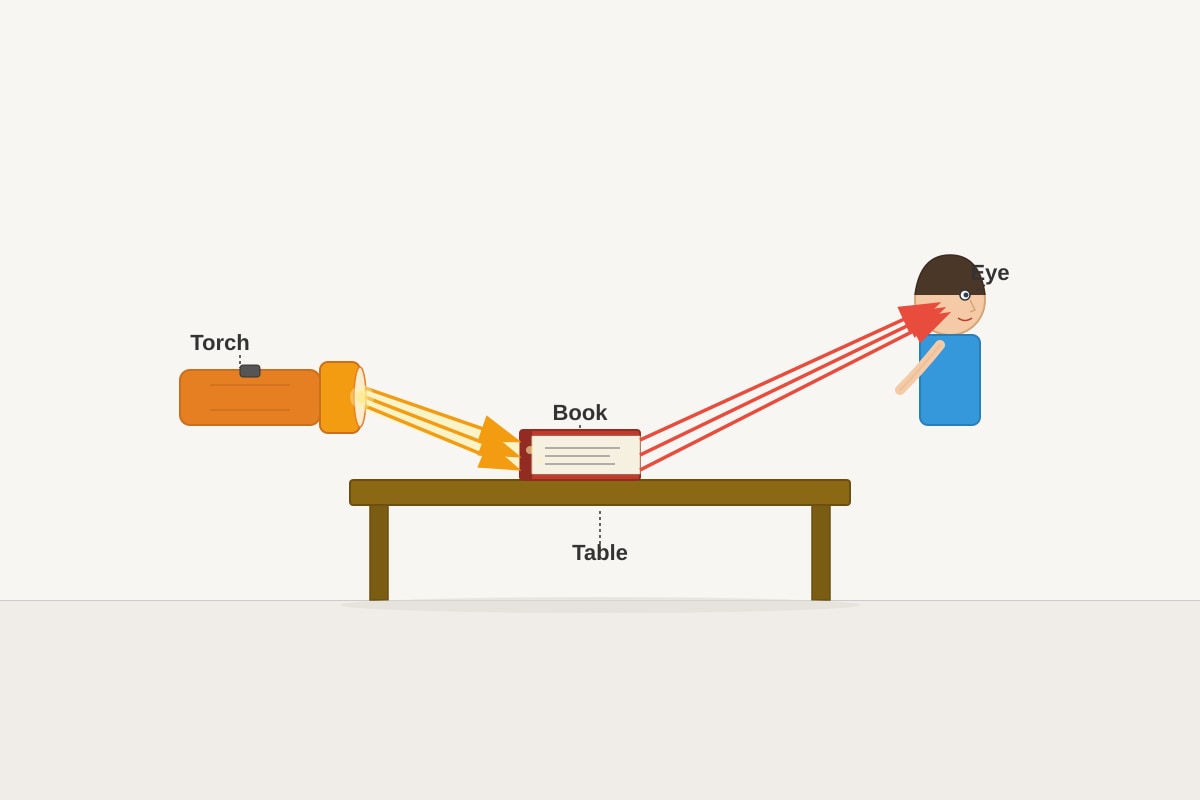
13. (2 marks) Explain how the person is able to see the book.
- Model answer: Light from the torch travels to the book. The light reflects off the book and travels into the person's eyes. This allows the person to see the book.
- Marking: 1 mark for stating light travels from torch to book. 1 mark for stating light reflects from book to eyes.
- Explanation: This is a two-step process: light hits the object, then reflected light enters the eye.
14. (2 marks) A student places a toy behind a thick book. Why can the student not see the toy?
- Model answer: The thick book is opaque and blocks light. Light from the toy cannot travel through the book to reach the student's eyes.
- Marking: 1 mark for stating the book blocks light. 1 mark for explaining that light cannot reach the eyes.
- Explanation: Light travels in straight lines. If an opaque object is in the path, light is blocked and cannot reach the eyes.
15. (2 marks) Give one example of a material that is transparent and one example of a material that is opaque.
- Acceptable answers:
- Transparent: clear glass, clear plastic, water, air
- Opaque: wood, metal, cardboard, brick, stone
- Marking: 1 mark for a correct transparent material. 1 mark for a correct opaque material.
- Explanation: Transparent materials allow light to pass through clearly. Opaque materials do not allow any light to pass through.
Section C: Application and Explanation (10 marks)
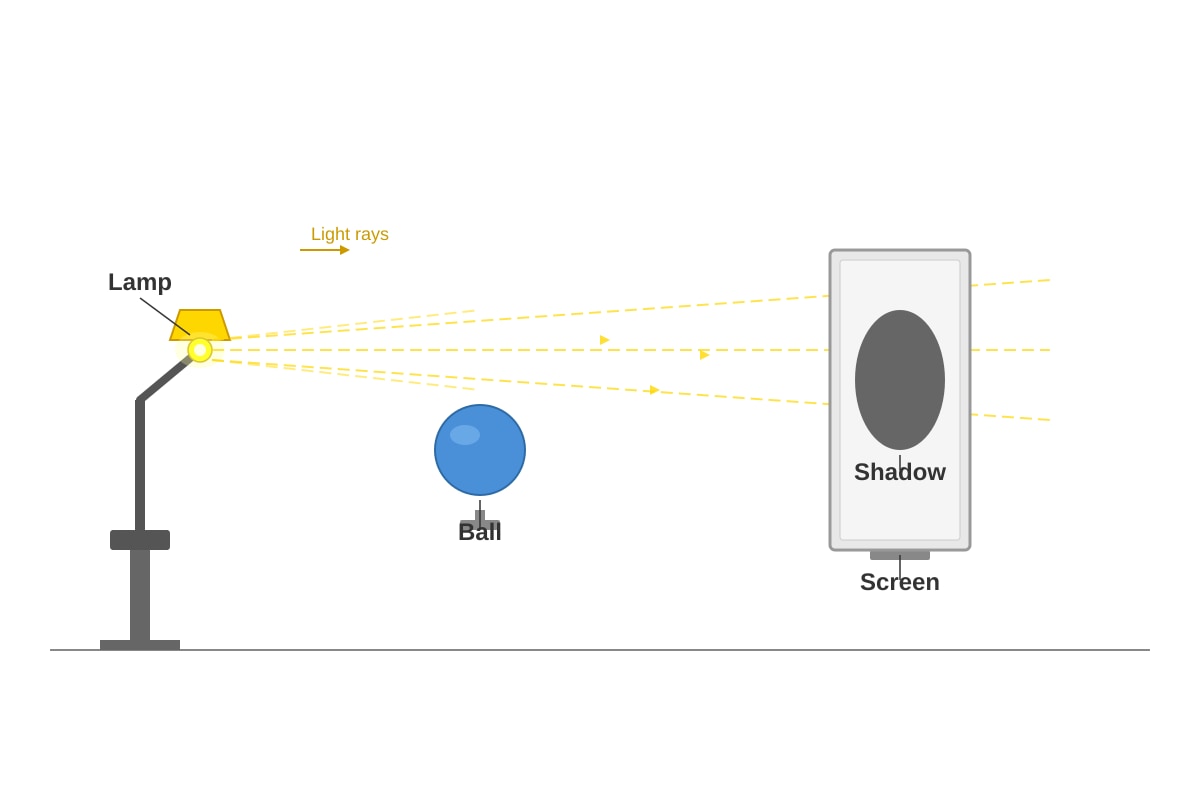
16. (2 marks) (a) What causes the shadow to form on the screen?
- Model answer: The ball blocks the light from the lamp. The area behind the ball does not receive light, forming a shadow on the screen.
- Marking: 1 mark for stating the ball blocks light.
- Explanation: Shadows form when an object blocks light from reaching a surface.
(b) If the ball is moved closer to the lamp, what will happen to the size of the shadow?
- Model answer: The shadow will become larger/bigger.
- Marking: 1 mark for "larger" or "bigger".
- Explanation: When an object is closer to the light source, it blocks more light, creating a larger shadow on the screen. This is because light spreads out as it travels.
17. (2 marks) A teacher shines a torch at a piece of cardboard. No light passes through the cardboard. What does this tell you about the cardboard?
- Model answer: The cardboard is opaque. It does not allow light to pass through it.
- Marking: 1 mark for stating the cardboard is opaque. 1 mark for explaining that it blocks light.
- Explanation: Opaque materials absorb or reflect all light; no light passes through them.
18. (2 marks) Why is it dangerous to look directly at the Sun?
- Model answer: The Sun is a very bright source of light. Looking directly at it can damage our eyes because the light is too strong.
- Marking: 1 mark for stating the Sun is very bright. 1 mark for stating it can damage eyes.
- Explanation: The Sun produces intense light and heat. Our eyes are not designed to handle such brightness, and permanent damage can occur.
19. (2 marks) A student says, "The Moon gives out its own light at night." Is the student correct? Explain your answer.
- Model answer: No, the student is not correct. The Moon does not produce its own light. It reflects light from the Sun. We see the Moon because sunlight bounces off its surface and reaches our eyes.
- Marking: 1 mark for stating "No" or "Incorrect". 1 mark for explaining that the Moon reflects sunlight.
- Explanation: The Moon is not a light source; it is a reflective surface like a giant rock in space.
20. (2 marks) A room has a small window. On a sunny day, a patch of sunlight falls on the floor. Explain why the patch of sunlight is in the shape of the window.
- Model answer: Light travels in straight lines. Sunlight passes through the open window. The shape of the window determines the shape of the light beam that enters the room. The patch of light on the floor has the same shape as the window because light travels in straight lines from the window to the floor.
- Marking: 1 mark for stating light travels in straight lines. 1 mark for explaining that the window's shape determines the light patch's shape.
- Explanation: This demonstrates that light travels in straight lines. The window acts like a stencil, allowing only light that passes through its opening to reach the floor.
--- END OF ANSWER KEY ---