From Real Exams Quiz
Primary 3 Science Light Quiz
Free P3 Science Light quiz, Exam version, with questions, answers, and syllabus-aligned practice for Singapore students.
These static practice materials are generated from the site's syllabus and paper-generation workflow, with source and model context shown so students and parents can evaluate the material before use.
Questions
Free quiz and exam paper access
Enter your details to view this paper
Your access is remembered on this device.
Answers
Primary 3 Science Quiz - Light (Answer Key)
Total Marks: 30
Section A: Multiple-Choice Questions (Questions 1 - 5)
1. C) A burning candle
- Marks: 1
- Explanation: A source of light is something that produces its own light. A burning candle produces light and heat. The Moon, a mirror, and a shiny metal spoon do not produce their own light; they only reflect light from other sources.
- Common mistake: Students may think the Moon is a light source because it appears bright at night. Remind them that the Moon only reflects the Sun's light.
2. C) No light passes through the door.
- Marks: 1
- Explanation: A wooden door is an opaque object. Opaque objects do not allow any light to pass through them. When light hits an opaque object, it is blocked, and a shadow is formed behind the object.
- Common mistake: Students may think some light passes through. Emphasise that opaque materials block all light.
3. C) A piece of cardboard
- Marks: 1
- Explanation: A shadow is formed when light is blocked. The darker the shadow, the more light is blocked. Cardboard is opaque and blocks all light, so it forms the darkest shadow. Clear glass and thin plastic bags allow most or all light to pass through, forming very light or no shadows. Tracing paper allows some light through, forming a lighter shadow.
- Common mistake: Students may confuse "darkest shadow" with "largest shadow." The question asks about darkness, not size.
4. A) A light source, an object, and a screen
- Marks: 1
- Explanation: For a shadow to form, three things are needed: a light source (to produce light), an object (to block the light), and a screen or surface (for the shadow to be seen on). Without any one of these, a shadow cannot form.
- Common mistake: Students may think only a light source and an object are needed. Emphasise that the shadow needs a surface to be seen on.
5. B) A firefly
- Marks: 1
- Explanation: A natural source of light is one that occurs in nature without being made by humans. A firefly produces its own light naturally. A torch, a lamp, and a candle are man-made sources of light.
- Common mistake: Students may think a candle is natural because it uses wax. Clarify that a candle is a man-made object.
Section B: Fill in the Blanks and Matching (Questions 6 - 10)
6. blocked
- Marks: 1
- Explanation: A shadow is formed when light is blocked by an object. The object prevents light from passing through, creating a dark area behind it.
7. straight
- Marks: 1
- Explanation: Light travels in straight lines. This is why shadows have the same shape as the object blocking the light.
8. Matching:
| Object | Type | |
|---|---|---|
| The Sun | --- | Light source |
| A mirror | --- | Not a light source |
| A torch (switched on) | --- | Light source |
| A book | --- | Not a light source |
- Marks: 1 (all four correct)
- Explanation:
- The Sun produces its own light → light source.
- A mirror reflects light but does not produce its own light → not a light source.
- A torch (switched on) produces its own light → light source.
- A book does not produce its own light → not a light source.
- Marking note: Award 1 mark if all four connections are correct. Award 0.5 mark if only 2-3 are correct.
9. translucent
- Marks: 1
- Explanation: A translucent object allows some light to pass through it, but not all of it. Examples include tracing paper and frosted glass. (Note: While the P3 syllabus does not require the terms "transparent/translucent/opaque," this question uses the concept in a simple way. If the term is too advanced, accept "partially see-through" or similar descriptions.)
10. shadow
- Marks: 1
- Explanation: A shadow is the dark area formed when light is blocked by an object.
Section C: Short Answer Questions (Questions 11 - 15)
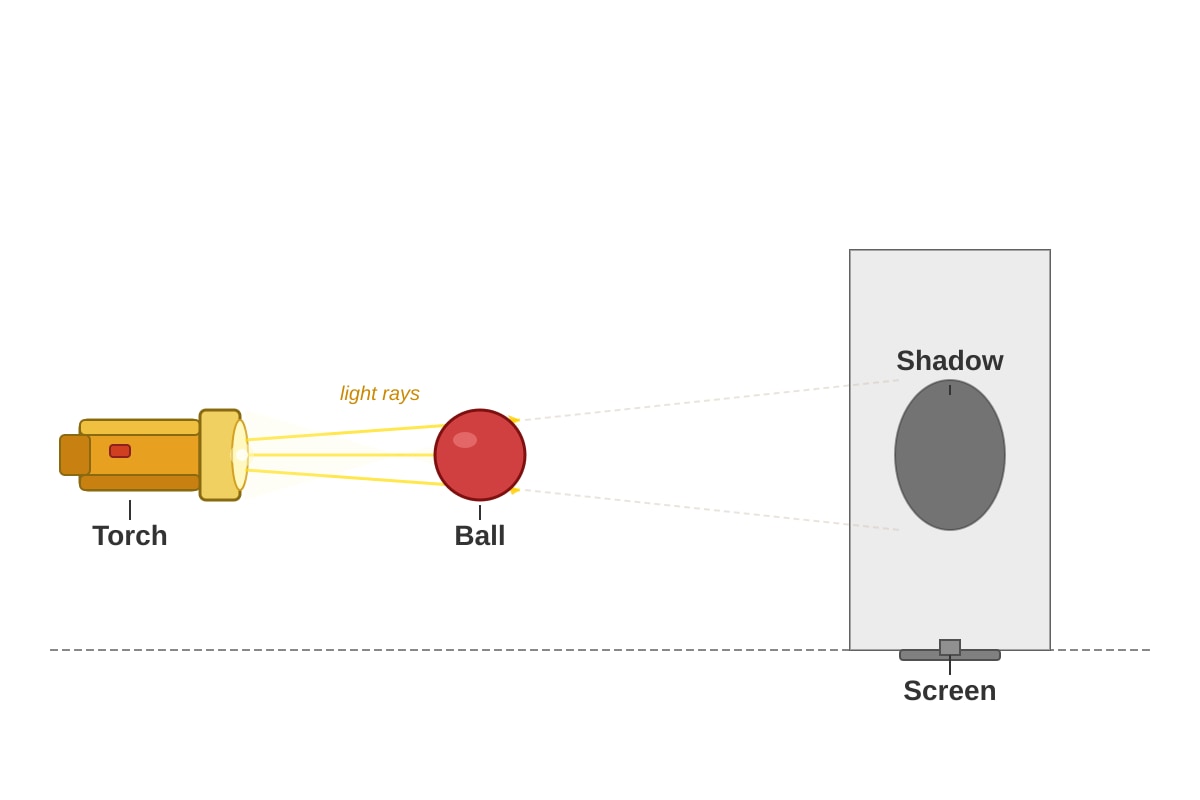
11.
(a) Shadow (1 mark)
(b) larger / bigger (1 mark)
- Explanation: When the ball is moved closer to the torch, it blocks more of the light from the torch, so the shadow becomes larger. This is because the ball is closer to the light source, so it blocks a wider angle of light rays.
- Common mistake: Students may think the shadow becomes smaller. Use a simple demonstration or diagram to show that moving an object closer to the light source makes its shadow bigger.
12.
(a) The teddy bear blocks the light from the torch. (1 mark)
- Explanation: A shadow is formed when an opaque object blocks light. The teddy bear is opaque, so it blocks the light from the torch, creating a shadow on the wall.
(b) The same shape as the teddy bear (1 mark)
- Explanation: Light travels in straight lines. When light is blocked by an object, the shadow formed has the same shape as the object.
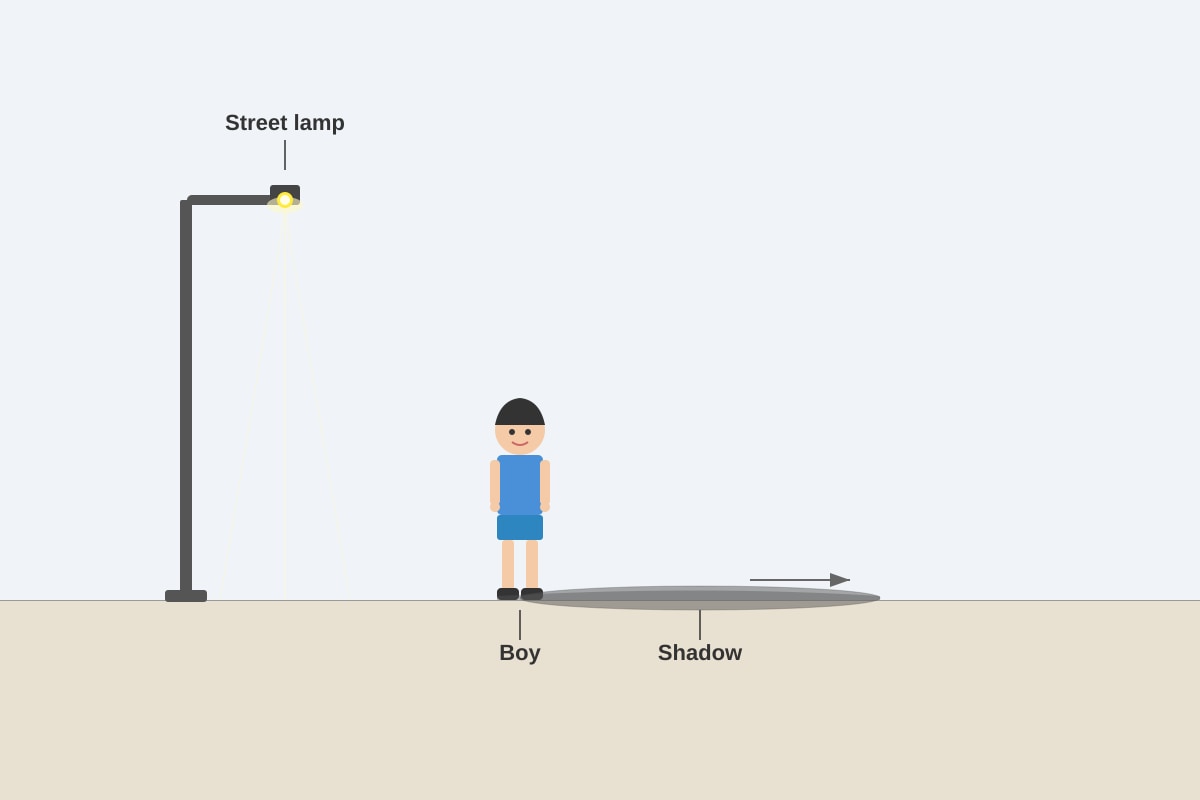
13.
(a) The side opposite the lamp (1 mark)
(b) The boy blocks the light from the lamp. The shadow is formed on the side where the light is blocked, which is the side opposite the lamp. (1 mark)
- Explanation: Light travels in straight lines from the lamp. The boy's body blocks the light, so the area behind him (opposite the lamp) is dark, forming a shadow.
- Marking note: Award 1 mark for a clear explanation that the boy blocks the light, and the shadow is on the side away from the lamp.
14.
(a) Wooden board (1 mark)
(b) Clear glass (1 mark)
- Explanation:
- An opaque object does not allow any light to pass through. The wooden board blocks all light.
- A transparent object allows most light to pass through. The clear glass allows most light through.
- Common mistake: Students may confuse "transparent" with "translucent." Tracing paper is translucent (allows some light), while clear glass is transparent (allows most light).
15. No, I do not agree. The Moon does not produce its own light. It reflects light from the Sun. (2 marks)
- Explanation: A source of light produces its own light. The Moon appears bright because it reflects sunlight. Without the Sun, the Moon would not shine.
- Marking note: Award 1 mark for saying "No, I do not agree." Award 1 mark for explaining that the Moon reflects light from the Sun.
Section D: Open-Ended Questions (Questions 16 - 20)
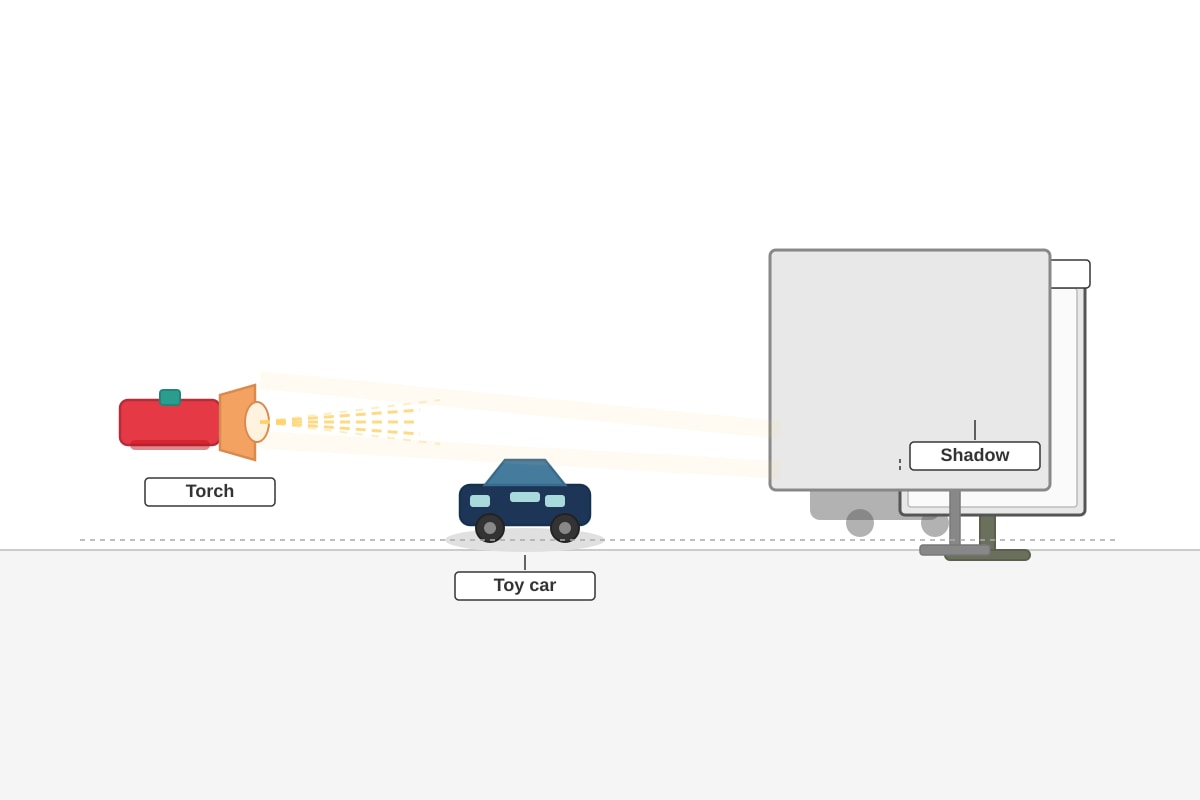
16.
(a) The shadow is the dark area formed when the toy car blocks the light from the torch. (1 mark)
(b) The shadow will become smaller. (1 mark)
(c) When the toy car is moved further away from the torch, it blocks less of the light, so the shadow becomes smaller. (1 mark)
- Explanation: The size of a shadow depends on the distance between the object and the light source. When the object is further from the light source, it blocks a smaller angle of light rays, resulting in a smaller shadow.
- Marking note: Award 1 mark for each correct part. For (c), accept any reasonable explanation that mentions the car blocking less light or being further from the torch.
17.
(a) Cardboard (1 mark)
(b) Cardboard is opaque, so it blocks all the light from the torch. No light passes through it, so the shadow is the darkest. (2 marks)
- Explanation: The darkness of a shadow depends on how much light is blocked. Cardboard is opaque and blocks all light, creating a completely dark shadow. Clear glass allows most light through, so it forms a very light shadow or no shadow. Tracing paper allows some light through, so it forms a lighter shadow.
- Marking note: Award 1 mark for identifying cardboard as opaque. Award 1 mark for explaining that it blocks all light.
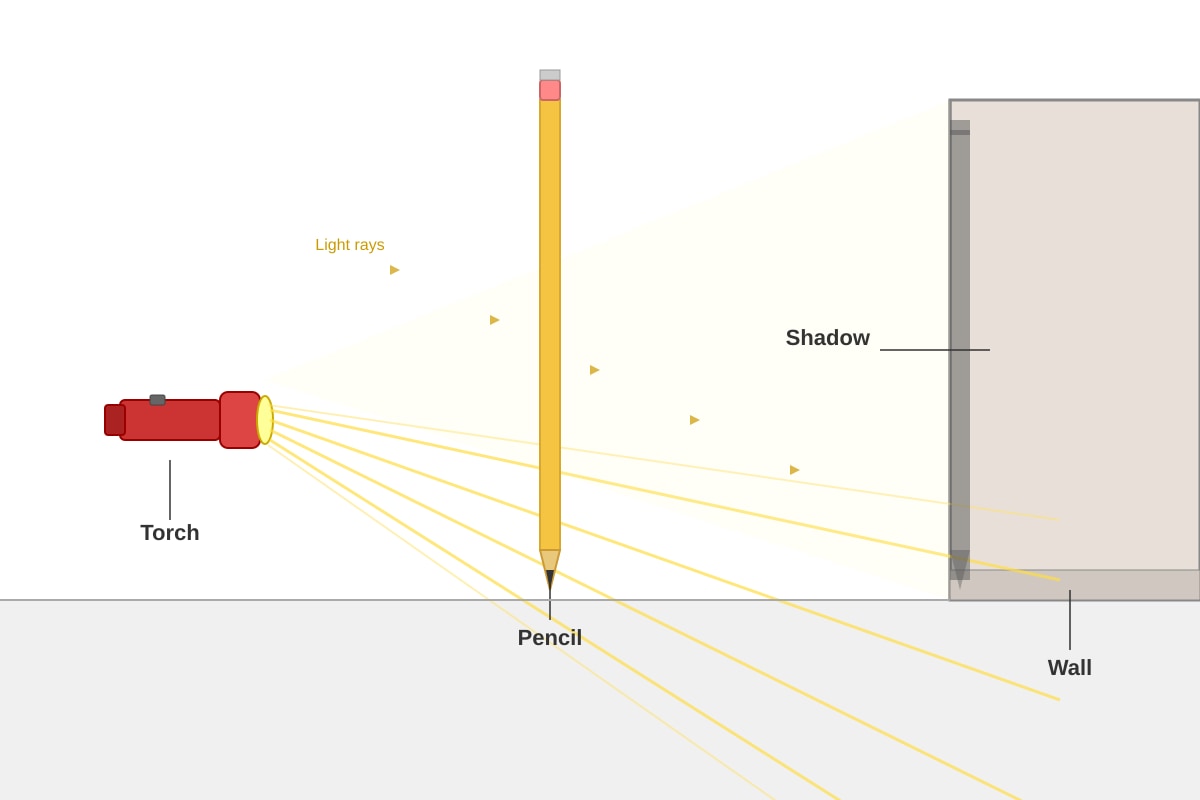
18.
(a) The shadow will have the same shape as the pencil (a long, thin rectangle). (1 mark)
(b) Light travels in straight lines. The pencil blocks the light, and the shadow formed has the same shape as the pencil. (2 marks)
- Explanation: Shadows have the same shape as the object blocking the light because light travels in straight lines. The pencil blocks the light rays, and the dark area behind it has the same outline as the pencil.
- Marking note: Award 1 mark for stating that light travels in straight lines. Award 1 mark for explaining that the shadow has the same shape as the pencil.
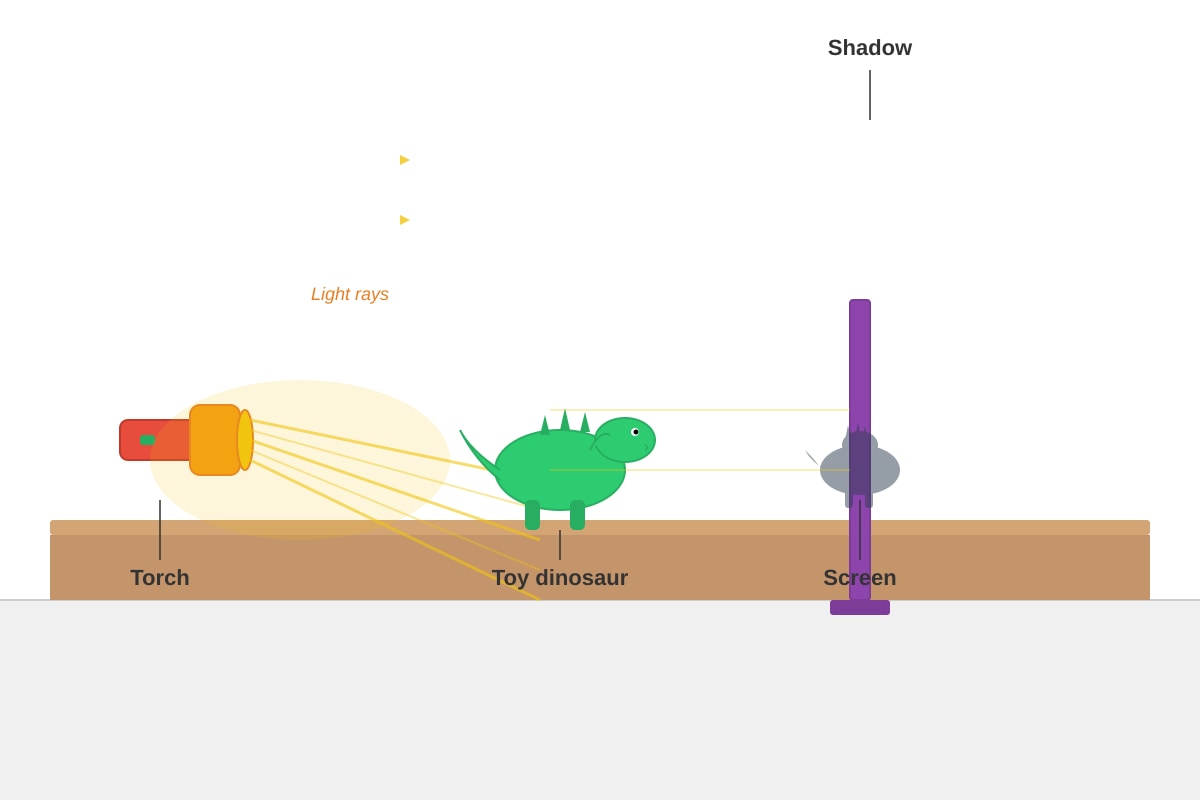
19.
(a) A light source, an object to block the light, and a screen/surface for the shadow to be seen on. (1 mark)
(b) The shadow will become larger. (1 mark)
(c) When the torch is moved closer to the dinosaur, the dinosaur blocks more of the light, so the shadow becomes larger. (1 mark)
- Explanation: Moving the light source closer to the object makes the shadow larger because the object blocks a wider angle of light rays.
- Marking note: Award 1 mark for each correct part. For (a), accept any answer that mentions a light source and an object. For (c), accept any reasonable explanation.
20.
(a) Black / dark (1 mark)
(b) Black / dark (1 mark)
(c) A shadow is always dark because it is formed when light is blocked. The colour of the object does not affect the colour of the shadow. (2 marks)
- Explanation: A shadow is the absence of light. When an object blocks light, the area behind it is dark, regardless of the object's colour. The red ball and blue ball both block light, so they both form black (dark) shadows.
- Common mistake: Students may think the shadow of a red ball is red. Emphasise that shadows are always dark because they are formed by blocked light.
- Marking note: Award 1 mark for each correct answer in (a) and (b). Award 2 marks for a clear explanation in (c). Award 1 mark for a partial explanation (e.g., "shadows are always dark").
END OF ANSWER KEY