From Real Exams Quiz
Primary 3 Science Human System Quiz
Free P3 Science Human System quiz, Exam version, with questions, answers, and syllabus-aligned practice for Singapore students.
These static practice materials are generated from the site's syllabus and paper-generation workflow, with source and model context shown so students and parents can evaluate the material before use.
Questions
Free quiz and exam paper access
Enter your details to view this paper
Your access is remembered on this device.
Answers
Answer Key: Primary 3 Science Quiz - Human System
Total Marks: 30
Section A: Multiple-Choice Questions (Questions 1 - 5, 5 marks)
1. B) To pump blood around the body [1]
- Explanation: The heart is a muscular organ that acts as a pump. Its main job is to pump blood, which carries oxygen and nutrients, to all parts of the body.
- Common mistake: Some students may choose A (breathe) because they know the heart is in the chest near the lungs. However, breathing is the job of the lungs.
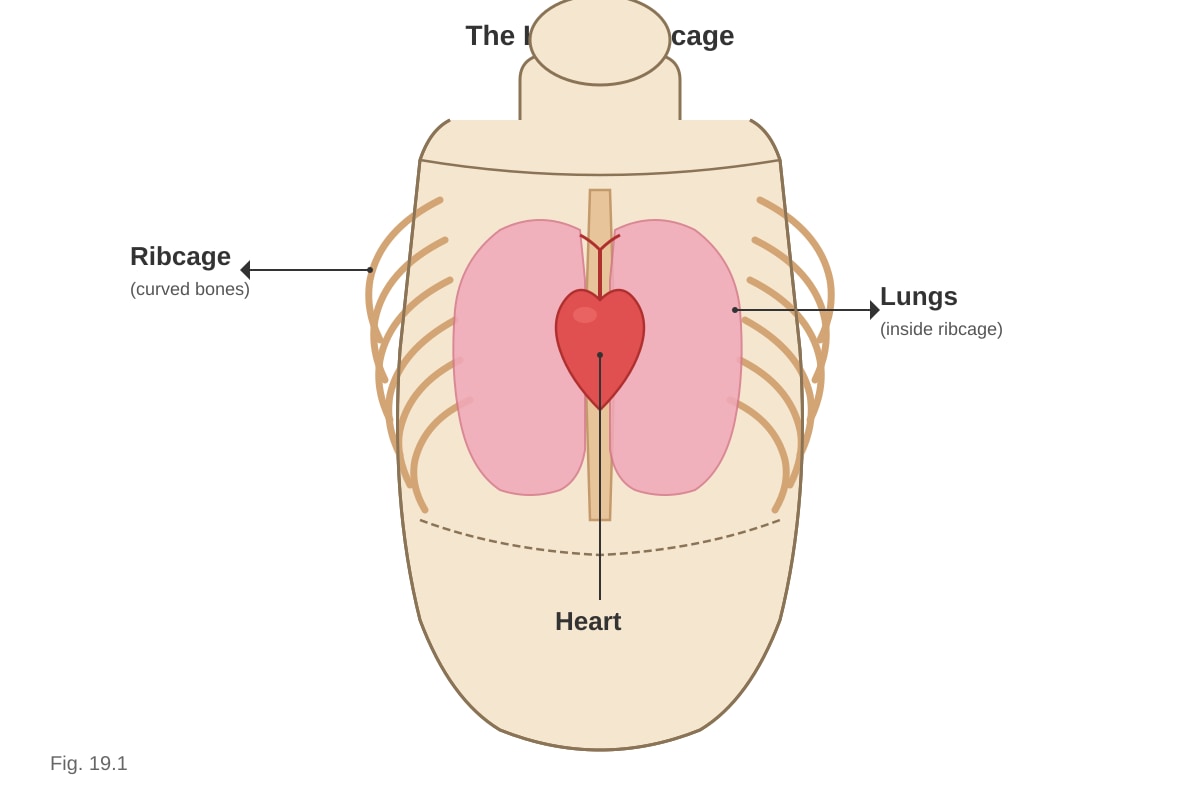
2. C) The heart and lungs [1]
- Explanation: The ribcage is a cage of bones that surrounds the chest area. It protects the delicate organs inside, which are the heart and lungs.
- Common mistake: Students may think the brain is protected by the ribcage, but the brain is protected by the skull.
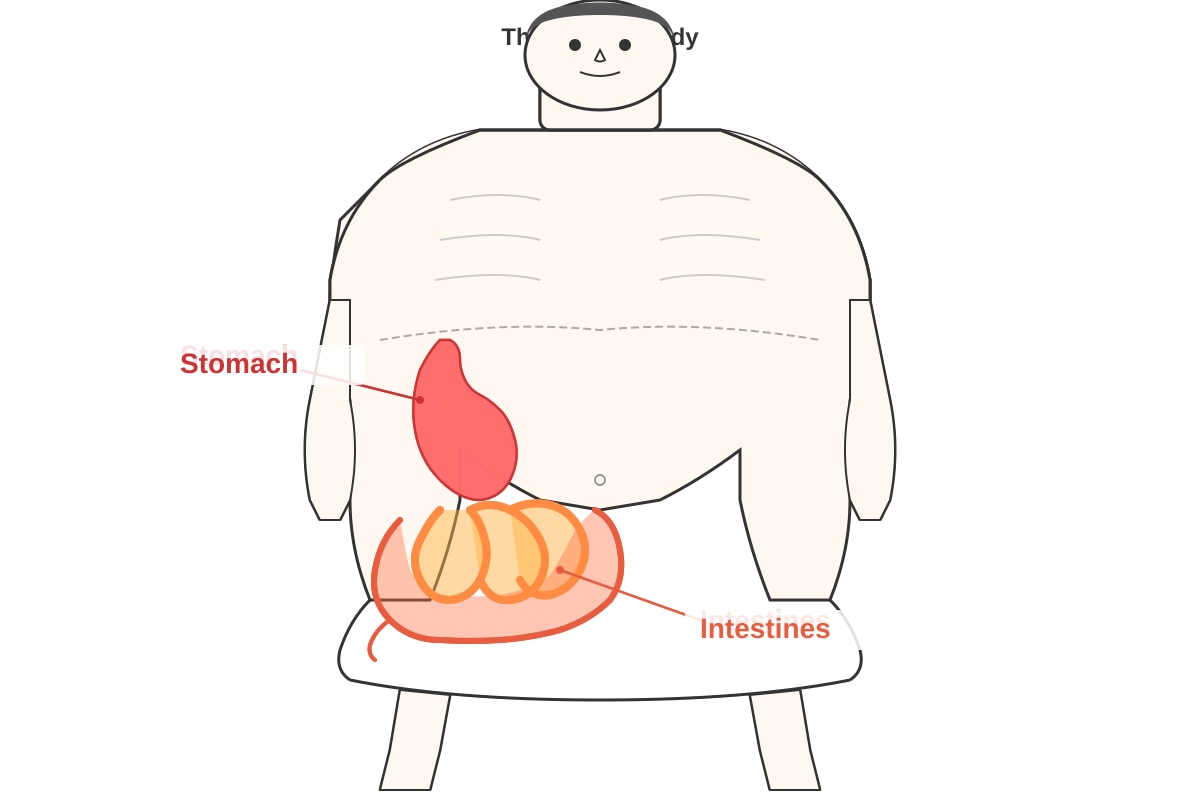
3. B) To digest food [1]
- Explanation: The stomach is part of the digestive system. It churns food and mixes it with digestive juices to break it down into smaller pieces.
- Note: The image shows the stomach in the abdominal area, which is where digestion of food takes place.
4. C) The tongue [1]
- Explanation: The five sense organs are the eyes, ears, nose, tongue, and skin. The tongue is the sense organ for taste.
- Common mistake: Students may confuse organs like the heart or lungs with sense organs. Sense organs are specifically for sensing the environment.
5. B) The skin [1]
- Explanation: The skin is the sense organ for touch. It has nerve endings that detect heat, cold, pressure, and pain. When you touch something hot, the skin senses it and sends a message to the brain.
- Common mistake: Students may think the brain senses the heat first, but the brain only receives the message after the skin detects it.
Section B: Matching and Fill-in-the-Blank (Questions 6 - 10, 8 marks)
6. Matching body parts to functions: [2]
| Body Part | Function |
|---|---|
| Brain | Controls our thoughts and movements |
| Heart | Pumps blood |
| Lungs | Helps us breathe |
| Stomach | Digests food |
- Marking: 1 mark for each correct pair. (2 marks total)
- Explanation: Each organ has a specific job. The brain is the control centre, the heart pumps blood, the lungs help us breathe, and the stomach digests food.
7. Fill in the blanks: [2]
(a) The organ that controls all our thoughts and actions is the brain.
(b) The organ that helps us to breathe in oxygen is the lungs.
- Marking: 1 mark for each correct answer.
- Explanation: The brain is the control centre of the body. The lungs are the organs that take in oxygen when we breathe.
8. State one job of the skeleton. [1]
Acceptable answers (any one):
-
It supports the body and gives it shape.
-
It protects the internal organs (e.g., skull protects the brain, ribcage protects the heart and lungs).
-
It helps us to move (together with muscles).
-
Explanation: The skeleton has three main jobs: support, protection, and movement. Any one of these is a correct answer.
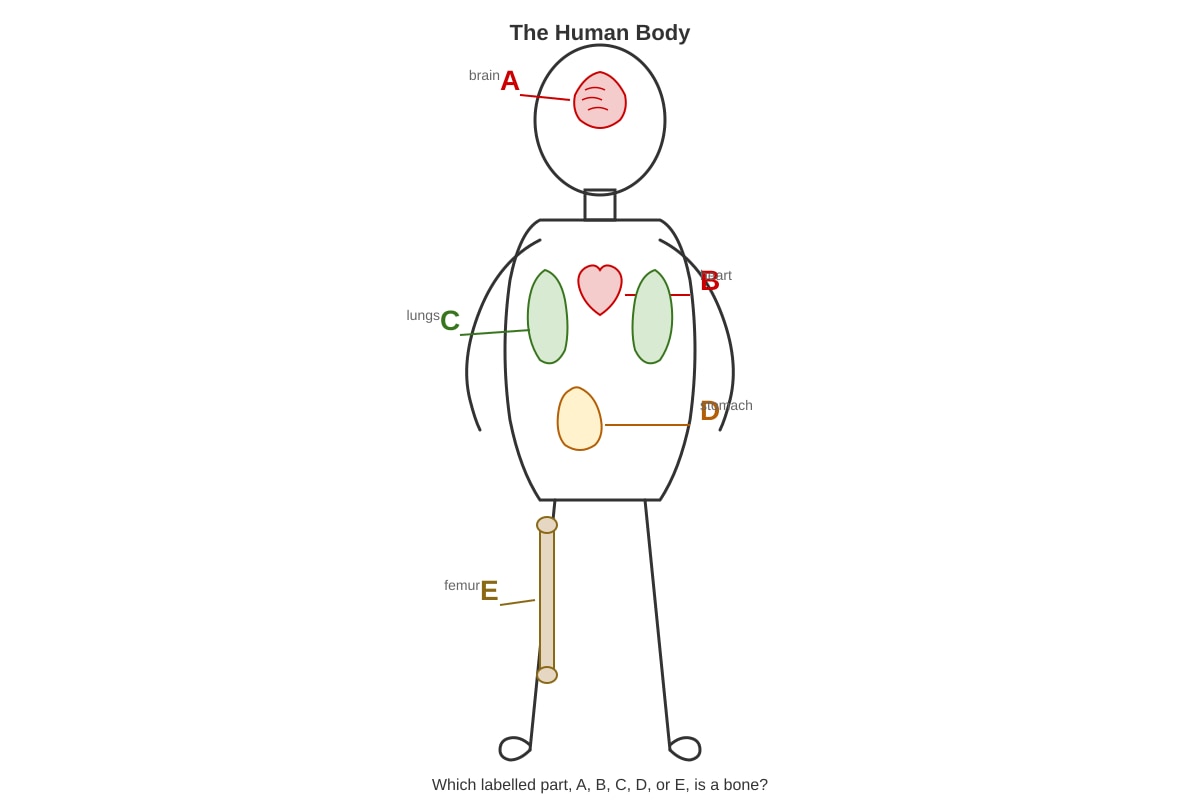
9. Which labelled part is a bone? E [1]
- Explanation: The femur (thigh bone) is labelled E in the diagram. It is the longest and strongest bone in the body.
- Note: The other labels (A-D) are organs: brain, heart, lungs, and stomach.
10. Complete the sentence: [2]
The five sense organs are the eyes, ears, nose, tongue, and skin. The sense organ that helps us to see is the eyes.
- Marking: 1 mark for each correct blank.
- Explanation: The five sense organs are eyes (sight), ears (hearing), nose (smell), tongue (taste), and skin (touch).
Section C: Short Answer Questions (Questions 11 - 15, 8 marks)
11. State one way the lungs help to keep us alive. [1]
Acceptable answers (any one):
-
The lungs help us to breathe in oxygen, which our body needs to survive.
-
The lungs help us to remove carbon dioxide from our body.
-
Explanation: Oxygen is needed by our cells to release energy from food. The lungs take in oxygen and remove carbon dioxide, a waste product.
12. Why is the skull important for the brain? [1]
Answer: The skull protects the brain from injury.
- Explanation: The brain is a very soft and delicate organ. The skull is a hard bone that surrounds the brain and protects it from damage.
13. Complete the table: [2]
| Body Part | Function |
|---|---|
| (a) Heart | To pump blood around the body |
| (b) Stomach | To digest food |
- Marking: 1 mark for each correct answer.
- Explanation: The heart pumps blood. The stomach digests food by breaking it down into smaller pieces.
14. A doctor tells a patient that his heart is very strong. What does a strong heart help the body to do? [2]
Answer: A strong heart can pump blood more efficiently around the body. This means oxygen and nutrients can be delivered to all parts of the body more quickly, giving the person more energy and helping them to stay healthy.
- Marking: 1 mark for mentioning that a strong heart pumps blood well. 1 mark for explaining the benefit (e.g., delivers oxygen/nutrients, gives energy, keeps the body healthy).
- Explanation: A strong heart is like a good pump. It pushes blood around the body effectively, ensuring all organs get the oxygen and nutrients they need.
15. Name the organ that is protected by the skull. [1]
Answer: The brain.
- Explanation: The skull is the bony structure that surrounds and protects the brain.
Section D: Application and Reasoning (Questions 16 - 20, 9 marks)
16. When you run, your heart beats faster. Why does your heart need to beat faster when you run? [2]
Answer: When you run, your muscles need more energy to work. This energy comes from oxygen and nutrients carried by the blood. The heart beats faster to pump more blood (carrying oxygen and nutrients) to the muscles quickly.
- Marking: 1 mark for stating that muscles need more oxygen/energy when running. 1 mark for stating that the heart pumps blood faster to deliver this oxygen/energy to the muscles.
- Explanation: This question tests the understanding of the link between the heart, blood, and oxygen. Exercise increases the body's demand for oxygen, so the heart must work harder to meet this demand.
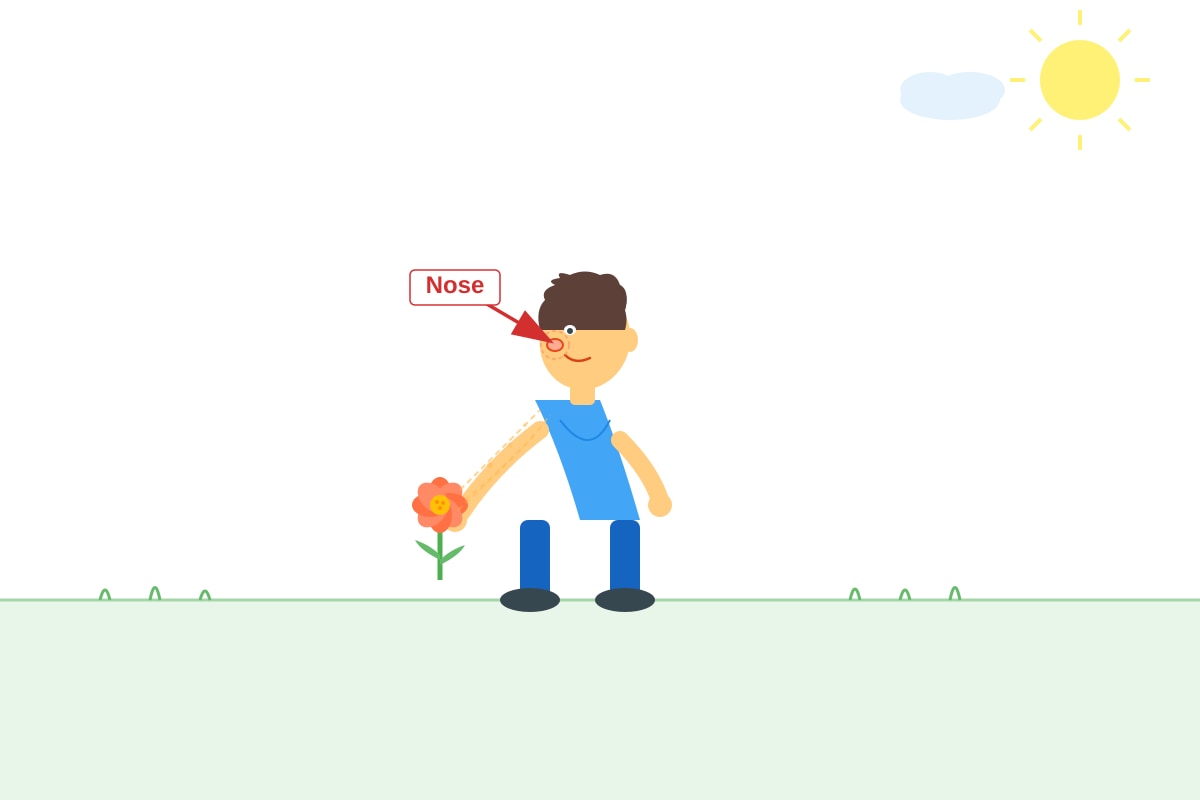
17. (a) Which sense organ is the boy using? Nose [1]
(b) Name the sense that this organ gives us. Smell [1]
- Explanation: The nose is the sense organ for smell. When we smell a flower, we are using our nose.
18. A student says, "The brain is the most important organ in the body." Do you agree? Give a reason for your answer. [2]
Acceptable answers (any one with a valid reason):
-
Agree: The brain controls all our thoughts, movements, and actions. Without the brain, the other organs would not know what to do.
-
Disagree: All organs are important. The heart is also important because it pumps blood, and the lungs are important because they help us breathe. If any organ stops working, we cannot survive.
-
Marking: 1 mark for stating whether they agree or disagree. 1 mark for a valid reason that explains their choice.
-
Explanation: This is an open-ended question that tests reasoning. Both answers are acceptable as long as the reason is logical and shows understanding of organ functions.
19. Why is the ribcage important for the heart and lungs? [2]
Answer: The ribcage is a cage of bones that surrounds and protects the heart and lungs. It acts like a shield, preventing these delicate organs from being injured by bumps or falls.
- Marking: 1 mark for stating that the ribcage protects the heart and lungs. 1 mark for explaining how (e.g., acts as a shield, prevents injury).
- Explanation: The heart and lungs are vital organs. The ribcage provides a strong, bony protection around them.
20. Arrange the following parts in the correct order to show the path of food. [1]
Correct order: Mouth → Stomach → Intestines
- Explanation: Food enters the body through the mouth, travels down to the stomach where it is digested, and then moves to the intestines where nutrients are absorbed.