From Real Exams Quiz
Primary 3 Science Heat Quiz
Free P3 Science Heat quiz, Kimi2.6 Exam version, with questions, answers, and syllabus-aligned practice for Singapore students.
These static practice materials are generated from the site's syllabus and paper-generation workflow, with source and model context shown so students and parents can evaluate the material before use.
Questions
Free quiz and exam paper access
Enter your details to view this paper
Your access is remembered on this device.
Answers
Primary 3 Science Quiz - Heat (Answer Key)
Total Marks: 40 marks
Section A: Multiple Choice (1 mark each)
1. (b) The Sun
Teaching note: The Sun is a natural source of heat energy. Ice cubes, cold water, and shade are all associated with coolness or absence of heat, not sources of heat. The Sun produces its own heat through nuclear reactions and radiates this energy to Earth.
2. (b) conduction
Teaching note: Conduction is the transfer of heat through a solid material without the material itself moving. In the metal spoon, heat energy travels from particle to particle along the spoon from the hot soup end to the handle end. Radiation does not require particles (travels through space), and convection involves movement of the fluid itself.
3. (c) Copper
Teaching note: Metals are generally good conductors of heat, and copper is an excellent conductor. Plastic, wood, and rubber are insulators—they do not conduct heat well. This is why we use metal for cooking pots but plastic or wood for handles.
4. (c) A black t-shirt
Teaching note: Dark, dull (matte) surfaces absorb more heat radiation than light, shiny surfaces. Black absorbs most wavelengths of light and converts them to heat. White and shiny surfaces reflect more radiation away, so they absorb less heat.
5. (b) plastic with a tight lid
Teaching note: To keep soup hot, we need to reduce heat loss. Plastic is an insulator (poor conductor), so it does not allow heat to escape easily. A tight lid prevents heat loss through convection (hot air rising and escaping) and evaporation. Metal conducts heat away quickly; holes would let heat escape; thin paper offers little insulation.
6. (b) expand and become bigger
Teaching note: Most solids expand when heated because their particles vibrate more vigorously and take up more space. This is called thermal expansion. Water is unusual—it expands when freezing, but this question asks about heating. Contracting (a) would happen when cooling, not heating.
7. (a) Feeling warm near a campfire
Teaching note: Feeling warm near a campfire demonstrates radiation, where heat travels in all directions from the source without needing air or other materials to carry it. You feel warm on all sides facing the fire. The other options involve conduction or convection, or in (d), no heat transfer at all.
8. (b) the temperature of an object
Teaching note: A thermometer measures temperature, which tells us how hot or cold something is. Temperature is measured in degrees Celsius (°C) in Singapore. Other tools measure different properties: colour (eyes), weight (weighing scale), length (ruler).
9. (c) Using a thin metal cup
Teaching note: Thin metal is a poor choice for keeping drinks warm because metal conducts heat very well, allowing heat to escape rapidly to the surroundings. Wool cosy (a), a lid (b), and double-walled cups (d) are all methods to reduce heat loss through insulation and trapping warm air.
10. (b) from the hotter object to the cooler object
Teaching note: Heat always flows from a region of higher temperature to a region of lower temperature. This is a fundamental law of thermodynamics. The hotter object loses heat and cools down; the cooler object gains heat and warms up, until they reach the same temperature (thermal equilibrium).
Section B: Fill in the Blanks and Short Answer (2 marks each)
11. (a) insulators / heat insulators / at insulating (1 mark)
Teaching note: Insulators are materials that do NOT conduct heat well. They slow down heat transfer. Common insulating materials include plastic, foam, wool, and fibreglass. The thick walls of a cooler box trap heat outside and keep cold inside.
(b) conduction / convection / radiation / stopping air movement / reducing heat transfer through the top (1 mark)
Teaching note: Any correct named method of heat transfer that the lid prevents earns the mark. The lid mainly stops warm air from escaping (convection) and reduces radiation and conduction at the surface. It creates a barrier between the cold inside and warm outside.
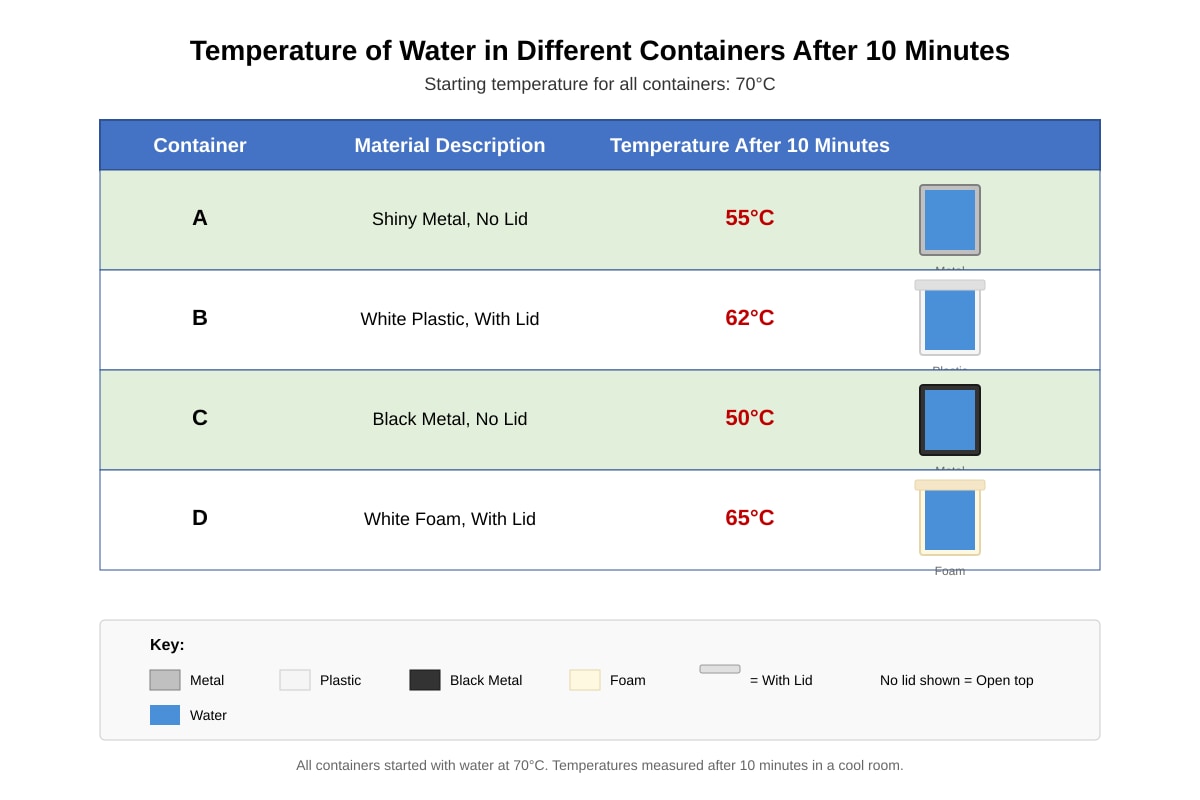
12. (a) Container C (black metal, no lid) (1 mark)
Teaching note: Container C dropped from 70°C to 50°C, a loss of 20°C—the largest drop of all four containers.
(b) Black/dark surfaces absorb heat faster than light/shiny surfaces; AND/OR metal is a good conductor of heat so heat escapes quickly; AND/OR having no lid allows heat to escape through convection. (1 mark for any valid explanation linked to the data)
Teaching note: Two factors make C lose the most heat: (1) black colour absorbs heat from the environment but also radiates heat away efficiently, and (2) metal conducts heat rapidly to the surrounding air. The lack of a lid adds convection losses.
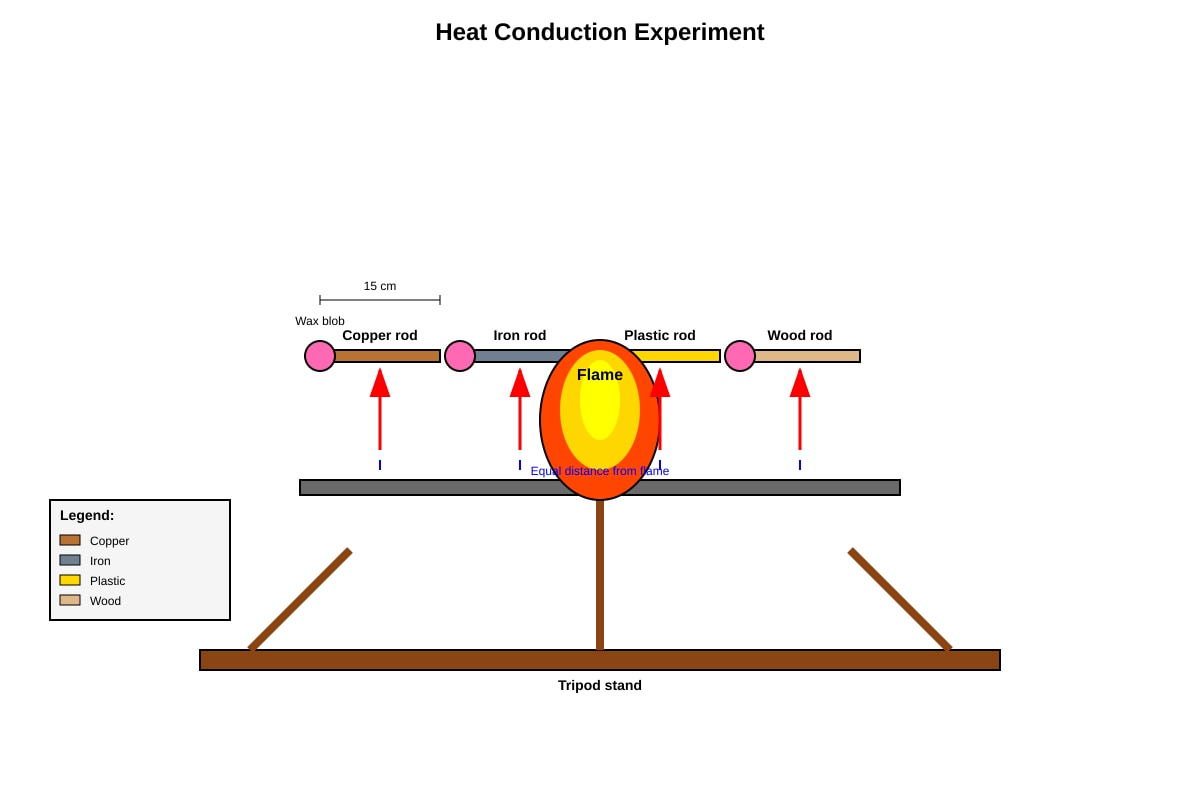
13. (a) Copper rod (1 mark)
Teaching note: Copper is the best conductor of heat among the four materials listed. We predict its wax will melt first because heat travels fastest through copper.
(b) Copper is a metal / copper is a good conductor of heat / heat travels fastest through copper compared to iron, plastic, and wood. (1 mark)
Teaching note: Metals contain free electrons that help transfer heat energy quickly. Copper conducts heat better than iron (another metal) and much better than plastic and wood (insulators). Good conductors allow heat to travel quickly from the flame to the wax.
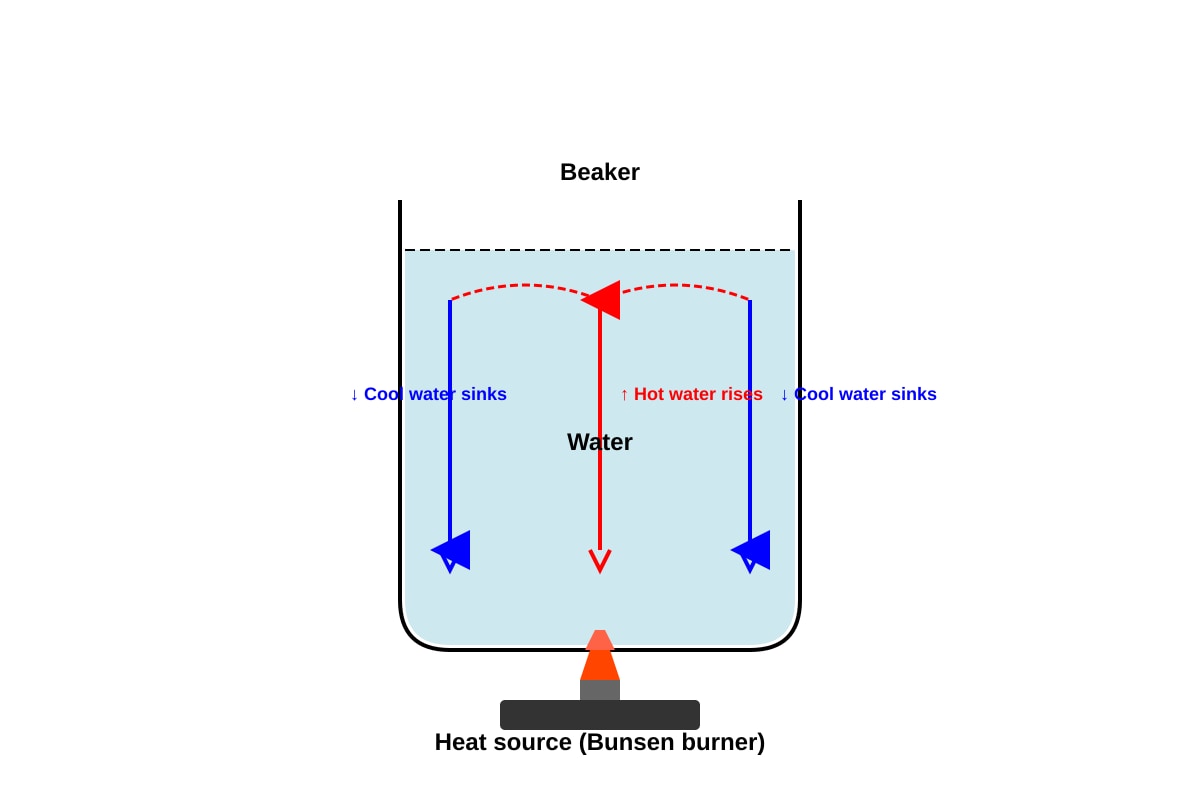
14. (a) Convection (1 mark)
Teaching note: Convection is heat transfer through the bulk movement of fluids (liquids and gases). In the beaker, water moves in a循环 (circular) pattern, carrying heat throughout the liquid.
(b) When water is heated, it expands and becomes less dense / lighter / the heated water rises because warm water is less dense than cool water. (1 mark)
Teaching note: This is the key concept of convection. When particles gain heat energy, they move faster and spread apart, making the fluid less dense. Less dense (lighter) fluid rises above denser (heavier) fluid. The cooler, denser water sinks down to be heated in turn, creating a convection current.
15. (a) The water in the black can will be hotter / at a higher temperature than the water in the white can (1 mark)
Teaching note: We expect the black can to absorb more radiant heat from the Sun, leading to greater warming of the water inside.
(b) Dark/black surfaces absorb more heat radiation than light/white surfaces / Black is a good absorber of heat / White reflects more heat. (1 mark)
Teaching note: Colour significantly affects heat absorption. Dark, matte surfaces absorb most incident radiation; light, shiny surfaces reflect most of it. This is why buildings in hot climates often use light colours and why we wear dark colours in cool weather to absorb more heat.
Section C: Structured Questions (3 marks each)
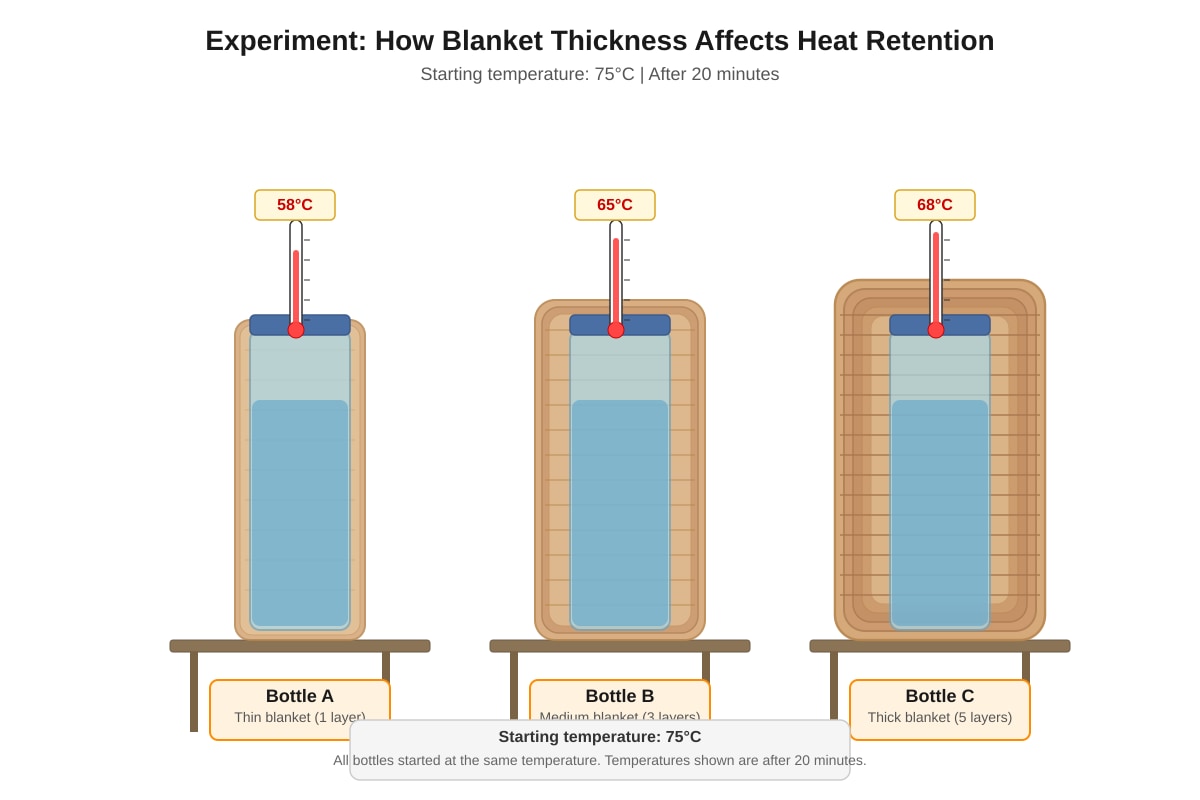
16. (a) 68°C (1 mark)
Teaching note: Read directly from the data provided in the diagram/table. Bottle C, with the thickest blanket (5 layers), maintained the highest temperature after 20 minutes.
(b) Bottle C (1 mark) because it has the thickest blanket / most layers of wool / the water cooled down the least / it stayed warmest (78°C start – 68°C = only 10°C drop) / thick materials trap more air which is a good insulator (1 mark)
Teaching note: Thicker insulating materials generally perform better because they contain more trapped air pockets. Air is an excellent insulator. The thickness of the blanket matters—more layers = more trapped air = slower heat loss. Mark breakdown: 1 mark for correct identification of Bottle C, 1 mark for a correct explanation linking thickness to better insulation/less heat loss.
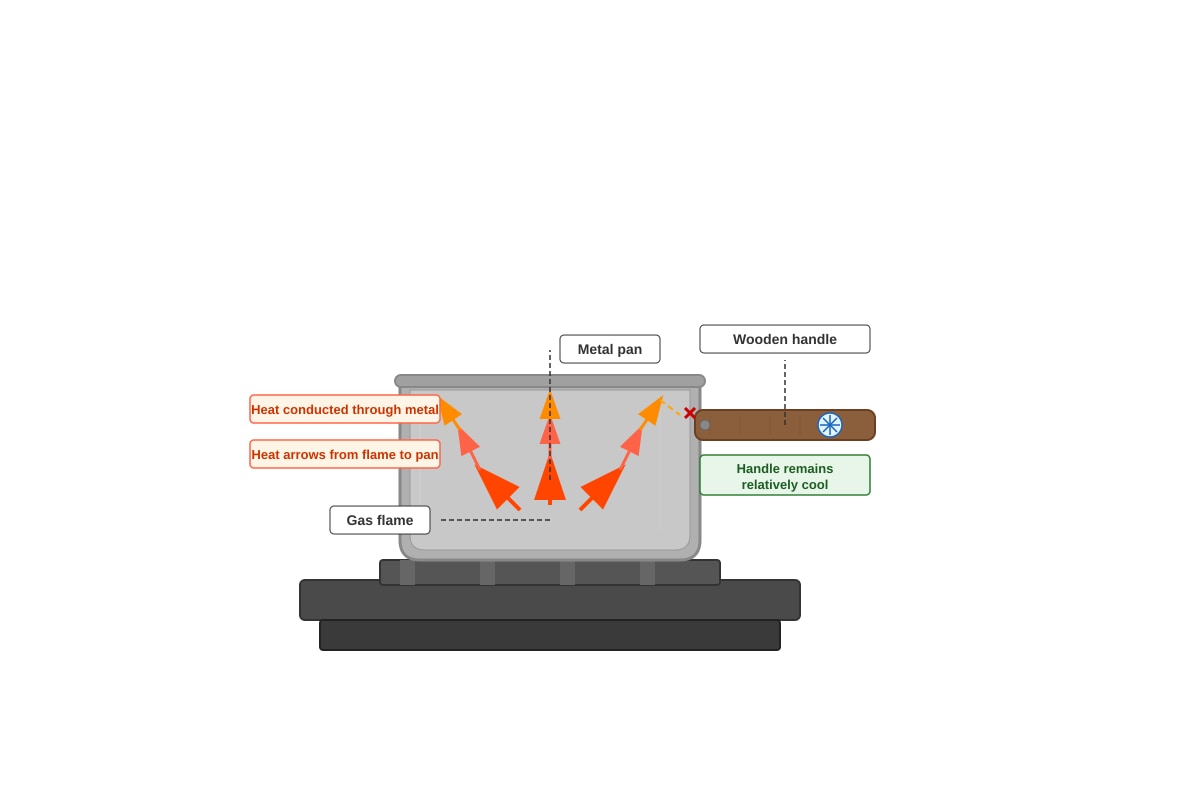
17. (a) The metal is a good conductor of heat / Heat from the flame travels quickly through the metal by conduction / Metal particles pass heat energy to neighbouring particles rapidly. (2 marks)
Mark breakdown: 1 mark for identifying metal as good conductor; 1 mark for explaining conduction mechanism or rapid heat transfer.
Teaching note: Metals have free electrons that move quickly and carry heat energy from the hot base to all parts of the metal saucepan. This is why the metal gets hot fast—conduction through metals is very efficient.
(b) Wood is a poor conductor of heat / an insulator / Wood does not conduct heat well, so the handle stays cool enough to hold safely. (1 mark)
Teaching note: Wood is an excellent thermal insulator. Its structure contains trapped air and does not have free electrons to carry heat. This safety feature prevents burns when cooking. Modern pans may use plastic or silicone for the same insulating purpose.
18. (a) Felt cloth (1 mark) – it is thick and contains trapped air which reduces heat loss / wool-like materials are good insulators.
Polystyrene foam (1 mark) – it has air pockets / is a good insulator / traps air which slows heat transfer / does not conduct heat well.
Teaching note: Both materials work by trapping air, which is an excellent insulator. The thickness and air content create barriers to heat flow. Students must identify both correct materials and give valid insulating reasons.
(b) Aluminium foil / Clear plastic wrap (0.5 mark either material)
Because aluminium foil is a thin metal/good conductor/lets heat escape quickly; OR clear plastic wrap is too thin/does not trap enough air/offers little insulation (0.5 mark for valid reason)
Teaching note: Aluminium foil, despite being shiny (reflective), is a metal and very thin, so it conducts heat readily. Its thinness means little insulation value. Clear plastic wrap is also extremely thin with no trapped air—useful for sealing but not for insulating.
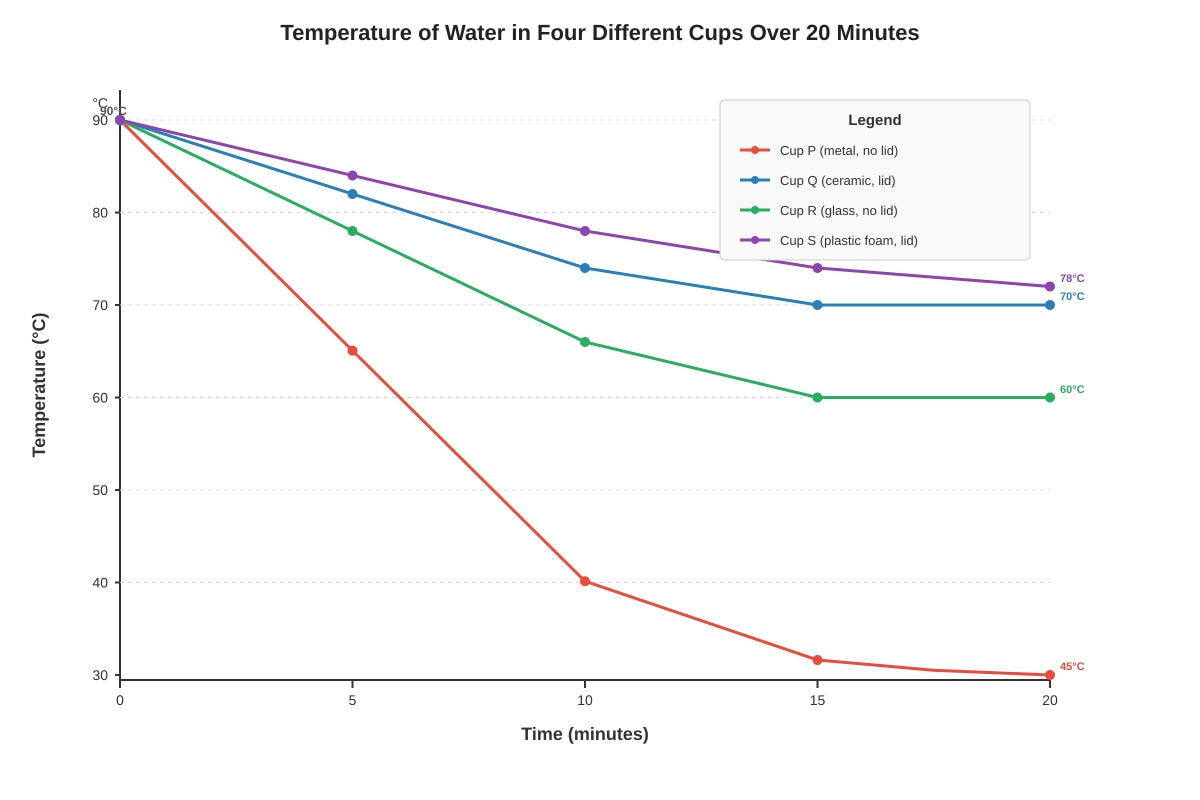
19. (a) Cup S (1 mark)
Teaching note: Cup S (plastic foam, lid) maintained the highest temperature at 78°C after 20 minutes, dropping only 12°C from the starting 90°C.
(b) Any TWO of: (2 marks, 1 mark each)
- Plastic foam is an insulator / poor conductor: It does not allow heat to pass through the walls easily.
- It has a lid: The lid stops hot air from rising and escaping / reduces convection losses.
- Foam contains trapped air: Air pockets in foam provide extra insulation / air is a good insulator.
- Plastic material: Unlike metal or glass, plastic does not conduct heat well.
Teaching note: The best insulated cup combines material choice (insulating foam) with design feature (lid). The lid addresses convection, the foam addresses conduction, and together they minimise all heat loss pathways.
20. (a) The colour of the can / colour / different colours / black, white, silver, red (1 mark)
Teaching note: The independent variable is what the experimenter deliberately changes to observe its effect. Jason painted the cans different colours—this is the variable under test.
(b) Any TWO of: (1 mark for two correct, 0.5 mark for one correct)
- Same type of can / same size / same material (metal)
- Same amount/volume of water
- Same starting temperature of water
- Same distance from heat lamp
- Same power/intensity of heat lamp
- Same time of heating (15 minutes)
- Same thermometer type
Teaching note: Fair test principles require all other variables to be controlled so that only the colour affects the result. In scientific experiments, we change ONE variable and keep ALL OTHERS constant.
(c) Darker colours (especially black) absorb more heat than lighter colours / Black is the best absorber of heat / White and shiny colours absorb the least heat / Dark colours get hotter faster in the sun. (1 mark)
Teaching note: The data shows Can C (black) reached 45°C, much higher than Can B (silver, 28°C) or A (white, 32°C). This pattern supports the conclusion that colour strongly affects heat absorption, with dark matte colours being the most effective absorbers.
END OF ANSWER KEY