From Real Exams Quiz
Primary 3 Science Heat Quiz
Free P3 Science Heat quiz, Exam version, with questions, answers, and syllabus-aligned practice for Singapore students.
These static practice materials are generated from the site's syllabus and paper-generation workflow, with source and model context shown so students and parents can evaluate the material before use.
Questions
Free quiz and exam paper access
Enter your details to view this paper
Your access is remembered on this device.
Answers
Answer Key: Primary 3 Science Quiz - Heat
Total Marks: 30
Section A: Multiple-Choice Questions (10 × 1 Mark = 10 Marks)
Question 1
Answer: (C) Use a thermometer
Explanation: A thermometer is the correct instrument for measuring temperature. Touching with your hand (A) is unreliable because our skin cannot give an exact measurement. Looking at the liquid (B) does not tell us the temperature. Weighing the liquid (D) measures mass, not temperature.
Teaching Note: Temperature is measured in degrees Celsius (°C) using a thermometer. Our senses can be fooled, so we always use a thermometer for accurate measurement.
Question 2
Answer: (A) Conduction
Explanation: Conduction is the transfer of heat through a solid material. When the metal spoon is placed in hot soup, heat travels from the hot soup, through the metal spoon, to the handle. The metal particles vibrate and pass the heat energy along.
Teaching Note: Conduction happens mainly in solids. Metals are good conductors of heat.
Question 3
Answer: (C) Metal
Explanation: Metals (such as iron, copper, and aluminium) are good conductors of heat. Wood, plastic, and rubber are all insulators—they do not allow heat to flow through them easily.
Teaching Note: Remember: metals = good conductors; non-metals (wood, plastic, rubber, fabric) = good insulators.
Question 4
Answer: (B) Convection
Explanation: Convection is the transfer of heat through liquids and gases. When water is heated, the water at the bottom becomes hot, expands, becomes less dense, and rises. Cooler, denser water sinks to take its place. This creates a circular motion called a convection current.
Teaching Note: Convection only happens in liquids and gases, not in solids.
Question 5
Answer: (C) Feeling the warmth of the Sun on your skin
Explanation: Radiation is the transfer of heat without needing a medium (solid, liquid, or gas). Heat from the Sun travels through empty space to reach the Earth. This is radiation.
Teaching Note: The other options (A, B, D) all involve conduction or convection, which require a material to travel through.
Question 6
Answer: (B) Traps air and slows down heat transfer
Explanation: Wool is a good insulator because it traps air in its fibres. Air is a poor conductor of heat, so the trapped air slows down the transfer of heat from the warmer surroundings into the cold drink. This keeps the drink cold for longer.
Teaching Note: Insulators do not "produce cold" or "absorb cold." They simply slow down the transfer of heat.
Question 7
Answer: (C) Wood
Explanation: Wood is a poor conductor of heat, making it a good insulator. Iron, copper, and aluminium are all metals, which are good conductors of heat.
Teaching Note: Common insulators include wood, plastic, rubber, wool, and glass.
Question 8
Answer: (B) Expands
Explanation: When a solid is heated, its particles gain energy and move further apart. This causes the solid to expand (increase in size). When cooled, the particles move closer together and the solid contracts (decreases in size).
Teaching Note: Most solids, liquids, and gases expand when heated and contract when cooled. Gases expand the most, solids expand the least.
Question 9
Answer: (A) The part closest to the flame
Explanation: Heat travels along the metal rod by conduction. The part of the rod closest to the flame receives heat first, so it becomes hot first. Heat then gradually travels along the rod to the farther parts.
Teaching Note: Conduction is a gradual process—heat moves from the hot end to the cold end of a material.
Question 10
Answer: (B) The Sun
Explanation: The Sun is the main source of heat for the Earth. It provides heat and light energy that allow living things to survive. The Moon does not produce its own heat—it only reflects sunlight.
Teaching Note: The Sun's heat reaches the Earth by radiation through empty space.
Section B: Fill in the Blanks (5 × 2 Marks = 10 Marks)
Question 11
Answer: radiation
Explanation: Heat from the Sun travels to the Earth by radiation. Radiation can travel through empty space, which is why we can feel the Sun's warmth even though there is no air between the Sun and the Earth.
Marking Note: 2 marks for the correct word. No partial marks.
Question 12
Answer: conductor
Explanation: A conductor is a material that allows heat to flow through it easily. Metals like iron, copper, and aluminium are good conductors of heat.
Marking Note: 2 marks for the correct word. No partial marks.
Question 13
Answer: insulator
Explanation: An insulator is a material that does not allow heat to flow through it easily. Wood, plastic, rubber, and wool are good insulators.
Marking Note: 2 marks for the correct word. No partial marks.
Question 14
Answer: expand
Explanation: When a metal ball is heated, its particles gain energy and move further apart. This causes the ball to expand (become bigger).
Marking Note: 2 marks for the correct word. No partial marks.
Question 15
Answer: contract
Explanation: When a metal ball is cooled, its particles lose energy and move closer together. This causes the ball to contract (become smaller).
Marking Note: 2 marks for the correct word. No partial marks.
Section C: Open-Ended Questions (5 × 2 Marks = 10 Marks)
Question 16
(a) Answer: The metal spoon will feel hotter. [1 mark]
(b) Explanation: Metal is a better conductor of heat than plastic. Heat from the hot water travels through the metal spoon quickly by conduction, so the metal spoon becomes hot faster than the plastic spoon. [1 mark]
Marking Notes:
- (a) 1 mark for "metal spoon"
- (b) 1 mark for mentioning that metal is a better conductor of heat than plastic
Common Mistake: Students may say "both feel the same" or "plastic spoon" because they think plastic is a conductor. Remind students that metals are good conductors while plastics are insulators.
Question 17
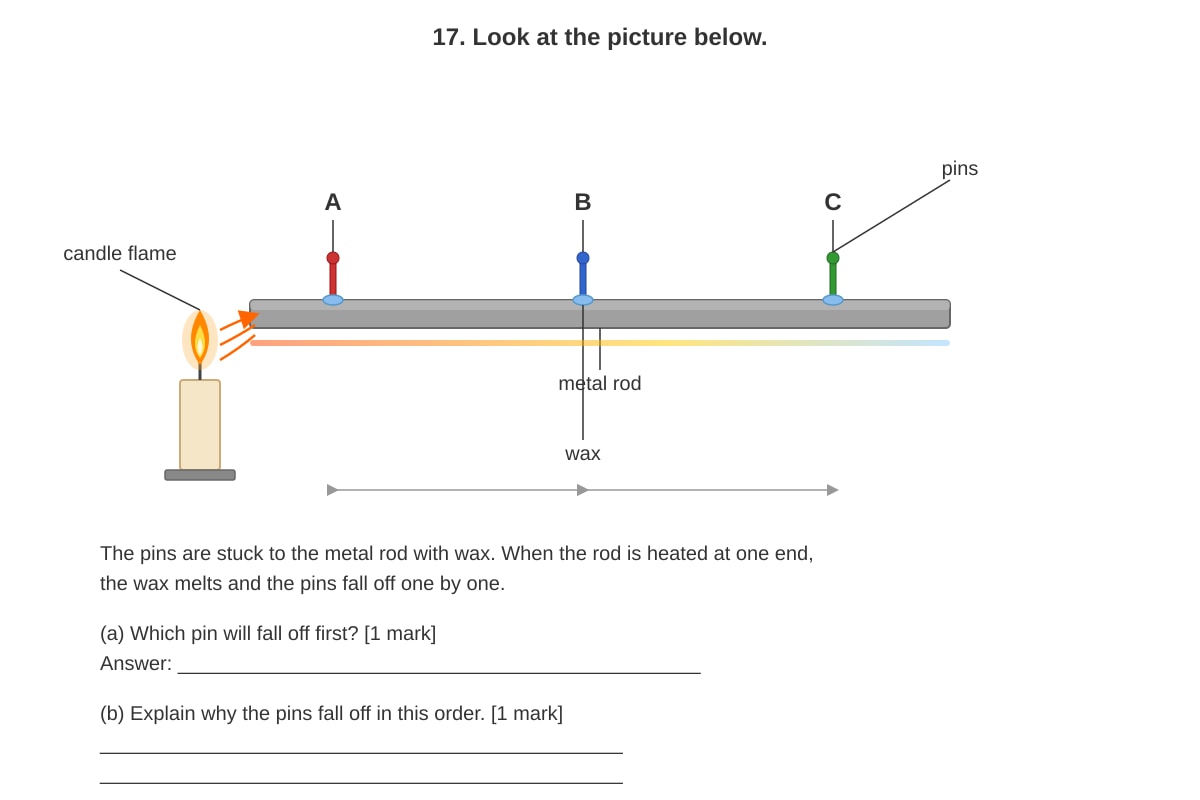
(a) Answer: Pin A will fall off first. [1 mark]
(b) Explanation: Heat travels along the metal rod by conduction. The part of the rod closest to the flame (where Pin A is) gets hot first. The wax holding Pin A melts first, so Pin A falls off first. Heat then travels along the rod to Pin B, then Pin C. [1 mark]
Marking Notes:
- (a) 1 mark for "Pin A"
- (b) 1 mark for explaining that heat travels by conduction from the hot end to the cold end, so the pin closest to the flame falls off first
Teaching Note: This experiment shows that heat travels gradually through a solid by conduction. The order of pins falling off (A, then B, then C) shows the direction of heat flow.
Question 18
(a) Answer: Cup 2 (made of thick plastic) [1 mark]
(b) Explanation: Plastic is a poor conductor of heat (an insulator). It slows down the transfer of heat from the hot tea to the cooler surroundings, so the tea stays warm for longer. The thick plastic also traps more air, which is a good insulator. [1 mark]
Marking Notes:
- (a) 1 mark for "Cup 2" or "thick plastic cup"
- (b) 1 mark for explaining that plastic is an insulator/poor conductor of heat, so it slows down heat loss
Common Mistake: Students may choose the metal cup because they think metal keeps things hot. In fact, metal conducts heat away quickly, so the tea would cool down faster.
Question 19
(a) Answer: The air inside the tyre expanded. [1 mark]
(b) Explanation: When the air is heated by the sun, the air particles gain energy and move further apart. This causes the air to expand and take up more space, making the tyre look tighter and feel harder. [1 mark]
Marking Notes:
- (a) 1 mark for "the air expanded" or "the air particles moved further apart"
- (b) 1 mark for explaining that heating causes air to expand and take up more space
Teaching Note: Gases expand the most when heated compared to liquids and solids. This is why tyres should not be pumped too full on a hot day—they might burst!
Question 20
Answer: No, I do not agree. [1 mark]
Heat and temperature are different. Heat is the energy that flows from a hotter object to a cooler object. Temperature is a measure of how hot or cold an object is. [1 mark]
Marking Notes:
- 1 mark for stating disagreement ("No, I do not agree")
- 1 mark for explaining the difference between heat and temperature
Acceptable explanations:
- "Heat is energy; temperature tells us how hot or cold something is"
- "Heat flows from hot to cold; temperature is measured with a thermometer"
- "Temperature is a measurement; heat is the energy that causes temperature to change"
Teaching Note: A simple analogy: Temperature is like a speedometer reading (how fast), while heat is like the amount of fuel (how much energy). A large object at a low temperature can have more heat energy than a small object at a high temperature.
Summary of Marking
| Section | Questions | Marks |
|---|---|---|
| A | 1-10 | 10 |
| B | 11-15 | 10 |
| C | 16-20 | 10 |
| Total | 30 |