From Real Exams Quiz
Primary 3 Science Heat Quiz
Free P3 Science Heat quiz, Exam version, with questions, answers, and syllabus-aligned practice for Singapore students.
These static practice materials are generated from the site's syllabus and paper-generation workflow, with source and model context shown so students and parents can evaluate the material before use.
Questions
Free quiz and exam paper access
Enter your details to view this paper
Your access is remembered on this device.
Answers
Answer Key - Primary 3 Science Quiz - Heat
Name: _________________________ Class: _________________________ Date: _________________________ Score: ________ / 30
Section A: Multiple-Choice Questions (10 × 1 Mark = 10 Marks)
| Question | Answer | Explanation |
|---|---|---|
| 1 | B | A thermometer is the correct tool for measuring temperature accurately. Feeling, looking at steam, or guessing are not accurate methods. |
| 2 | C | Conduction is the transfer of heat through a solid material (the metal spoon) from the hot soup to the handle. |
| 3 | B | A thick piece of cloth is a poor conductor of heat, so it will protect the hand from the hot pot. Metal and glass are good conductors and would get hot quickly. Thin plastic might melt. |
| 4 | B | When water is heated to its boiling point, it changes into steam (water vapour). |
| 5 | B | A small metal coin has a small mass and is a good conductor of heat. It will lose heat to the surroundings quickly and cool down the fastest. |
| 6 | A | The ice cube has melted. The heat from the sun causes the ice to change from a solid (ice) to a liquid (water). |
| 7 | C | Iron is a metal and is a good conductor of heat. Wood, plastic, and rubber are poor conductors of heat (insulators). |
| 8 | B | Light-coloured clothes reflect more heat from the sun, keeping us cooler. Dark colours absorb more heat. |
| 9 | C | 37°C is the normal temperature of a healthy human body. A freezer is much colder (below 0°C), iced water is near 0°C, and boiling water is 100°C. |
| 10 | B | Heat always flows from a hotter object to a cooler object until both reach the same temperature. |
Section B: Short-Answer Questions (5 × 2 Marks = 10 Marks)
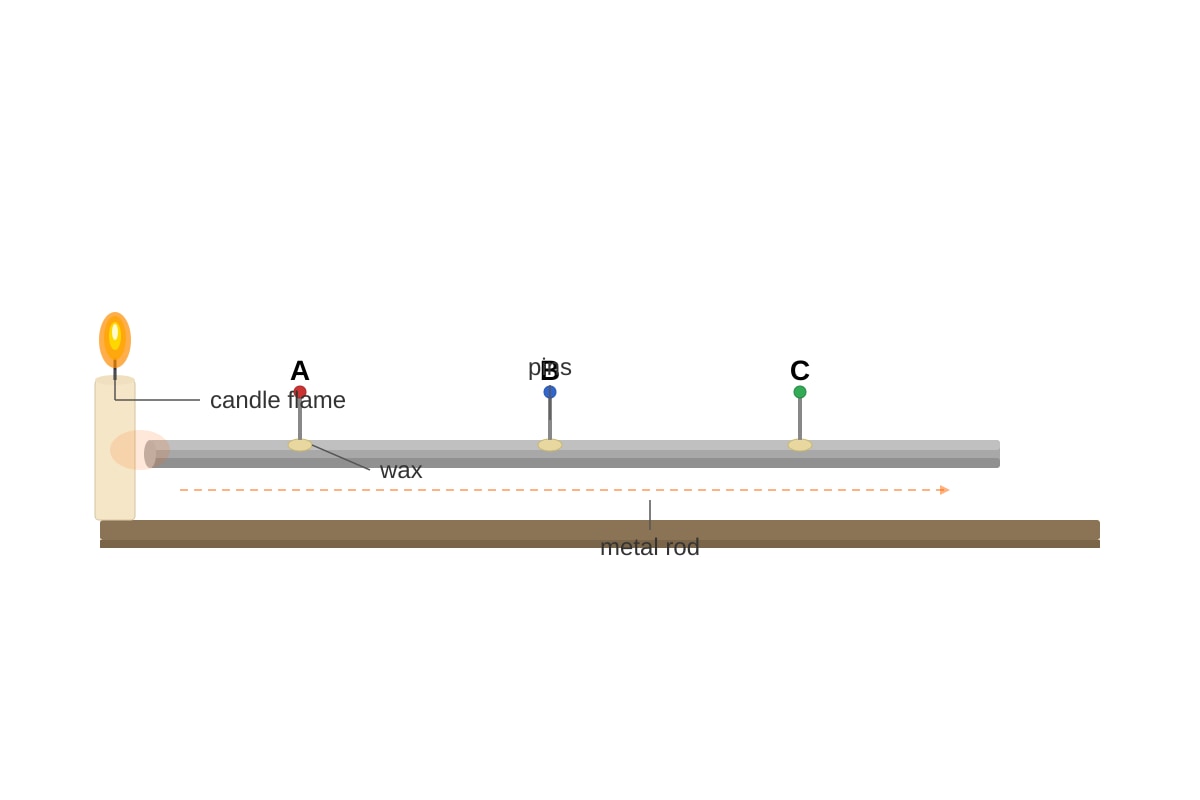
11. The pins will fall off in this order: A, then B, then C. [1 mark]
Explanation: Heat travels along the metal rod by conduction. The pin closest to the flame (A) receives heat first, so the wax holding it melts first, and it falls off. Then the heat reaches pin B, and finally pin C. [1 mark]
Teaching Note: This question tests the understanding that heat travels through a solid by conduction, and that heat travels from the hotter end to the cooler end. The wax melts because it absorbs heat from the rod.
Common Mistake: Students may think the pins fall off in a random order or that all pins fall off at the same time. Emphasise that heat takes time to travel along the rod.
12. The pan is made of metal because metal is a good conductor of heat, so it heats up food quickly. [1 mark] The handle is made of plastic or wood because these materials are poor conductors of heat (insulators), so they do not get hot and burn our hands. [1 mark]
Teaching Note: This question connects material properties to their uses. Metals are good conductors of heat, making them suitable for cooking pans. Plastics and wood are poor conductors, making them suitable for handles.
Common Mistake: Students may say the handle is made of plastic because it is "cheaper" or "lighter." Focus on the scientific reason: it does not conduct heat well.
13. Any two of the following: [2 marks - 1 mark each]
- Blow on the water (fan it).
- Put it in a cooler place (e.g., in the shade).
- Pour it into a wider/shallower container (increases surface area).
- Add some cold water or ice cubes to it.
- Stir the water.
Teaching Note: This question tests understanding of factors that affect the rate of cooling. Blowing or fanning removes hot air around the water, allowing heat to escape faster. A wider container increases the surface area for heat loss. Adding cold water lowers the temperature directly.
Common Mistake: Students may suggest putting the cup in a freezer, which is correct but may be considered too extreme. Accept any reasonable method that speeds up cooling.
14. The towel in direct sunlight will be drier. [1 mark]
Explanation: The sun provides heat energy, which makes the water in the towel evaporate faster. The towel in the shade has less heat, so evaporation happens more slowly. [1 mark]
Teaching Note: This question tests the understanding that heat speeds up evaporation. The sun is a source of heat, and heat provides the energy needed for water to change from a liquid to a gas.
Common Mistake: Students may think the towel in the shade will be drier because it is cooler. Emphasise that heat is needed for evaporation, so more heat means faster evaporation.
15. Water boils at 100°C. [1 mark] When water reaches this temperature, it changes from a liquid into a gas (steam/water vapour). [1 mark]
Teaching Note: This is a recall question about the boiling point of water. The key concept is that boiling is a process where a liquid changes to a gas at a specific temperature.
Common Mistake: Students may confuse boiling with evaporation. Boiling happens at a specific temperature (100°C) throughout the liquid, while evaporation can happen at any temperature and only at the surface.
Section C: Open-Ended Questions (5 × 2 Marks = 10 Marks)
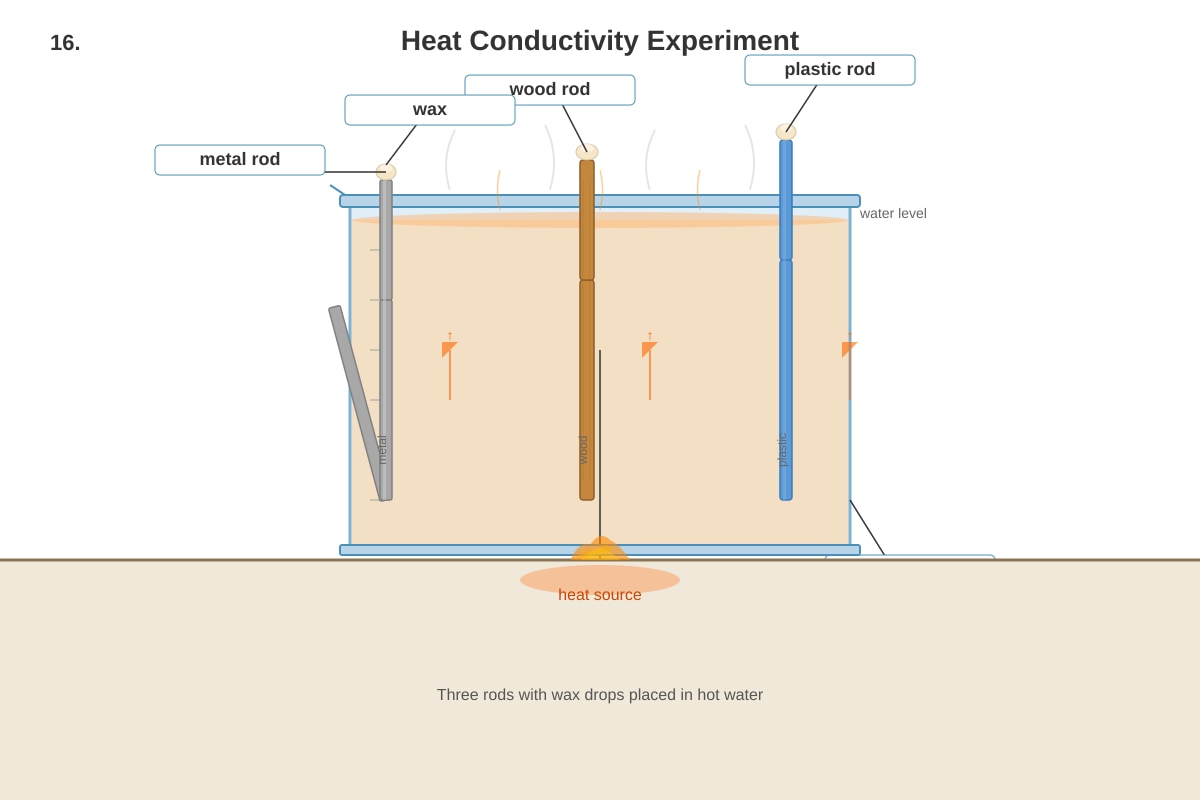
16.
(a) The metal rod will have its wax melt first. [1 mark]
(b) Metal is a good conductor of heat. [1 mark] It transfers heat from the hot water along the rod to the wax faster than wood or plastic, which are poor conductors of heat.
Teaching Note: This question tests the understanding of conductors and insulators. The experiment is a classic way to compare the conductivity of different materials. The wax melts when it receives enough heat, and the better conductor delivers heat faster.
Common Mistake: Students may think the plastic rod will melt first because plastic is "weaker." Emphasise that the question is about heat conduction, not the strength of the material.
17. Metal is a good conductor of heat, so heat from the hot tea travels quickly through the metal spoon to the handle, making it feel hot. [1 mark] Plastic is a poor conductor of heat (an insulator), so it does not transfer heat quickly, and the handle of the plastic spoon stays cooler. [1 mark]
Teaching Note: This question applies the concept of conductors and insulators to a real-life situation. The metal spoon conducts heat from the tea to the hand, while the plastic spoon does not.
Common Mistake: Students may say the metal spoon is "hot" itself, rather than understanding that it conducts heat from the tea. Emphasise that heat flows from the hot tea to the cooler spoon.
18. The water has evaporated. [1 mark] The heat from the sun caused the water to change from a liquid into water vapour (a gas), which mixed with the air. [1 mark]
Teaching Note: This question tests the understanding of evaporation. Evaporation is the process where a liquid changes into a gas at the surface, and it can happen at any temperature, but heat speeds it up.
Common Mistake: Students may say the water has "disappeared" or "soaked into the ground." Emphasise that the water has changed into water vapour, which is invisible in the air.
19. The water droplets come from the water vapour in the air. [1 mark] The cold glass cools the water vapour in the air around it. When the water vapour loses heat, it condenses into tiny water droplets on the outside of the glass. [1 mark]
Teaching Note: This question tests the understanding of condensation. Condensation is the process where a gas changes into a liquid when it loses heat. The cold glass cools the water vapour in the air, causing it to condense.
Common Mistake: Students may think the water droplets come from inside the glass (leaking) or from the cold water itself. Emphasise that the droplets are on the outside of the glass and come from the air.
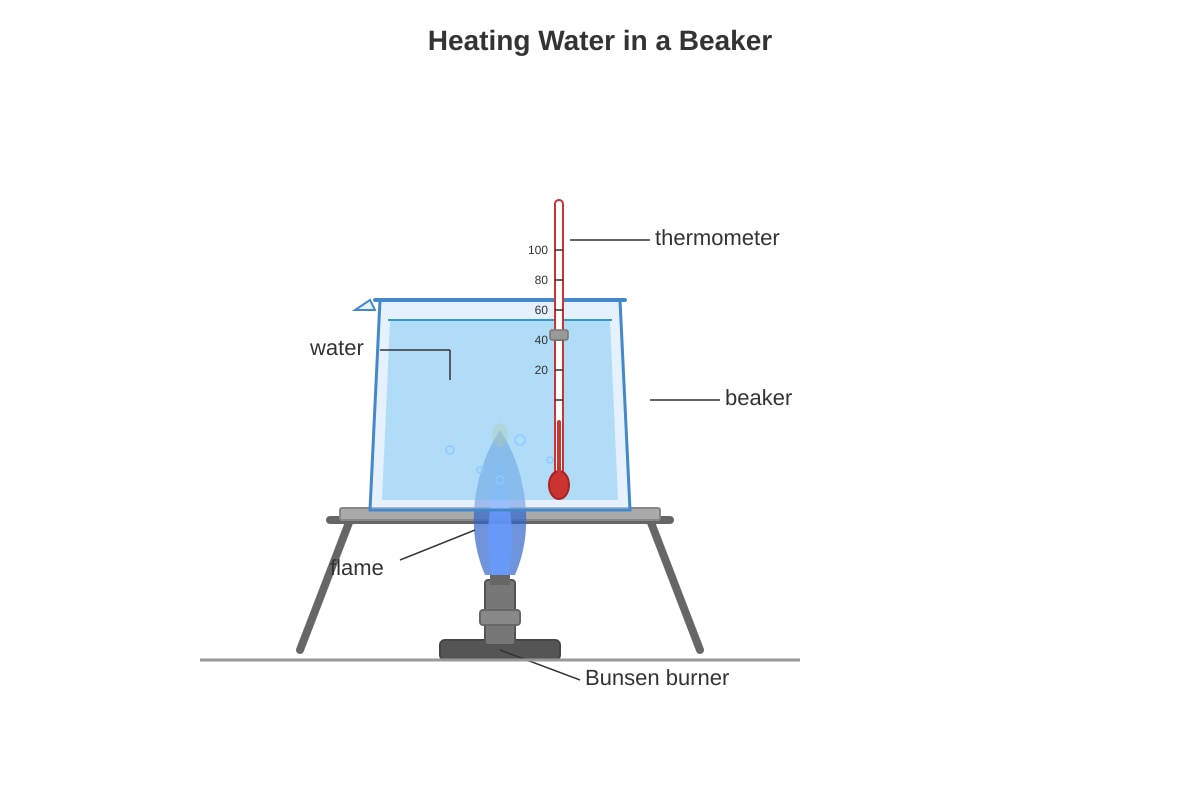
20.
(a) 100°C [1 mark]
(b) The temperature will stay at 100°C. [1 mark] Once water reaches its boiling point, the heat energy is used to change the water into steam, not to raise the temperature further.
Teaching Note: This question tests the understanding of the boiling point. The temperature of a boiling liquid remains constant even if more heat is added. The extra heat energy is used to change the liquid into a gas.
Common Mistake: Students may think the temperature will continue to rise above 100°C. Emphasise that the boiling point is a fixed temperature for a given liquid at a given pressure.
Marking Notes for Teachers:
- For questions 11, 12, 14, 15, 16, 17, 18, 19, and 20, accept any answer that conveys the correct scientific concept, even if the wording is different.
- For 2-mark questions, award 1 mark for the correct answer/identification and 1 mark for the correct explanation, unless otherwise specified.
- Common misconceptions to address:
- Students may think that boiling water gets hotter the longer it is heated (Q20b).
- Students may think that evaporation only happens when water is boiling (Q18).
- Students may confuse conduction with convection or radiation (Q2, Q11).
- Students may think that all metals are always hot, rather than being good conductors of heat (Q17).