From Real Exams Quiz
Primary 3 Science Diversity Materials Quiz
Free P3 Science Diversity Materials quiz, Exam version, with questions, answers, and syllabus-aligned practice for Singapore students.
These static practice materials are generated from the site's syllabus and paper-generation workflow, with source and model context shown so students and parents can evaluate the material before use.
Questions
Free quiz and exam paper access
Enter your details to view this paper
Your access is remembered on this device.
Answers
Answer Key: Primary 3 Science Quiz - Diversity Materials
Total Marks: 20
Section A: Multiple-Choice Questions (Questions 1 to 10)
Each question is worth 1 mark.
1. C. Wood
- Explanation: Wood comes from trees, which are natural. Plastic, glass, and nylon are all man-made materials created by humans.
- Marking: 1 mark for correct answer.
2. B. Transparent
- Explanation: A transparent material allows most light to pass through it, so you can see clearly through it. Opaque materials do not let light through. Flexible means it can bend. Waterproof means it does not let water through.
- Marking: 1 mark for correct answer.
3. C. Rubber
- Explanation: Rubber is waterproof and flexible, making it ideal for a raincoat to keep the wearer dry. Cotton absorbs water, metal is not flexible, and wood is not suitable for clothing.
- Marking: 1 mark for correct answer.
4. B. Conductor of heat
- Explanation: The heat from the soup travels through the metal spoon to the handle. This shows that metal allows heat to pass through it easily, which is the property of being a good conductor of heat.
- Marking: 1 mark for correct answer.
5. D. Plastic
- Explanation: Plastic is a man-made material created from chemicals. Cotton, wool, and leather are all natural materials that come from plants or animals.
- Marking: 1 mark for correct answer.
6. C. Flexible
- Explanation: A flexible material can be bent easily without breaking. Strong means it can hold heavy loads. Hard means it is difficult to scratch or dent. Waterproof means it does not let water through.
- Marking: 1 mark for correct answer.
7. B. It is transparent and lets light through.
- Explanation: The main reason for using glass in windows is that it is transparent, allowing light to enter a room while still providing a barrier to the outside.
- Marking: 1 mark for correct answer.
8. B. A drinking cup
- Explanation: Ceramic is a hard, brittle material often used to make cups, plates, and bowls. Frying pans are usually metal, T-shirts are fabric, and bicycle tyres are rubber.
- Marking: 1 mark for correct answer.
9. B. Lighter than water
- Explanation: An object floats if it is less dense (lighter) than the liquid it is placed in. Wood floats because it is lighter than water.
- Marking: 1 mark for correct answer.
10. B. It is flexible and provides grip.
- Explanation: Rubber is flexible, which allows the sole to bend with the foot, and it provides good grip on the ground, preventing slipping.
- Marking: 1 mark for correct answer.
Section B: Matching and Fill-in-the-Blanks (Questions 11 to 15)
Each question is worth 1 mark.
11. (a) Metal - C. Strong and shiny <br>(b) Rubber - A. Flexible <br>(c) Glass - B. Transparent
- Explanation: Metals are typically strong and have a shiny surface. Rubber is known for its flexibility. Glass is known for being transparent.
- Marking: 1 mark for all three correct matches. Award 0 marks if any match is incorrect.
12. Waterproof
- Explanation: A waterproof material does not allow water to pass through it. This is an important property for items like raincoats and umbrellas.
- Marking: 1 mark for correct answer.
13. Metal (Accept: "Iron", "Steel", "Aluminium", "Copper")
- Explanation: Metals are good conductors of heat, which means they allow heat to pass through them quickly. This makes them suitable for frying pans that need to get hot evenly.
- Marking: 1 mark for any correct metal.
14. Absorbent
- Explanation: An absorbent material soaks up liquid. The cloth became wet because it absorbed water vapour from the hot water.
- Marking: 1 mark for correct answer.
15. Wood (Accept: "Brick", "Stone", "Concrete", "Metal")
- Explanation: Wood is a hard and strong natural material that is commonly used in construction for building houses.
- Marking: 1 mark for any suitable building material.
Section C: Open-Ended Questions (Questions 16 to 20)
Each question is worth 2 marks.
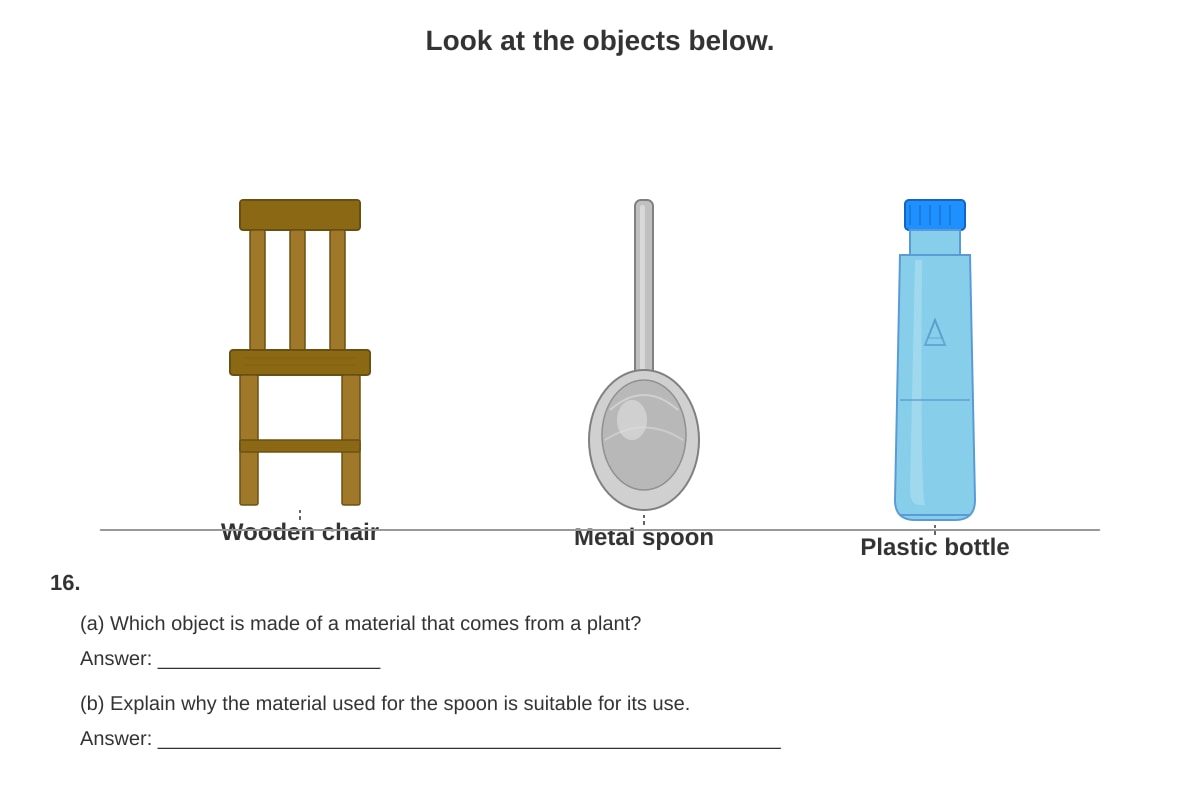
16. (a) Wooden chair (1 mark)
- Explanation: Wood comes from trees, which are plants. The metal spoon comes from metal (a non-living material found in the ground), and the plastic bottle is made from man-made plastic.
(b) Metal is a good conductor of heat, so it can be used to stir hot food without melting. (1 mark)
- Explanation: The spoon is used for cooking and eating. Metal is strong, does not melt easily, and conducts heat well, making it suitable for this purpose. Accept any reasonable explanation linking the property of metal to its use.
- Marking: 1 mark for a clear explanation linking a property (e.g., strong, does not melt, conducts heat) to the use (stirring, eating).
17. (a) Waterproof (1 mark)
- Explanation: The kite needs to be able to fly in the rain without getting wet and heavy. A waterproof material will not absorb water, keeping the kite light and functional.
(b) Plastic (Accept: "Rubber", "Waxed paper") (1 mark)
- Explanation: Plastic is a common waterproof material that is also lightweight, making it suitable for a kite.
- Marking: 1 mark for a suitable waterproof material.
18. (a) Rubber is flexible and provides better grip on the ground. (1 mark)
- Explanation: Wheels need to grip the surface to move the car forward. Rubber is flexible and has a high friction surface, which provides good grip. Plastic is harder and smoother, which would cause the wheels to slip.
(b) Plastic is lightweight and can be moulded into different shapes easily. (1 mark)
- Explanation: The body of a toy car needs to be light so it can move easily, and it needs to be shaped into the car's form. Plastic is both lightweight and easy to shape. Accept any reasonable property like "it is strong" or "it is cheap".
- Marking: 1 mark for a reasonable property of plastic related to making the car body.
19. (a) The metal nail is heavier (denser) than water. (1 mark)
- Explanation: An object sinks in water if it is heavier than the same amount of water (i.e., it is denser). The nail sinks because it is denser than water.
(b) A stone (Accept: "A glass marble", "A coin", "A steel ball") (1 mark)
- Explanation: Any material that is denser than water will sink. Stone, glass, and most metals are denser than water.
- Marking: 1 mark for any correct material that sinks.
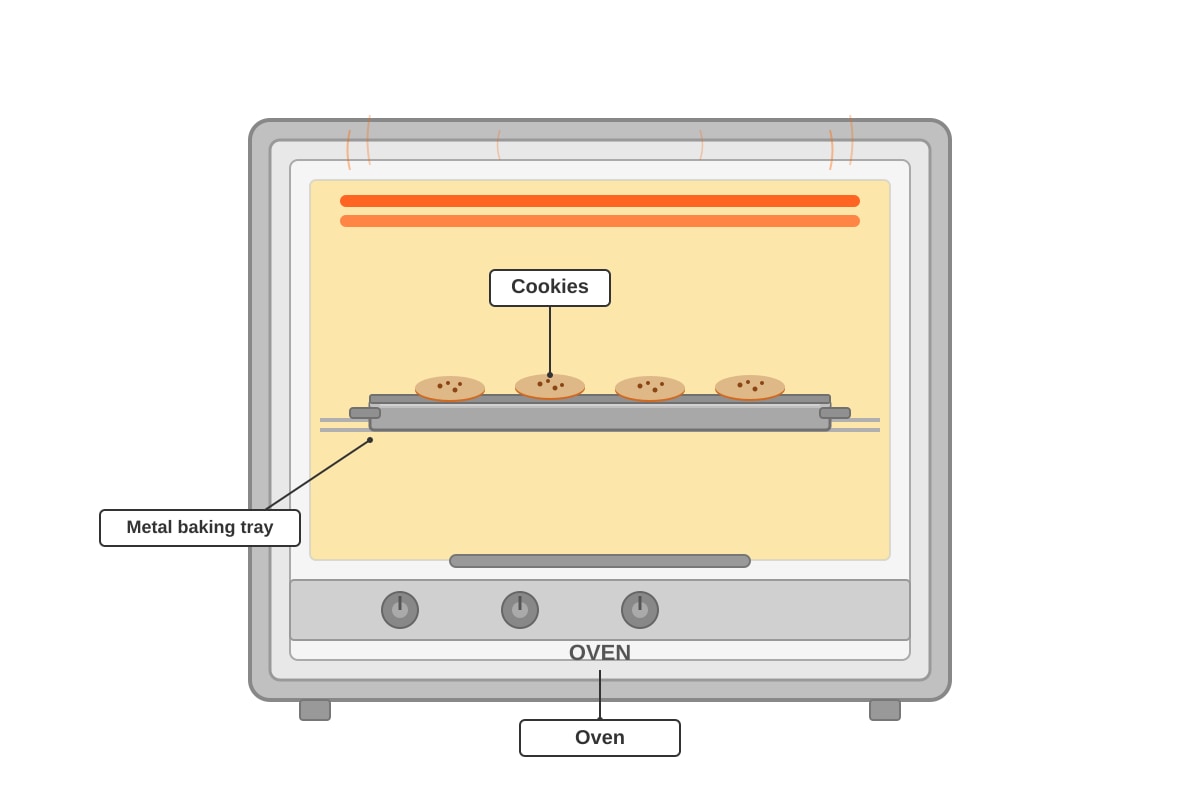
20. (a) Metal can withstand high heat without melting or getting damaged. (1 mark)
- Explanation: Ovens get very hot. Metal is a good conductor of heat and has a high melting point, so it can be used safely in the oven. Plastic would melt or get deformed in the high heat.
(b) Metal is a good conductor of heat, so metal mitts would burn the baker's hands. (1 mark)
- Explanation: Oven mitts are used to protect hands from the heat of the hot tray. If the mitts were made of metal, they would conduct the heat from the tray to the baker's hands very quickly, causing burns. The mitts are made of fabric, which is a poor conductor of heat (an insulator).
- Marking: 1 mark for explaining that metal conducts heat, which would be dangerous. Accept "Metal would get too hot to hold."