From Real Exams Quiz
Primary 3 Science Diversity Materials Quiz
Free P3 Science Diversity Materials quiz, Exam version, with questions, answers, and syllabus-aligned practice for Singapore students.
These static practice materials are generated from the site's syllabus and paper-generation workflow, with source and model context shown so students and parents can evaluate the material before use.
Questions
Free quiz and exam paper access
Enter your details to view this paper
Your access is remembered on this device.
Answers
Answer Key & Explanations: Primary 3 Science Quiz - Diversity of Materials
Total Marks: 20
Section A: Multiple-Choice Questions
-
(C) A metal spoon [1 mark]
- Explanation: A waterproof material does not let water pass through it or soak it up. A metal spoon is smooth and solid, so water cannot go into it. A sponge (A), cloth (B), and paper towel (D) are all absorbent—they soak up water—so they are not waterproof.
- Common Mistake: Students may think a sponge repels water, but sponges are designed to absorb liquids.
-
(B) transparent [1 mark]
- Explanation: A window needs to let light through so we can see outside. A material that allows light to pass through is called transparent. Glass is transparent, which is why it is used for windows. Wood is opaque (you cannot see through it), so it would block the view.
- Common Mistake: Students might choose 'strong' or 'waterproof,' but while these are good properties for a window, the main reason for choosing glass over wood is the ability to see through it.
-
(C) A brick [1 mark]
- Explanation: A brick is a building material. It is very hard and strong—it can support a lot of weight and is difficult to break. A rubber band (A) is flexible, a t-shirt (B) is soft and flexible, and a plastic bag (D) is thin and easily torn. None of these are strong and hard like a brick.
- Common Mistake: Students might think a plastic bag is strong because it can hold shopping. At the P3 level, we focus on comparing the typical properties of different material types.
-
(A) flexible [1 mark]
- Explanation: Flexibility is the ability to bend without breaking. When the rubber ball hits the ground, it squashes (bends out of shape) and then bounces back. This shows it is flexible. The metal spoon does not bend, so it is not flexible. The bounciness is a direct result of its flexibility.
- Common Mistake: Students might confuse 'bouncy' with a material property. At P3, bounciness is linked to flexibility. A key point is that the ability to deform and return to shape demonstrates flexibility.
-
(D) A thin sheet of plastic [1 mark]
- Explanation: The question requires a material that is BOTH waterproof AND flexible. A thin sheet of plastic has these properties. Metal (A) is waterproof but not flexible (it would dent and stay dented). Paper (B) is flexible but not waterproof (it would get soggy). Wood (C) is not flexible and is not suitable for clothing.
- Common Mistake: Students might choose paper because it is flexible, but they must remember the material also needs to be waterproof. A raincoat that gets soggy would be useless.
Section B: Matching and Fill-in-the-Blanks
-
(D) [1 mark]
- Explanation: Strength is the ability to hold a heavy weight without breaking (D). A strong material like steel can support a lot of load.
-
(C) [1 mark]
- Explanation: Flexibility is the ability to be bent without breaking (C). A flexible material like rubber can be bent easily.
-
(A) [1 mark]
- Explanation: Transparency is the property of allowing light to pass through (A). You can see through a transparent material like glass. The syllabus notes that the specific terms "transparent/translucent/opaque" are not required for recall, but the concept of allowing light through is tested.
-
wood [1 mark]
- Explanation: Wood is a natural material that comes from trees. It is known for being strong, which is why it is used to make furniture and houses.
-
metal [1 mark]
- Explanation: Metal can be melted and shaped into many things. It often has a shiny surface. It is malleable, which means it can be bent or hammered into different shapes without breaking easily.
Section C: Short Answer Questions
-
Answer: R [1 mark for correct answer] Reason: R is the best material because it both floats on water AND is waterproof. [1 mark for correct reason explaining both properties are needed]
- Explanation: A toy boat needs to stay on top of the water (float) and not get soaked and sink (be waterproof). Only material R has both properties. Material P floats but is not waterproof, so it would get soaked. Material Q is waterproof but sinks, so it would not make a good boat.
- Marking Notes: Award 1 mark for 'R'. Award 1 mark for explaining that it needs to float AND be waterproof (or be able to stay on water without getting wet).
-
Answer: Plastic is waterproof / Plastic is strong / Plastic is lightweight. (Accept any one correct property) [1 mark]
- Explanation: A pencil case protects pencils. Plastic is waterproof, so it protects the pencils from getting wet if the bag is left in the rain. It is also strong and durable, so it doesn't tear easily. It is also lightweight, so it is easy to carry.
- Marking Notes: Accept any one property that is clearly a property of plastic and is an advantage for a pencil case.
-
Answer: Metal is strong / Metal is hard / Metal is a good conductor of heat (or metal gets hot quickly). (Accept any one correct property) [1 mark]
- Explanation: A cooking pot needs to be strong and not break. It also needs to conduct heat from the stove to the soup inside the pot. If the pot were made of wood, it would not get hot and might burn.
- Marking Notes: Accept any one property. At P3, "good conductor of heat" is often simplified to "it gets hot quickly," which is acceptable.
-
Answer: The plastic is more flexible (than glass). [1 mark]
- Explanation: The observation shows that when force is applied (being dropped), the plastic cup can bend or deform without breaking, whereas the glass cup cannot. This quality of bending without breaking is flexibility. Glass is hard and brittle, so it breaks.
- Marking Notes: Answer must state the property of flexibility. Do not accept "it doesn't break" without linking it to a material property.
-
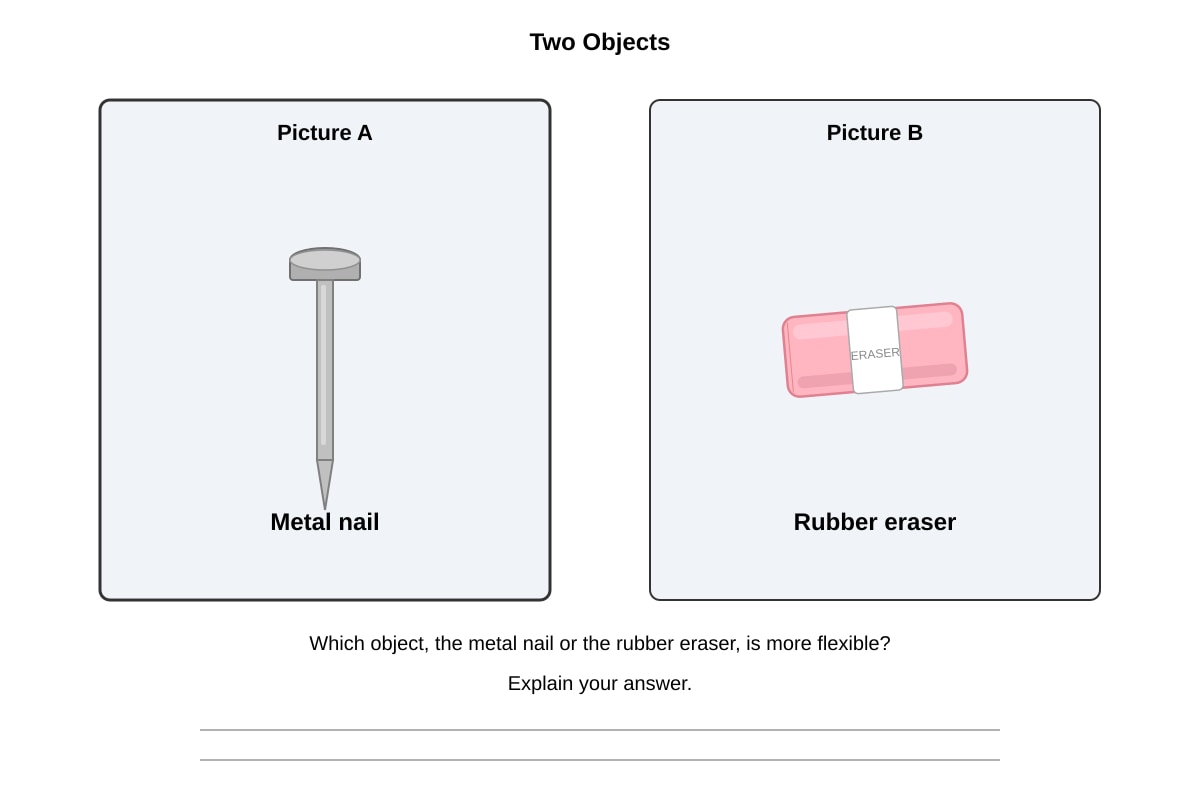
Answer: The rubber eraser is more flexible. [1 mark] Explanation: A rubber eraser can be bent or twisted easily without breaking. A metal nail is strong and hard; it is very difficult to bend and will not return to its original shape. [1 mark for explaining why rubber is flexible or why metal is not]
- Explanation: The answer should show an understanding that flexibility is a property, and rubber is a classic example of a flexible material. Metal is usually rigid.
- Marking Notes: Award 1 mark for naming the rubber eraser. Award 1 mark for a clear explanation comparing the two materials.
Section D: Application and Explanation
-
Answer: Waterproof [1 mark]
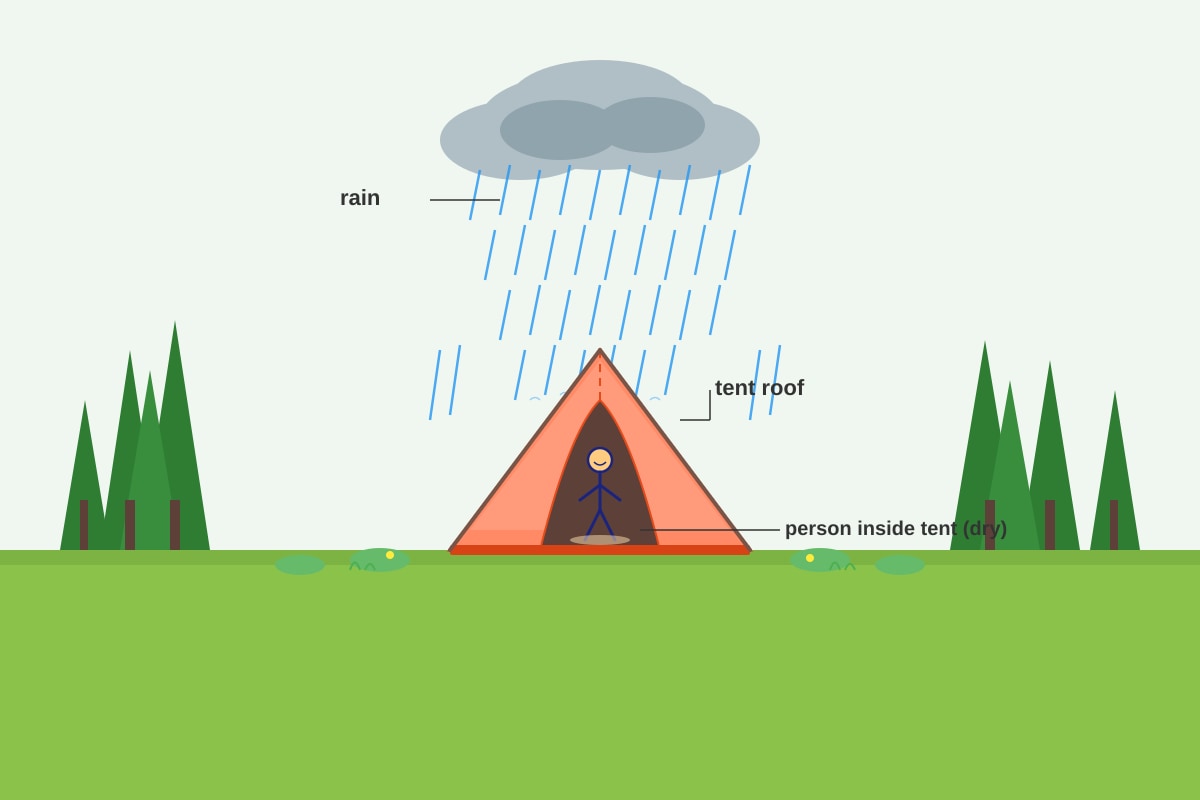
- Explanation: A material that does not let water in is called waterproof. This is important for a tent roof to keep the people inside dry.
-
Answer: It is important for the poles to be flexible so that the tent can be bent and folded down for easy packing and carrying. [2 marks]
- Explanation: If the poles were rigid like metal bars, they would not bend. This would make the tent impossible to fold up and put into a bag. A flexible material allows the tent's frame to bend into a loop shape for the roof and then back into a straight line for storage.
- Marking Notes: Award 1 mark for understanding that flexibility allows the poles to bend. Award 1 mark for linking this to a practical purpose like "packing," "storing," or "setting up the tent."
-
Answer: Fabric is too soft and flexible to hold its shape as a zipper. Metal or plastic is used because it is hard (or strong) and can be shaped into interlocking teeth that stay locked together. [2 marks]
- Explanation: The zipper needs to be strong and rigid enough to open and close securely. A soft fabric zipper would easily come apart and would not be able to slide smoothly. Metal and plastic can be made into hard, shaped pieces that work perfectly as a zipper.
- Marking Notes: Award 1 mark for stating that fabric is not strong/hard enough. Award 1 mark for stating that metal/plastic are strong/hard and can be shaped to work as a fastener.
-
Material: Plastic (or nylon) [1 mark] Explanation: Plastic is suitable because it is waterproof (so the kite will not get heavy and soggy in rain), lightweight (so it can fly easily), and strong (so it does not tear easily in the wind). [1 mark for explaining at least one correct property linked to the need]
- Explanation: The question asks for a suitable material AND an explanation. Students must connect the properties of the material to the needs of a kite. Plastic is a common choice for a kite's body.
- Marking Notes: Award 1 mark for the material name. Award 1 mark for an explanation connecting one of its properties (waterproof, light, strong, or even flexible) to a requirement of the kite (e.g., "so it can fly" or "so the wind doesn't break it"). Do not accept just "it is strong" without linking it to why the kite needs that property.
-
Answer: Metal conducts heat well (or is a good conductor of heat). Wood does not conduct heat well (or is a poor conductor of heat / an insulator). [2 marks]
- Explanation: The heat from the soup travels through the metal spoon to the handle, making it hot. This shows metal is a good heat conductor. The heat does not travel through the wooden spoon, so the handle stays cool. This shows wood is a poor heat conductor (or an insulator). This is why wooden spoons are used for stirring hot food, as they do not get hot.
- Marking Notes: Award 1 mark for a correct statement about the property of metal. Award 1 mark for a correct statement about the property of wood. The answer must compare both materials. Accept simplified terms like "metal gets hot easily" and "wood does not get hot easily."