From Real Exams Quiz
Primary 3 Science Diversity Materials Quiz
Free P3 Science Diversity Materials quiz, Exam version, with questions, answers, and syllabus-aligned practice for Singapore students.
These static practice materials are generated from the site's syllabus and paper-generation workflow, with source and model context shown so students and parents can evaluate the material before use.
Questions
Free quiz and exam paper access
Enter your details to view this paper
Your access is remembered on this device.
Answers
Answer Key - Primary 3 Science Quiz - Diversity Materials
Total Marks: 40
Section A: Multiple-Choice Questions (Questions 1 - 5)
Q1. (B) Plastic sheet, because it is waterproof and does not absorb water.
- Marks: 2
- Explanation: A raincoat must keep the person dry. A waterproof material like plastic does not absorb water, so it is the most suitable. Cotton absorbs water, metal is too stiff and heavy, and paper would tear and absorb water.
Q2. (C) A wooden chair
- Marks: 2
- Explanation: Wood comes from trees, which are natural. Plastic, glass, and nylon are all man-made materials that are processed in factories.
Q3. (C) Wood is less dense than water, while steel is denser than water.
- Marks: 2
- Explanation: An object floats if it is less dense than water and sinks if it is denser than water. The steel ball sinks because it is denser than water, while the wooden ball floats because it is less dense than water. (Note: "heavier" is not a good comparison since they are the same size; we need to compare density.)
Q4. (B) It allows most light to pass through.
- Marks: 2
- Explanation: Windows are meant to let light into a room. Glass is transparent, meaning it allows most light to pass through, making it suitable for windows.
Q5. (B) Flexibility
- Marks: 2
- Explanation: Flexibility is the ability to bend without breaking. A rubber band can be stretched and bent, so it is flexible.
Section B: Matching and Classification (Questions 6 - 10)
Q6.
| Material | Answer |
|---|---|
| 1. Metal | D |
| 2. Glass | A |
| 3. Rubber | B |
| 4. Fabric (cotton) | C |
- Marks: 4 (1 mark for each correct match)
- Explanation:
- Metal is typically strong and hard.
- Glass allows most light to pass through (transparent).
- Rubber can be bent easily without breaking (flexible).
- Fabric (cotton) absorbs water, meaning it is not waterproof.
Q7.
| Natural Materials | Man-made Materials |
|---|---|
| A (cotton T-shirt) | B (plastic toy car) |
| C (wooden pencil) | D (glass bottle) |
- Marks: 2 (1 mark for each correct column; both items must be correct in a column to earn the mark)
- Explanation: Cotton comes from the cotton plant, and wood comes from trees. These are natural materials. Plastic and glass are made by humans through manufacturing processes.
Q8. Sponge.
- Marks: 2 (1 mark for identifying sponge, 1 mark for explanation)
- Explanation: The sponge changed shape and became smaller when pressed, which shows it is the softest. The other materials (wood, metal, plastic) did not change shape, meaning they are harder.
Q9.
| Object | Material | Property that makes it suitable |
|---|---|---|
| (a) Cooking pot | Metal | Strong / hard / does not melt easily in heat |
| (b) Raincoat | Plastic | Waterproof / does not absorb water |
| (c) Window | Glass | Allows light to pass through / transparent |
- Marks: 3 (1 mark for each correct property)
- Explanation:
- (a) Metal is strong and can withstand high heat without melting, making it suitable for cooking pots.
- (b) Plastic is waterproof, so it keeps the person dry.
- (c) Glass allows most light to pass through, so we can see through it and light enters the room.
Q10. Wood.
- Marks: 2 (1 mark for material, 1 mark for reason)
- Explanation: Wood floats in water, so the toy boat will stay on the surface of the puddle. Metal sinks, so a metal boat would not float.
Section C: Short-Answer Questions (Questions 11 - 15)
Q11. (a) Material P.
- Marks: 2 (1 mark for material, 1 mark for reason)
- Explanation: An umbrella needs to be waterproof to keep the person dry. Material P is waterproof. It also floats, which is not necessary but does not matter. Materials Q, R, and S are not waterproof.
(b) Material Q.
- Marks: 2 (1 mark for material, 1 mark for reason)
- Explanation: A window needs to allow light to pass through. Material Q allows light to pass through. It is also waterproof, which is good for a window to keep rain out.
Q12. Metal is strong and hard, so it can hold the cake without breaking. It can also withstand the high heat of the oven without melting or getting damaged.
- Marks: 2 (1 mark for strength/hardness, 1 mark for withstanding heat)
- Explanation: A baking tray must be strong enough to hold the cake and must not melt or deform in a hot oven. Metal has these properties.
Q13. (a) Cup A (paper cup) will become soft and may leak or break.
- Marks: 1
- Explanation: Paper absorbs water.
(b) Paper is not waterproof / paper absorbs water.
- Marks: 1
- Explanation: The paper cup absorbs the water, causing it to weaken and possibly leak. Plastic is waterproof and does not absorb water.
Q14. Metal.
- Marks: 2 (1 mark for material, 1 mark for explanation)
- Explanation: Metal is strong and hard, so it can withstand the heavy weight of the trucks without breaking. Wood and plastic are not as strong as metal.
Q15. Waterproof.
- Marks: 1
- Explanation: A material that does not let water pass through it is called waterproof.
Section D: Application and Reasoning (Questions 16 - 20)
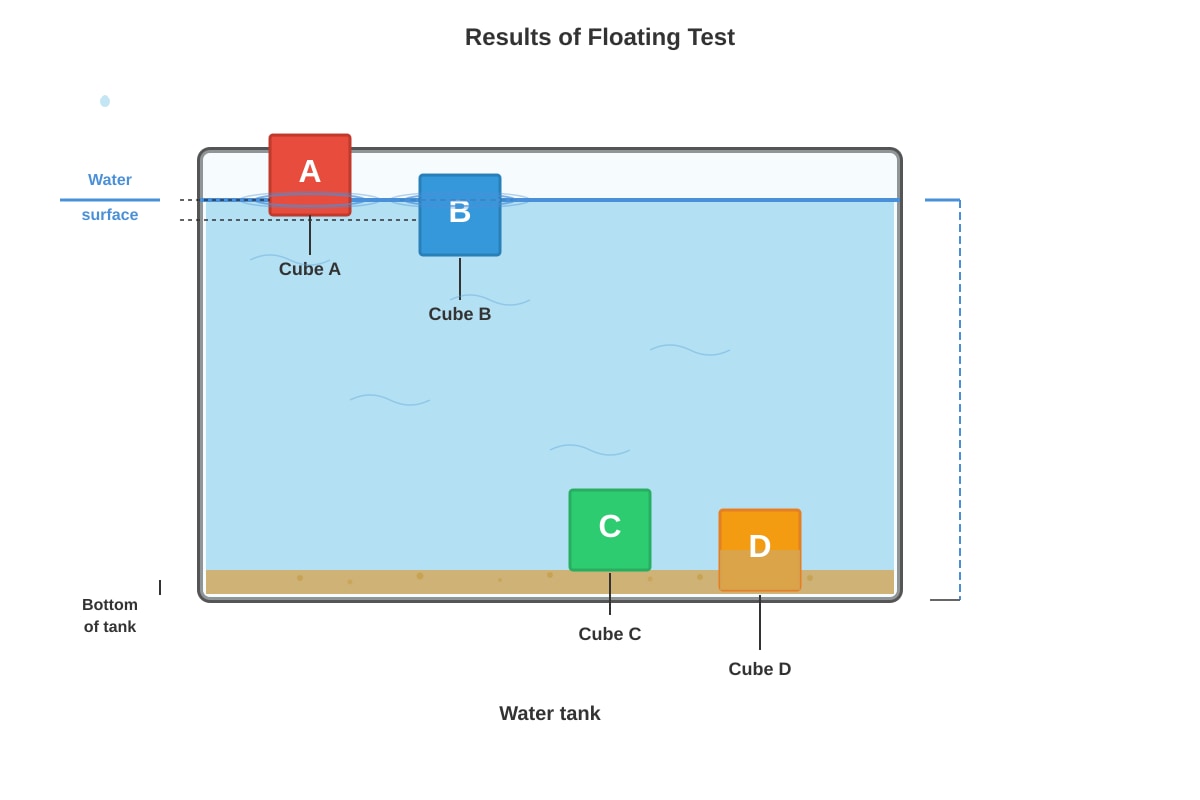
Q16. (a) Cubes A and B.
- Marks: 1
- Explanation: The diagram shows cubes A and B floating on the water surface. This means they are made of materials that float.
(b) Cubes C and D.
- Marks: 1
- Explanation: The diagram shows cubes C and D resting at the bottom of the tank. This means they are made of materials that sink.
(c) Cube A is made of a material that is less dense than the material of Cube B (or Cube A's material is "lighter" for its size).
- Marks: 1
- Explanation: A cube that floats higher in the water is less dense. Since Cube A floats higher than Cube B, its material is less dense.
Q17. Thin plastic sheet.
- Marks: 2 (1 mark for material, 1 mark for explanation)
- Explanation: A kite needs to be light so it can be carried by the wind. The thin plastic sheet is light and flexible, making it easier for the kite to fly. Cardboard is thick, heavy, and stiff, which would make the kite too heavy to fly well.
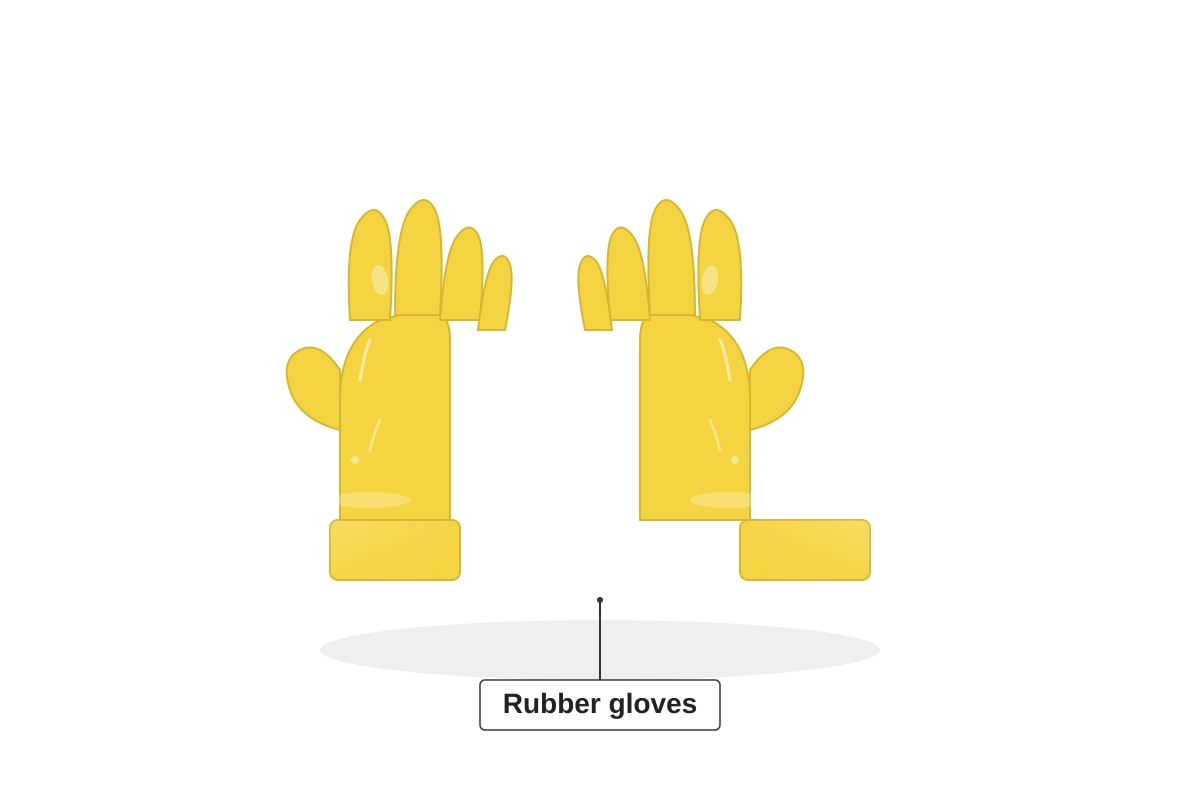
Q18. (a) Waterproof (does not absorb water).
- Marks: 1
- Explanation: Rubber gloves keep the hands dry when washing dishes.
(b) Flexible (can be bent easily).
- Marks: 1
- Explanation: The gloves need to be flexible so the person can move their fingers easily to hold and wash the dishes.
Q19. (a) Material X.
- Marks: 1
- Explanation: The water stays as a droplet on the surface of Material X, meaning it does not absorb water. This is the definition of waterproof.
(b) Raincoat / umbrella / rain boots (any suitable example).
- Marks: 1
- Explanation: Objects that need to keep things dry should be made of waterproof materials.
Q20. (a) Plastic (or a strong, shatter-resistant material).
- Marks: 1
- Explanation: Plastic is strong and does not break easily.
(b) Plastic is stronger and more flexible than glass, so it will not shatter into sharp pieces if hit. This makes it safer for a classroom.
- Marks: 2 (1 mark for strength, 1 mark for safety/flexibility)
- Explanation: Glass can break into sharp, dangerous shards. Plastic is more durable and will not break as easily, making it a safer choice for a classroom window.
END OF ANSWER KEY