From Real Exams Quiz
Primary 3 Science Diversity Living Nonliving Quiz
Free P3 Science Diversity Living Nonliving quiz, Exam version, with questions, answers, and syllabus-aligned practice for Singapore students.
These static practice materials are generated from the site's syllabus and paper-generation workflow, with source and model context shown so students and parents can evaluate the material before use.
Questions
Free quiz and exam paper access
Enter your details to view this paper
Your access is remembered on this device.
Answers
Answer Key: Primary 3 Science Quiz - Diversity Living Nonliving
Total Marks: 20
Section A: Multiple-Choice Questions (10 × 1 mark = 10 marks)
1. Answer: C. A sunflower
- Marks: 1
- Explanation: A sunflower is a plant. Plants are living things because they grow, need water, air, and food (they make their own food using sunlight), and can reproduce. A wooden chair, a toy robot, and a plastic bottle are all non-living things made by humans. They do not grow, need food, or reproduce on their own.
- Common mistake: Students may think a toy robot is alive because it can move. However, movement alone does not mean something is alive. Living things must have ALL the characteristics of life.
2. Answer: B. Water, food, and air
- Marks: 1
- Explanation: All living things need water, food, and air to survive. Plants need water and air to make food, and animals need water, food, and air to live. Sunlight and soil are needed by plants but not by all living things. Toys, shelter, electricity, and batteries are not needed by all living things.
- Common mistake: Students may think all living things need sunlight. However, animals do not need sunlight to survive directly (though they may need it for warmth or vitamin D, the basic survival needs are water, food, and air).
3. Answer: B. grow
- Marks: 1
- Explanation: A seed growing into a plant is an example of growth. Growth is a characteristic of living things. The seed increases in size and develops into a more complex organism (a plant with roots, stem, and leaves).
- Common mistake: Students may confuse growth with other characteristics. A seed does not "move" on its own in the way animals do. It does not "reproduce" at this stage (it is the beginning of a new plant). It may "respond" to water and warmth, but the main process shown here is growth.
4. Answer: C. respond to changes
- Marks: 1
- Explanation: The cat hears a loud noise (a change in its environment) and runs away. This is a response to a change in the environment. Living things can sense changes around them and react to them. This helps them stay safe.
- Common mistake: Students may think this shows movement. While the cat does move, the reason for the movement is to respond to a change (the loud noise). The question asks what the cat's action shows, which is the ability to respond.
5. Answer: B. Birds only
- Marks: 1
- Explanation: Feathers are a unique characteristic of birds. No other group of animals has feathers. Fish have scales, mammals have fur or hair, reptiles have dry scaly skin, and insects have an exoskeleton.
- Common mistake: Students may think some mammals (like dogs or cats) have feathers, but they have fur. Feathers are only found on birds.
6. Answer: C. fungi
- Marks: 1
- Explanation: Mushrooms are not plants because they cannot make their own food (they do not have chlorophyll). They are not animals. They belong to a separate group called fungi. Other examples of fungi include mould and yeast.
- Common mistake: Students often think mushrooms are plants because they grow in the ground and do not move. However, fungi are a different kingdom of living things.
7. Answer: B. They can make their own food.
- Marks: 1
- Explanation: Only plants can make their own food (using sunlight, water, and air in a process called photosynthesis). Animals, fungi, and bacteria cannot make their own food. They must eat or absorb food from other sources. All living things can grow, need air, and can reproduce.
- Common mistake: Students may think all living things make their own food because they know plants do. However, this is not a characteristic of ALL living things.
8. Answer: C. insects
- Marks: 1
- Explanation: Insects are a group of animals that have six legs and a body divided into three parts (head, thorax, abdomen). A butterfly has these features, so it is an insect. Mammals have fur/hair and feed milk to their young. Birds have feathers and a beak. Reptiles have dry scaly skin.
- Common mistake: Students may think butterflies are birds because they have wings and can fly. However, butterflies have six legs and three body parts, which are insect characteristics.
9. Answer: C. A rock
- Marks: 1
- Explanation: A rock is a non-living thing. It does not grow, does not need food or water, does not reproduce, and does not respond to changes in its environment. A frog, a fern plant, and a mushroom are all living things.
- Common mistake: Students may think a mushroom is non-living because it does not move. However, all fungi are living things.
10. Answer: D. No, because it cannot reproduce.
- Marks: 1
- Explanation: A balloon getting bigger is not the same as a living thing growing. Living things grow by increasing the number of cells in their body. A balloon just stretches when air is added. The balloon is non-living because it cannot reproduce, does not need food, and cannot respond to changes on its own.
- Common mistake: Students may think that anything that gets bigger is growing. Growth in living things is a permanent increase in size due to cell division, not just stretching or inflating.
Section B: Matching and Classification (5 × 1 mark = 5 marks)
11. Answer:
- (a) Grow → A puppy becomes a bigger dog
- (b) Reproduce → A cat gives birth to kittens
- (c) Respond to changes → A plant bends towards the sunlight
- Marks: 1 (all three correct)
- Explanation:
- Growth is an increase in size. A puppy growing into a bigger dog is a clear example.
- Reproduction is the process of creating new living things. A cat giving birth to kittens is reproduction.
- Responding to changes means reacting to the environment. A plant bending towards sunlight is responding to light.
- Common mistake: Students may mix up growth and reproduction. Remember: growth is about getting bigger; reproduction is about making new individuals.
12. Answer:
| Thing | L or NL? |
|---|---|
| A dog | L |
| A plastic cup | NL |
| A rose bush | L |
| A moving car | NL |
- Marks: 1 (all four correct)
- Explanation:
- A dog is a living thing (animal).
- A plastic cup is made by humans from plastic, which is a non-living material.
- A rose bush is a living thing (plant).
- A moving car is a non-living thing. Even though it moves, it cannot grow, reproduce, or respond to changes on its own. It needs a human to drive it.
- Common mistake: Students may think a moving car is alive because it moves. Movement alone is not enough to be considered alive.
13. Answer:
| Animal | Group |
|---|---|
| Eagle | Bird |
| Dolphin | Mammal |
| Goldfish | Fish |
| Ant | Insect |
- Marks: 1 (all four correct)
- Explanation:
- Eagle: Has feathers, wings, and a beak → Bird
- Dolphin: Lives in water but breathes air with lungs, has a small amount of hair, gives birth to live young and feeds them milk → Mammal
- Goldfish: Lives in water, has scales and fins, breathes with gills → Fish
- Ant: Has six legs and three body parts → Insect
- Common mistake: Students may think a dolphin is a fish because it lives in water. However, dolphins are mammals because they breathe air, give birth to live young, and feed milk to their babies.
14. Answer: No, I do not agree. A teddy bear is a non-living thing. Even though it has eyes and a mouth, it cannot grow, reproduce, need food or water, or respond to changes on its own. It is just a toy made by humans.
- Marks: 1
- Explanation: A teddy bear looks like a living thing (a bear) but it does not have any of the characteristics of living things. It is made of fabric and stuffing. It cannot grow, move by itself, need food, or reproduce. Having eyes and a mouth does not make something alive.
- Common mistake: Young students often think that if something looks like a living thing (has eyes, mouth, or looks like an animal), it must be alive. This is a common misconception.
15. Answer: Any ONE of the following:
- They can grow.
- They can reproduce.
- They need food/water/air.
- They can respond to changes.
- They can move by themselves.
- Marks: 1
- Explanation: All living things share these characteristics. Non-living things do not have any of these characteristics. For example, a rock cannot grow, reproduce, or need food.
- Note: Accept any one correct characteristic.
Section C: Open-Ended Questions (5 × 1 mark = 5 marks)
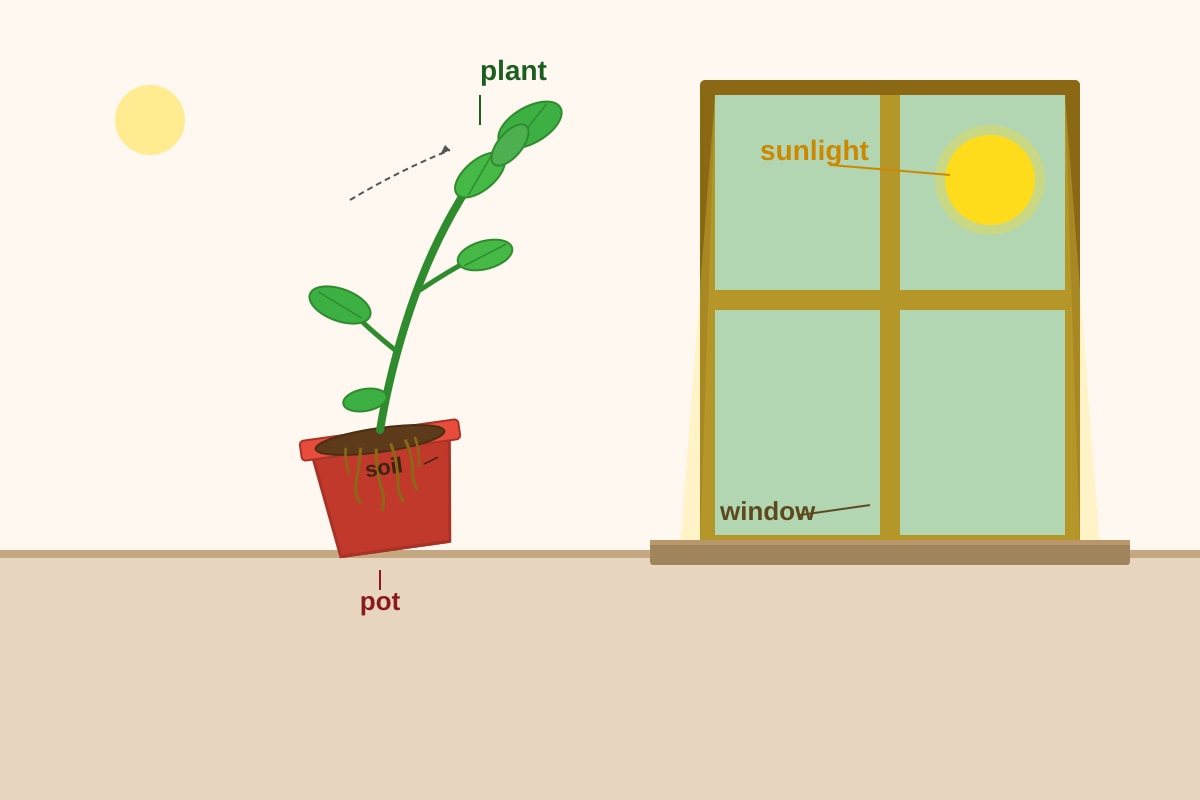
16. Answer: Responding to changes (in the environment).
- Marks: 1
- Explanation: The plant is bending towards the sunlight. Sunlight is a change in the environment (the light source is coming from the window). The plant responds to this change by growing towards the light. This is called phototropism.
- Image note: The image shows a plant on a windowsill bending towards the sunlight coming through the window. This visual helps students understand that the plant is responding to light.
- Common mistake: Students may say "growing" because the plant is getting taller. While growth is involved, the key idea is that the plant is responding to the direction of light.
17. Answer: Amphibian
- Marks: 1
- Explanation: Frogs are amphibians. Amphibians are animals that can live both on land and in water. They have smooth, moist skin and usually lay eggs in water. Other examples of amphibians include salamanders and toads.
- Common mistake: Students may think a frog is a reptile because it can live on land. However, reptiles have dry scaly skin, while amphibians have smooth, moist skin.
18. Answer: Any ONE of the following:
- Some bacteria help break down dead plants and animals (decomposition).
- Some bacteria are used to make yoghurt or cheese.
- Some bacteria help plants get nutrients from the soil.
- Some bacteria in our intestines help us digest food.
- Marks: 1
- Explanation: Bacteria are living things (microorganisms). While some bacteria cause diseases, many are helpful. They play important roles in nature and in food production.
- Common mistake: Students may only know that bacteria are harmful. It is important to teach that many bacteria are beneficial.
19. Answer: Yes, mould is a living thing. Reason: Mould can grow on the bread. / Mould can reproduce by making spores. / Mould needs food (the bread) to survive.
- Marks: 1
- Explanation: Mould is a type of fungus. Fungi are living things. Mould grows on bread because it uses the bread as food. It reproduces by releasing tiny spores into the air. This shows it has the characteristics of living things.
- Common mistake: Students may think mould is non-living because it does not move. However, mould is a living fungus that grows and reproduces.
20. Answer:
- X: Bird
- Y: Mammal
- Z: Fish
- Marks: 1 (all three correct)
- Explanation:
- X has feathers and 2 legs, and lives on land and in air. Only birds have feathers.
- Y has fur and 4 legs, and lives on land. Mammals have fur/hair and usually 4 legs.
- Z has scales and 0 legs, and lives in water. Fish have scales, no legs, and live in water.
- Common mistake: Students may confuse Z (fish) with a reptile. While some reptiles have scales, reptiles usually have 4 legs (or no legs like snakes) and live on land. Fish have fins and gills and live in water.
End of Answer Key