From Real Exams Quiz
Primary 3 Science Diversity Living Nonliving Quiz
Free P3 Science Diversity Living Nonliving quiz, Exam version, with questions, answers, and syllabus-aligned practice for Singapore students.
These static practice materials are generated from the site's syllabus and paper-generation workflow, with source and model context shown so students and parents can evaluate the material before use.
Questions
Free quiz and exam paper access
Enter your details to view this paper
Your access is remembered on this device.
Answers
Answer Key - Primary 3 Science Quiz - Diversity Living Nonliving
Total Marks: 30
Section A: Multiple-Choice Questions (10 Questions)
1. C) A potted plant [1]
- Explanation: A potted plant is a living thing because it can grow, needs water and food (makes its own food), and can reproduce. A wooden chair, glass of water, and plastic toy car are non-living things because they do not grow, do not need food, and cannot reproduce.
- Common mistake: Students may think a glass of water is living because it is needed by living things. Water itself is non-living.
2. C) It can grow. [1]
- Explanation: Growth is a characteristic of living things. A baby bird growing into an adult bird shows that living things grow and develop over time.
- Common mistake: Students may confuse growth with reproduction. Reproduction is about producing new living things, not about the individual getting bigger.
3. B) They can move from place to place. [1]
- Explanation: Not all living things can move from place to place. Plants, for example, are living things but they cannot move from place to place. However, all living things need air and water to survive, and they can all reproduce.
- Common mistake: Students may think that all living things can move. Plants are living but they stay in one place.
4. C) It responds to changes. [1]
- Explanation: The sunflower turning to face the sun is a response to a change in its environment (the position of the sun). This is called responding to stimuli.
- Common mistake: Students may think this is growth because the plant is moving. Responding to changes is about reacting to the environment, not growing.
5. D) Amphibian [1]
- Explanation: A frog is an amphibian. Amphibians have smooth, moist skin and typically live both in water and on land. They lay eggs in water.
- Common mistake: Students may think a frog is a reptile because it lives near water. Frogs have smooth, moist skin, while reptiles have dry, scaly skin.
6. B) Insect [1]
- Explanation: Insects have six legs and three body parts. A butterfly has six legs and wings, so it is an insect. Birds have two legs and feathers.
- Common mistake: Students may think a butterfly is a bird because it has wings. Birds have feathers and beaks, while insects have six legs.
7. C) A cloud [1]
- Explanation: A cloud is non-living. It does not grow, does not need food or water, and cannot reproduce. A mushroom, snail, and bamboo shoot are all living things.
- Common mistake: Students may think a cloud is living because it moves. Movement alone does not mean something is living.
8. B) Duck [1]
- Explanation: A duck is a bird. Birds have feathers and lay eggs. A bat is a mammal, a dolphin is a mammal, and a lizard is a reptile.
- Common mistake: Students may think a bat is a bird because it can fly. Bats have fur and give birth to live young, so they are mammals.
9. C) Gills [1]
- Explanation: Fish breathe underwater using gills. Gills take in oxygen from the water. Lungs are used by mammals, birds, and reptiles to breathe air.
- Common mistake: Students may think fins are used for breathing. Fins are used for swimming and balance.
10. C) Bacteria are living things that can only be seen with a microscope. [1]
- Explanation: Bacteria are living things. They are very small and can only be seen with a microscope. Some bacteria are helpful (e.g., in making yoghurt), and some are harmful.
- Common mistake: Students may think bacteria are not living or that all bacteria are harmful. Bacteria are living and can be both helpful and harmful.
Section B: Matching and Classification (5 Questions)
11. Matching: [2]
- (a) Grows → A seedling becomes a tall tree
- (b) Reproduces → A cat gives birth to kittens
- (c) Responds to changes → A mimosa plant folds its leaves when touched
- (d) Needs water and food → A hamster drinks water and eats seeds
Marking: 2 marks for all four correct; 1 mark for two or three correct; 0 marks for fewer than two correct.
- Explanation: Growth is an increase in size. Reproduction is producing new living things. Responding to changes is reacting to the environment. Needing water and food is a basic need of all living things.
12. Classification: [2]
| Fish | Bird | Reptile | Mammal |
|---|---|---|---|
| shark | eagle | snake | cat |
Marking: 2 marks for all four correct; 1 mark for two or three correct; 0 marks for fewer than two correct.
- Explanation: A shark is a fish (lives in water, has gills and fins). An eagle is a bird (has feathers and wings). A snake is a reptile (has dry scaly skin). A cat is a mammal (has fur and feeds its young with milk).
13. Living and non-living: [2]
| Thing | Living (✓) or Non-living (✗) |
|---|---|
| (a) A wooden spoon | ✗ |
| (b) A potted cactus | ✓ |
| (c) A toy robot | ✗ |
| (d) A mouldy piece of bread | ✓ |
Marking: 2 marks for all four correct; 1 mark for two or three correct; 0 marks for fewer than two correct.
- Explanation: A wooden spoon is non-living (it was once part of a living tree, but the wood itself is no longer living). A potted cactus is a living plant. A toy robot is non-living (it cannot grow or reproduce on its own). A mouldy piece of bread has mould on it, which is a living fungus.
14. Reptile [1]
- Explanation: Animals with dry scaly skin that lay eggs on land are reptiles. Examples include snakes, lizards, and turtles.
- Common mistake: Students may think it is an amphibian. Amphibians have smooth, moist skin and lay eggs in water.
15. Examples: [2] (a) Mammal: cat, dog, cow, whale, bat, human (any one correct example) (b) Insect: butterfly, ant, bee, grasshopper, beetle (any one correct example)
Marking: 1 mark for each correct example.
- Explanation: Mammals have fur or hair and feed their young with milk. Insects have six legs and three body parts.
Section C: Short-Answer Questions (5 Questions)
16. Any two of the following: [2] (a) A toy car cannot grow. (b) A toy car cannot reproduce. (c) A toy car does not need water, food, or air to survive. (d) A toy car cannot respond to changes in its surroundings.
Marking: 1 mark for each correct characteristic (max 2 marks).
- Explanation: Living things share common characteristics: they need water, food, and air; they grow; they respond to changes; and they reproduce. A toy car does not show any of these characteristics.
17. No, the student is not correct. [2]
- The balloon is not a living thing because it cannot grow by itself. [1]
- The balloon only gets bigger because air is blown into it from outside. It does not grow by taking in food and water like living things do. [1]
Marking: 1 mark for saying "No" with a correct reason; 1 mark for explaining why the balloon's increase in size is not growth.
- Explanation: Growth in living things happens because they take in food and water and use it to build new cells. The balloon's size increase is caused by an external force (air being blown in), not by the balloon itself.
- Common mistake: Students may think any increase in size is growth. Growth must come from within the living thing.
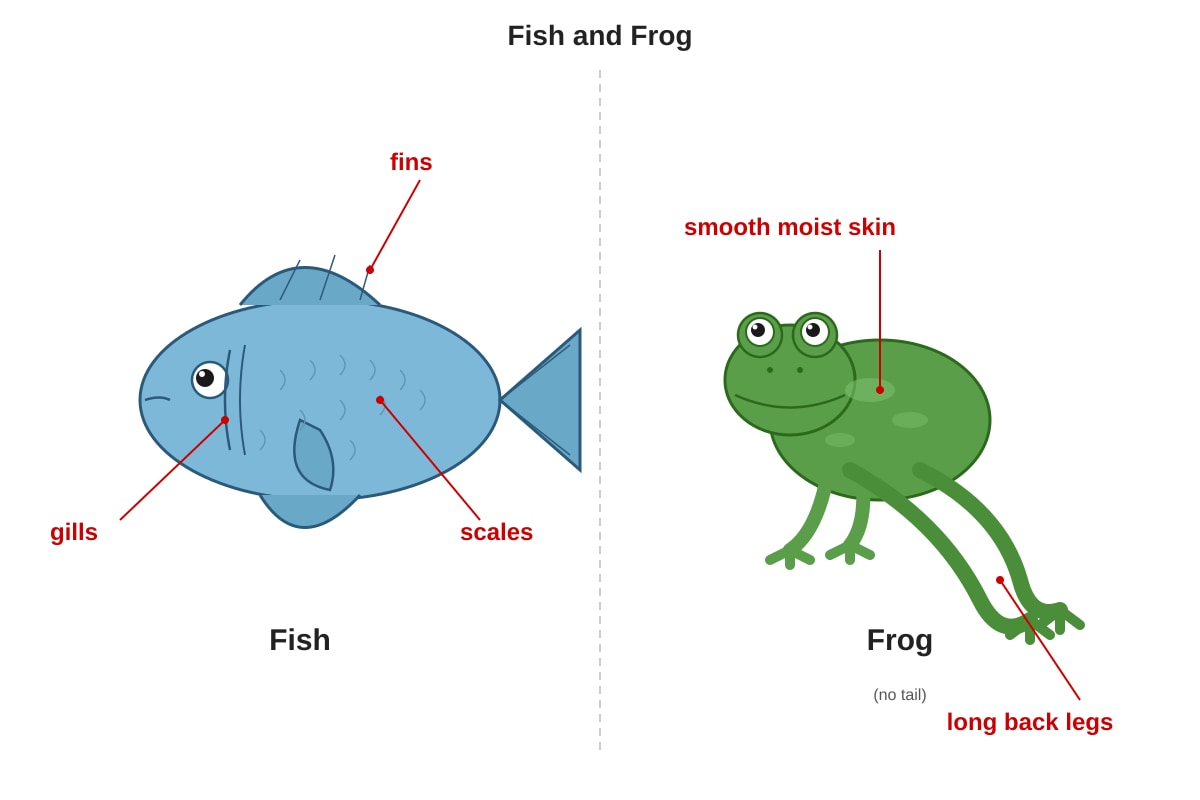
18. (a) One difference: [1]
- The fish has scales, but the frog has smooth, moist skin. (OR: The fish has fins, but the frog has legs. OR: The fish breathes with gills, but the frog breathes with lungs and skin.)
(b) One similarity: [1]
- Both are animals. (OR: Both are living things. OR: Both need water to survive. OR: Both can reproduce.)
Marking: 1 mark for each correct answer.
- Explanation: Fish and frogs are both animals and living things. They differ in body covering (scales vs. smooth skin), body parts (fins vs. legs), and breathing methods (gills vs. lungs).
19. Any one of the following: [1]
- A cat feeds its young with milk, but a chicken does not.
- A cat gives birth to live young, but a chicken lays eggs.
- A cat has fur, while a chicken has feathers. (This is already given, so do not accept.)
Marking: 1 mark for a correct difference.
- Explanation: Cats are mammals and chickens are birds. Mammals give birth to live young and feed them with milk. Birds lay eggs and do not produce milk.
20. (a) The plant grew taller over the two weeks. [1]
- Explanation: The height increased from 5 cm to 10 cm.
(b) It shows that living things can grow. [1]
- Explanation: The increase in height is a sign of growth, which is a characteristic of living things.
(c) The plant needs water to survive. [1]
- Explanation: All living things need water to survive. Plants use water to make food and to stay healthy.
- Acceptable answers: "To survive", "To stay alive", "To make food", "To grow".
Marking: 1 mark for each correct answer.
- Explanation: Water is a basic need of all living things. Without water, the plant would die.
END OF ANSWER KEY