From Real Exams Quiz
Primary 3 Science Diversity Living Nonliving Quiz
Free P3 Science Diversity Living Nonliving quiz, Exam version, with questions, answers, and syllabus-aligned practice for Singapore students.
These static practice materials are generated from the site's syllabus and paper-generation workflow, with source and model context shown so students and parents can evaluate the material before use.
Questions
Free quiz and exam paper access
Enter your details to view this paper
Your access is remembered on this device.
Answers
Answer Key: Primary 3 Science Quiz - Diversity Living Nonliving
Total Marks: 20
Section A: Multiple-Choice Questions (Questions 1 – 5)
1. C) A sunflower plant [1 mark]
- Explanation: A sunflower plant is a living thing because it needs water, food (from photosynthesis), and air. It can grow, respond to changes, and reproduce. A wooden chair, glass of water, and toy robot are non-living things because they do not have all these characteristics.
- Common mistake: Students may think a toy robot is living because it moves. However, it cannot grow, reproduce, or need food and water to survive.
2. B) Grow [1 mark]
- Explanation: Growth is the process where a living thing increases in size and develops. A puppy growing into an adult dog is a clear example of growth. Reproduction is when living things produce young. Moving by itself is when an animal changes position. Responding to changes is when a living thing reacts to its surroundings.
3. C) A stone [1 mark]
- Explanation: A stone is a non-living thing because it does not need air, food, or water. It cannot grow, reproduce, or respond to changes. A mushroom, butterfly, and fish are all living things.
4. C) Respond to changes [1 mark]
- Explanation: The plant's leaves turning towards the sunlight is a response to a change in the environment (light). This is called responding to changes. The plant is reacting to the light source.
5. B) A car is a non-living thing because it cannot grow. [1 mark]
- Explanation: Although a car moves and needs petrol (like a living thing needs food), it cannot grow, reproduce, or respond to changes on its own. Therefore, it is a non-living thing. Movement alone does not make something living.
Section B: Matching and Classification (Questions 6 – 10)
6. Matching: [1 mark for all correct; 0.5 mark if partially correct]
-
(a) Grow → A seedling becomes a tall tree
-
(b) Reproduce → A hen lays eggs
-
(c) Respond to changes → A cat runs away when it hears a loud noise
-
Explanation: Growth is an increase in size (seedling to tree). Reproduction is producing new living things (hen laying eggs). Responding to changes is reacting to the environment (cat hearing a loud noise and running away).
7. Table classification: [1 mark for all correct; 0.5 mark if 3 correct]
| Object | Living Thing | Non-Living Thing |
|---|---|---|
| (a) A bird | ✓ | |
| (b) A pencil | ✓ | |
| (c) A cactus | ✓ | |
| (d) A cloud | ✓ |
- Explanation: A bird and a cactus are living things because they need air, food, and water, and can grow and reproduce. A pencil and a cloud are non-living things because they do not have these characteristics.
8. Classification: [1 mark for all correct; 0.5 mark if 3 correct]
| Living Things | Non-Living Things |
|---|---|
| A fish | A plastic bottle |
| A tree | A rubber ball |
- Explanation: A fish and a tree are living things because they need air, food, and water, and can grow and reproduce. A plastic bottle and a rubber ball are non-living things because they do not have these characteristics.
9. B) A balloon being blown up [1 mark]
- Explanation: A balloon increases in size when blown up, but this is not growth. Growth in living things involves cells dividing and the organism developing. A balloon is a non-living thing. A baby, a seed, and a chick are living things that grow.
10. B) Reproduce [1 mark]
- Explanation: Reproduction is the process where living things produce new living things. A butterfly laying eggs is an example of reproduction because the eggs will hatch into new butterflies.
Section C: True or False and Short Answer (Questions 11 – 15)
11. True or False: [1 mark for all correct; 0.5 mark if 3 correct]
(a) True – All living things need water, food, and air to survive. (b) False – A toy car is a non-living thing. It cannot grow, reproduce, or need food and water. (c) True – Plants are living things because they can grow, respond to changes, and reproduce. (d) True – A table is a non-living thing because it cannot reproduce, grow, or need food and water.
12. A rock is a non-living thing because it cannot grow / reproduce / respond to changes / does not need air, food, or water. [1 mark]
- Explanation: Any one valid characteristic of living things that the rock lacks is acceptable. The rock does not show any of the characteristics of living things.
13. A fish is a living thing because it needs air, food, and water / it can grow / it can reproduce / it can respond to changes. [1 mark]
- Explanation: Any one valid characteristic of living things is acceptable. The fish shows all the characteristics of living things.
14. The seed growing into a young plant shows that living things grow. [1 mark]
- Explanation: Growth is the increase in size and development of a living thing. The seed is developing into a plant.
15. The cat running away when it sees a dog shows that living things respond to changes. [1 mark]
- Explanation: The cat is reacting to a change in its environment (the presence of a dog). This is a response to a change.
Section D: Application and Explanation (Questions 16 – 20)
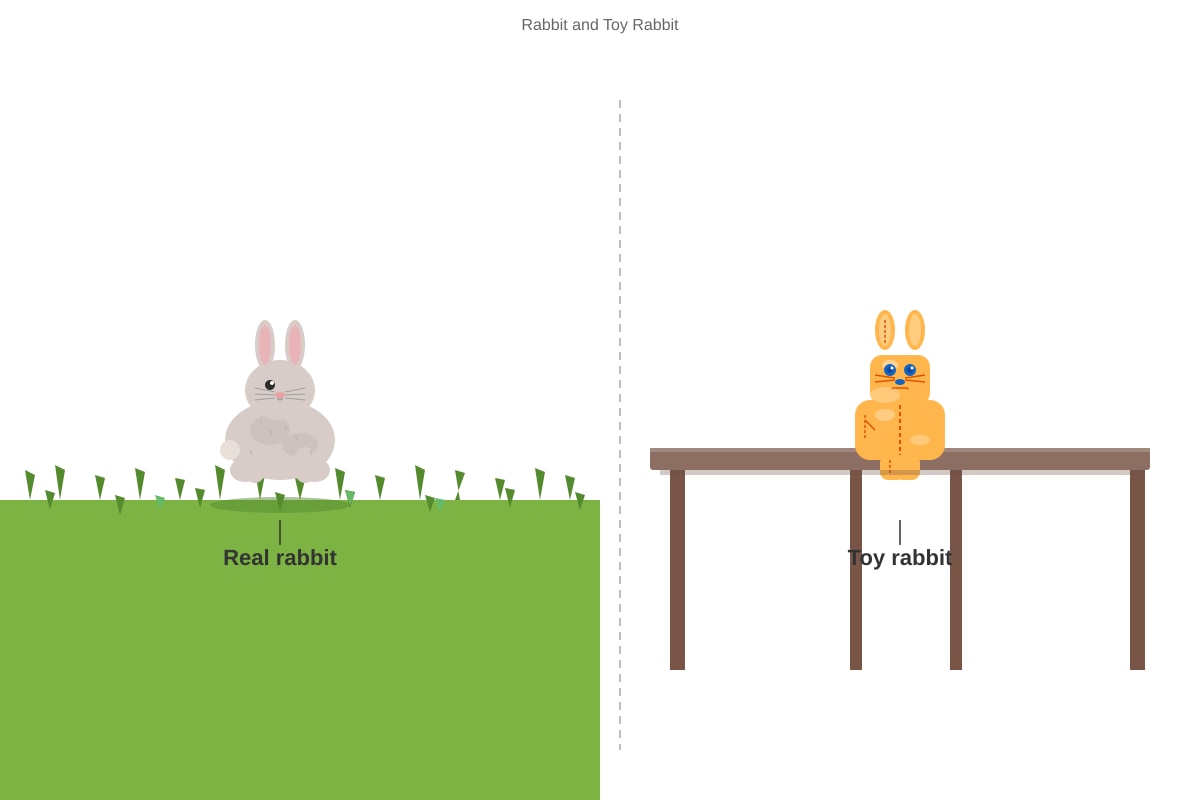
16. (a) The real rabbit is alive / can move by itself / needs food and water / can grow / can reproduce, while the toy rabbit cannot. [1 mark]
- Explanation: Any one valid difference is acceptable. The real rabbit shows characteristics of living things, while the toy rabbit does not.
(b) The real rabbit can grow / reproduce / respond to changes / needs food and water / needs air. [1 mark]
- Explanation: Any one characteristic of living things is acceptable. The toy rabbit does not show any of these characteristics.
17. (a) The plant shows that living things grow. [1 mark]
- Explanation: The plant grew taller over the week, showing growth.
(b) The stone does NOT show growth / reproduction / responding to changes / needing food and water. [1 mark]
- Explanation: Any one characteristic of living things that the stone lacks is acceptable. The stone did not change over the week.
18. (a) The bird laying eggs shows that living things reproduce. [1 mark]
- Explanation: Reproduction is the process of producing new living things. The eggs will hatch into new chicks.
(b) The chicks growing into adult birds shows that living things grow. [1 mark]
- Explanation: The chicks are increasing in size and developing into adult birds, which is growth.
19. (a) The plant's leaves facing the window shows that living things respond to changes. [1 mark]
- Explanation: The plant is responding to the change in light direction by turning its leaves towards the light source.
(b) The toy plant is a non-living thing because it cannot grow / reproduce / respond to changes / does not need air, food, or water. [1 mark]
- Explanation: Any one characteristic of living things that the toy plant lacks is acceptable. The toy plant did not change even when placed near the window.
20. (a) No, this is not an example of growth in a living thing. [1 mark]
(b) The man's weight increase is not growth because growth is an increase in size and development of a living thing, not just an increase in weight. The weight gain could be due to eating more food or other reasons, not necessarily growth. [1 mark]
- Explanation: Growth in living things refers to the development and increase in size of the organism, such as a child growing taller. A weight increase alone does not prove growth, as it could be due to fat, muscle, or water gain. This question tests the misconception that any increase in size or weight is growth.
- Marking note: Award 1 mark for stating that it is not growth, and 1 mark for a valid explanation.
END OF ANSWER KEY