From Real Exams Quiz
Primary 3 Science Diversity Quiz
Free Exam-Derived Kimi K2 6 Free Primary 3 Science Diversity quiz with questions and answers for Singapore students. This page is rendered as a direct URL so the questions and answers can be discovered without pressing in-page buttons.
These static practice materials are generated from the site's syllabus and paper-generation workflow, with source and model context shown so students and parents can evaluate the material before use.
Questions
Primary 3 Science Quiz - Diversity
Name: _________________________ Class: _______ Date: ___________
Duration: 40 minutes
Total Marks: 40 marks
Instructions: Answer all questions. For multiple choice questions, circle the correct answer. For other questions, write your answers in the spaces provided.
Section A: Living and Non-Living Things (Questions 1–7, 14 marks)
1. Which of the following is a living thing? (1 mark)
| A | B | C | D |
|---|---|---|---|
| plastic bottle | flowering plant | glass marble | toy robot |
Circle your answer: ________
2. Living things need certain things to stay alive. Match each need to why it is important. The first one has been done for you. (2 marks)
| Need | Why it is important |
|---|---|
| Water | keeps the body working properly |
| Food | |
| Air |
3. Look at the list below. (3 marks)
butterfly, rock, mushroom, water, earthworm, plastic bag
(a) Write down all the living things from the list in the space below.
(b) Write down all the non-living things from the list in the space below.
(c) The mushroom is a living thing but it does not make its own food like plants do. Name the group of living things that a mushroom belongs to. (1 mark)
4. Lily says, "A balloon gets bigger when I blow air into it, so the balloon is growing. This means the balloon is a living thing."
Is Lily correct? Explain your answer. (2 marks)
5. Study the table below. (3 marks)
| Object | Can it move by itself? | Can it grow? | Does it need food? |
|---|---|---|---|
| A bird | |||
| A teddy bear | |||
| A seedling |
(a) For each object, tick (✓) the correct boxes in the table above to show which characteristics apply. (2 marks)
(b) Using your answers in part (a), explain why the teddy bear is not a living thing. (1 mark)
6. All living things can respond to changes around them. Give an example of how each living thing below responds to a change. (2 marks)
(a) A cat when it hears a loud noise: _________________________________________________
(b) A plant when you place it near a sunny window: _________________________________________________
7. Choose the correct word from the box to complete each sentence below. Each word can be used once, more than once, or not at all. (1 mark)
reproduce move grow die
All living things can ________________. This means they can make young of their own kind.
Section B: Classification of Animals (Questions 8–14, 16 marks)
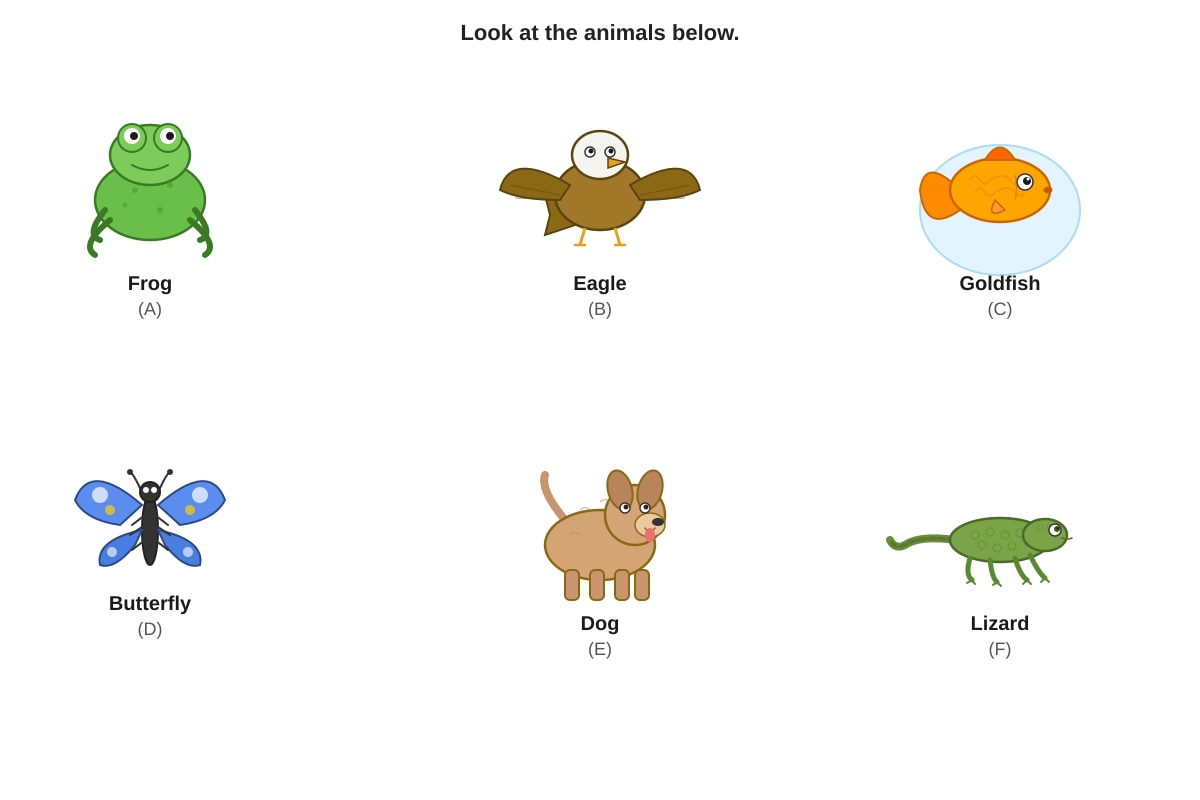
8. Animals can be grouped in different ways. Look at the animals below. (2 marks)
<image_placeholder> id: Q8-fig1 type: diagram linked_question: Q8 description: Six animals arranged in a grid: frog, eagle, goldfish, butterfly, dog, lizard. Simple cartoon-style illustrations clearly showing key features. labels: Frog (A), Eagle (B), Goldfish (C), Butterfly (D), Dog (E), Lizard (F) values: none must_show: Frog has moist skin and no feathers; Eagle has feathers, wings, and beak; Goldfish has fins, scales, and lives in water; Butterfly has six legs and wings; Dog has fur and four legs; Lizard has dry scaly skin and four legs. Each animal labeled with a letter A-F below it. </image_placeholder>
(a) Which two animals have bodies covered with feathers? Write the letters. (1 mark)
(b) Which animal is an insect? Write the letter. (1 mark)
9. Jane sorted some animals into two groups as shown below. (2 marks)
<image_placeholder> id: Q9-fig1 type: table linked_question: Q9 description: A two-column classification table with animal names and simple icons labels: Group X: eagle, penguin, bat, sparrow; Group Y: crocodile, lizard, snake, tortoise values: none must_show: Clear two-column table. Group X shows four animals with wings (flying animals or animals with wings). Group Y shows four reptiles with scaly skin, no wings. Simple recognizable animal shapes. </image_placeholder>
(a) What is the similarity between all the animals in Group X? (1 mark)
(b) Name one animal that could be added to Group Y. (1 mark)
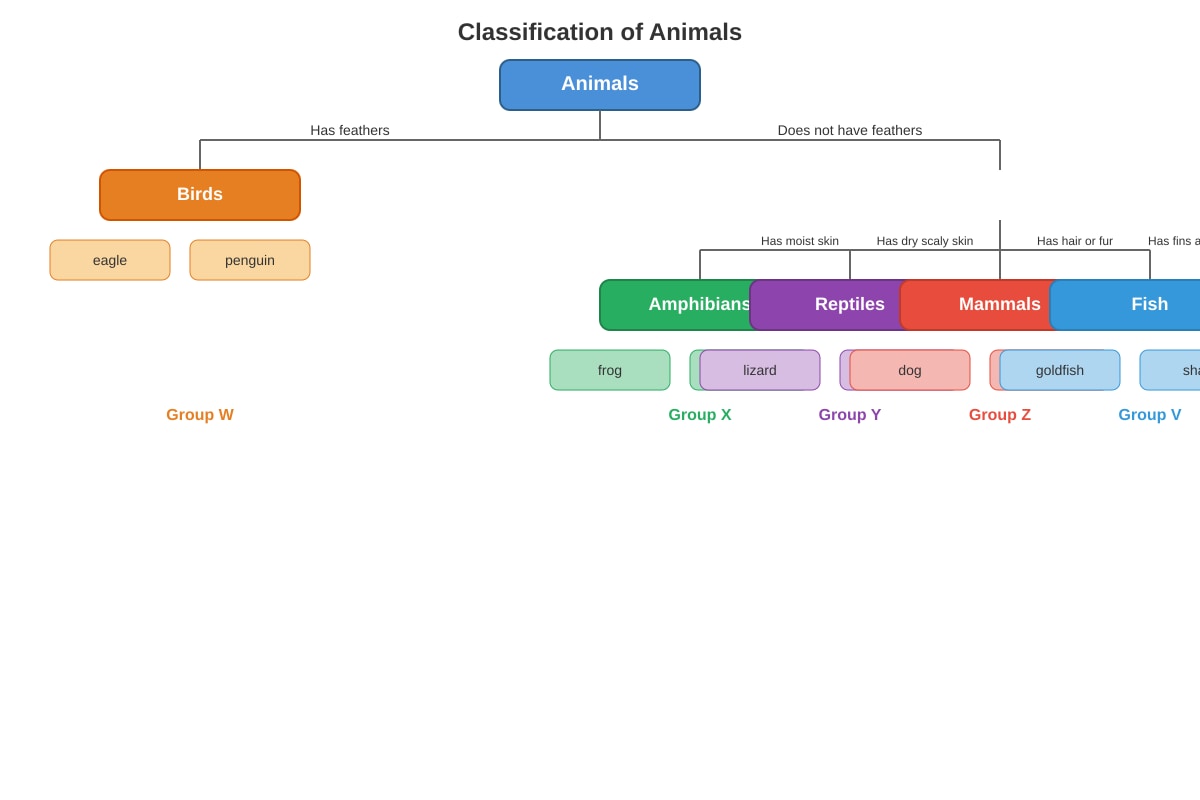
10. The diagram shows how some animals are classified. (3 marks)
<image_placeholder> id: Q10-fig1 type: diagram linked_question: Q10 description: A simple branching classification diagram (dichotomous tree) for animals starting from "Animals" labels: Top: Animals; First branch: "Has feathers" → Birds (eagle, penguin); "Does not have feathers" → splits to "Has moist skin" → Amphibians (frog, toad); "Has dry scaly skin" → Reptiles (lizard, snake); "Has hair or fur" → Mammals (dog, cat); "Has fins and scales" → Fish (goldfish, shark) values: none must_show: Clear branching tree structure from top to bottom. Each branch point labeled with one characteristic question. End groups labeled with animal group names and two examples each. Arrows connect branches cleanly. </image_placeholder>
(a) According to the diagram, what two characteristics do all mammals have? (1 mark)
(b) James found an animal that has dry scaly skin and four legs. Which group does this animal belong to? (1 mark)
(c) A whale does not have fins and scales, does not have feathers, but does have hair. Which group does a whale belong to? Use the diagram to help you. (1 mark)
11. Fish and mammals are both groups of animals. Complete the table below to compare them. (2 marks)
| Feature | Fish | Mammals |
|---|---|---|
| How they breathe | using gills | |
| Body covering | hair or fur | |
| How young are born | from eggs |
12. An amphibian has some features of fish and some features of mammals. (2 marks)
(a) Name one feature of an amphibian that is similar to a fish. (1 mark)
(b) Name one feature of an amphibian that is similar to a mammal. (1 mark)
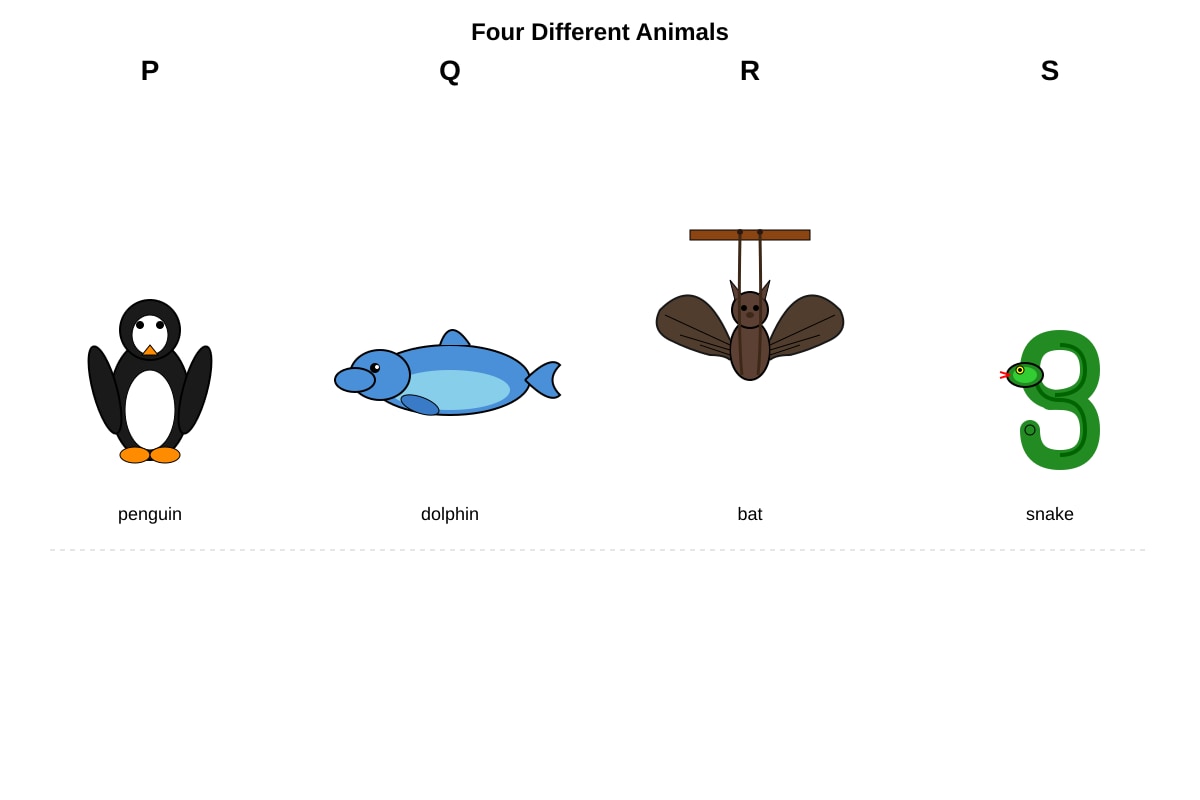
13. The pictures show four different animals. (3 marks)
<image_placeholder> id: Q13-fig1 type: diagram linked_question: Q13 description: Four animals shown side by side with clear distinguishing features labels: Animal P: penguin; Animal Q: dolphin; Animal R: bat; Animal S: snake values: none must_show: Penguin standing upright with flipper-like wings, black and white coloring. Dolphin with streamlined body, dorsal fin, no visible legs. Bat hanging upside down with wings stretched showing membrane wings with bone structure. Snake coiled with no legs, scaly pattern visible. Each labeled P, Q, R, S at top. </image_placeholder>
(a) Which animal(s) cannot live on land for their whole life? Write the letter(s). (1 mark)
(b) Which animal looks like a bird but cannot fly? Write the letter. (1 mark)
(c) Animal R is a bat. Bats are mammals, not birds. What evidence from the picture shows that a bat is a mammal? (1 mark)
14. Read the clues below and name the animal group. (2 marks)
| Clue | Animal group |
|---|---|
| These animals have six legs and three body parts. Most can fly. | |
| These animals have smooth, moist skin. They can live in water and on land. Their young have gills and live in water. |
Section C: Classification of Plants and Fungi (Questions 15–17, 6 marks)
15. Plants can be grouped by whether they have flowers or not. (2 marks)
<image_placeholder> id: Q15-fig1 type: diagram linked_question: Q15 description: Four plants shown with labels labels: Plant W: hibiscus with large red flower; Plant X: fern with fronds, no flowers; Plant Y: moss with small green leafy growth, no flowers; Plant Z: grass with narrow leaves and small flowers values: none must_show: Hibiscus with obvious colorful flower. Fern showing divided fronds, no flowers visible. Moss as low green carpet, no flowers. Grass with blade-like leaves and tiny inconspicuous flowers or flower heads. Each plant clearly labeled W, X, Y, Z. </image_placeholder>
(a) Which plants are flowering plants? Write the letters. (1 mark)
(b) Which plant is a non-flowering plant that does NOT make seeds? (1 mark)
16. Fungi are living things but they are not plants. Explain why fungi are not classified as plants. Use two differences in your answer. (2 marks)
17. Bacteria are very small living things. We cannot see them with our eyes alone. (2 marks)
(a) Name the tool we use to see bacteria. (1 mark)
(b) Bacteria do not make their own food and do not have chlorophyll. Which other group of living things also does not have chlorophyll? (1 mark)
Section D: Materials and Their Properties (Questions 18–20, 4 marks)
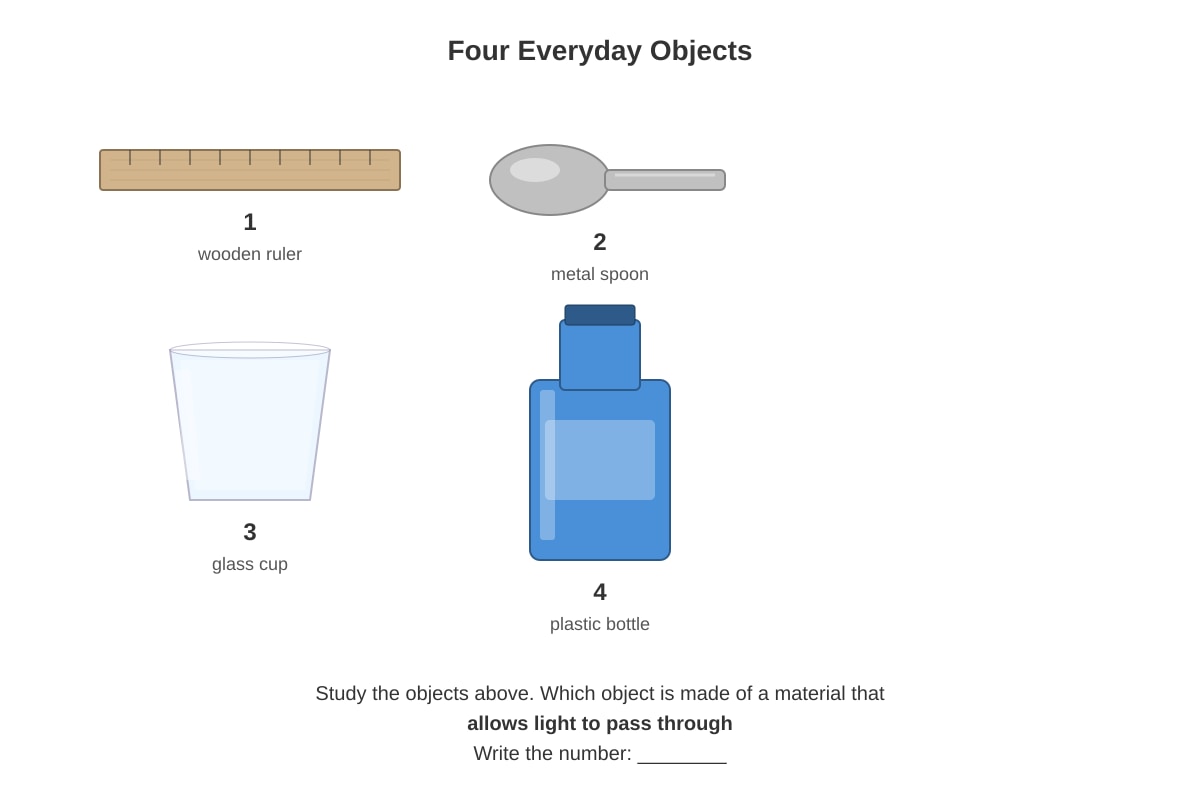
18. Study the objects below. (1 mark)
<image_placeholder> id: Q18-fig1 type: diagram linked_question: Q18 description: Four everyday objects shown labels: Object 1: wooden ruler; Object 2: metal spoon; Object 3: glass cup; Object 4: plastic bottle values: none must_show: Simple clear drawings of each object with material obvious from appearance (wood grain on ruler, metallic shine on spoon, transparency on glass cup, smooth colored surface on plastic bottle). Each labeled 1, 2, 3, 4. </image_placeholder>
Which object is made of a material that allows light to pass through? Write the number.
19. Metal, wood, glass, and plastic are common materials. (2 marks)
(a) Name a property of metal that makes it suitable for making cooking pots. (1 mark)
(b) Why is plastic used to make raincoats instead of paper? (1 mark)
20. The table shows some materials and their properties. (1 mark)
| Material | Hard or soft? | Flexible or rigid? | Waterproof? |
|---|---|---|---|
| Rubber | hard | flexible | yes |
| Cotton | soft | flexible | no |
| Ceramic | hard | rigid | yes |
Auntie Mei wants to make a flexible, waterproof container to carry wet swimming clothes. Which material should she choose?
Circle your answer: Rubber / Cotton / Ceramic
END OF QUIZ
Answers
Primary 3 Science Quiz - Diversity: Answer Key
Total Marks: 40 marks
Section A: Living and Non-Living Things
1. B (flowering plant) — 1 mark
Teaching note: Living things can grow, reproduce, respond, move by themselves, and need food, water, and air. A plastic bottle, glass marble, and toy robot are non-living things. They do not need food or water, and they cannot reproduce.
2. (2 marks — 1 mark per correct match)
| Need | Why it is important |
|---|---|
| Water | keeps the body working properly |
| Food | gives energy / helps the body grow |
| Air | for breathing / to get oxygen |
Teaching note: Food provides energy for all life activities and materials for growth. Air (oxygen) is needed for breathing, which releases energy from food.
3. (3 marks)
(a) butterfly, mushroom, earthworm — 1 mark (all three correct; ½ mark if two correct)
(b) rock, water, plastic bag — 1 mark (all three correct; ½ mark if two correct)
(c) Fungi — 1 mark
Teaching note: Water is non-living — it does not need food, cannot reproduce, and does not grow in the way living things do. Mushrooms are fungi, not plants. Fungi cannot make their own food through photosynthesis.
4. (2 marks)
Answer: No, Lily is not correct. (1 mark)
Explanation: The balloon getting bigger is not growth. Growth in living things means increasing in size by making more body cells. The balloon only gets bigger because air is pushed into it. The balloon does not need food, water, or air to stay alive, and it cannot reproduce. (1 mark for clear explanation of why balloon is non-living)
Common mistake: Students confuse "getting bigger" with "growth." Growth in living things is a permanent increase in size due to cell division.
5. (3 marks)
(a) (2 marks — ½ mark per row, round down)
| Object | Can it move by itself? | Can it grow? | Does it need food? |
|---|---|---|---|
| A bird | ✓ | ✓ | ✓ |
| A teddy bear | ✗ | ✗ | ✗ |
| A seedling | ✗* | ✓ | ✓ |
*Seedlings cannot move from place to place by themselves, though they can grow toward light.
Alternative acceptable: If seedling "move by itself" left unticked or ticked (with note about growing toward light), accept with reasonable explanation.
(b) The teddy bear does not need food, cannot grow, and cannot move by itself (it can only move when someone moves it). (1 mark for any one correct reason clearly stated)
6. (2 marks — 1 mark each)
(a) The cat runs away / jumps / turns its head / becomes alert (any appropriate response showing reaction to stimulus)
(b) The plant grows/bends toward the light / its leaves turn toward the sun (accept "bends toward light")
Teaching note: Responding to stimuli is one characteristic of living things. Plants respond to light (phototropism), water (hydrotropism), and gravity (geotropism).
7. reproduce — 1 mark
Section B: Classification of Animals
8. (2 marks)
(a) B (eagle) — 1 mark
Self-correction note: Only eagle has feathers. Penguin has feathers too but is not in this set. Based on the figure described with A-F labels, B is the eagle with feathers. If multiple animals have feathers, accept all correct letters.
(Revised for consistency with described figure: The eagle is the only bird shown with clear feathers. Bat (R in Q13) has membranous wings, not feathers.)
Corrected answer: B — 1 mark
(b) D (butterfly) — 1 mark
Teaching note: Insects have six legs and three body parts (head, thorax, abdomen). Butterflies are insects. They are different from birds, which have feathers and four limbs.
9. (2 marks)
(a) They all have wings / they can fly — 1 mark (accept "they are birds" if all are birds; accept "they have feathers")
(b) Lizard / snake / crocodile / tortoise / any other reptile — 1 mark
Teaching note: Group X shows animals with wings (birds and bat). Group Y shows reptiles with dry scaly skin and no wings. The classification is based on physical features, not behavior.
10. (3 marks)
(a) Have hair or fur / do not have feathers / do not have moist skin / do not have dry scaly skin / do not have fins and scales — 1 mark (any correct characteristic from the diagram; "have hair or fur" is the defining feature)
(b) Reptiles — 1 mark
(c) Mammals — 1 mark
Working: Follow the diagram: No feathers → no moist skin → no dry scaly skin → no fins and scales → has hair or fur → Mammals
Teaching note: Whales are mammals. They breathe air through lungs, give birth to live young, and feed their young with milk. They do not have gills like fish.
11. (2 marks — 1 mark per correct cell)
| Feature | Fish | Mammals |
|---|---|---|
| How they breathe | using gills | using lungs |
| Body covering | scales | hair or fur |
| How young are born | from eggs | live young / born alive (not from eggs) |
12. (2 marks)
(a) Has gills when young / lives in water when young / has moist skin / has no hair or fur — 1 mark (any correct similarity)
(b) Breathes with lungs as adult / has four legs / lives on land as adult — 1 mark (any correct similarity)
Teaching note: Amphibians like frogs have a life cycle with both aquatic and terrestrial stages. Tadpoles (young) have gills and live in water like fish. Adult frogs breathe with lungs and live on land like mammals, but they are cold-blooded and have moist skin.
13. (3 marks)
(a) Q (dolphin) — 1 mark (dolphins are fully aquatic mammals; accept R or S if student explains, but correct answer is Q as dolphin cannot live on land)
Clarification: Penguins live on land and water. Bats live on land. Snakes live on land. Dolphins live only in water.
(b) P (penguin) — 1 mark
(c) Bats have hair/fur on their bodies / bats do not have feathers / bats give birth to live young — 1 mark (any correct evidence; from picture: bat has membranous wings with visible arm/bone structure, not feathered wings)
14. (2 marks)
| Clue | Animal group |
|---|---|
| These animals have six legs and three body parts. Most can fly. | Insects |
| These animals have smooth, moist skin. They can live in water and on land. Their young have gills and live in water. | Amphibians |
(1 mark each)
Section C: Classification of Plants and Fungi
15. (2 marks)
(a) W and Z — 1 mark (both needed; accept if student identifies hibiscus and grass as flowering)
(b) Y (moss) — 1 mark (or X, fern; but moss is more obviously non-seed as ferns make spores. Accept X or Y with reasonable explanation. Moss does not make seeds at all.)
Teaching note: Mosses are non-vascular plants that do not make seeds. They reproduce using spores. Ferns also use spores. Flowering plants and conifers make seeds.
16. (2 marks)
Answer should include two of the following differences: (1 mark each, maximum 2 marks)
- Fungi do not have chlorophyll / cannot make their own food (they absorb nutrients from decaying matter)
- Fungi do not have leaves, stems, or roots
- Fungi reproduce using spores, not seeds
- Fungi are not green in color
Teaching note: Plants have chlorophyll and make their own food through photosynthesis. Fungi are decomposers that break down dead organic matter.
17. (2 marks)
(a) Microscope — 1 mark
(b) Fungi — 1 mark (accept "animals" as bacteria are also in this category, but fungi is the most direct comparison)
Section D: Materials and Their Properties
18. 3 (glass cup) — 1 mark
Teaching note: Glass is transparent — it allows light to pass through. We can see through a glass cup. Wood, metal, and most plastic are opaque.
19. (2 marks)
(a) It is a good conductor of heat / it can withstand high temperatures / it is strong — 1 mark (any suitable property)
(b) Plastic is waterproof / does not absorb water / paper absorbs water and will tear — 1 mark
Teaching note: Materials are chosen based on their properties and the purpose of the object. Metal conducts heat well for cooking. Plastic repels water for rain protection.
20. Rubber — 1 mark
Working: Need flexible AND waterproof. Check table:
- Rubber: flexible ✓, waterproof ✓ → CORRECT
- Cotton: flexible ✓, waterproof ✗
- Ceramic: rigid ✗, waterproof ✓
END OF ANSWER KEY