From Real Exams Quiz
Primary 3 Science Diversity Quiz
Free P3 Science Diversity quiz, HY3 Exam version, with questions, answers, and syllabus-aligned practice for Singapore students.
These static practice materials are generated from the site's syllabus and paper-generation workflow, with source and model context shown so students and parents can evaluate the material before use.
Questions
Free quiz and exam paper access
Enter your details to view this paper
Your access is remembered on this device.
Answers
Primary 3 Science Quiz - Diversity (Answer Key)
Total Marks: 30
Question count: 20 (exactly)
Section A: Living and Non-Living Things
1. B (cat) [1 mark]
Teaching note: A cat is an animal that needs food, water, and air, can grow and reproduce — these are living things' characteristics. Toys, stones, and cups do not do these.
2. No, the teddy bear is not living because it cannot grow, reproduce, or need food by itself; it only moves when a child pushes it. [1 mark]
Teaching note: Movement alone does not make something living. Living things move by themselves.
3. [2 marks: ½ each correct tick]
- Rose plant: ✓ (living)
- Wooden chair: ( )
- Earthworm: ✓ (living)
- Mobile phone: ( )
Note: Common mistake — thinking a phone is "alive" because it lights up.
4. B (It can grow) [1 mark]
Teaching note: Growth is a key characteristic of living things. Colour or size alone does not prove life.
5. No, because the balloon only changes size from air pushed in, not from inside growth like a living thing. [1 mark]
Teaching note: Inflating is not growth; living things grow by making more of their own cells.
6. [2 marks: 1 for each group correct]
Living: bird, fish, mushroom
Non-living: book, table, bicycle
Note: Mushroom is a fungus, but it is still a living thing.
7. Yes [1 mark]
Teaching note: Bacteria are microorganisms that are alive; they are not plants.
Section B: Materials
8. B (Clear glass window) [1 mark]
Teaching note: Transparent means light passes through so we can see clearly.
9. [2 marks: ½ each]
- Plastic ruler: Rigid (✓ under Rigid)
- Rubber band: Flexible (✓ under Flexible)
Note: Rigid means cannot bend easily; flexible means can bend.
10. B (Cotton shirt) [1 mark]
Teaching note: Cotton comes from plants — natural. Plastic, glass, nylon are man-made.
11. So that rain water cannot pass through and the person stays dry. [1 mark]
Teaching note: Waterproof means material does not absorb water.
12. B (Strength) [1 mark]
Teaching note: Strength lets material hold load without breaking.
13. [2 marks: 1 each]
Natural: wood, cotton, wool
Man-made: plastic, glass
14. [2 marks: 1 material, 1 reason]
Material: glass (or clear plastic)
Reason: It is transparent so light passes through and we can see outside.
Section C: Mixed Diversity
15. [4 marks: 1 each]
- Has scales: fish, snake
- Has feathers: bird
- Has fur/hair: dog
- Has wings but no feathers: butterfly
Teaching note: Insects like butterfly have wings but not feathers.
16. No, mushrooms are fungi, not plants, because they do not make food from sunlight and belong to a different group. [1 mark]
Teaching note: Fungi absorb food; plants make their own.
17. D (Not fully transparent) [1 mark]
Teaching note: At P3, we say most/some/none light passes; "not fully transparent" is acceptable description.
18. [1 mark]
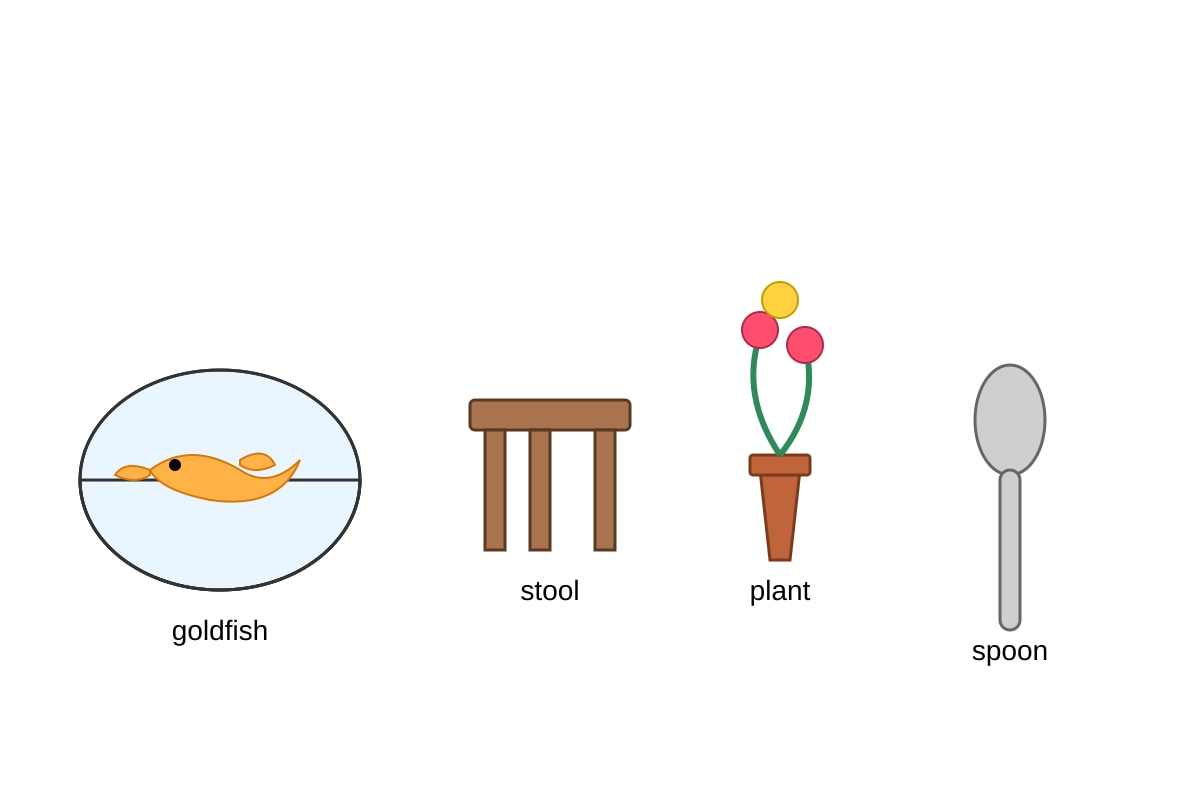
Living things: goldfish, plant (or labels given: goldfish and plant)
Teaching note: From image, goldfish and plant are living; stool and spoon are non-living.
19. B (Bird, fish, beetle) [1 mark]
Teaching note: Fern, mushroom, tree, rose are not animals.
20. To organise living and non-living things by their characteristics so we can study and understand them better. [1 mark]
Teaching note: Classification helps scientists see patterns.
Marking summary: 20 questions, total 30 marks. Easy/Medium spread aligned to P3 Diversity topic.