AI Generated Exam Paper
Primary 3 Science Practice Paper 5
Free P3 Science Practice Paper 5, Kimi2.6 AI version, with questions, answers, and syllabus-aligned practice for Singapore students.
These static practice materials are generated from the site's syllabus and paper-generation workflow, with source and model context shown so students and parents can evaluate the material before use.
Questions
Free quiz and exam paper access
Enter your details to view this paper
Your access is remembered on this device.
Answers
Primary 3 Science Quiz - Diversity (Version 5 of 5): ANSWER KEY
Total Marks: 40
Section A: Multiple Choice (Questions 1–8)
1. B — A potted orchid plant (1 mark)
Teaching note: Living things show all the characteristics of life: they need food, water, and air; they grow; they respond to changes; they reproduce; they move by themselves. A plastic dinosaur (A), stone paperweight (C), and metal bottle (D) cannot do these things, so they are non-living. An orchid plant grows, needs water, and can produce flowers and seeds.
2. B — Food, water, and air (1 mark)
Teaching note: These are the basic needs of all living things. While plants need sunlight to make food (photosynthesis), animals cannot make their own food and must eat. All living things need water to carry out life processes and air (oxygen) to breathe and release energy from food. Electricity (A) and plastic/metal (D) are not needs of living things.
3. C — respond to changes around them (1 mark)
Teaching note: The cat chasing the string shows response to stimuli (the moving string is the stimulus; chasing is the response). Living things detect and react to changes in their environment. Cats do not stay still forever (A), cannot make their own food (B), and do not become non-living when sleeping (D) — sleeping is just a resting state, not death.
4. C — Insects (1 mark)
Teaching note: Butterflies have six legs, three body parts (head, thorax, abdomen), and usually wings — all characteristics of insects. Mammals (A, D) have fur/hair and feed milk to young. Reptiles (B) have scales and lay eggs with tough shells. The four-stage life cycle (egg → caterpillar → pupa → adult) is also typical of insects.
5. B — a fungus (1 mark)
Teaching note: Mushrooms and mould are fungi, not plants. Unlike plants, fungi cannot make their own food through photosynthesis (they have no chlorophyll). They absorb nutrients from their surroundings. Fungi are a separate kingdom of living things, distinct from plants, animals, and bacteria. This is an important P3 distinction.
6. B — Rock and glass bottle (1 mark)
Teaching note: Both rock and glass bottle are non-living — they do not grow, reproduce, respond, or need food/water/air. Fish and seaweed (A) are both living; frog and tadpole (C) are both living (tadpole is frog's young); fern and mushroom (D) are both living. Students often mistake mushrooms for non-living — emphasise that fungi are living.
7. B — grow and develop (1 mark)
Teaching note: The seed growing into a seedling shows growth — a key characteristic of living things. The seed that did not grow might have been dead, lacking water, or missing another condition for life. Living things do not disappear completely (A), stay the same size (C), or change into rocks (D). Growth means increasing in size and/or complexity.
8. D — Panda (1 mark)
Teaching note: Pandas are mammals — they have fur, give birth to live young, and female pandas feed their cubs milk. Pythons (A) are reptiles (scales, lay eggs). Pigeons (B) and parrot fish (C) are not mammals — pigeons are birds (feathers, beak, lay eggs), and parrot fish are fish (scales, fins, live in water, lay eggs).
Section B: Fill in the Blanks and Matching (Questions 9–14)
9.
- First blank: air (1 mark)
- Second blank: respond (1 mark)
Teaching note: All living things need air (oxygen for respiration), food (for energy and building body parts), and water (for transport and reactions in the body). When a sunflower turns to face the Sun, this is phototropism — a response to light. The stimulus is light; the response is growing/moving towards it. Other examples: leaves closing when touched (Mimosa), roots growing towards water.
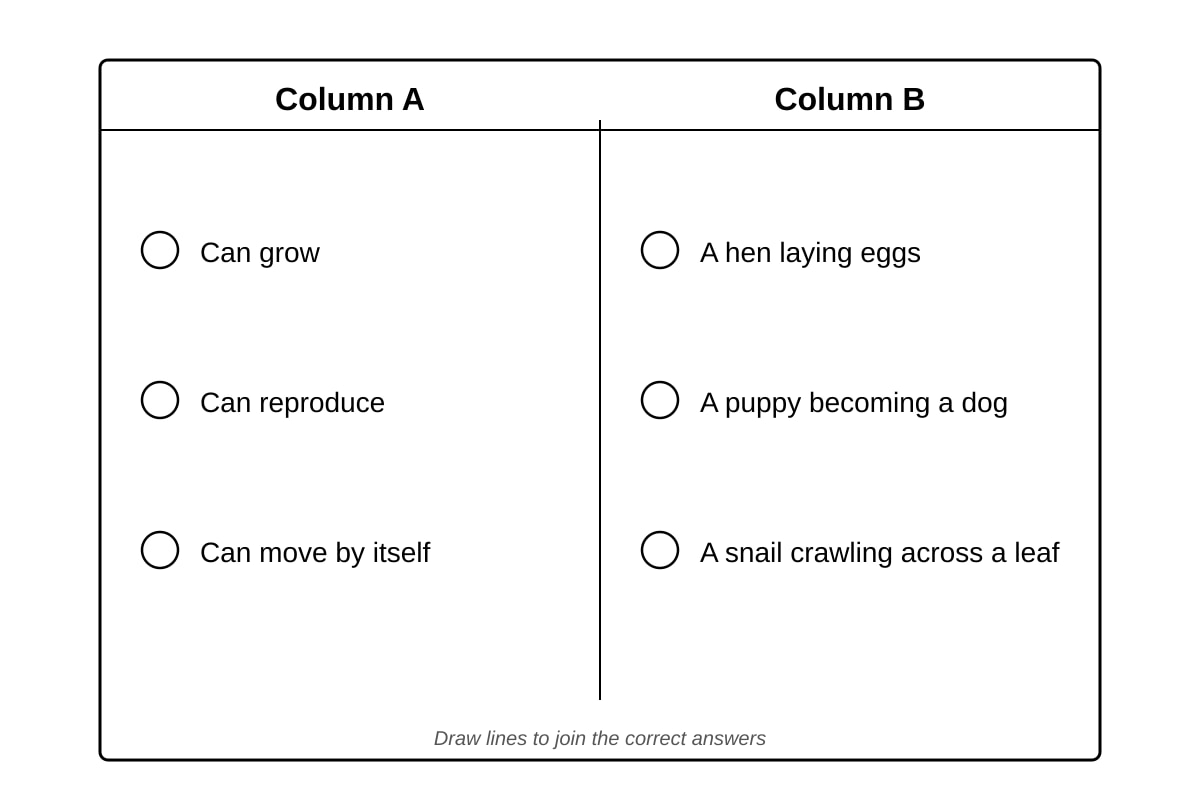
10. Correct matching: (2 marks — 1 mark for 2 correct, 2 marks for all 3 correct)
| Characteristic | Example |
|---|---|
| Can grow | A puppy becoming a dog |
| Can reproduce | A hen laying eggs |
| Can move by itself | A snail crawling across a leaf |
Teaching note:
- Growth means increase in size and/or complexity over time. A puppy grows into an adult dog.
- Reproduction means producing young of the same kind. Hens lay eggs that hatch into chicks.
- Movement by itself (self-directed): snails move using a muscular foot. They do not need to be pushed or pulled.
Common error: Students may match "can grow" to the hen laying eggs (confusing growth with reproduction). Emphasise the difference.
11.
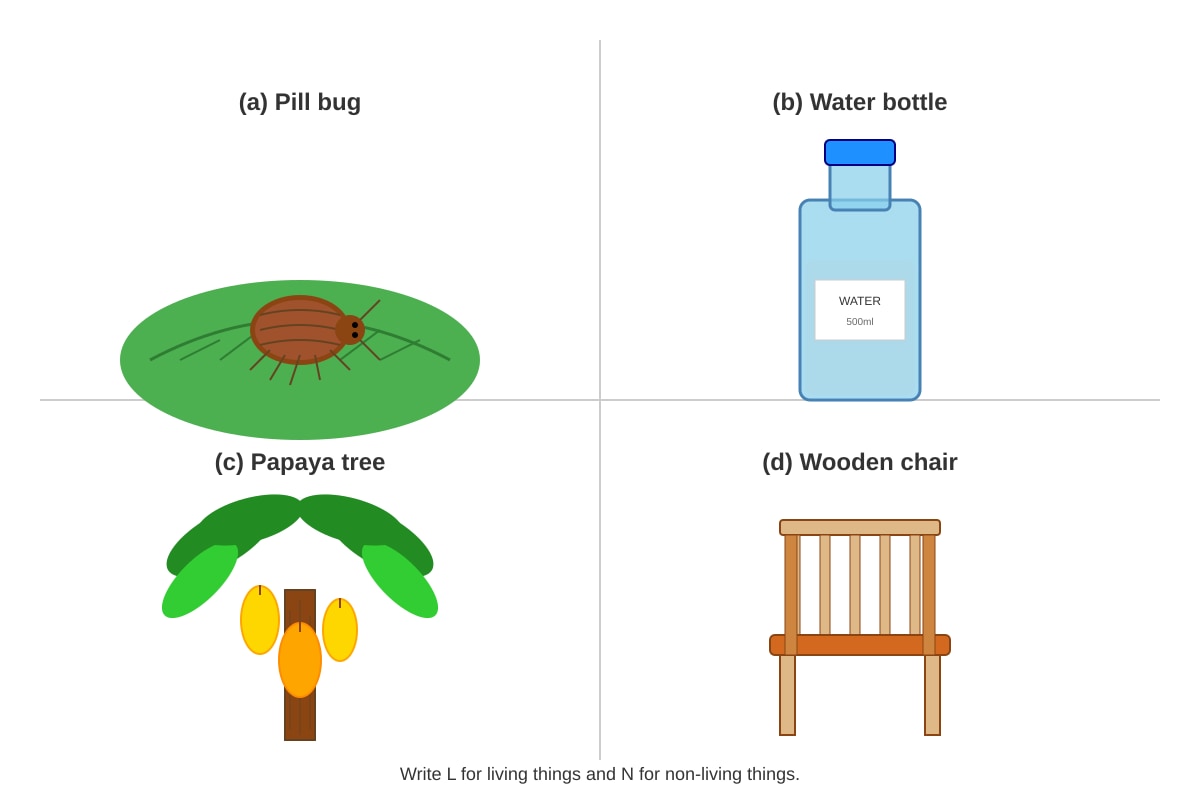
- (a) L (pill bug) — 0.5 mark
- (b) N (water bottle) — 0.5 mark
- (c) L (papaya tree) — 0.5 mark
- (d) N (wooden chair) — 0.5 mark
Teaching note: Pill bugs (also called woodlice or roly-polies) are small crustaceans — they are living animals. They need moisture, curl into balls when disturbed (response), and reproduce. The water bottle and wooden chair are non-living (human-made objects). The papaya tree is a living plant — it grows, produces fruit with seeds, needs water and sunlight.
Common error: Pill bugs may be mistaken for insects or non-living because they are small and curl up. Actually they are crustaceans (related to crabs), but for P3, classifying as "living animal" is sufficient.
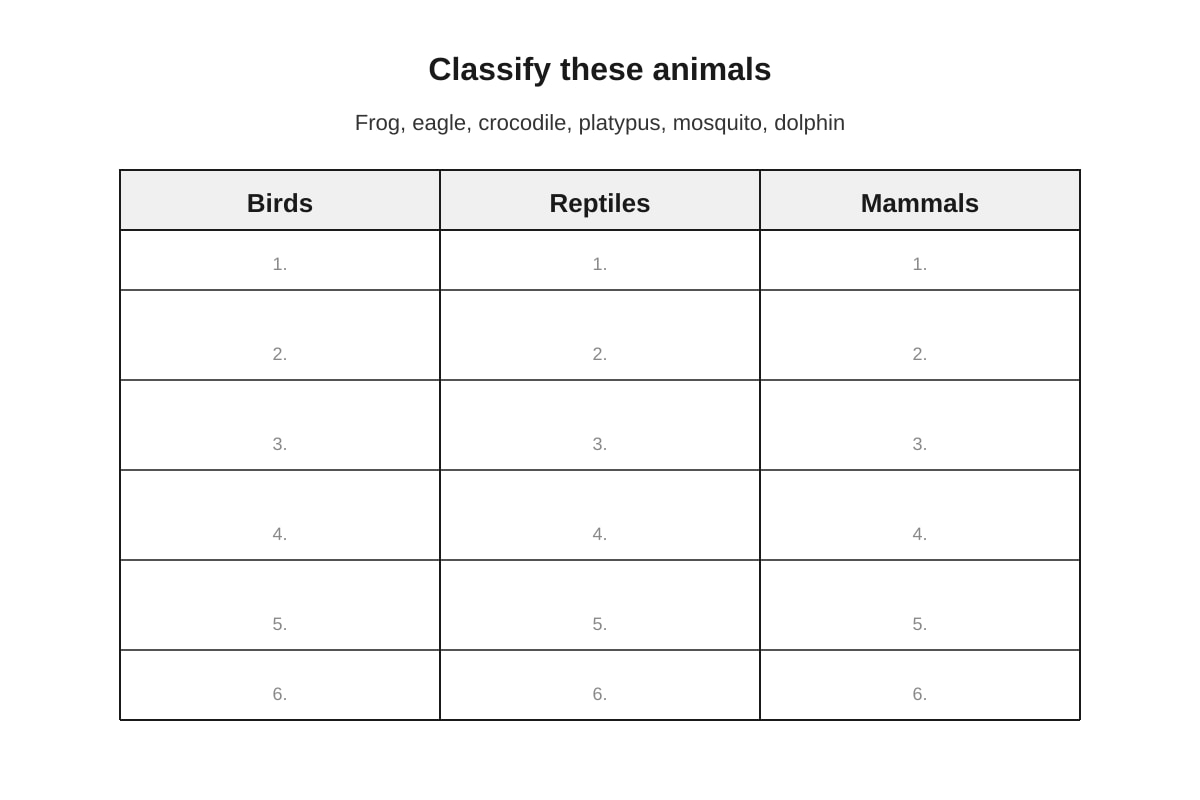
12. (2 marks — 1 mark for 2–4 correct, 2 marks for all 6 correct)
| Birds | Reptiles | Mammals |
|---|---|---|
| Eagle | Crocodile | Platypus |
| Dolphin |
Note: Frog is an amphibian; mosquito is an insect. Neither fits these three columns.
Teaching note:
- Eagle: bird — feathers, beak, lays eggs, can fly
- Crocodile: reptile — scales, lays eggs with tough shells, lives on land and in water
- Platypus: mammal — has fur, lays eggs (unusual mammal!), feeds young milk
- Dolphin: mammal — lives in water but breathes air with lungs, gives birth to live young, feeds milk
- Frog: amphibian — moist skin, lives in water and land, metamorphosis (tadpole → frog)
- Mosquito: insect — six legs, three body parts, metamorphosis
Important: Platypus is often confusing — it lays eggs like birds/reptiles but is a mammal because it has fur and produces milk. Dolphins are mammals despite living in water (not fish, as they don't have scales/gills).
13. (a) Living things (1 mark)
(b) Any TWO from: (1 mark)
- They can grow/spread (mould grows across bread; mushroom grows larger)
- They can reproduce (mould produces spores; mushroom produces spores)
- They need food/nutrients (absorb from surroundings)
- They need water (mould needs moisture on bread)
Teaching note: Fungi like mould and mushrooms are often mistaken for non-living because they don't move visibly and don't have green leaves. Key teaching point: fungi absorb nutrients (unlike plants that make their own food). Mould reproduces by releasing tiny spores into the air. Both need suitable conditions: moisture, warmth, and food source.
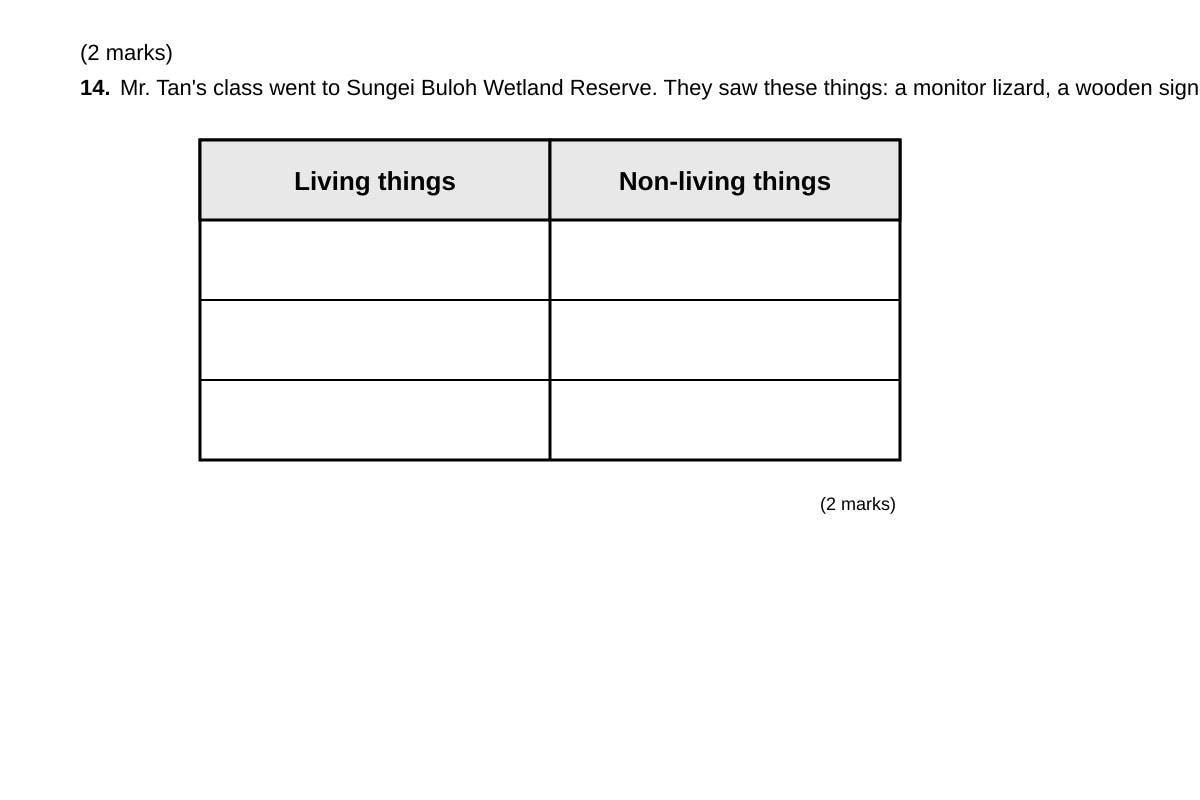
14. (2 marks — 1 mark for all living things correct, 1 mark for all non-living correct)
| Living things | Non-living things |
|---|---|
| Monitor lizard | Wooden signboard |
| Kingfisher bird | Plastic bag |
| Mangrove tree |
Teaching note:
- Monitor lizard: reptile — living animal, needs food, grows, reproduces
- Kingfisher: bird — living animal, catches fish, builds nests
- Mangrove tree: living plant — grows in salt water, has special roots, produces seeds
- Wooden signboard: non-living — made from tree but no longer alive; cannot grow or reproduce
- Plastic bag: non-living — human-made, does not biodegrade quickly; no life processes
Note: A wooden signboard was once part of a living tree, but it is now dead wood — no life processes occur. This distinction (once-living vs. never-living vs. living) is important for P3.
Section C: Short Answer and Application (Questions 15–20)
15. (3 marks)
(a) No (0.5 mark)
(b) No (0.5 mark)
(c) No, the robot dog is NOT a living thing. (1 mark)
Explanation (any ONE clear reason, 1 mark):
- It cannot grow bigger by itself; it is made by humans and stays the same size unless someone builds a bigger version.
- It cannot reproduce; it cannot make baby robot dogs by itself.
- It does not need real food, water, or air; it needs batteries/electricity instead.
- It only responds because of programming/sensors, not because it is alive.
Teaching note: This tests the misconception that moving/responding = living. The robot dog is a good example because it mimics life-like behaviour (walking, barking, wagging) but fails the true characteristics of living things. Emphasise: response alone does not prove something is living — it must show ALL characteristics (or at least true growth, reproduction, need for food/water/air, and natural response, not programmed response).
16. (4 marks)
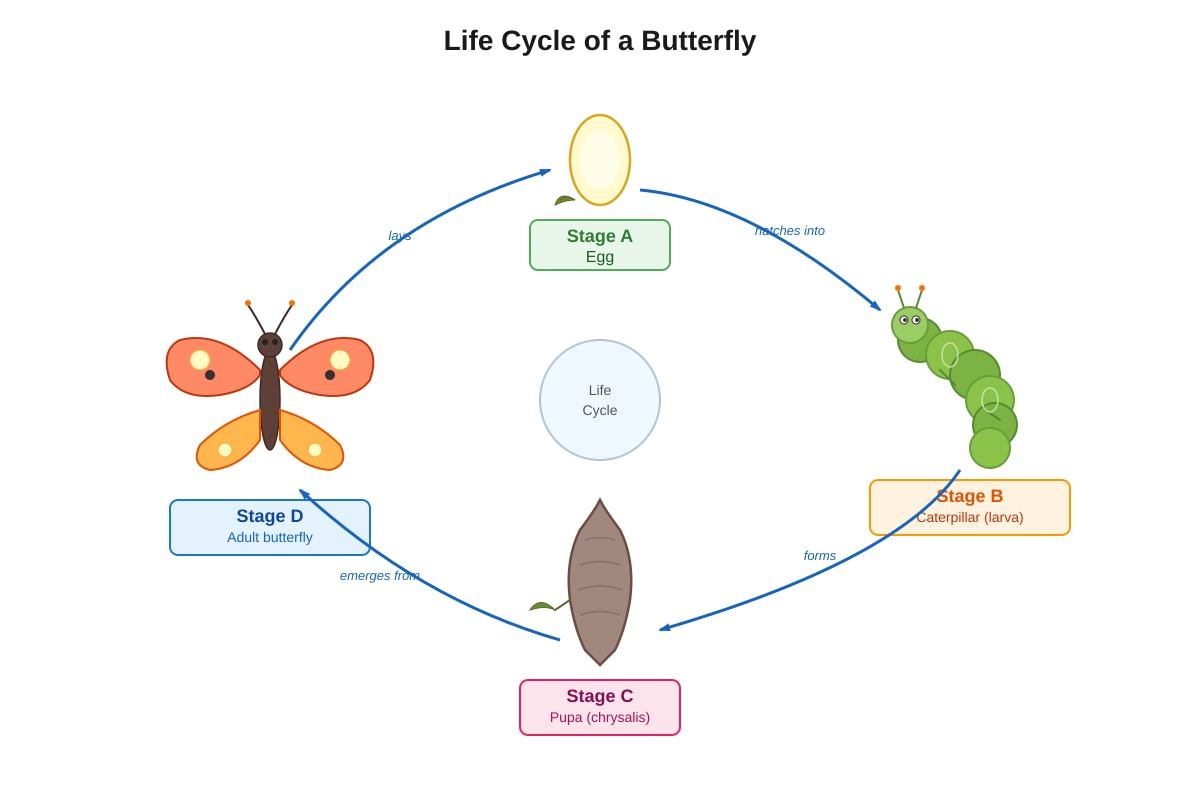
(a) Caterpillar / larva (1 mark)
(b) Pupa / The caterpillar forms a chrysalis and changes into a butterfly / Metamorphosis occurs (1 mark)
(c) Yes, with TWO reasons: (1 mark)
- It can grow (egg → caterpillar → pupa → adult, increasing in size)
- It can reproduce (adult butterfly lays eggs)
- It can respond to changes (e.g., flies away when touched)
- It moves by itself (flies, crawls)
- It needs food, water, and air
Any TWO characteristics = 1 mark (0.5 each)
(d) Moth / beetle / fly / mosquito / dragonfly / any insect with complete metamorphosis (1 mark)
Common acceptable answers: moth, ladybug, beetle, mosquito, fly, ant (some ants have complete metamorphosis), bee.
Teaching note: This is complete metamorphosis (four distinct stages). Not all insects have this — some have incomplete metamorphosis (egg → nymph → adult), like grasshoppers and cockroaches, where the young looks like a small adult. Accept "moth" as the most common alternative. Butterflies and moths are both Lepidoptera.
17. (3 marks)
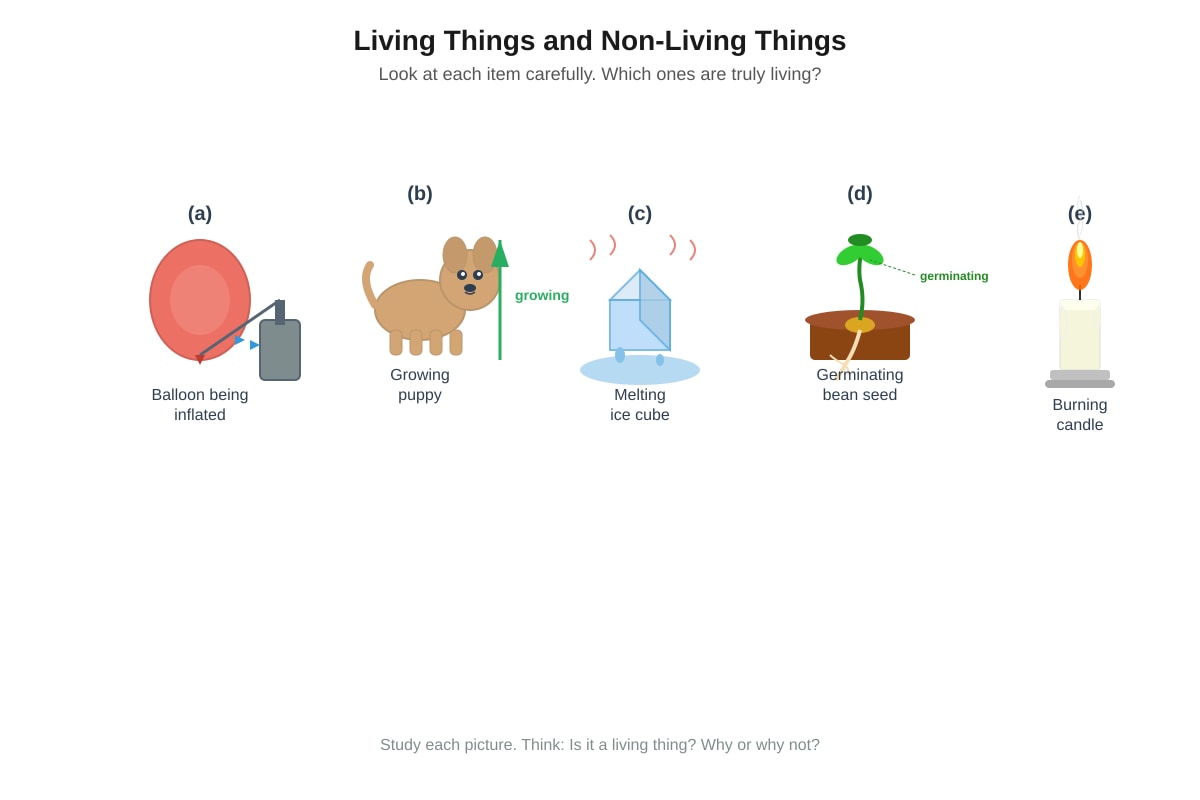
(a) (b) — Growing puppy AND (d) — Germinating bean seed are both correct; but since only one circle, (d) Germinating bean seed or (b) Growing puppy — however, the question says "which item" singular, so expected answer is (d) — the germinating bean seed OR accept (b) if student interpreted differently.
Clarification: Both (b) and (d) are true living things growing. The most explicit "growing" in the description is the germinating bean seed (germination = beginning of growth) and growing puppy. If student circles either, accept. Expected primary answer: (d) or (b). (1 mark)
(b) Explanation: (2 marks)
Puppy is living: (1 mark for any two characteristics)
- It grows naturally from puppy to adult dog (true biological growth)
- It needs food, water, and air to survive
- It can reproduce when adult
- It is made of living cells
Candle is NOT living: (1 mark for any clear reason)
- The candle melts/burns down but this is NOT growth — it is losing wax, not building itself up
- The candle does not reproduce — it cannot make baby candles
- The candle does not need food, water, or air for life processes — burning is a chemical reaction with oxygen, not respiration for survival
- The flame responds to wind (flickers), but this is physical/chemical change, not living response
Teaching note: This is a classic P3 misconception question. The key distinction:
- Living growth = increase in size by adding new cells, controlled by the organism's own genetics
- Non-living "change" = physical change (melting) or chemical reaction (burning) caused by external factors, not directed by the object itself
Candles "respond" to wind by flickering, but this is passive physics, not active sensing and decision-making like a living response.
18. (3 marks)
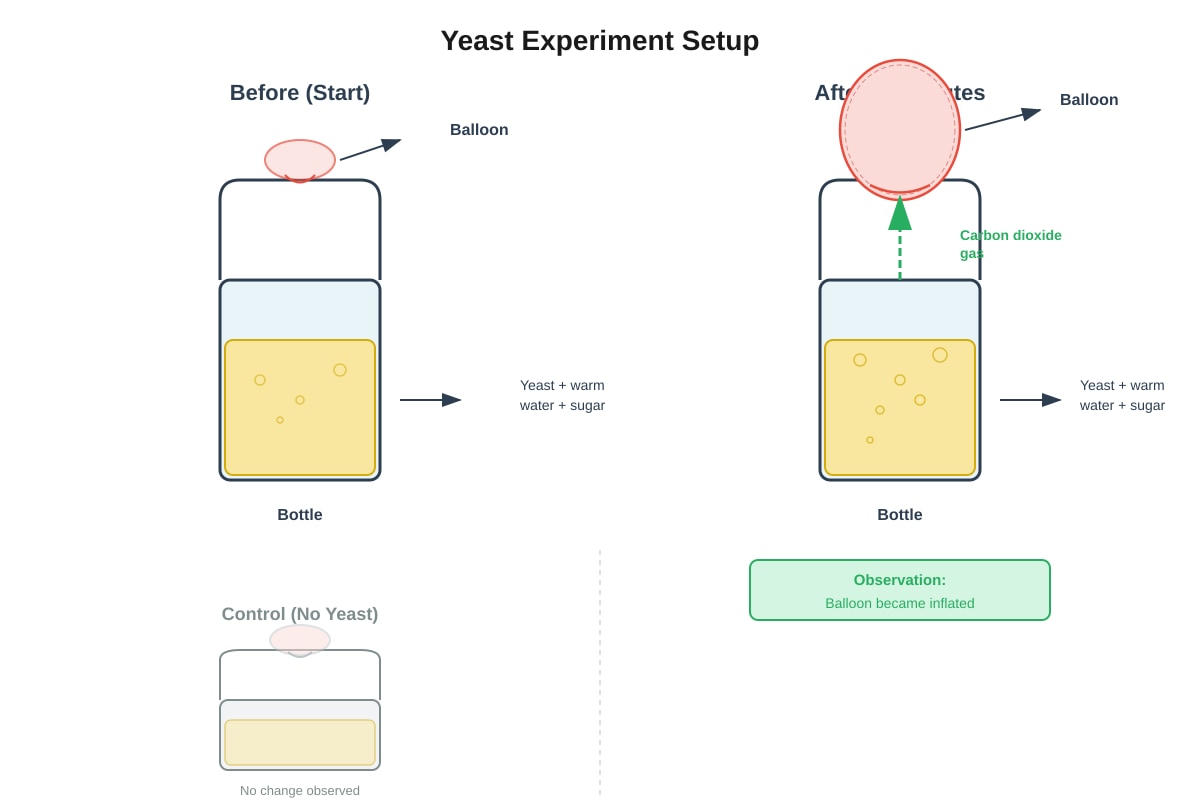
(a) Carbon dioxide / CO₂ (1 mark)
(b) respire / breathe (1 mark) ["grow" or "reproduce" are not directly shown by this experiment]
Note: Accept "respire" or "produce gas during respiration." Do NOT accept "photosynthesis" — yeast does not photosynthesise.
(c) Yes, yeast is a living thing (0.5 mark) because it respires/breathes (or: produces carbon dioxide, needs food/sugar, can reproduce/grow) (0.5 mark)
Teaching note: Yeast is a single-celled fungus. It carries out anaerobic respiration (fermentation): sugar → alcohol + carbon dioxide + energy. The CO₂ gas inflates the balloon. This experiment is a classic P3 investigation. Key learning: microorganisms are living even though we cannot see them individually without a microscope. The control bottle with no yeast shows that the sugar and water alone do not produce gas — the yeast is necessary.
Control explanation: The setup with sugar + warm water but NO yeast shows no balloon inflation, proving yeast causes the gas production.
19. (3 marks)
(a) Cat, coconut palm, ant (1 mark — all three correct; 0.5 if two correct)
(b) Any TWO: (1 mark, 0.5 each)
- It can grow taller and produce more leaves/coconuts
- It can reproduce by producing seeds in coconuts
- It makes its own food through photosynthesis (using sunlight, water, CO₂)
- It responds to light (leaves face Sun)
- It needs water, air, and nutrients from soil
(c) Explanation: (1 mark)
The sandcastle is non-living because:
- It was made by people (Devi or others), not born or grown naturally
- It cannot grow by itself — it only gets bigger if someone adds more sand
- It cannot reproduce — it cannot make baby sandcastles
- It does not need food, water, or air to continue existing
- It will crumble/dry out without any life processes occurring
Teaching note: Sandcastles, snowmen, and sculptures are common "trick" items in P3 — they have shape and may change (crumble, melt), but they lack all true characteristics of life. Emphasise the origin (human-made vs. born from parents) and needs (no biological requirements).
20. (4 marks)
| Statement | Correct or Wrong? |
|---|---|
| (a) All things that move are living things. | Wrong |
| (b) Plants are living things because they can make their own food. | Correct |
| (c) Bacteria are too small to see, so they are non-living. | Wrong |
| (d) Living things can be classified into plants, animals, fungi, and bacteria. | Correct |
Marking: 1 mark for all four correct judgments.
Explanation for wrong statements: (2 marks, 1 mark each)
Statement (a) is wrong because: (1 mark)
- Cars, wind, water, and robot dogs move but are not living.
- Living things move by themselves using body parts (legs, wings, muscles), not because they are pushed or have engines.
Alternative explanation: Movement alone does not mean something is living. Things can move due to wind, water currents, machines, or electricity without being alive.
Statement (c) is wrong because: (1 mark)
- Size does not determine if something is living. Bacteria are microorganisms/microbes — they are too small to see with our eyes alone, but they can be seen with microscopes.
- Bacteria carry out all life processes: they grow, reproduce, respire, respond, and need food/water/air. Many bacteria are helpful (in our gut, in yoghurt making); some cause illness.
Teaching note: Statement (b) is correct — photosynthesis is the key reason plants are living and distinct from animals. They produce their own food using chlorophyll, sunlight, water, and carbon dioxide. Statement (d) is correct — these are the four main groups of living things taught in P3 (some syllabi combine fungi and bacteria under "microorganisms" or keep them separate; either grouping is acceptable if logical).
TOTAL: 40 MARKS