AI Generated Exam Paper
Primary 3 Science Practice Paper 5
Free P3 Science Practice Paper 5, HY3 AI version, with questions, answers, and syllabus-aligned practice for Singapore students.
These static practice materials are generated from the site's syllabus and paper-generation workflow, with source and model context shown so students and parents can evaluate the material before use.
Questions
Free quiz and exam paper access
Enter your details to view this paper
Your access is remembered on this device.
Answers
TuitionGoWhere Practice Paper — Science Primary 3 (Version 5) Answer Key
Total Marks: 40
Topic: Diversity (syllabus-first, not past-year derived)
Section A (10 marks)
1. (b) A fern plant
Teaching note: A fern is a plant and shows living characteristics (grow, reproduce). Toys, chairs, and cups are made by humans and cannot grow or reproduce.
Marks: 1
2. (c) Bird
Teaching note: Parrots have feathers and wings and belong to the bird group. Fish live in water with gills; mammals have fur and feed milk; insects have six legs.
Marks: 1
3. (c) Fungi
Teaching note: Mushrooms are fungi, not plants. They do not make food like plants and belong to their own group.
Marks: 1
4. (b) Plastic
Teaching note: Plastic is waterproof (does not absorb water), so it keeps the wearer dry. Cotton, paper, sponge absorb water.
Marks: 1
5. (b) A cloud
Teaching note: A cloud is water droplets in the sky, non-living. Caterpillar, goldfish, rose bush are living.
Marks: 1
6. (b) Living microorganisms
Teaching note: Bacteria are tiny living things. They are not plants and not non-living.
Marks: 1
7. (c) Fish
Teaching note: Fish have scales and use gills to breathe underwater. Frog is amphibian; eagle bird; monkey mammal.
Marks: 1
8. (c) Glass
Teaching note: Glass lets light pass through (transparent) so we can see outside. Wood, metal, rubber block light.
Marks: 1
9. (b) Non-living because it cannot grow or reproduce
Teaching note: Looking like an animal does not make it living. Teddy bears are made of fabric and cannot carry out life processes.
Marks: 1
10. (c) Wood
Teaching note: Wood comes from trees (natural). Plastic, nylon, glass are man-made.
Marks: 1
Section B (12 marks)
11. (2 marks)
Accept any two from: need air / need food / need water / can grow / can reproduce / can respond to changes / can move by itself.
Teaching note: Living things share these features; non-living things do not.
Marking: 1 mark per correct characteristic.
12. (2 marks)
Living: ant, mango tree
Non-living: book, eraser
Teaching note: Ant and tree are living (grow, reproduce). Book and eraser are objects made by people.
Marking: 1 mark for living list, 1 mark for non-living list.
13. (2 marks)
Example: Rubber is flexible (can bend) and waterproof.
Teaching note: Flexible soles help shoes bend when walking; waterproof keeps feet dry.
Marking: 1 mark property, 1 mark link to use (or just 2 for clear property with relevance).
14. (2 marks)
Metal is strong and can conduct heat well, so it is good for cooking pans.
Teaching note: Strength stops pan breaking; heat conduction cooks food evenly.
Marking: 1 mark for property, 1 mark for cooking use.
15. (2 marks)
Example: Mushroom (or mould/yeast) — it is living (fungi).
Teaching note: Fungi are living but not plants.
Marking: 1 mark example, 1 mark living/non-living correct.
16. (2 marks)
Plastic is light, waterproof, and does not break easily, so it is good for water bottles.
Teaching note: Waterproof keeps water in; light easy to carry.
Marking: 1 mark property, 1 mark reason.
Section C (8 marks)
17. (3 marks total)
(a) Living: lizard, hibiscus flower, butterfly (2 marks: 1 mark each correct group, all three needed)
(b) Example: Lizard can move by itself. (1 mark)
Teaching note: Stone is non-living. Living things shown are animals and plant.
18. (2 marks total)
(a) Plastic (1 mark)
(b) Plastic does not absorb water (waterproof). (1 mark)
Teaching note: Cloth and rubber may let or absorb some water; plastic best blocks water.
19. (2 marks total)
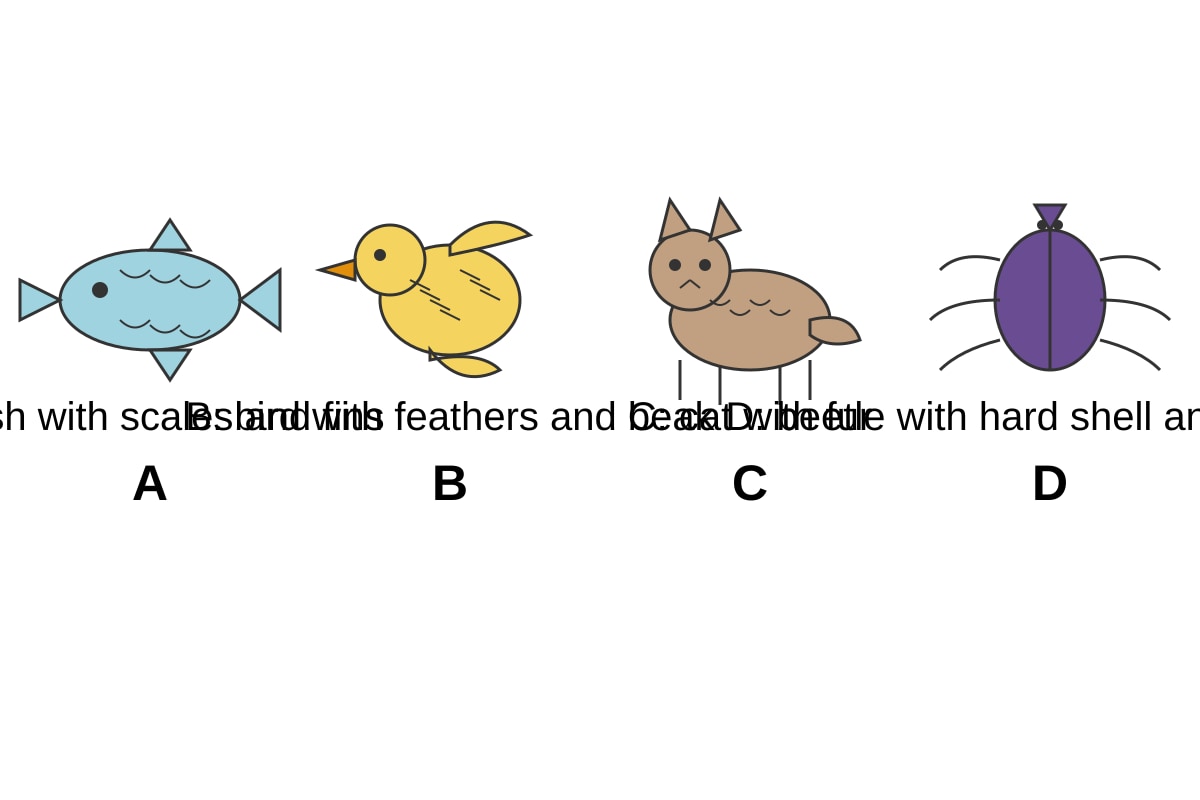
(a) D (beetle) (1 mark)
(b) A (fish) (1 mark)
Teaching note: Beetle has six legs and shell = insect. Fish has gills and scales. Image must show labels A–D with coverings.
20. (2 marks)
Mould is living because it can grow and reproduce (new mould spots appear).
Teaching note: Growth and reproduction are signs of life. Common mistake: thinking mould is non-living because it does not move like animals.
Marking: 1 mark growth, 1 mark reproduce / example.