AI Generated Exam Paper
Primary 3 Science Practice Paper 4
Free P3 Science Practice Paper 4, HY3 AI version, with questions, answers, and syllabus-aligned practice for Singapore students.
These static practice materials are generated from the site's syllabus and paper-generation workflow, with source and model context shown so students and parents can evaluate the material before use.
Questions
Free quiz and exam paper access
Enter your details to view this paper
Your access is remembered on this device.
Answers
TuitionGoWhere Practice Paper - Science Primary 3 (Answer Key)
Version: 4 of 5
Total Marks: 40
Section A (10 marks)
-
(b) A fern [1]
Teaching note: Fern is a plant; plants are living. Toys, stones, and glass are non-living. -
(b) It can reproduce [1]
Teaching note: Reproduction is a characteristic of living things. Softness, colour, size are not proof of life. -
(c) Insect [1]
Teaching note: Butterflies have wings and six legs; they are insects. -
(b) Wood [1]
Teaching note: Wood comes from trees (natural). Plastic, glass, nylon are man-made. -
(b) Waterproof [1]
Teaching note: Raincoat keeps user dry, so waterproof property is most useful. -
(c) Fungi [1]
Teaching note: Mushrooms are fungi, not plants or animals. -
(c) Fish [1]
Teaching note: Fish use gills to breathe underwater. -
(d) Made by humans [1]
Teaching note: Many non-living things are made by humans; this is not a life characteristic. -
(b) Natural material [1]
Teaching note: Rubber from tree is natural, though processed rubber can be synthetic. -
(b) It cannot move by itself [1]
Teaching note: Teddy bear is moved by child; living things move by themselves.
Section B (12 marks)
-
[2] Any two: need food / need water / need air / grow / reproduce / respond to changes / move by itself.
Marking: 1 mark per correct characteristic. -
[2] Living: rose, dog. Non-living: book, spoon.
Marking: 1 mark for correct grouping of each pair (or list correctly). -
[2] Property: transparent (light passes through) or hard. Use: window / cup / lens.
Marking: 1 mark property, 1 mark use. -
[2] Mammal: e.g., cat, dog, human. Reptile: e.g., lizard, snake, turtle.
Marking: 1 mark each. -
[2] Plastic is made by humans from chemicals (not directly from nature).
Marking: 1 mark "man-made", 1 mark reason (from petroleum/chemicals). -
[2] Bacteria can help make yoghurt / medicine / break down waste.
Marking: 1 mark "living" implied, 1 mark useful example.
Section C (18 marks)
-
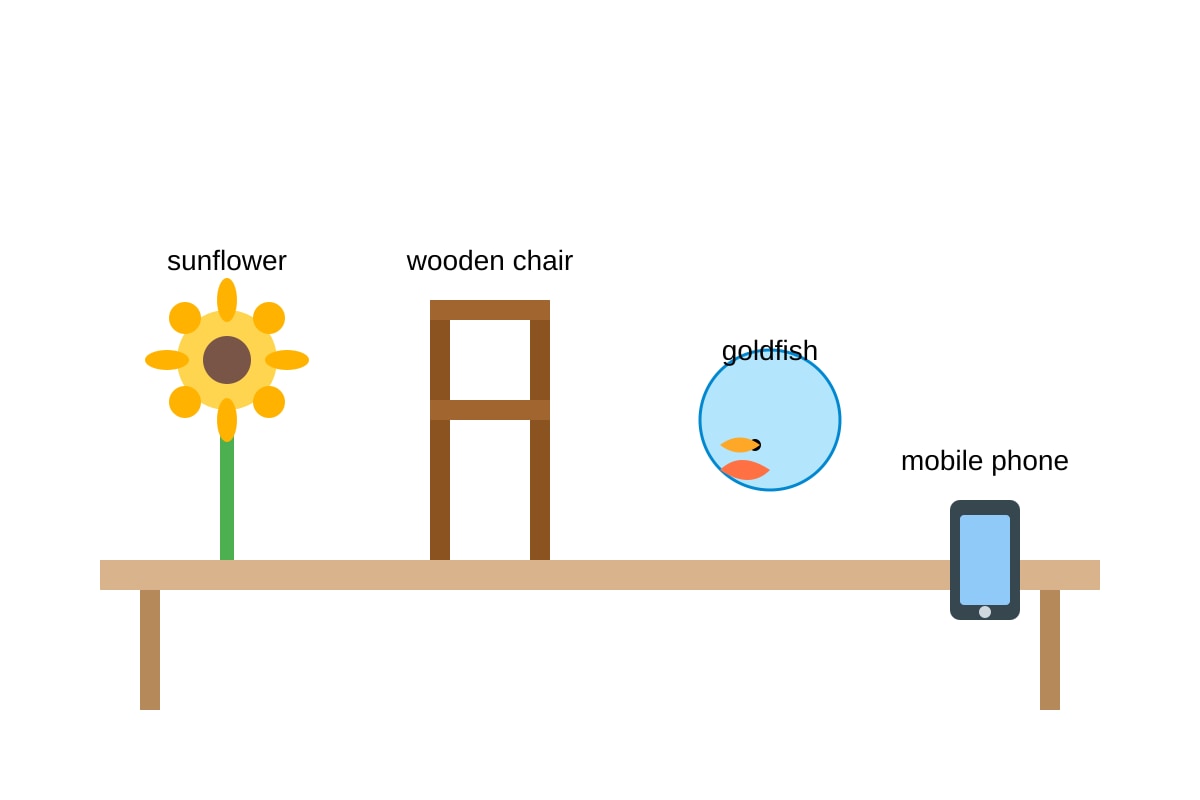
[3]
(a) Sunflower: Living – it grows / needs air, water, food. [1]
(b) Wooden chair: Non-living – made from wood but cannot grow or reproduce. [1]
(c) Goldfish: Living – moves by itself / breathes / grows. [1]
Image note: Pupil uses labelled drawing to identify each. -
[2]
Crab: Living [0.5]
Seashell: Non-living (shell is from animal but empty shell not living) [0.5]
Coconut tree: Living [0.5]
Plastic bottle: Non-living [0.5]
Common mistake: thinking seashell is living because it came from animal. -
[3]
Wood: does not rust, comfortable → Yes [1]
Metal: strong but can rust → No (if rust is problem) [1]
Plastic: waterproof but less comfortable → Maybe [0.5]
Best: Wood [0.5]
Marking descriptors: table completion 2 marks, best choice 1 mark. -
[3]
Explanation: Mushroom is living because it grows and reproduces (spores), even if no legs. [2]
Observation: Check mushroom over days for size increase / new mushrooms. [1]
Marking: 2 for reason, 1 for simple investigation.