AI Generated Exam Paper
Primary 3 Science Practice Paper 1
Free P3 Science Practice Paper 1, Kimi2.6 AI version, with questions, answers, and syllabus-aligned practice for Singapore students.
These static practice materials are generated from the site's syllabus and paper-generation workflow, with source and model context shown so students and parents can evaluate the material before use.
Questions
Free quiz and exam paper access
Enter your details to view this paper
Your access is remembered on this device.
Answers
TuitionGoWhere Practice Paper - Science Primary 3
Version: 1 of 5 — Answer Key
Section A: Multiple Choice (10 marks)
1. Answer: C — A butterfly in the park
The butterfly is a living thing because it can grow, move by itself, reproduce, and needs food, water and air. The plastic flower (A), stone (B), and wooden chair (D) are all non-living things. They do not need food or water, cannot reproduce, and do not grow in the way living things do.
Common mistake: Choosing A because the plastic flower "looks alive." Appearance alone does not make something living.
Marking: 1 mark for C.
2. Answer: B — They need water, food and air to survive
All living things need water, food and air to survive. This is one of the key characteristics of living things. Not all living things can fly (A) — only some animals like birds and insects. Not all can make sounds (C) — plants and many animals are silent. Not all have four legs (D) — think of birds, fish, and insects.
Teaching point: The five characteristics of living things are: need food/water/air, can grow, can reproduce, can move by themselves, and can respond to changes.
Marking: 1 mark for B.
3. Answer: B — 2
The living things are the koi fish and the lotus flower. The park signboard and plastic water bottle are non-living.
Check: Koi fish — living (moves, needs food, grows, reproduces). Lotus flower — living (grows, needs water/sunlight, reproduces). Signboard — non-living (made of metal, does not grow). Water bottle — non-living (plastic, does not need food).
Marking: 1 mark for B.
4. Answer: C — Reptiles
Monitor lizards are reptiles. Reptiles have dry, scaly skin and most lay eggs with leathery shells. They are cold-blooded. Mammals (A) have fur or hair and feed their young with milk. Birds (B) have feathers and beaks. Amphibians (D) have moist skin and typically live both in water and on land.
Singapore context: Monitor lizards are commonly seen in parks like Sungei Buloh Wetland Reserve and MacRitchie Reservoir.
Marking: 1 mark for C.
5. Answer: B — Amphibians
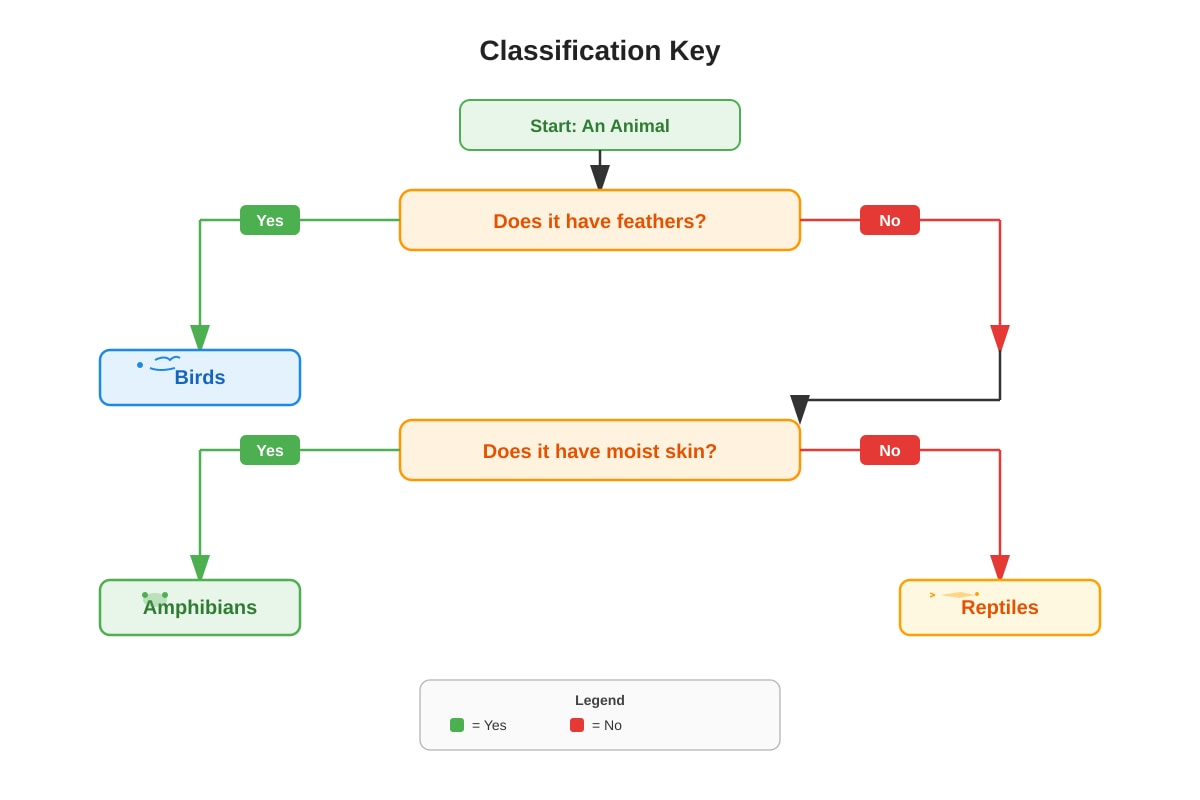
Following the key: Frog → "Does it have feathers?" → No (frogs do not have feathers) → "Does it have moist skin?" → Yes (frogs have moist, smooth skin) → Amphibians.
Frogs are amphibians, not reptiles. Reptiles have dry, scaly skin. The key works correctly for a frog.
Marking: 1 mark for B.
6. Answer: C — Fern
Ferns are non-flowering plants. They reproduce using spores, not flowers and seeds. Hibiscus (A), sunflower (B), and rose (D) are all flowering plants that produce seeds from flowers.
Teaching point: Non-flowering plants include ferns, mosses, and fungi (though fungi are not strictly plants). They were among the first plants on Earth.
Marking: 1 mark for C.
7. Answer: D — Beth and Chen
Both Beth and Chen gave correct reasons:
- Beth correctly identified that the robot needs batteries, not food. Living things need food for energy, but non-living things might need other energy sources like electricity or batteries.
- Chen correctly identified that the robot is made of non-living materials (plastic and metal).
Amir's reason is wrong. Movement alone does not make something living. Cars, fans, and robot toys can move but are not alive. Living things must be able to move by themselves without an external power source being constantly applied.
Marking: 1 mark for D.
8. Answer: C — B and D
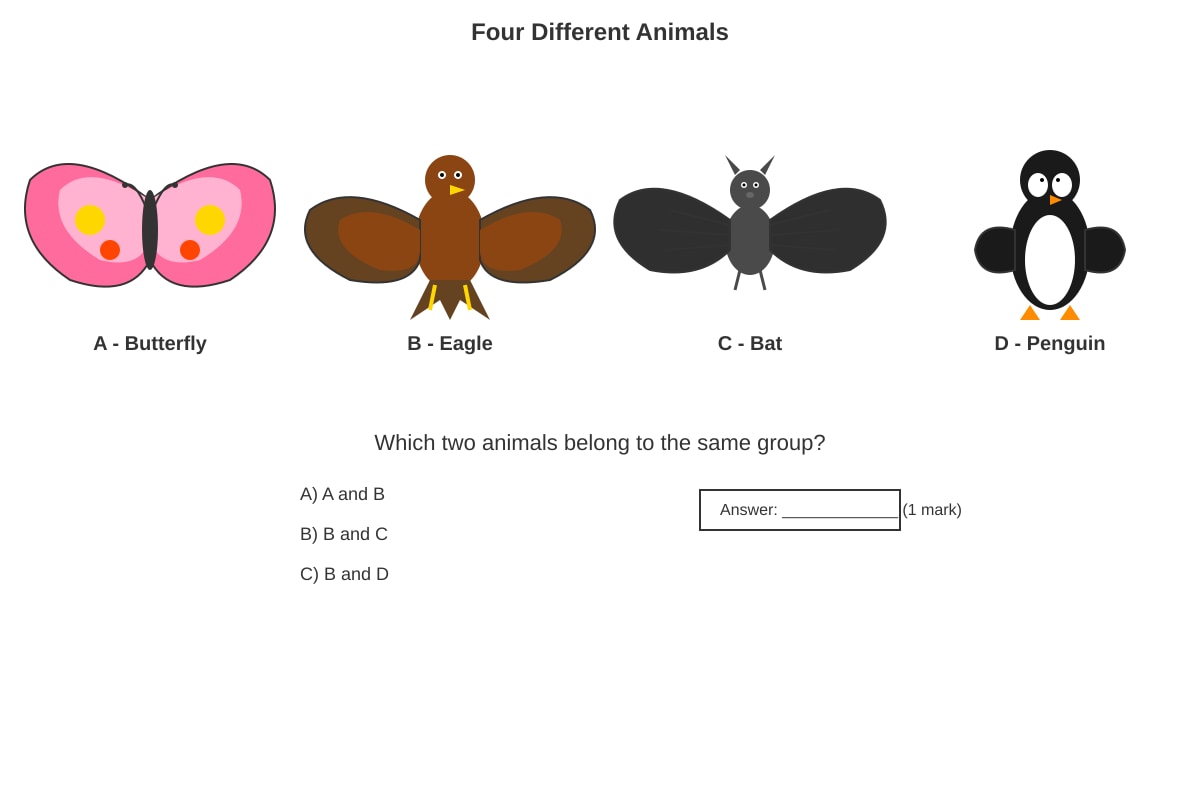
Both the eagle (B) and the penguin (D) are birds. They have feathers, beaks, and lay eggs with hard shells.
- Butterfly (A): Insect — has six legs, three body parts, and antennae (not feathers).
- Bat (C): Mammal — has fur, gives birth to live young, feeds babies with milk.
The key feature is feathers. Both eagles and penguins have feathers, even though penguins cannot fly they are still birds.
Marking: 1 mark for C.
9. Answer: B — They can grow and reproduce
Fungi grow and reproduce, which are characteristics of all living things. Fungi do NOT move from place to place (A) — they stay fixed in one location like on decaying matter. They do NOT make their own food (C) — they are decomposers that absorb nutrients from dead organic matter. They do NOT have green leaves (D) — mushrooms and mould have no leaves or chlorophyll.
Teaching point: Fungi are a separate kingdom of living things, neither plants nor animals.
Marking: 1 mark for B.
10. Answer: A — The fallen leaf — it was no longer growing on a plant
A fallen leaf was once part of a living plant, but once separated, it is dead and no longer living. It will not grow, reproduce, or respond. However, students often mistake it as living because it looks like a plant part.
B is wrong — earthworms are living whether moving or resting. C is wrong — the marble is clearly non-living. D is wrong — mushrooms ARE living; they don't need roots (they absorb nutrients).
Marking: 1 mark for A.
Section A Subtotal: 10 marks
Section B: Short Answer and Structured Questions (18 marks)
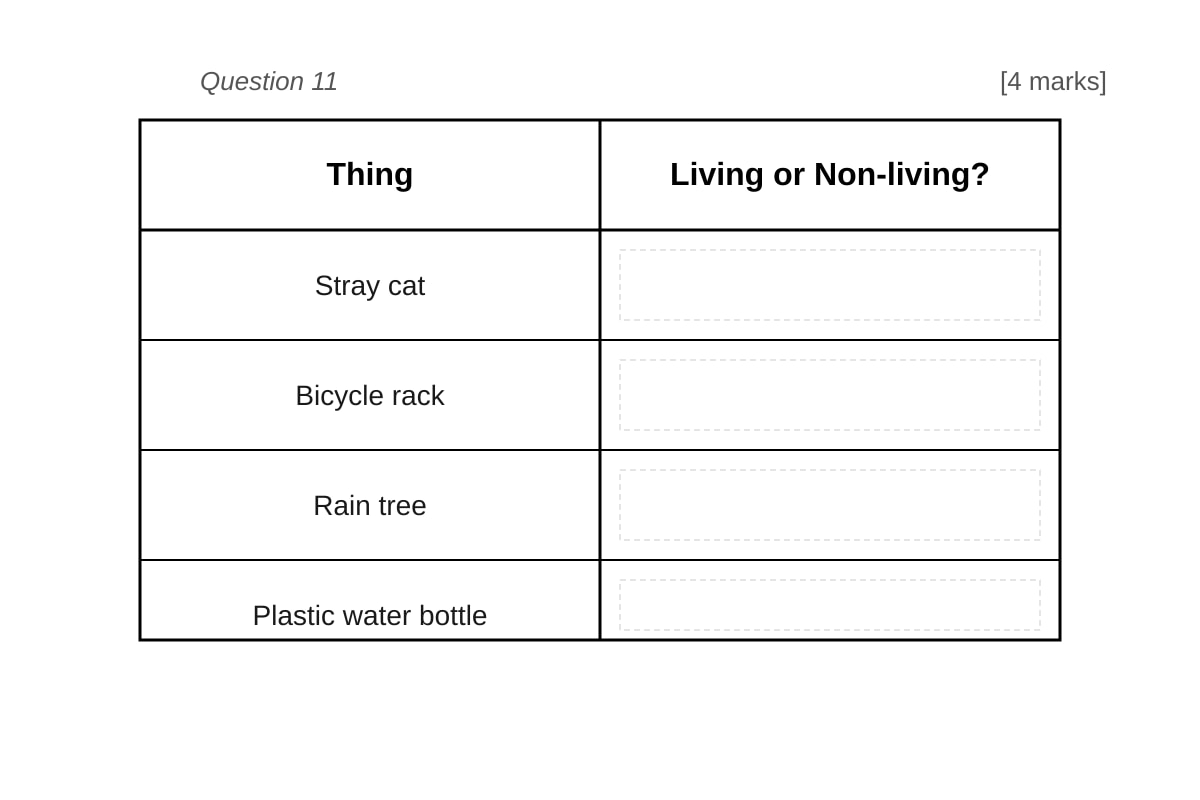
11. (4 marks)
| Thing | Living or Non-living? | Characteristic (living things only) |
|---|---|---|
| Stray cat | Living | Can move by itself / Can grow / Needs food and water [any one] |
| Bicycle rack | Non-living | (blank or "not applicable" — no mark needed) |
| Rain tree | Living | Can grow / Needs water and sunlight / Can reproduce [any one] |
| Plastic water bottle | Non-living | (blank or "not applicable" — no mark needed) |
Mark breakdown:
- 1 mark for correct classification of all four items (1/2 mark each, rounded up)
- 1 mark for cat characteristic
- 1 mark for rain tree characteristic
- 1 mark for logical consistency (non-living items correctly left blank or marked "not applicable")
Common mistake: Writing characteristics for non-living items or giving characteristics that apply to both (e.g., "has weight").
12. (a) (2 marks)
The toy car or photograph of a bird might be mistaken as living.
Explanation: The toy car can move (when pushed or with batteries), which might make students think it is living OR the photograph shows a bird, which looks like a living thing. Students might confuse appearance with actual life.
Mark breakdown:
- 1 mark for identifying a plausible item
- 1 mark for explaining the misconception (movement for toy car, appearance for photo)
12. (b) (2 marks)
No, this does not prove it is non-living.
Explanation: While it is true that the photograph is non-living, the reason given is incomplete. Many living things also cannot move by themselves — for example, plants and adult corals do not move from place to place. To prove something is non-living, we need to show it lacks several characteristics: it does not need food/water/air, cannot grow, cannot reproduce, and does not respond to stimuli.
Mark breakdown:
- 1 mark for "No" with recognition that the reasoning is flawed
- 1 mark for explaining with counter-example (plant that doesn't move but is living) or listing missing characteristics
13. (a) (1 mark)
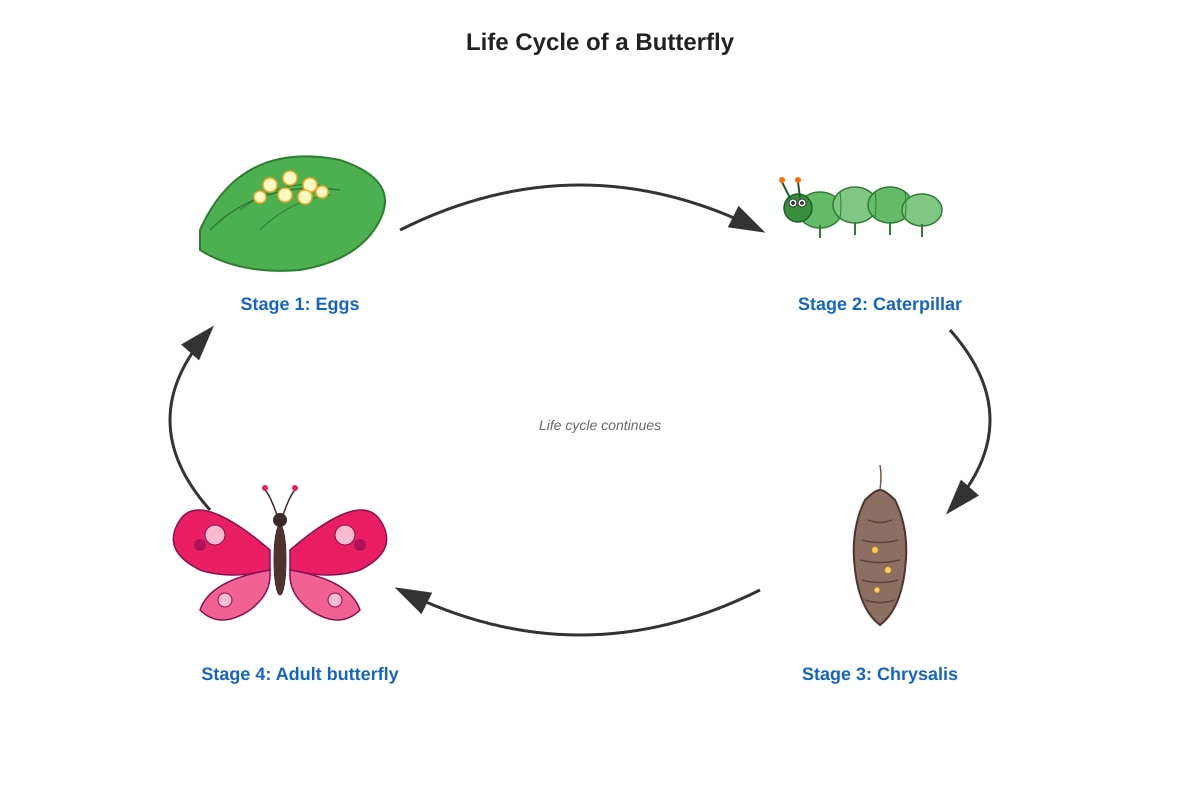
Pupa or Chrysalis
13. (b) (2 marks)
The butterfly is living because its life cycle shows it can grow and reproduce:
- The caterpillar grows larger and eats food
- The adult butterfly lays eggs, producing offspring
- The cycle repeats when eggs hatch into new caterpillars
Mark breakdown:
- 1 mark for identifying growth in the life cycle (caterpillar growing, or any stage change)
- 1 mark for identifying reproduction (adult lays eggs)
14. (a) (3 marks)
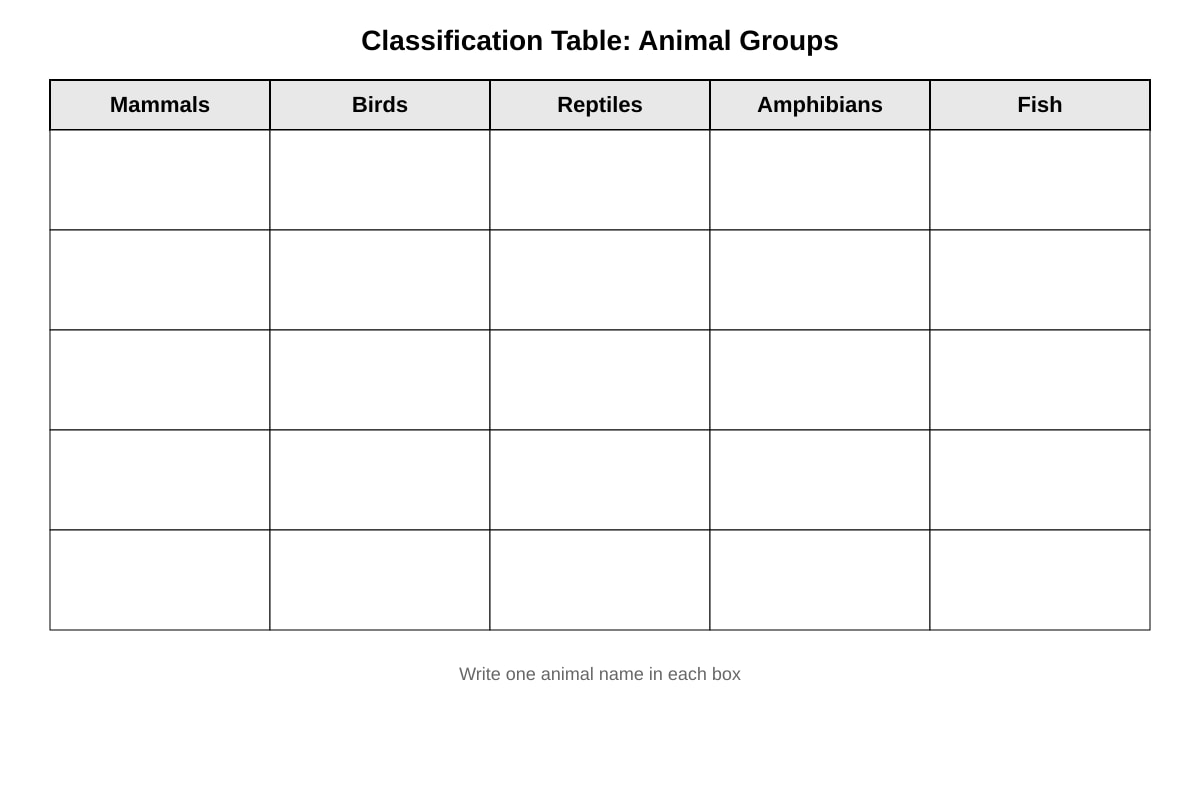
| Mammals | Birds | Reptiles | Amphibians | Fish |
|---|---|---|---|---|
| Dolphin | Pigeon | Crocodile | Frog | Salmon |
| Bat |
Marking: 3 marks for all correct, 2 marks for 4 correct, 1 mark for 2-3 correct, 0 marks for 0-1 correct.
Note: Bats are mammals (have fur, give birth to live young, feed milk). Dolphins are mammals, not fish.
14. (b) (2 marks)
No, Sam is not correct.
Explanation: Bats are mammals, not birds. Bats have fur (not feathers), give birth to live young (not eggs), and feed their babies with milk. Birds have feathers, beaks, and lay hard-shelled eggs. The ability to fly does not make something a bird — flight is not the defining characteristic; having feathers is.
Mark breakdown:
- 1 mark for "Not correct"
- 1 mark for giving the correct group (mammal) with one valid reason (fur / live young / milk)
15. (a) (1 mark)
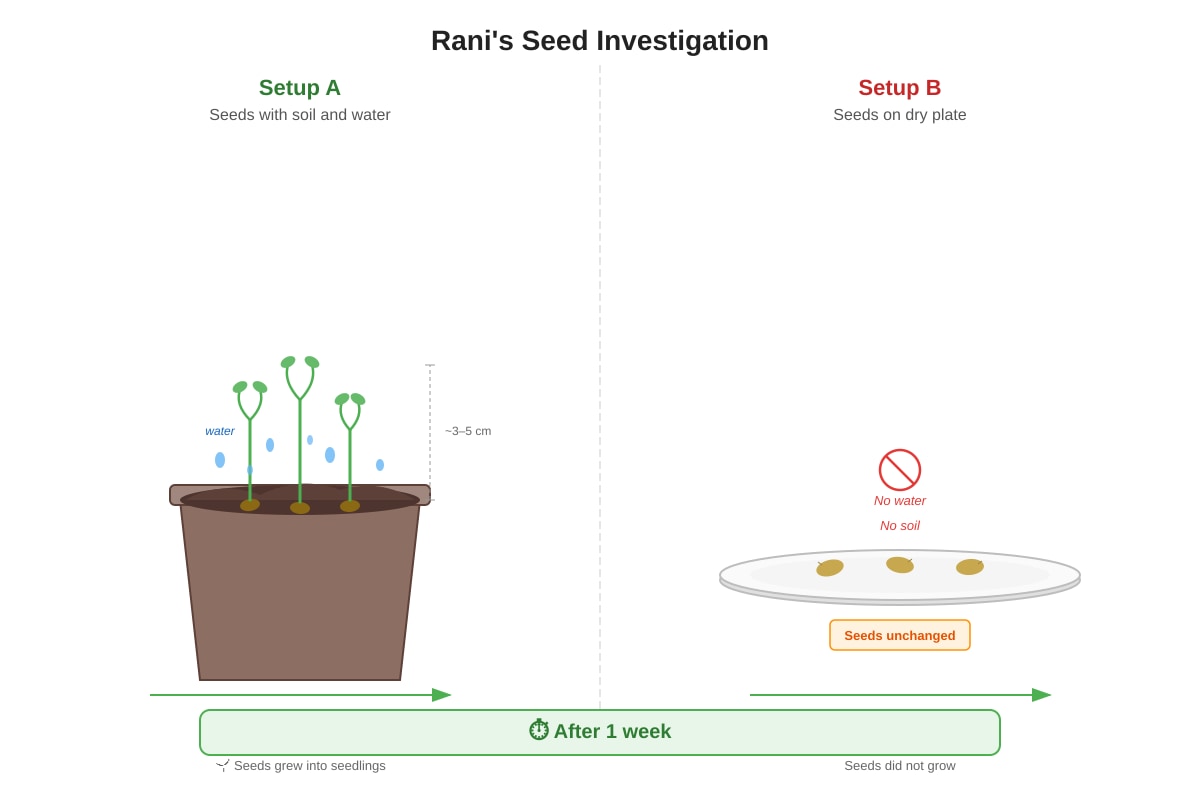
In Setup A, the bean seeds should germinate / sprout / grow into seedlings with small roots and shoots emerging from the seeds.
15. (b) (2 marks)
Rani can conclude that seeds are living things because:
- The seeds in Setup A grew into seedlings — this shows growth, a characteristic of living things
- The seeds in Setup B (on the dry plate without water) did not grow, showing that seeds need water to show they are alive
The comparison proves that seeds have the potential to grow when given the right conditions, which means they are living.
Mark breakdown:
- 1 mark for conclusion that seeds are living
- 1 mark for using evidence of growth from the investigation (must reference both setups or the contrast)
16. (a) (1 mark)
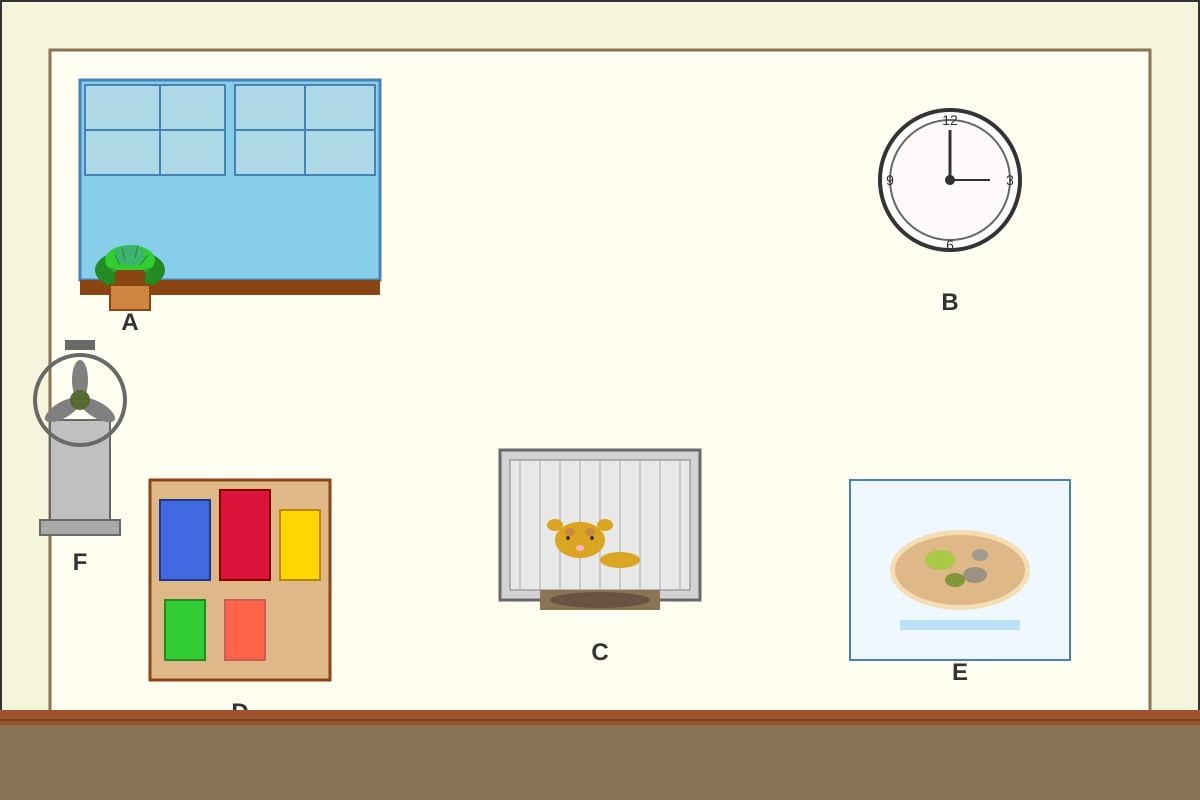
A (potted cactus) and C (class pet hamster) — or E (mould growing on old bread) if included.
Acceptable answers: A and C, or A and E, or C and E. Mould is a living fungus.
16. (b) (2 marks)
Example 1 — Battery-operated fan (F): The fan moves and blows air, but it is non-living because it needs electricity from batteries to move. It does not need food or water, cannot grow, and cannot reproduce. The movement is caused by an external power source, not by itself.
Example 2 — Wooden bridge (B) or photo [not shown, but could reference D textbooks]: The bridge might seem to change over time (weathering, mould growing on it), but the bridge itself does not grow — the mould is a separate living thing growing ON it. The bridge does not reproduce or respond to stimuli.
Example 3 — Clock (B): The clock's hands move, but this is caused by a battery or mechanism. It does not move by itself and lacks all other life characteristics.
Mark breakdown:
- 1 mark for identifying a non-living item and noting a feature that might seem "living-like"
- 1 mark for explaining why it is actually non-living (lacks life characteristics / needs external power)
Section B Subtotal: 18 marks
Section C: Application and Thinking Questions (12 marks)
17. (a) (2 marks)
Aunty Lim should recommend the fern.
Explanation: Ferns are non-flowering plants that can grow well in shady, damp places with little sunlight. They do not need bright light to make flowers. Roses are flowering plants that need more sunlight to grow well and produce flowers. A dark bathroom would not provide enough light for a rose to thrive.
Mark breakdown:
- 1 mark for correct choice (fern)
- 1 mark for explaining that ferns can grow in low light / don't need sunlight for flowers, OR that roses need more sun
17. (b) (2 marks)
All plants in the nursery are living things because they share the characteristics of living things:
- They need water, air and nutrients to survive
- They can grow — ferns unfurl new fronds, orchids and roses grow taller and produce more leaves
- They can reproduce — orchids and roses make seeds from flowers; ferns make spores
Whether flowering or non-flowering, all plants carry out these life processes.
Mark breakdown:
- 1 mark for naming a characteristic of living things relevant to plants
- 1 mark for applying it to both flowering and non-flowering plants specifically
18. (a) (2 marks)
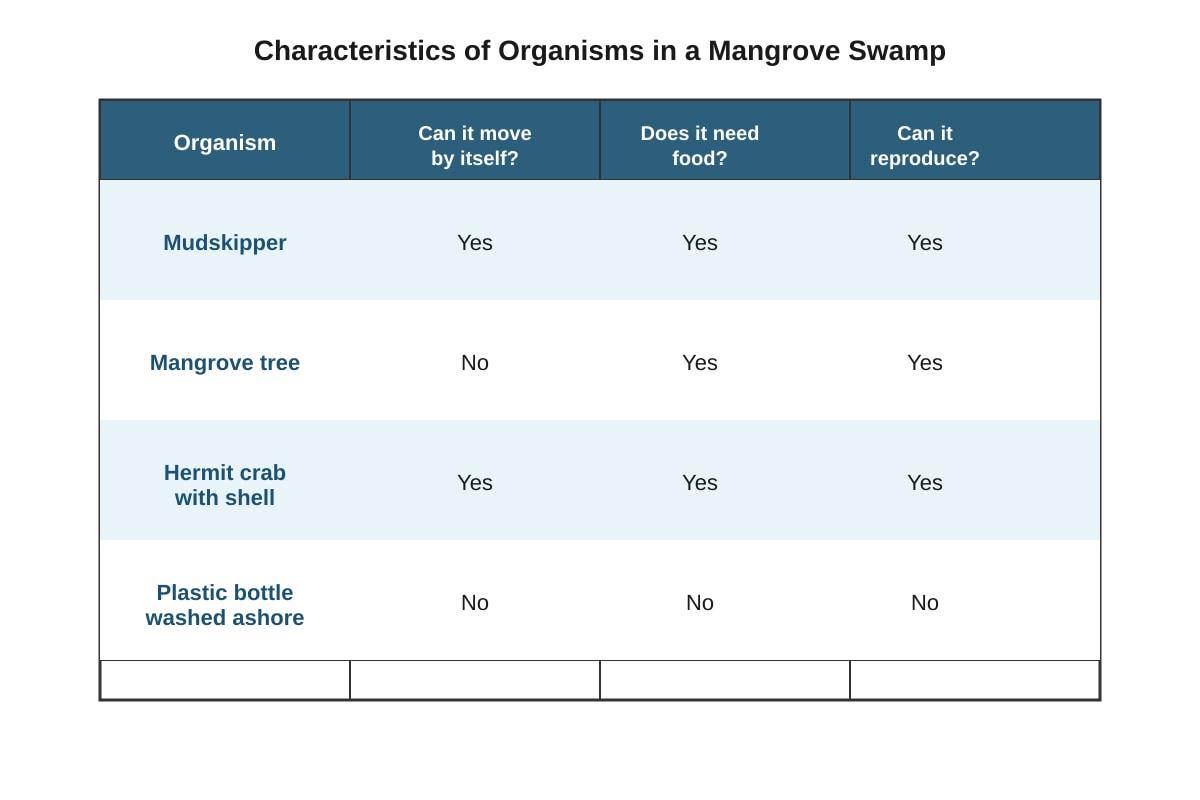
The mudskipper and hermit crab are living things because:
- Both can move by themselves — the mudskipper flips across mud, the hermit crab walks with its legs
- Both need food — they eat other organisms for energy
- Both can reproduce — they produce offspring
Using evidence from the table: all three characteristics have "Yes" for both organisms, matching the characteristics of living things.
Mark breakdown:
- 1 mark for quoting at least two "Yes" characteristics from the table
- 1 mark for linking these to the definition of living things
18. (b) (2 marks)
I do not agree with Kai.
Explanation: The table shows the mangrove tree does need food and can reproduce ("Yes" for both). It does not need to move to be living. Many living things, especially plants, cannot move from place to place but are still alive. The tree grows, needs food and water, and produces seeds — these prove it is living. Movement is only ONE characteristic, and not all living things show all characteristics equally.
Mark breakdown:
- 1 mark for disagreeing with correct reasoning
- 1 mark for using evidence from table (needs food, can reproduce) or giving plant counter-example
19. (a) (2 marks)
Living things: Eagle, algae, water snails
Non-living things: Wooden bridge, empty drink can
Marking: 1 mark for all three living things correct, 1 mark for both non-living things correct (allow 1/2 mark if partially correct, round up). Deduct if items are swapped between categories.
19. (b) (2 marks)
The algae growing and spreading shows growth, which is a characteristic of all living things. Only living things can grow and increase in size or number. The algae are not just moving like water currents might carry them — they are actively reproducing and making more algae, which is why the covered area increases over time.
Mark breakdown:
- 1 mark for identifying "growth" as the key characteristic
- 1 mark for explaining that growth proves the algae are living (distinguishing from non-living movement)
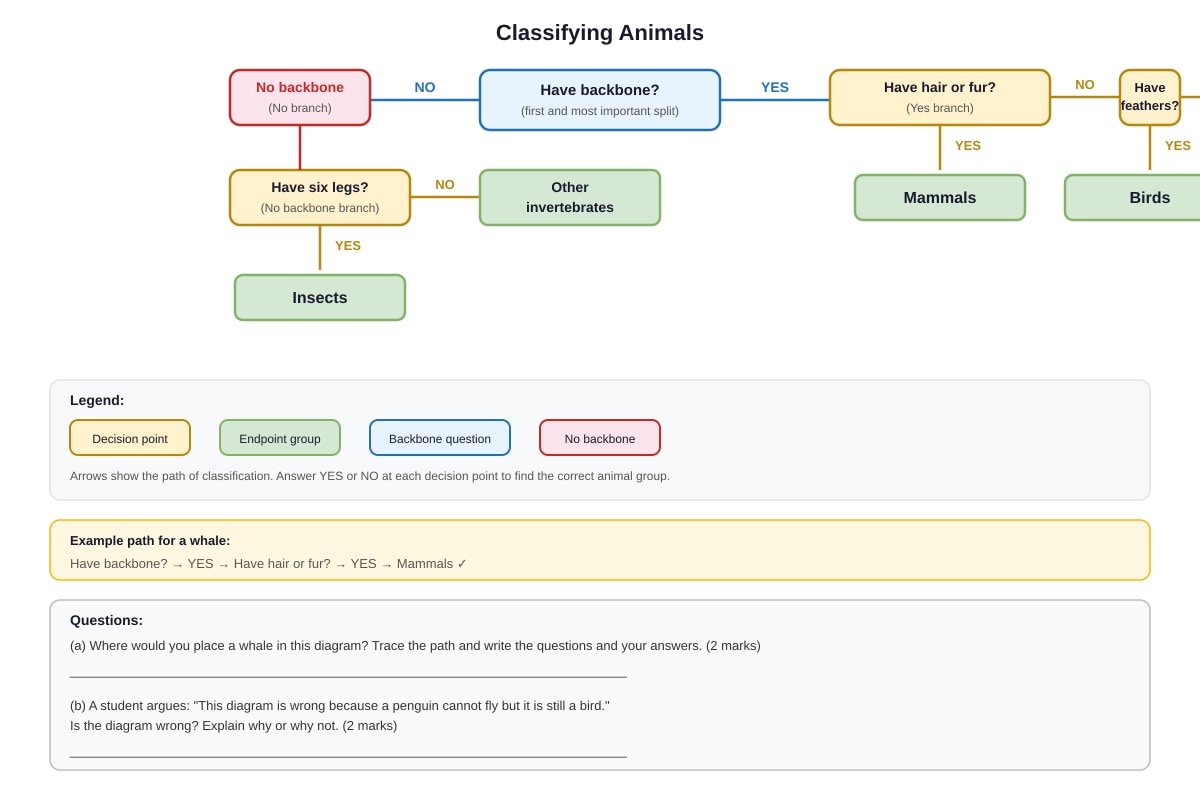
20. (a) (2 marks)
Path:
- "Does it have a backbone?" → Yes (whales have a backbone/vertebrae)
- "Does it have hair or fur?" → Yes (whales have some hair as newborn calves / are mammals with hair follicles)
- → Mammals
Note: Accept the path even if student notes whales have minimal hair; the key places them in mammals. If student traces to "Reptiles/Fish" via "No" to hair, this is technically incorrect for whales but explain in teaching notes that whales are mammals.
Mark breakdown:
- 1 mark for correct first two steps (backbone: yes; then hair/fur: yes)
- 1 mark for arriving at Mammals
20. (b) (2 marks)
The diagram is not wrong.
Explanation: The classification key uses feathers to identify birds, not the ability to fly. Penguins do have feathers — they are special feathers that keep them warm in cold water. Many birds cannot fly (ostriches, kiwis, cassowaries) but they are still birds because they have feathers, beaks, and lay eggs with hard shells. The student confused "flying" with "having feathers," but the diagram correctly uses the proper feature for classification.
Mark breakdown:
- 1 mark for "Not wrong" with recognition that feathers (not flight) is the criterion
- 1 mark for explaining that penguins have feathers / that flightless birds exist
Section C Subtotal: 12 marks
TOTAL MARKS: 40 MARKS
| Section | Marks Available |
|---|---|
| Section A | 10 |
| Section B | 18 |
| Section C | 12 |
| Total | 40 |
Duration: 45 minutes (approximately 1 minute per mark, with 5 minutes review buffer)
Difficulty distribution: Easy 35% (14 marks), Medium 45% (18 marks), Challenging 20% (8 marks)