AI Generated Exam Paper
Primary 3 Science Practice Paper 1
Free P3 Science Practice Paper 1, HY3 AI version, with questions, answers, and syllabus-aligned practice for Singapore students.
These static practice materials are generated from the site's syllabus and paper-generation workflow, with source and model context shown so students and parents can evaluate the material before use.
Questions
Free quiz and exam paper access
Enter your details to view this paper
Your access is remembered on this device.
Answers
TuitionGoWhere Practice Paper — Science Primary 3 (Answer Key)
Version 1 of 5 — Topic: Diversity
Syllabus-first content generated from LLM-inferred Stage 4 templates. Not derived from past-year papers.
Section A (10 marks)
1. (b) Rose plant
Teaching note: A rose plant is living because it grows, needs air/water/food, and can reproduce. Toys and chairs are made by people and do not grow or reproduce.
[1 mark]
2. (b) It can move by itself
Teaching note: Movement by itself is a key living characteristic. Softness and colour are not proof of life.
[1 mark]
3. (b) Bird
Teaching note: Parrots have feathers and wings and belong to the bird group of animals.
[1 mark]
4. (c) Rock
Teaching note: Rock does not grow, reproduce, or respond. Mushroom, bacteria, fern are living.
[1 mark]
5. (c) Plastic raincoat
Teaching note: Plastic does not absorb water, so it is waterproof. Paper and tissue absorb water.
[1 mark]
6. (c) Transparent
Teaching note: Transparent means most light passes through. Strength and flexibility are different properties.
[1 mark]
7. (c) Wood
Teaching note: Wood comes from trees (natural). Plastic, glass, nylon are man-made.
[1 mark]
8. (b) Living things but not plants
Teaching note: Fungi such as mushrooms are living but belong to their own group, not plants.
[1 mark]
9. (b) Fish
Teaching note: Fish have scales and use gills to breathe underwater.
[1 mark]
10. (a) Rubber
Teaching note: Rubber is flexible and can bend without breaking, good for hairbands.
[1 mark]
Section B (12 marks)
11. [2 marks]
Accept any two from: need food, need water, need air, can grow, can reproduce, can respond, can move by itself.
Example answer: Living things need food and water. / They can grow and reproduce.
Marking: 1 mark per correct characteristic.
12. [2 marks]
Living: Butterfly, mango tree
Non-living: Book, eraser
Marking: 1 mark for living list, 1 mark for non-living list. Common mistake: thinking book is living because words "look alive".
13. [2 marks]
Example: Rubber is flexible (can bend) and waterproof. These help shoes grip and keep feet dry.
Marking: 1 mark for property named, 1 mark for link to use.
14. [2 marks]
Natural materials come from nature (e.g., wood). Man-made are made by people (e.g., plastic).
Marking: 1 mark difference, 1 mark example pair.
15. [2 marks]
Metal is strong and can conduct heat well, so it is good for cooking pans.
Marking: 1 mark property, 1 mark use link.
16. [2 marks]
No, he is not correct. Bacteria are living things because they can grow and reproduce.
Marking: 1 mark correct yes/no, 1 mark reason.
Section C (18 marks)
17. (3 marks)
| Object | Living/Non-living | Characteristic |
|---|---|---|
| Pigeon | Living | Can move by itself / reproduces |
| Fern | Living | Can grow / needs water |
| Bench | Non-living | Cannot grow or reproduce |
| Grasshopper | Living | Can move by itself |
Marking: 1 mark for correct classification of all 4; 1 mark for at least 2 characteristics; 1 mark for remaining characteristics.
Teaching note: Living things show characteristics; metal bench is made by people.
18. (4 marks)
Method: Leave teddy bear in a cupboard for 2 weeks. Observe if it grows, eats, or reproduces.
Result: It stays same size, does not eat, does not reproduce → non-living.
Marking: 1 mark investigation idea, 1 mark observation of no growth, 1 mark no reproduction, 1 mark conclusion non-living.
Teaching note: Things that look alive may not be living.
19. (4 marks)
Ceramic: slip-resistant when dry, hard, water stays on top.
Rubber: slip-resistant, soft/comfy, water drains.
Concrete: can be slippery, hard, water pools.
Best: Rubber matting — safe and comfortable when wet.
Marking: 1 mark comparison, 1 mark comfort, 1 mark water, 1 mark best choice + reason.
20. (4 marks)
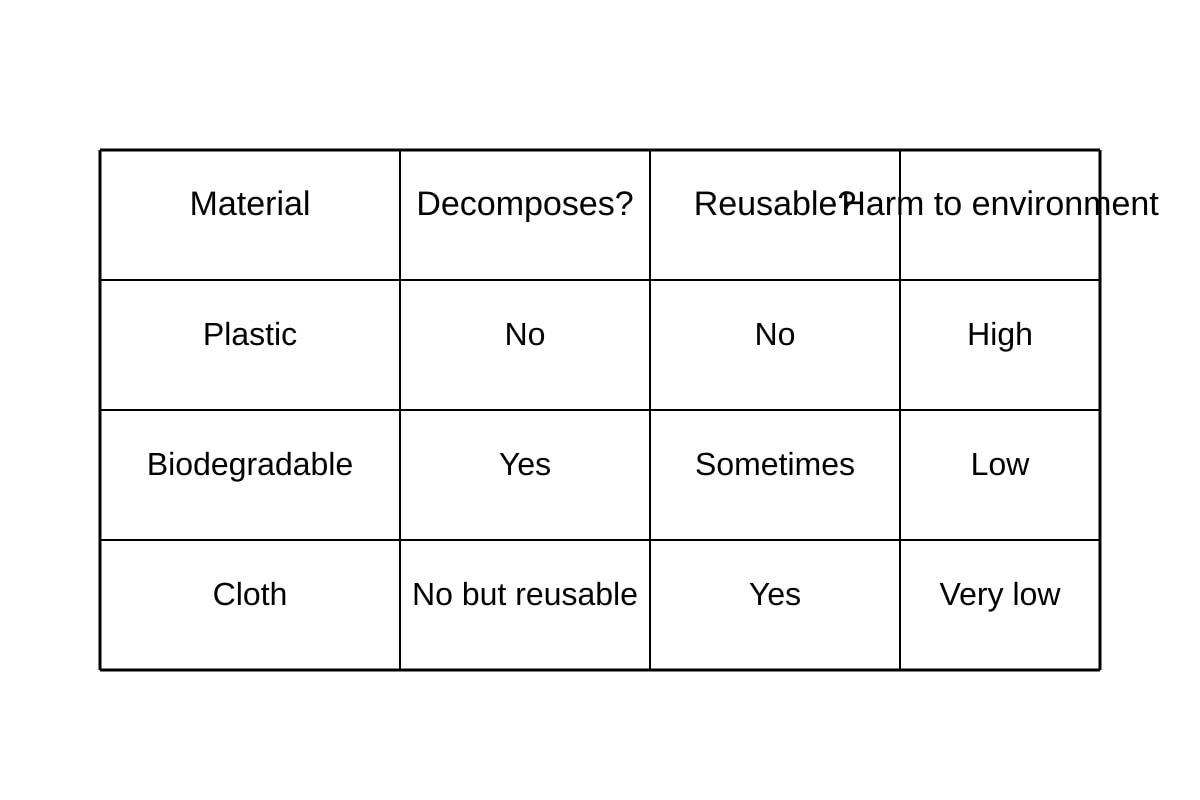
From table Q20-fig1: Plastic (no decompose, high harm), Biodegradable (yes, low harm), Cloth (reusable, very low harm).
Best: Cloth for long-term use; biodegradable for throwaway.
Marking: 1 mark use of table, 1 mark plastic point, 1 mark biodegradable, 1 mark cloth + conclusion.
Teaching note: Reusable and decomposable materials help environment.