From Real Exams Exam Paper
Primary 3 Science Semestral Assessment 2 (End of Year) Paper 5
Free P3 Science SA2 Paper 5, HY3 Exam version, with questions, answers, and syllabus-aligned practice for Singapore students.
These static practice materials are generated from the site's syllabus and paper-generation workflow, with source and model context shown so students and parents can evaluate the material before use.
Questions
Free quiz and exam paper access
Enter your details to view this paper
Your access is remembered on this device.
Answers
TuitionGoWhere Exam Practice (AI) — Science Primary 3
SA2 Practice Paper Version 5 — Answer Key
Total Marks: 40
Section A (10 marks)
1. B (1 mark)
Teaching note: A rose plant is living because it grows, needs water/air/food, and reproduces. Toy car, chair, cup are non-living made by humans.
2. B (1 mark)
Teaching note: Growth is a characteristic of living things. Softness, colour, size are not proof of life.
3. B (1 mark)
Teaching note: Birds have feathers and lay eggs. Fish have scales, mammals have fur and usually live birth, reptiles have dry scales.
4. C (1 mark)
Teaching note: Mushroom is fungus, not plant. Fungi do not make food like plants.
5. B (1 mark)
Teaching note: Cotton is natural from cotton plant. Plastic, glass, nylon are man-made.
6. B (1 mark)
Teaching note: Clear glass is transparent (most light passes). Wood, metal, rubber are not.
7. C (1 mark)
Teaching note: Goldfish breathes with gills underwater. Dog/sparrow use lungs; frog on land uses lungs/skin.
8. C (1 mark)
Teaching note: Rock is non-living. Mould, yeast, bacteria are living microorganisms.
9. A (1 mark)
Teaching note: Waterproof means water cannot pass through. Flexible = bend, transparent = light passes, strong = hard to break.
10. B (1 mark)
Teaching note: Fish have scales and live in water. Birds have feathers, insects have wings, mammals have fur.
Section B (10 marks)
11. (2 marks: 1 for each group correct)
Living: cow, mushroom, fern
Non-living: table, bicycle
Teaching note: Living need food/air/water, grow, reproduce. Mushroom is fungus (living). Table/bicycle are made, do not grow.
12. (2 marks: ½ mark per cell)
Plastic bag: Transparent (or not, acceptable if clear bag), Flexible
Wooden ruler: Not transparent, Not flexible
Teaching note: Plastic bag bends and may be see-through; wood is rigid and opaque.
13. (2 marks: 1 mark each characteristic+example)
(a) Grow — example: child grows taller
(b) Reproduce — example: hen lays eggs
Teaching note: Other accepted: respond to change (plant bends to light), need food/air/water (dog eats). Must give real example.
14. (2 marks: 1 for property, 1 for link to use)
Plastic is waterproof (1). So rain cannot pass through to wet the boy (1).
Teaching note: Property must match purpose. Common mistake: says "strong" but raincoat needs waterproof.
15. (2 marks: ½ each correct)
Fur: cat
Feathers: sparrow
Scales: snake, fish
Teaching note: Body covering helps classify animals.
Section C (10 marks)
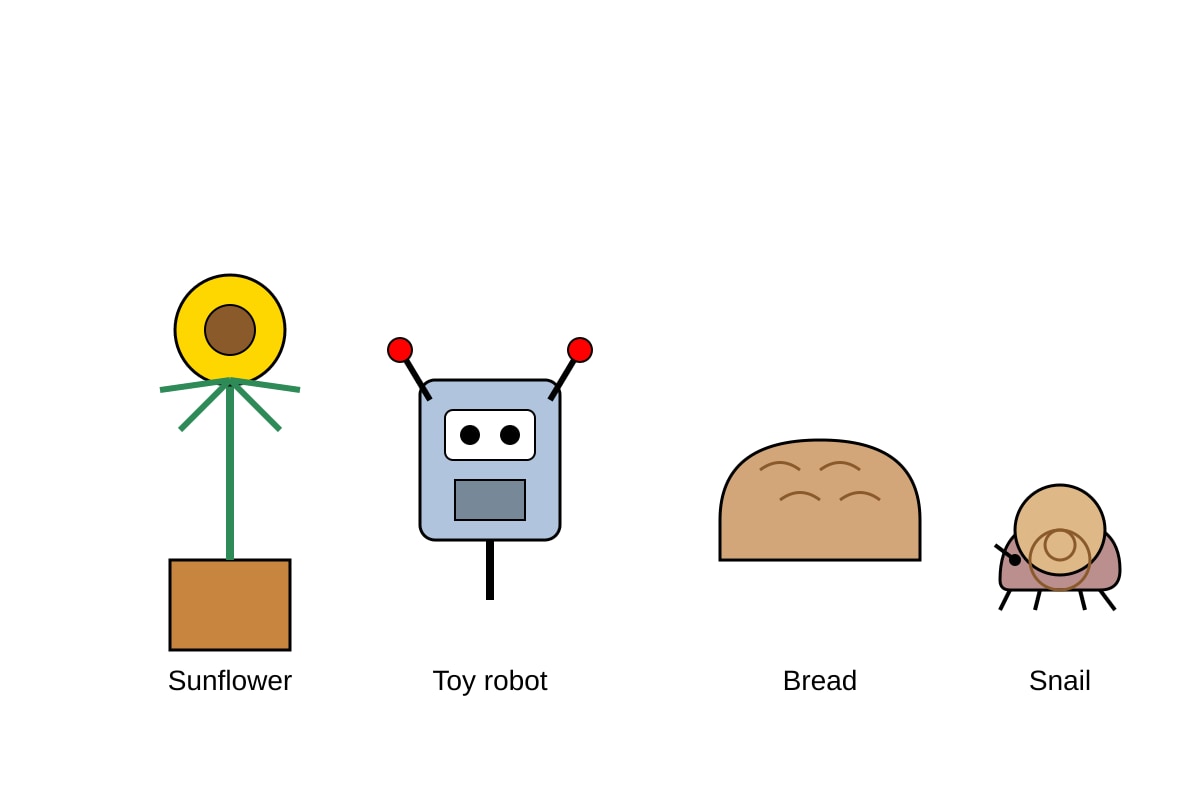
16. (2 marks: 1 living list, 1 reason)
Living: sunflower, snail (1)
Reason: They grow and need air/food/water (1)
Teaching note: From image, toy robot and bread are non-living though bread was once from living wheat. Snail moves and grows.
17. (2 marks: 1 answer, 1 explain)
No, not all bacteria are harmful (1). Some help like yeast in bread or good bacteria in yoghurt (1).
Teaching note: Bacteria can be useful; misconception all are bad.
18. (2 marks: 1 shared, 1 use)
Shared: break easily / not flexible (1)
Use of glass: window so we see through (1)
Teaching note: Transparency lets light pass; both are brittle.
19. (2 marks: 1 each group)
Natural: wool, leather
Man-made: steel (processed), polyester
Teaching note: Wool from sheep, leather from animal skin; polyester synthetic, steel from iron ore processed (accepted man-made).
20. (2 marks: 1 group, 1 special)
Group: amphibian (1)
Special: changes from tadpole with tail to frog with legs (metamorphosis) (1)
Teaching note: Frog is amphibian; life cycle shows big change, not just growing bigger.