From Real Exams Exam Paper
Primary 3 Science Semestral Assessment 2 (End of Year) Paper 4
Free P3 Science SA2 Paper 4, Kimi2.6 Exam version, with questions, answers, and syllabus-aligned practice for Singapore students.
These static practice materials are generated from the site's syllabus and paper-generation workflow, with source and model context shown so students and parents can evaluate the material before use.
Questions
Free quiz and exam paper access
Enter your details to view this paper
Your access is remembered on this device.
Answers
TuitionGoWhere Exam Practice (AI) - Science Primary 3
Answer Key and Marking Scheme
Paper: SA2
Level: Primary 3
Version: 4 of 5
Total Marks: 60
SECTION A: Multiple-Choice Questions (20 marks)
| Question | Answer | Marks | Working and Explanation |
|---|---|---|---|
| 1 | (B) | [2] | All living things need water to survive. This is one of the seven characteristics of living things. (A) is wrong because not all living things can fly (e.g., plants, fish). (C) is wrong because not all living things are green (e.g., animals, mushrooms). (D) is wrong because only plants make their own food; animals do not. |
| 2 | (B) | [2] | The object is living because it grows and makes seeds (reproduces). These are key characteristics of living things. (A) and (C) are wrong because plants are living even though they do not move from place to place. (D) is wrong because being green alone is not enough; many non-living things like green toys are not living. |
| 3 | (B) | [2] | Fern, moss, and mushroom are all non-flowering plants. Important note: Mushroom is a fungus, not a plant. However, in P3 syllabus, students learn fern and moss as non-flowering plants. The correct answer based on syllabus is (B) because fern and moss are definitely non-flowering plants, though mushroom is technically fungi. (A) has rose which is flowering. (C) all flowering. (D) has cactus which has flowers. |
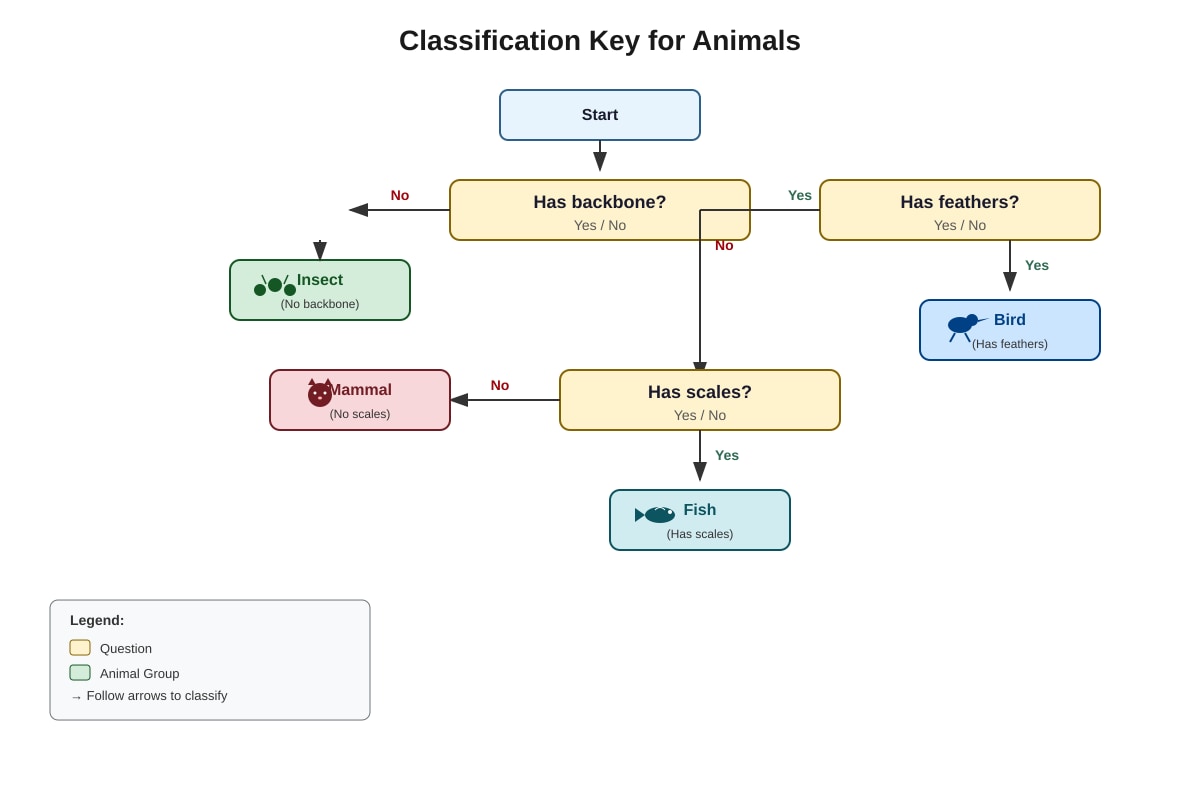
| 4 | (B) | [2] | Following the key: Has backbone? Yes → Has feathers? Yes → Bird. The key branches from "backbone yes" to "feathers yes" which leads to Bird. (A) Mammal would be backbone yes → feathers no → hair yes. (C) Fish would be backbone yes → feathers no → scales yes. (D) Insect would be backbone no from the start. |
| 5 | (B) | [2] | Frog is an amphibian. Amphibians live both in water and on land, have moist skin, and typically go through an aquatic larval stage (tadpole). (A) Crocodile, (C) Lizard, and (D) Snake are all reptiles with dry, scaly skin. |
| 6 | (C) | [2] | Statement (C) is FALSE. Non-living things CANNOT grow and reproduce. This is the key difference between living and non-living things. (A), (B), and (D) are all true statements about living things. |
| 7 | (B) | [2] | P (Goldfish) and R (Class hamster) are living things. Both can move by themselves and need food. Q (Storybook) and S (Water bottle) are non-living — they cannot move by themselves and do not need food. |
| 8 | (B) | [2] | Mammals have hair or fur, but reptiles have scales. This is a clear distinguishing feature. (A) is wrong because many mammals (like whales) don't have four visible legs, and some reptiles (like snakes) don't have legs. (C) is wrong because some mammals (like the platypus) also lay eggs. (D) is wrong because both can swim. |
| 9 | (C) | [2] | Mould belongs to fungi. Fungi include mould, mushrooms, and yeast. They are living things but are neither plants nor animals. (A) is wrong because mould does not make its own food like plants. (B) Bacteria are single-celled organisms, different from mould. (D) Animals feed on other organisms; mould absorbs nutrients from decaying matter. |
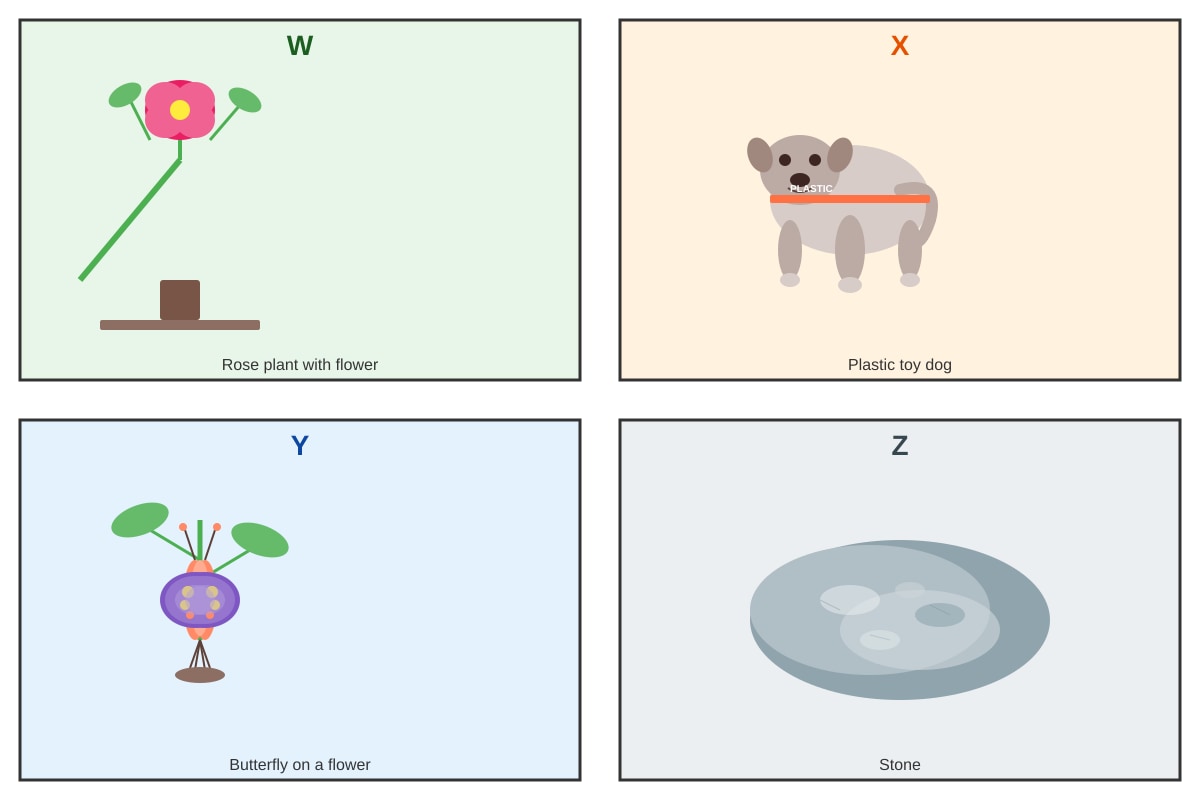
| 10 | (B) | [2] | W (Rose) and Y (Butterfly) are living things. Rose is a plant that grows and reproduces. Butterfly is an animal that moves, feeds, and reproduces. X (Plastic toy dog) is non-living — it is made of plastic and cannot grow or reproduce. Z (Stone) is non-living — it is a rock with no life processes. |
Section A Total: [20]
SECTION B: Structured Questions (24 marks)
| Question | Answer | Marks | Working and Explanation |
|---|---|---|---|
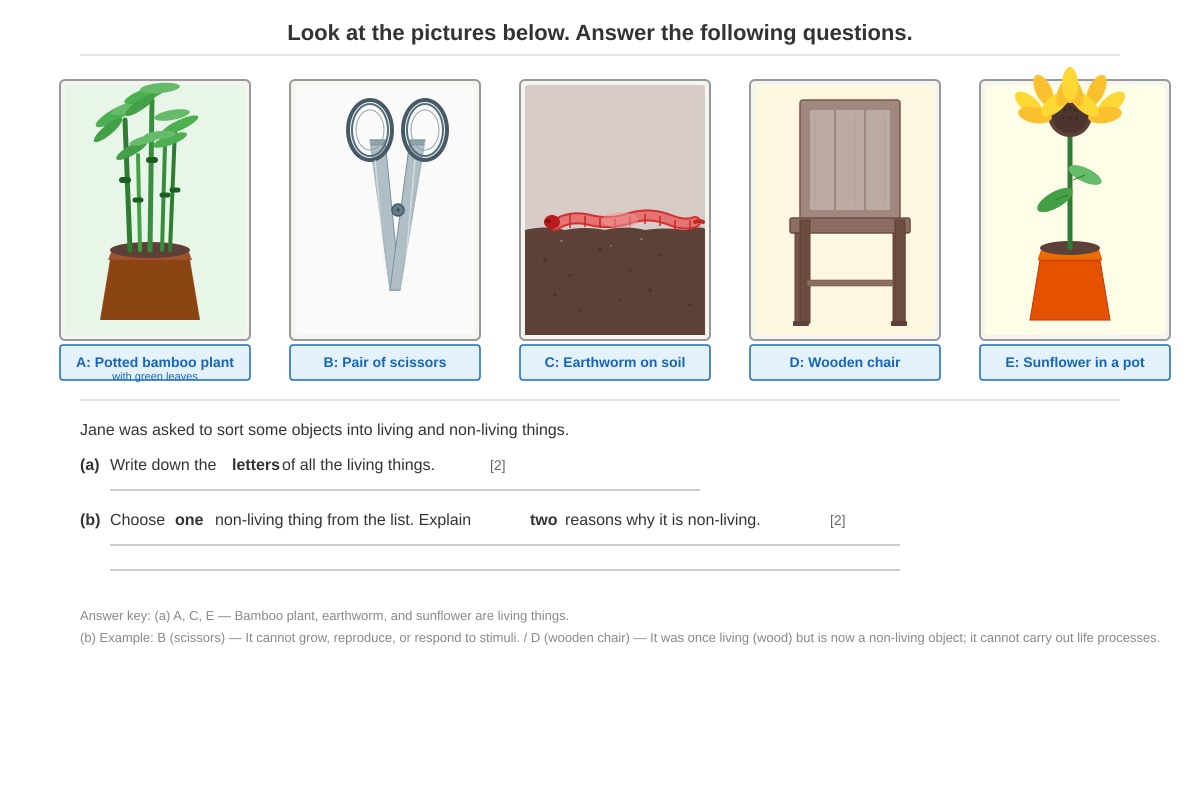
| 11(a) | A, C, E (any order) | [2] | Living things: A (Bamboo plant — grows, needs water, makes food), C (Earthworm — moves, feeds, reproduces), E (Sunflower — grows, makes seeds, needs sunlight). Award 1 mark for two correct, 2 marks for all three correct. |
| 11(b) | Example answer for B (Scissors): It is non-living because (i) it cannot grow or reproduce, and (ii) it does not need food, water, or air to survive. OR for D (Wooden chair): It is non-living because (i) it cannot move by itself or respond to changes, and (ii) it does not need food, water, or air. | [2] | 1 mark for each correct reason. Must state two different characteristics that show why it is non-living (cannot grow/reproduce/move/respond/need food/need water/need air — any two). Common mistake: Saying "it doesn't move" — chairs can be moved, but they don't move BY THEMSELVES. |
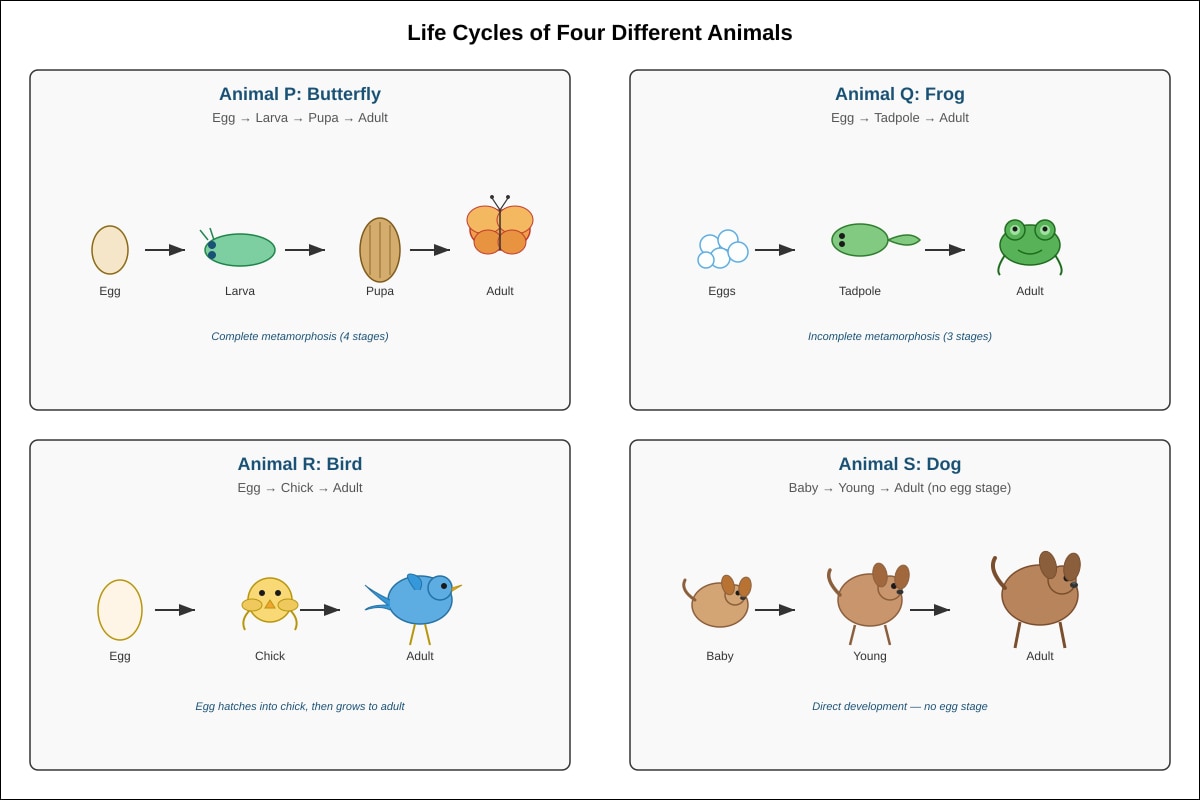
| 12(a) | Animal P (the butterfly/go through complete metamorphosis) | [1] | Animal P has four stages: egg → larva → pupa → adult. The others have fewer stages. |
| 12(b) | Animal Q and Animal R (or frog and bird/chick) | [1] | Both Q (frog) and R (bird) hatch from eggs but do not have a pupa stage. Frog goes: egg → tadpole → adult. Bird goes: egg → chick → adult. |
| 12(c) | Animal S is a mammal because (i) it does not hatch from an egg — it is born alive as a baby, and (ii) it has hair/fur and its mother feeds it with milk. | [2] | 1 mark for each correct point. Mammals are born alive (not from eggs, generally), have hair/fur, and suckle their young with milk. Animals S shows direct development from baby to adult with no egg, which is typical of mammals. Birds hatch from eggs, even though they also care for their young. |
| 13(a) | Diana's answer is not correct. Reason: Being big, colourful, and beautiful are not characteristics of living things. Many non-living things (like a colourful poster or a big building) can be big, colourful, and beautiful but are not alive. Living things must show life processes like growth, reproduction, response, movement, need for food/water/air. | [2] | 1 mark for identifying Diana. 1 mark for correct explanation. Must explain that Diana's criteria (size, colour, beauty) are not scientific characteristics of living things. |
| 13(b) | Example: Betty — A puppy needs food, water, and air to survive. If we don't give it food, it will become weak and may die. OR Charlie — A touch-me-not plant responds to touch by closing its leaves. OR Ali — A baby grows taller and heavier as it becomes an adult; a seedling grows into a plant. | [2] | 1 mark for choosing a correct student (Ali, Betty, or Charlie). 1 mark for a valid example that matches their statement. Example must clearly illustrate the characteristic named. |
| 14(a) | The platypus is special because it has hair like a mammal AND it lays eggs like a bird/reptile. Most mammals do NOT lay eggs. OR: It is a mammal that lays eggs, which is unusual. | [2] | 1 mark for identifying that platypus has hair (mammal feature). 1 mark for identifying that it lays eggs (unusual for mammal). The platypus is one of only two mammals (along with echidna) that lays eggs — called monotremes. |
| 14(b) | The student is not correct. The platypus (Animal S) lays eggs but is a mammal, not a bird or fish. This shows that not all egg-laying animals are birds or fish. | [2] | 1 mark for stating "not correct". 1 mark for using platypus as evidence from the table. Must specifically reference the table data showing platypus has hair + lays eggs. |
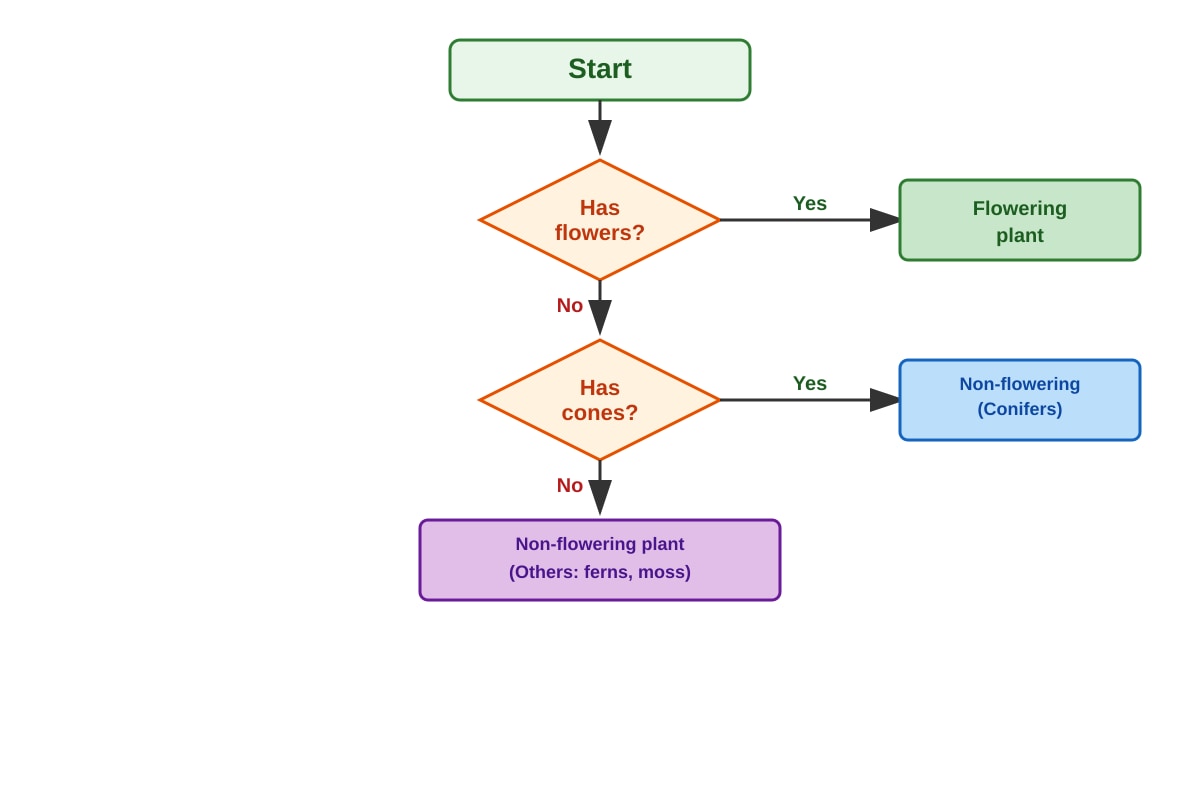
| 15(a) | Any two: Fern, moss (acceptable from P3 syllabus). Students may also write "yeast" or "mushroom" though technically fungi; in some curricula these are grouped with non-flowering plants at introductory level. | [2] | 1 mark for each correct answer. Ferns and mosses reproduce by spores, not seeds or flowers. They need water for reproduction. |
| 15(b) | Does it have cones? (OR: Are there cones on the plant?) | [1] | If yes → conifer (non-flowering plant with cones). If no → it is a fern/moss (non-flowering plant without cones). |
| 15(c) | Scientists use classification keys to organise living things into groups / help identify unknown organisms / show how organisms are related / make it easier to study the diversity of life. | [1] | Any one valid purpose. Classification keys help us sort organisms based on their features, step by step. |
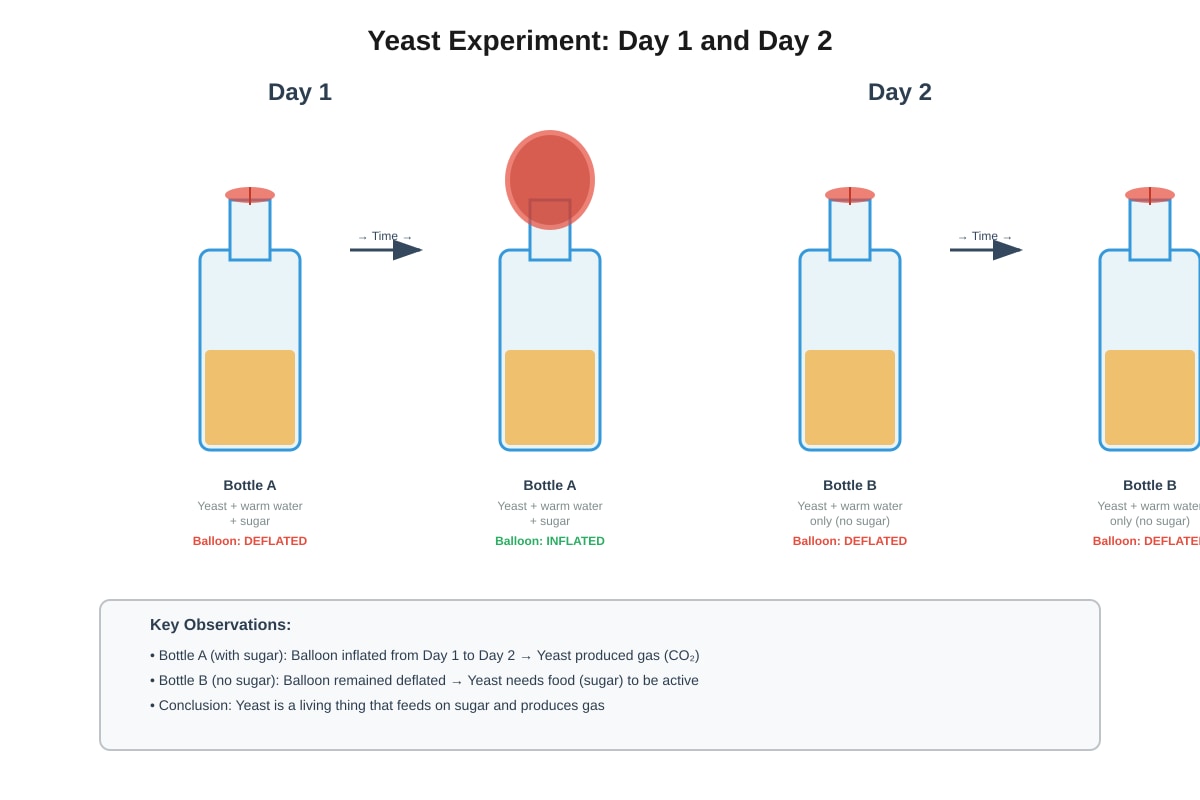
| 16(a) | The balloon got bigger / inflated / became rounded. | [1] | Visual check: Bottle A's balloon expands due to gas produced by yeast. |
| 16(b) | This tells us that yeast is a living thing because it can reproduce/grow/respire and produce gas (carbon dioxide). | [1] | Yeast feeds on sugar and produces carbon dioxide gas through respiration. The balloon collects this gas. |
| 16(c) | Bottle B is the control / to compare with Bottle A / to show that sugar is needed for yeast to grow and produce gas. OR: To make sure it is the yeast with sugar causing the change, not just the warm water alone. | [2] | 1 mark for identifying as a control/fair test/comparison. 1 mark for explaining purpose — to show sugar is necessary. This is called a controlled variable or fair test principle. Without Bottle B, we cannot be sure sugar causes the balloon to inflate. |
Section B Total: [24]
SECTION C: Application and Process Skills (16 marks)
| Question | Answer | Marks | Working and Explanation |
|---|---|---|---|
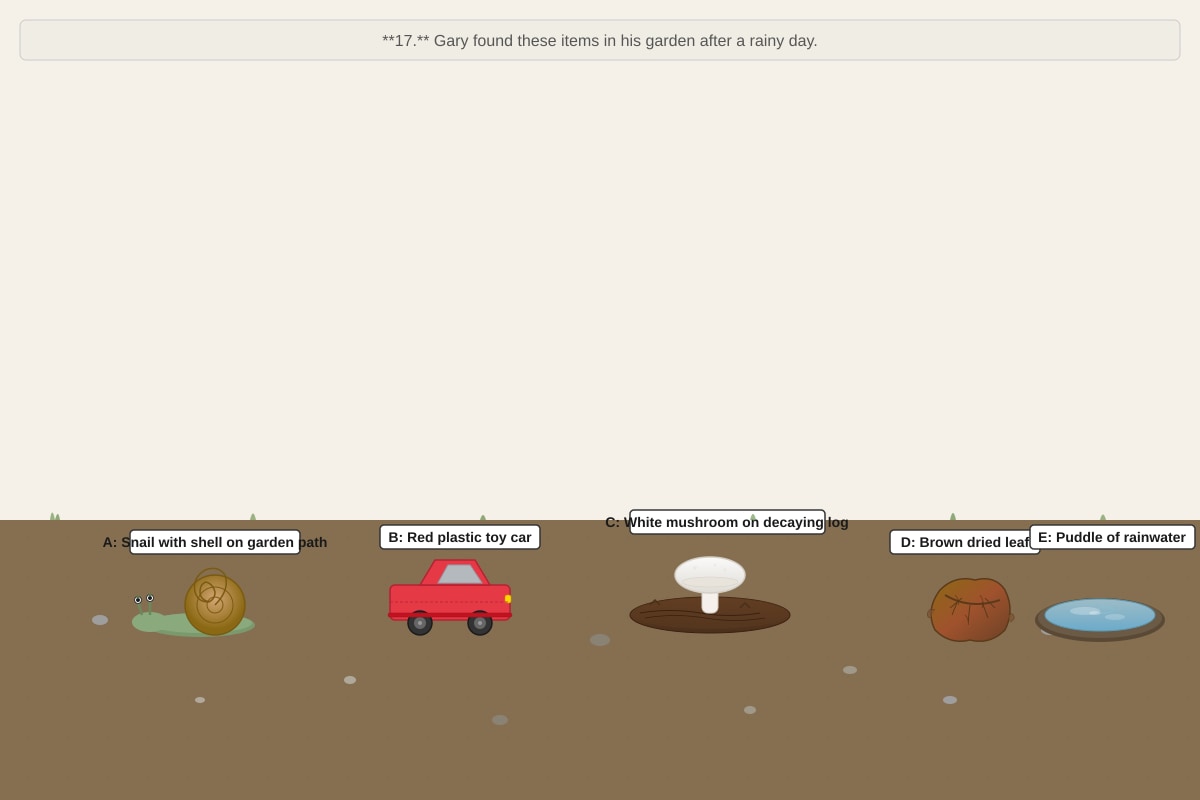
| 17(a) | A and C (Snail and Mushroom) | [2] | 1 mark for each correct letter. A (Snail) — animal, moves, feeds, reproduces. C (Mushroom) — fungus, living thing that grows and reproduces by spores. B (Toy car) is plastic, non-living. D (Dried leaf) was part of a living plant but is now dead/non-living. E (Puddle) is water, non-living. |
| 17(b) | Gary is correct (or partially correct — accept "correct" at P3 level). The dried leaf is dead/non-living now because it can no longer grow, make food, or respond to changes. However: It was part of a living plant. At P3, accept that it is non-living because it shows no life processes. | [2] | 1 mark for stating correct (or noting it was once living but now dead). 1 mark for explanation. Key point: The leaf has been separated from the plant, has no water supply, cannot photosynthesise, and is decaying. It no longer shows life processes. |
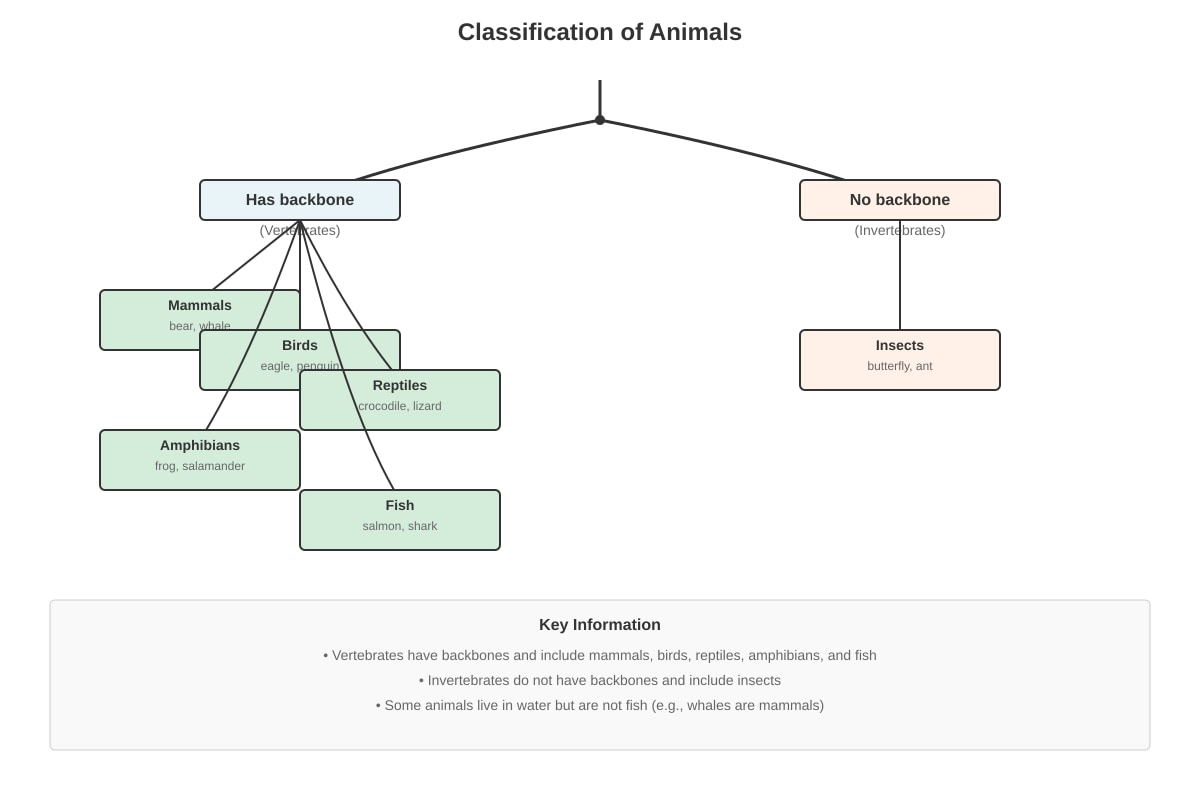
| 18(a) | Any two from: Eagle, Penguin, Crocodile, Lizard, Frog, Salamander, Salmon, Shark | [1] | Any two correct examples of vertebrates that are NOT mammals. Must have backbones but be in other groups (bird, reptile, amphibian, fish). |
| 18(b) | The student is wrong. Whale (from diagram) is a mammal that lives in water, not a fish. OR Penguin lives in/near water but is a bird. | [2] | 1 mark for stating "wrong"/"not correct". 1 mark for giving whale or penguin as counter-example from the diagram. Whale has hair (when young), feeds milk to young, has lungs — mammal features despite living in water. |
| 18(c) | Five (5) main groups | [1] | Mammals, Birds, Reptiles, Amphibians, Fish — five groups of vertebrates shown. |
| 19(a) | Seeds are living things / seeds can grow (under suitable conditions) / seeds need water, air, and suitable temperature to grow. | [1] | Pot B had all needed conditions: water, air, warmth (sunlight), and the seeds grew. |
| 19(b) | To compare results / to make it a fair test / to find out what seeds need to grow / to test different conditions. | [1] | Using multiple pots with one changed variable each time allows us to identify which factor affects growth. |
| 19(c) | From Pot A vs Pot C: Seeds need both water AND sunlight to grow. OR: Seeds need light/sunlight (comparing A dark no growth vs C light but no water — actually both didn't grow, so we conclude seeds need BOTH conditions together). Better answer: Sarah can conclude that seeds need both water and light together; one condition alone is not enough. OR: The comparison shows that removing EITHER water OR light stops growth, so both are necessary. | [2] | 1 mark for identifying need for water. 1 mark for identifying need for light/sunlight. OR 2 marks for synthesis: Both are needed together. Common error: Students may say A vs C shows "light is more important" — incorrect; both are essential. The fair comparison is A vs B (shows light needed) and C vs B (shows water needed). |
| 20(a) | Sample table: | [3] | 1 mark per correct pair of differences (must be valid, observable differences). |
| Real Cactus (X) | Plastic Cactus (Y) | ||
| 1. Grows slowly / gets bigger over time | Does not grow / stays same size | ||
| 2. Has natural soil with roots in pot | Has fake base / no real roots / styrofoam or plastic base | ||
| 3. Spines are sharp, natural, may vary | Spines are smooth, moulded, uniform | ||
| 4. Colour varies naturally / may change with health | Uniform bright green, never changes | ||
| 5. Needs water to survive | Does not need water | ||
| Any three valid differences accepted. | |||
| 20(b) | Sam is wrong because looking alike and standing up are not characteristics of living things. The plastic cactus cannot grow, reproduce, respond to changes, or need food/water/air. OR: Standing up straight is something non-living things can also do (like a broom or umbrella). | [1] | Must explain that appearance alone does not determine if something is living. Need to check for life processes. |
Section C Total: [16]
GRAND TOTAL: [60]
Marking Notes Summary:
- Section A: 10 questions × 2 marks = 20 marks
- Section B: 6 questions × 4 marks = 24 marks
- Section C: 4 questions × 4 marks = 16 marks
- Total: 60 marks
Common errors to watch for in marking:
- Confusing "moves" with "moves by itself" — toys move when pushed, only living things move on their own.
- Thinking all green things are plants / all living things are plants.
- Believing eggs = birds only; forgetting reptiles, fish, amphibians, and some mammals lay eggs.
- Confusing growth (living thing, permanent increase in size) with temporary changes like inflating a balloon.
- "Died" is not a characteristic of living things — it is what happens when life ends.