From Real Exams Exam Paper
Primary 3 Science Semestral Assessment 2 (End of Year) Paper 3
Free P3 Science SA2 Paper 3, Kimi2.6 Exam version, with questions, answers, and syllabus-aligned practice for Singapore students.
These static practice materials are generated from the site's syllabus and paper-generation workflow, with source and model context shown so students and parents can evaluate the material before use.
Questions
Free quiz and exam paper access
Enter your details to view this paper
Your access is remembered on this device.
Answers
TuitionGoWhere Exam Practice (AI) - Answer Key
SA2 Practice Paper - Science Primary 3
Version 3 of 5
Subject: Science
Level: Primary 3
Paper: SA2 Practice
Total Marks: 60 marks
SECTION A: Multiple Choice Questions (20 marks)
1. Answer: C) A real cat sleeping on a mat
Explanation: Living things have characteristics such as needing food, water, and air, being able to grow, respond to changes, and reproduce. A real cat is a living thing because it possesses all these characteristics. A plastic toy dog (A), a stone statue of a bird (B), and a wooden model of a fish (D) are all non-living—they cannot grow, move by themselves, or reproduce. The cat might be sleeping, but it is still alive; sleeping is actually a response to being tired!
Marks: 1 mark
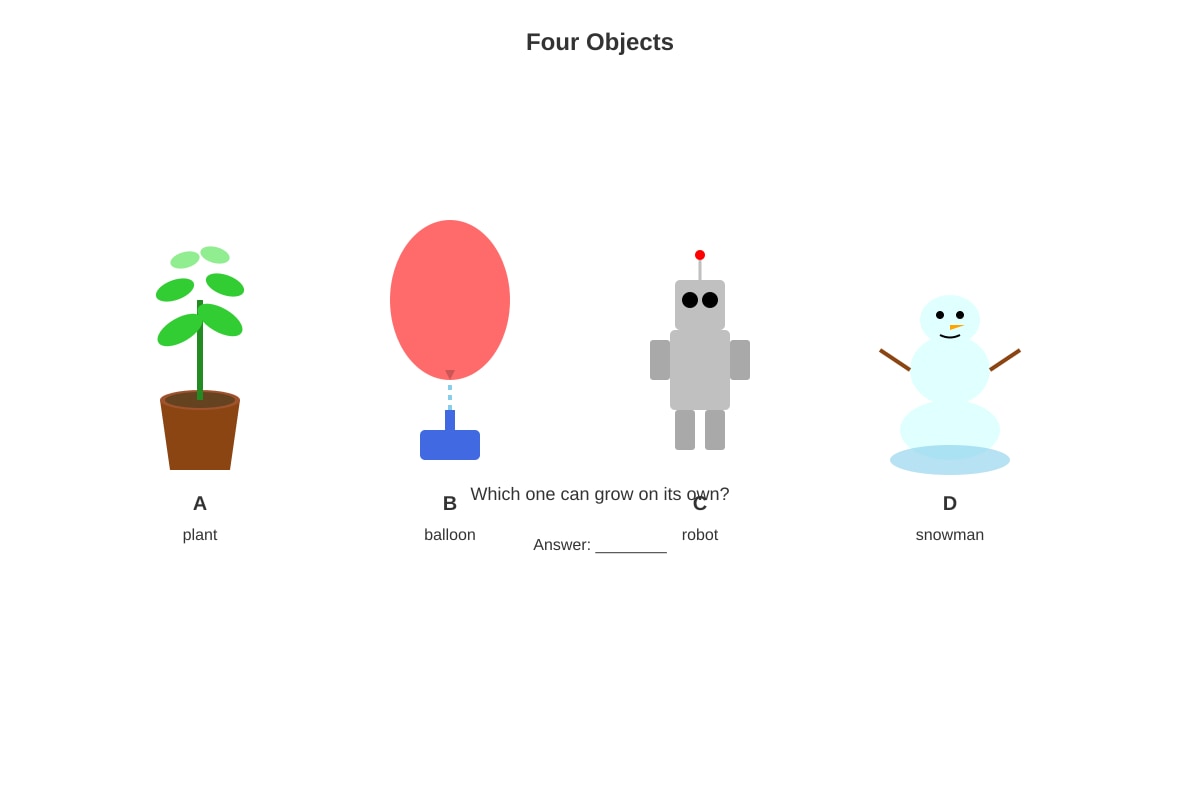
2. Answer: A) The potted plant (A)
Explanation: Only living things can grow on their own through natural processes. The plant (A) grows by making its own food and developing new leaves. The balloon (B) gets bigger when someone blows air into it—this is not true growth, just expansion. The robot (C) cannot grow bigger; it stays the same size. The snowman (D) gets smaller as it melts—this is not growth but a change of state from solid to liquid.
Visual check: The plant shows new leaves sprouting, indicating natural growth.
Marks: 1 mark
3. Answer: B) food
Explanation: All living things need three basic things to survive: air (to breathe), water (for body processes), and food (for energy and growth). Sunlight (A) is needed by plants but not by all living things in the same way—animals cannot use sunlight directly. Soil (C) is where some plants grow but is not a basic need for all living things. Money (D) is something humans use but is not a biological need for life.
Marks: 1 mark
4. Answer: D) They cannot respond to changes
Explanation: This statement is NOT true—living things CAN respond to changes, which is why it is the correct answer. Living things respond to stimuli like light, touch, temperature, and danger. A plant grows toward light; an animal runs from danger. Options A, B, and C are all TRUE characteristics of living things: they can move by themselves (though plants move slowly), they can reproduce, and they can grow bigger.
Marks: 1 mark
5. Answer: B) grow and develop
Explanation: The seed changing into a seedling, then into a flowering plant, shows the process of growth and development. This is a key characteristic of living things. The plant does move slightly (A) as it grows toward light, but the main idea here is growth. Plants do not make sounds (C) in a way that we can usually hear. Living things never become non-living (D)—if a plant dies, it stops being alive, but the process of growing does not turn it into a non-living thing.
Marks: 1 mark
6. Answer: A) W only
Explanation: To be a living thing, an object must have ALL the key characteristics: it must be able to move by itself, grow, AND need water. Object W has all three features (Yes, Yes, Yes), so it is a living thing. Object Z can move by itself and needs water but CANNOT grow—this means it might be something like a robot or wind-up toy that moves but does not truly grow. A toy robot moves when wound up but is not alive. Object X has no living characteristics. Object Y needs water but cannot move or grow—this could describe a sponge that soaks up water, which is non-living.
Marks: 1 mark
7. Answer: B) Snake, lizard, crocodile, turtle
Explanation: All four in group B are reptiles, which is a group of animals. Group A is wrong because a mushroom is a fungus, not an animal. Group C contains only plants (grass, fern, moss, flower). Group D contains fungi and bacteria—mould, yeast, and mushroom are fungi; bacteria are microorganisms but not animals.
Marks: 1 mark
8. Answer: B) amphibian
Explanation: Amphibians are animals that can live both on land and in water. Examples include frogs, toads, and salamanders. They typically have moist skin and lay eggs in water. Insects (A) like butterflies have six legs and usually live on land or in air. Reptiles (C) like snakes have dry, scaly skin and most live mainly on land. Mammals (D) like dogs and humans have fur or hair and feed their young with milk.
Marks: 1 mark
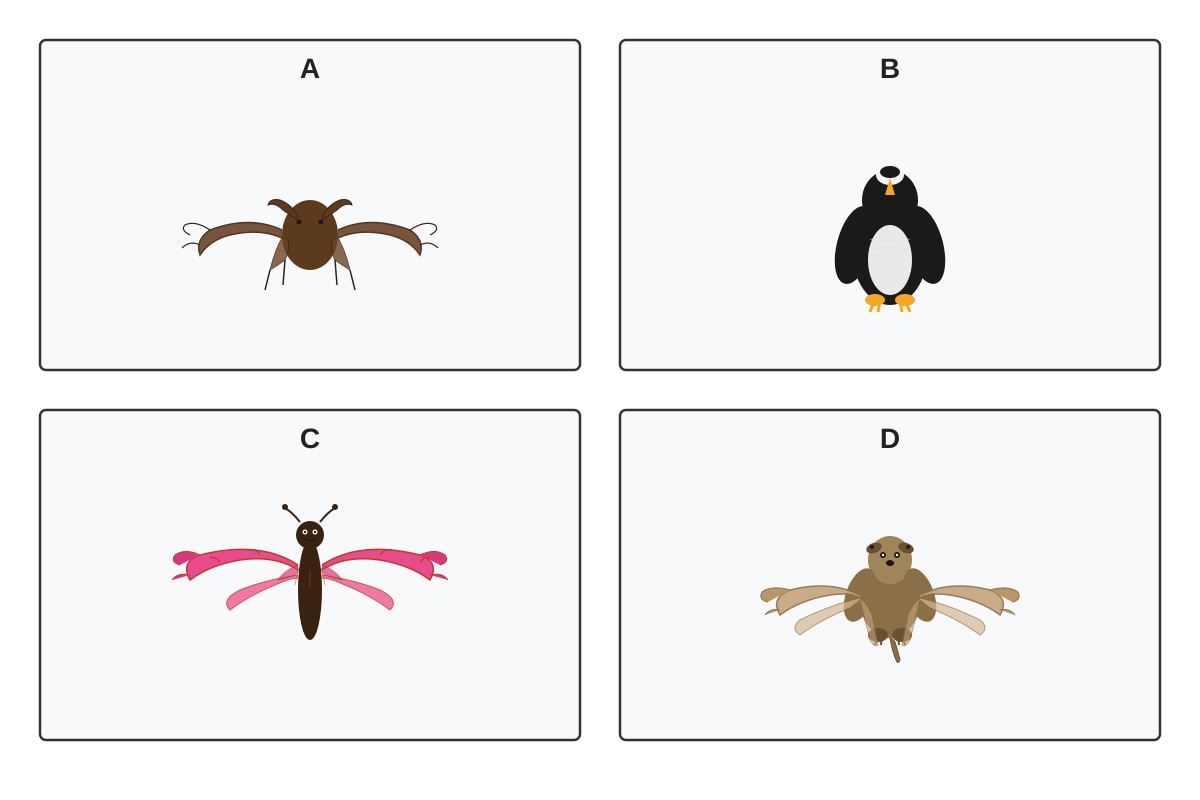
9. Answer: B) The penguin
Explanation: Birds are characterized by having feathers and a beak (or bill). The penguin is a bird—it has feathers covering its body and a beak for catching fish. The bat (A) is a mammal with leathery wings made of skin, not feathers. The butterfly (C) is an insect with wings covered in tiny scales, not feathers. The flying squirrel (D) is a mammal with a furry body and a gliding membrane, not true wings or feathers.
Visual check: The penguin clearly shows feathered body and pointed beak; bat shows stretched skin wings; butterfly shows large, patterned wings; flying squirrel shows furry body with flap of skin between legs.
Marks: 1 mark
10. Answer: C) Fern
Explanation: Ferns are non-flowering plants—they reproduce using spores instead of seeds and flowers. Rose (A), hibiscus (B), and sunflower (D) are all flowering plants that produce seeds inside flowers. Ferns have fronds (leaf-like structures) and grow in damp, shady places. They are among the oldest types of plants on Earth.
Marks: 1 mark
11. Answer: B) reproduce
Explanation: Reproduction is the process by which living things produce young of their own kind. A dog giving birth to puppies is an example of reproduction. Respiration (A) means breathing and using oxygen—important but not shown here. Excretion (C) means removing waste from the body. Photosynthesis (D) is how plants make their own food using sunlight—animals cannot do this.
Marks: 1 mark
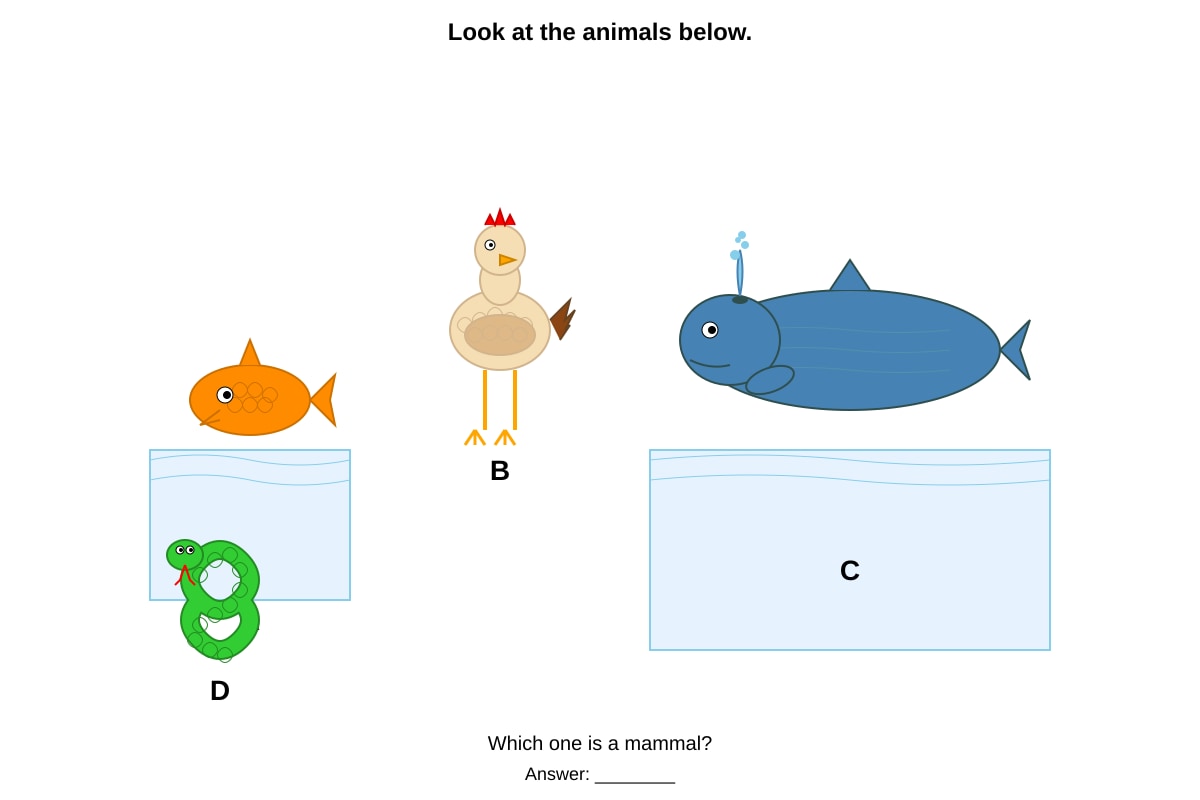
12. Answer: C) The whale
Explanation: Whales are mammals. Although they live in water and look like fish, whales have key mammal features: they breathe air through lungs (not gills), they have smooth skin (not scales), and female whales feed their calves with milk produced in their bodies. The goldfish (A) is a fish with scales and gills. The chicken (B) is a bird with feathers and a beak. The snake (D) is a reptile with scales and lays eggs.
Visual check: Whale shows smooth skin, blowhole on top of head, and horizontal tail fluke; fish shows vertical tail and visible scales; chicken shows feathers and beak; snake shows patterned scales.
Marks: 1 mark
13. Answer: C) fungus
Explanation: Mould is a type of fungus. Fungi are living things that are neither plants nor animals. They cannot make their own food like plants do, and they do not move like animals. Instead, fungi absorb nutrients from their surroundings. Mould grows on bread because it is feeding on the nutrients in the bread. Other fungi include mushrooms and yeast.
Marks: 1 mark
14. Answer: B) Bacteria are very small living things
Explanation: Bacteria are microscopic living things—they are too small to see with our eyes alone and need a microscope. Statement A is wrong because bacteria are not plants (they do not need sunlight and cannot photosynthesise). Statement C is wrong because bacteria CAN reproduce, often very quickly by dividing into two. Statement D is wrong because bacteria are NOT visible to the naked eye; we need microscopes to see them.
Marks: 1 mark
15. Answer: B) Group by whether they have characteristics of living things
Explanation: Scientific classification of living and non-living things is based on whether objects have the characteristics of life: growth, reproduction, response to stimuli, movement by themselves, and need for food, water, and air. Grouping by colour (A), size only (C), or where bought (D) are not scientific ways to classify living things versus non-living things. These might help organise objects, but they don't tell us about life processes.
Marks: 1 mark
16. Answer: A) need food and can excrete
Explanation: The rabbit eating grass shows that living things need food for energy and growth. Producing droppings shows excretion—removing waste materials from the body. This is a key characteristic of living things. Living things do not fly and swim as defining features (B)—many cannot do either. Being green (C) is only true for plants with chlorophyll, not animals like rabbits. All living things need water (D), so this statement is false.
Marks: 1 mark
17. Answer: B) Lizard
Explanation: Lizards are reptiles. Reptiles are characterized by having dry, scaly skin and most lay eggs (though some give birth to live young). The lizard fits both criteria. Bats (A) are mammals with fur that give birth to live young. Whales (C) are mammals that give birth to live young and feed with milk. Rabbits (D) are mammals with fur that give birth to live young.
Marks: 1 mark
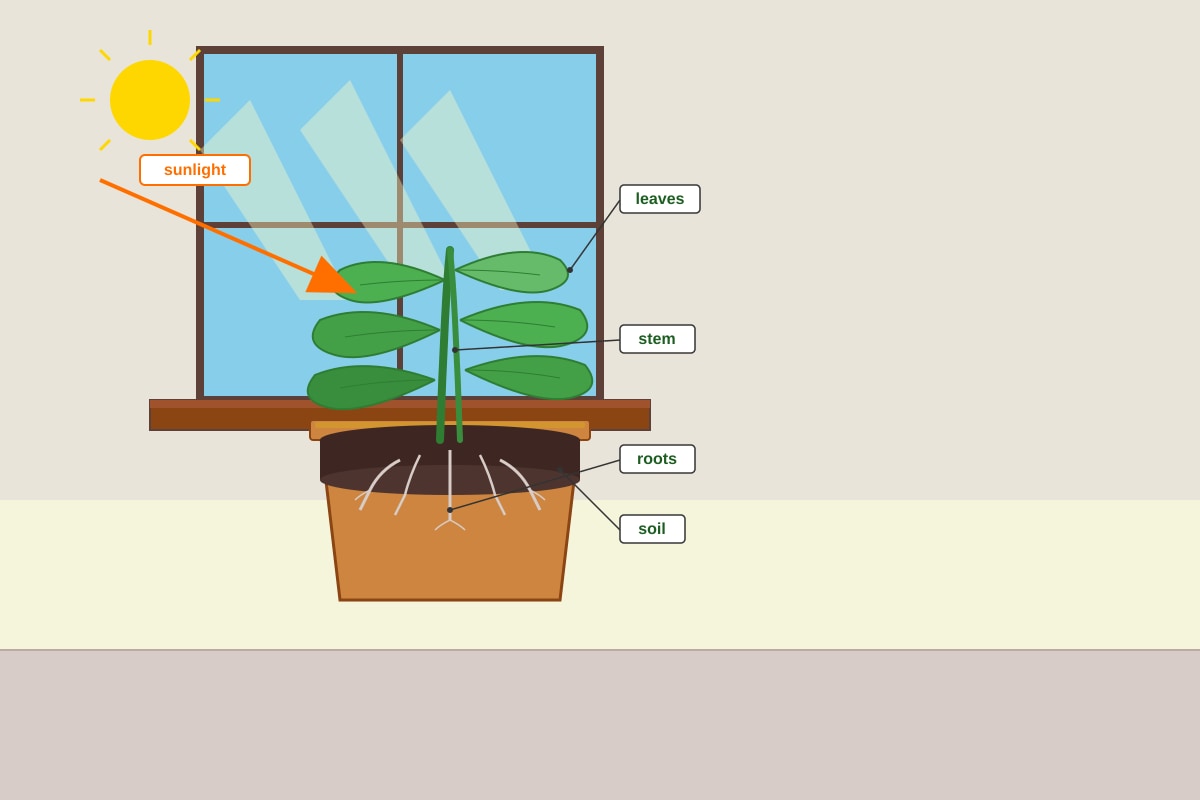
18. Answer: B) green leaves
Explanation: Green leaves contain chlorophyll, a green substance that allows plants to trap light energy from the sun and make their own food through photosynthesis. This is why leaves are green. Colourful flowers (A) attract pollinators but do not make food. Thick bark (C) protects the tree but does not make food. Sharp thorns (D) protect against animals but do not make food.
Visual check: The plant shows broad green leaves positioned to catch sunlight; arrow labeled "sunlight" points directly to leaf surface.
Marks: 1 mark
19. Answer: B) fungus
Explanation: Yeast is a type of fungus. When yeast is added to bread dough, it feeds on sugar and produces a gas called carbon dioxide. This gas makes bubbles in the dough, causing it to rise and become soft. Yeast is alive—you can buy it as dried granules, and when you add warm water and sugar, it becomes active. It is not a plant (A) because it cannot make its own food with chlorophyll. It is definitely not an insect (C) or reptile (D).
Marks: 1 mark
20. Answer: C) They need water to survive
Explanation: Both plants and animals need water to survive—this is a shared characteristic of all living things. Plants and animals have different ways of getting water, but both must have it. Plants can make their own food (A), but animals cannot—this is a difference, not a shared feature. Most animals can move from place to place (B), but most plants cannot move around freely. Only birds have feathers (D)—this is not true for plants or most animals.
Marks: 1 mark
Section A Total: 20 marks
SECTION B: Short Answer Questions (24 marks)
21. (a) Answer: Items C (growing bean plant) and A (freshly picked apple—while still attached to tree it was living; accept "C only" if reasoning focuses on plant being clearly alive)
Acceptable answers with marks:
- C only (1 mark) — the growing bean plant is clearly alive as it is growing, needs water, and can make its own food.
- A and C (2 marks) — A was living when on the tree (can accept if student explains the apple is a fruit which is part of a living plant); C is clearly living.
Reasoning must include:
- Living things grow (bean plant is growing)
- Living things need water
- Living things can respond to their environment
Sample answer for 2 marks: "Item C, the growing bean plant, is a living thing because it is growing bigger, it needs water to survive, and it can make its own food. Item A is also from a living thing—it was part of an apple tree."
Marks: 2 marks (1 mark for identifying correct item(s); 1 mark for valid reason based on characteristics of living things)
21. (b) Answer: Item B (the plastic apple)
Explanation: The plastic apple looks like a real apple—it has similar colour, shape, and size. However, it is non-living because it cannot grow, it does not need food or water, it cannot reproduce to make new plastic apples, and it cannot respond to changes around it. It only looks alive because humans made it to resemble a real apple.
Marks: 2 marks (1 mark for identifying B; 1 mark for explaining why it is non-living despite appearances—must mention at least one missing characteristic of living things)
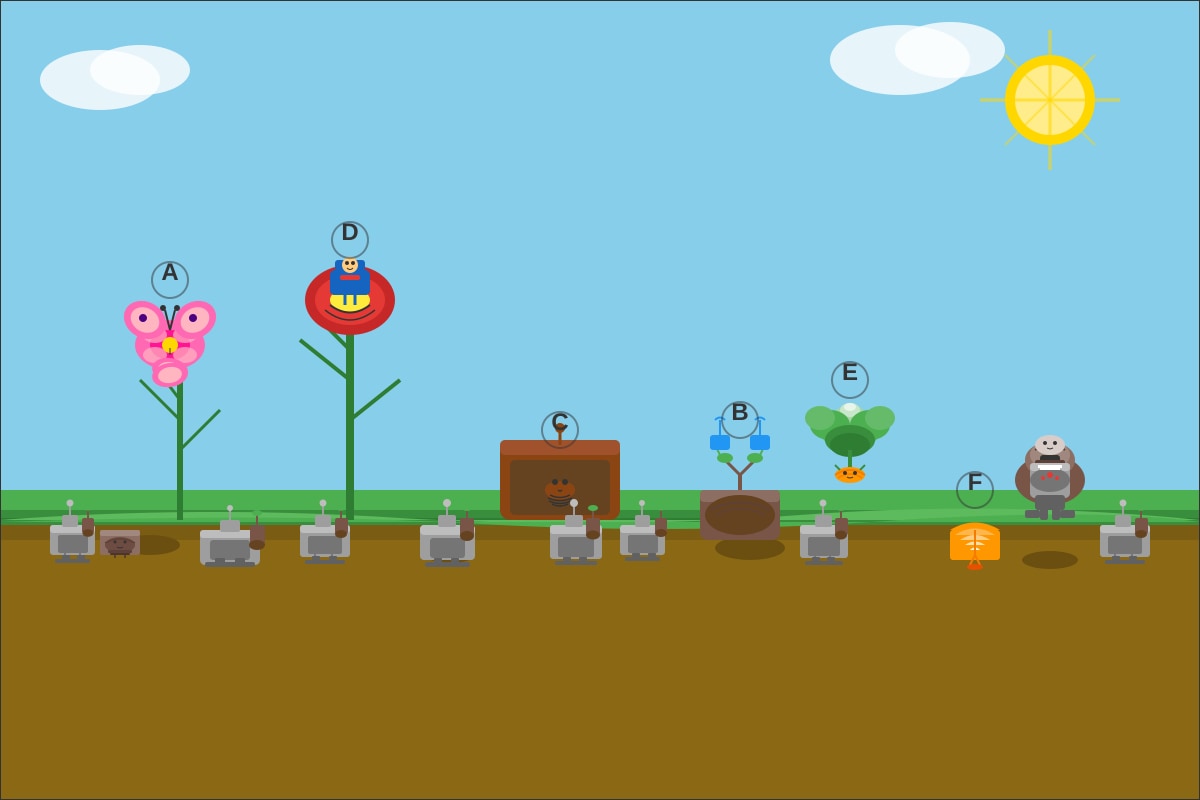
22. (a) Answer: Any three of: A (butterfly), C (worm), E (snail)
Acceptable combinations: A+C+E (3 marks); any two correct (2 marks); any one correct (1 mark)
Explanation: These are all animals that show characteristics of living things. The butterfly is moving and feeding on nectar. The worm is in the soil, responding to its environment and growing. The snail is moving slowly on the leaf and feeding.
Marks: 3 marks (1 mark each, maximum 3 marks)
22. (b) Answer: Example: The butterfly (A) is moving from flower to flower / The worm (C) is in the soil showing it needs a suitable habitat / The snail (E) is moving along the leaf
Characteristic matched to observation:
- Movement: "The butterfly is flying/moving" (1 mark for characteristic; 1 mark for linking to picture)
- Feeding/need for food: "The butterfly is on a flower getting nectar"
- Response to environment: "The worm is in damp soil where it can survive"
Sample answer for 2 marks: "The butterfly (A) shows that living things can move by themselves. In the picture, we can see it flying from flower to flower, which is movement."
Marks: 2 marks (1 mark for naming correct characteristic; 1 mark for linking to what is visible in the picture)
22. (c) Answer: The garden gnome is non-living because it does not have any of the characteristics of living things.
Required explanation points:
- It cannot move by itself (it only stands still; if it falls, it does not get up)
- It cannot grow bigger (it stays the same size forever)
- It does not need food, water, or air
- It cannot reproduce to make baby gnomes
- It cannot respond to changes (it doesn't feel hot or cold, doesn't run from danger)
Sample answer for 2 marks: "The garden gnome is not a living thing because it cannot move by itself, it does not grow bigger, and it does not need food or water to survive. It is made of painted stone or plastic, so it cannot do any of the things living things do."
Marks: 2 marks (1 mark for stating non-living; 1 mark for at least two valid reasons why)
23. (a) Answer:
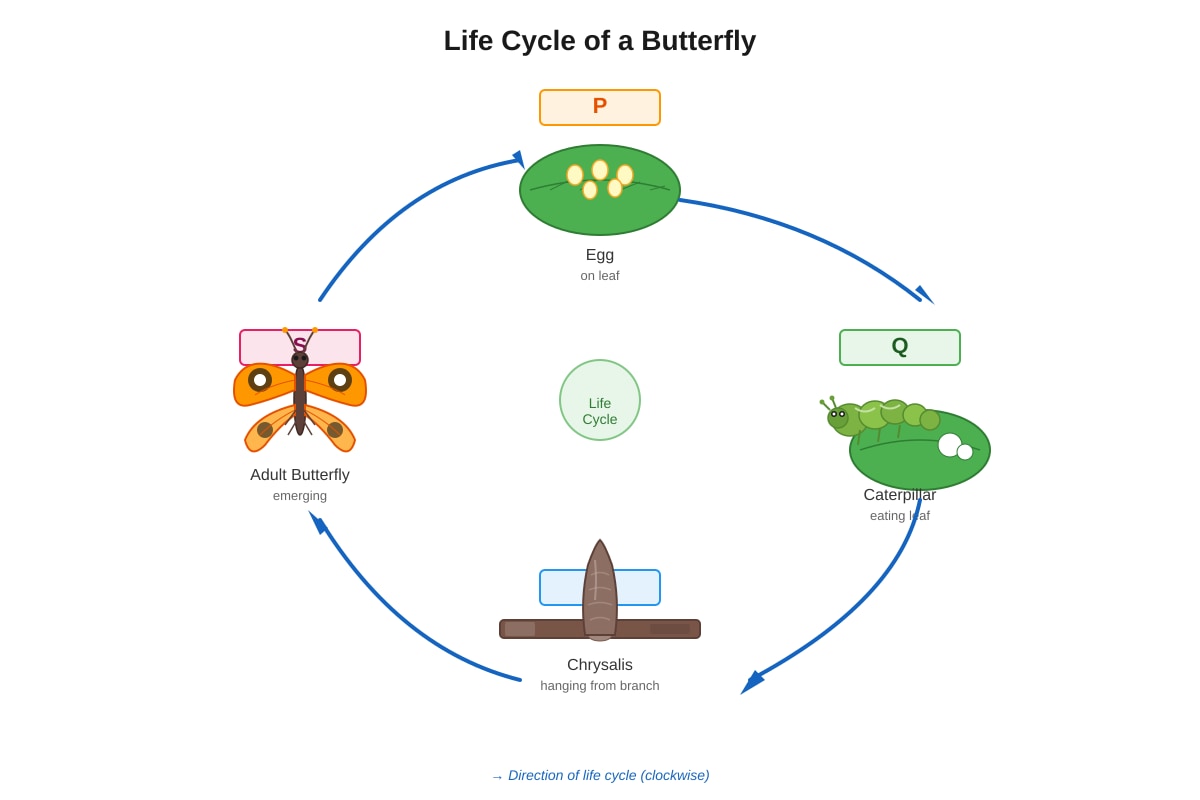
- P: Egg (1 mark)
- R: Pupa / Chrysalis (1 mark)
Explanation: The butterfly life cycle has four stages: egg (P), larva/caterpillar (Q), pupa/chrysalis (R), and adult butterfly (S). These stages show complete metamorphosis, which is common in insects. The egg is laid on a leaf so the caterpillar has immediate food when it hatches.
Marks: 2 marks (1 mark each)
23. (b) Answer: Stage Q (the caterpillar)
Explanation: The caterpillar eats the most food because it needs to store up energy and nutrients for the big change that happens during the pupa stage. When the caterpillar becomes a chrysalis, it does not eat at all—its body is completely reorganizing into a butterfly. Without enough food during the caterpillar stage, the butterfly might not develop properly.
Sample answer for 2 marks: "The caterpillar (Q) eats the most food. This is important because it needs to store lots of energy before it becomes a chrysalis. Inside the chrysalis, it does not eat, so it must have enough stored food to grow into a butterfly."
Marks: 2 marks (1 mark for correct stage; 1 mark for explanation about storing energy for metamorphosis)
23. (c) Answer: The life cycle shows that butterflies can reproduce and grow, which are characteristics of living things.
Explanation: The butterfly lays eggs (reproduction), and the eggs develop through stages into an adult (growth and development). Only living things can reproduce and have life cycles. Non-living things do not go through stages of development or produce offspring.
Sample answer for 2 marks: "This life cycle shows that a butterfly is a living thing because it can reproduce by laying eggs, and the young grow and develop through different stages. The caterpillar grows bigger, then changes into a chrysalis, and finally becomes an adult butterfly. Non-living things cannot do this."
Marks: 2 marks (1 mark for identifying reproduction/growth; 1 mark for explaining how the cycle demonstrates this)
24. (a) Answer: An eagle is a bird because it has feathers AND it lays eggs.
Explanation from table: Using the table: "The eagle has feathers (Yes in table) and lays eggs (Yes in table). All birds have feathers, and most birds lay eggs. The eagle does not have scales or fur, so it is not a reptile or mammal."
Marks: 2 marks (1 mark for each correct feature from the table; must use table data)
24. (b) Answer: Most mammals do not lay eggs—they give birth to live young. The platypus is unusual because it has fur like a mammal but lays eggs like a bird or reptile.
From table: Platypus: Has fur? Yes. Lays eggs? Yes. This combination is unusual—most mammals (like tigers) have fur but do NOT lay eggs.
Sample answer for 2 marks: "The platypus is different from most mammals because it lays eggs. From the table, the tiger is a mammal with fur that does not lay eggs. But the platypus also has fur—like a mammal—yet it lays eggs. Most mammals give birth to live babies, not eggs."
Marks: 2 marks (1 mark for identifying that it lays eggs unlike most mammals; 1 mark for noting it still has fur like mammals)
24. (c) Answer: Reptiles
Other feature (any one):
- They have dry, scaly skin (this is in the table, so should be avoided—accept if student notes it's already there)
- They are cold-blooded (ectothermic)
- They breathe air through lungs
- Most have four legs (though snakes have lost theirs through evolution)
Better answer for feature NOT in table: "They are cold-blooded, which means their body temperature changes with the environment" OR "They breathe air through lungs, even those that live in water like sea snakes."
Sample answer for 2 marks: "Snakes belong to the group called reptiles. Another feature of reptiles is that they are cold-blooded, which means they need to warm themselves in the sun to get energy for activity."
Marks: 2 marks (1 mark for "reptiles"; 1 mark for valid feature not already listed in the table)
25. (a) Answer: The plant in Jar X will continue to grow / stay green / produce more leaves / remain alive.
Explanation: The plant has everything it needs: moist soil provides water, sunlight comes through the window for food-making (photosynthesis), and the air in the sealed jar provides carbon dioxide. It can make its own food and survive for some time in a sealed jar.
Sample answer for 2 marks: "The plant will stay green and may grow a bit bigger. This is because it has water from the moist soil, sunlight from the window, and air in the jar. It can make its own food using its green leaves."
Marks: 2 marks (1 mark for correct prediction; 1 mark for valid explanation using plant needs)
25. (b) Answer: The temperature in Jar Y will rise MORE / become HIGHER than in Jar X.
Explanation: Jar Y contains dry sand and a plastic toy tree—both are non-living. The plastic and sand will absorb heat from sunlight and get hot, trapping heat inside. In Jar X, the plant will use some of the light energy for photosynthesis and release water vapour through transpiration, which actually cools the air slightly. Non-living objects heat up more than living plants under the same sunlight.
Sample answer for 3 marks: "The temperature in Jar Y will become higher than in Jar X. The plastic toy and sand in Jar Y are non-living—they absorb heat from sunlight and get very hot. But in Jar X, the plant uses some sunlight to make food, and water from the plant's leaves cools the air a little. So Jar Y gets hotter."
Marks: 3 marks (1 mark for correct prediction—Jar Y hotter; 1 mark for explaining Jar Y heating (non-living materials absorb heat); 1 mark for explaining why Jar X stays cooler (plant uses energy for photosynthesis/transpiration))
Common misconception: Students might think the sealed jar with a plant would get hotter—mark accordingly if explanation shows misunderstanding.
Section B Total: 24 marks
SECTION C: Application and Reasoning (16 marks)
26. (a) Answer: Fish belong to the group: Fish
Feature besides living in water:
- They have scales covering their body
- They have fins for swimming
- They have gills for breathing underwater (not lungs)
- They are cold-blooded
Sample answer for 2 marks: "Fish belong to the group called fish. One feature is that they have scales covering their bodies. Another is that they use gills to breathe in water, not lungs like we do."
Marks: 2 marks (1 mark for "fish"; 1 mark for valid additional feature)
26. (b) Answer: Penguins are birds because they have feathers and a beak, and they lay eggs.
From passage: The passage states penguins "waddle on land but swim gracefully in the pool"—these describe how they move, not why they are birds. Students must infer from knowledge plus passage context.
Key reasoning: Having feathers is the defining feature of birds. Even though penguins cannot fly, they swim using their wings as flippers, they have a beak for catching fish, and they lay eggs.
Sample answer for 2 marks: "Penguins are birds because they have feathers covering their bodies and they have beaks. The passage says they waddle and swim—these are how they move. Even though they cannot fly like other birds, they still have the key features of birds: feathers and a beak."
Marks: 2 marks (1 mark for identifying feathers/beak/eggs; 1 mark for acknowledging they cannot fly but are still birds due to these features)
26. (c) Answer: The caterpillar growing and changing into a butterfly shows growth and development, which are characteristics of living things.
Explanation: The change from caterpillar to butterfly is metamorphosis—a form of growth and development. Only living things go through life cycles and change form as they develop. The caterpillar eats and grows larger, then transforms inside the chrysalis—this complex process of change proves the butterfly is alive.
Sample answer for 2 marks: "This shows butterflies are living things because they grow and develop. The caterpillar eats leaves and gets bigger, then it changes into a chrysalis, and finally becomes an adult butterfly. Non-living things cannot grow or change like this."
Marks: 2 marks (1 mark for growth/development; 1 mark for explaining the transformation process)
26. (d) Answer: Jane should answer that heat lamps are NOT alive.
Explanation using characteristics:
- The heat lamp gives out warmth, but it does not need food, water, or air to do this
- It was made by humans from metal and glass—it did not grow or develop from a smaller lamp
- It cannot reproduce to make baby heat lamps
- It cannot respond to changes—it turns on because a human flips a switch, not because it "decides" to
- It does not move by itself
Sample answer for 3 marks: "Jane should say the heat lamp is not alive. It gives out warmth, but this is because electricity passes through it, not because it is a living thing. The heat lamp does not need food or water, it cannot grow bigger, and it cannot reproduce. A human has to turn it on—it does not respond by itself. Only living things have all the characteristics of life."
Marks: 3 marks (1 mark for stating NOT alive; 2 marks for at least two valid characteristics of living things that the lamp lacks, with clear explanation)
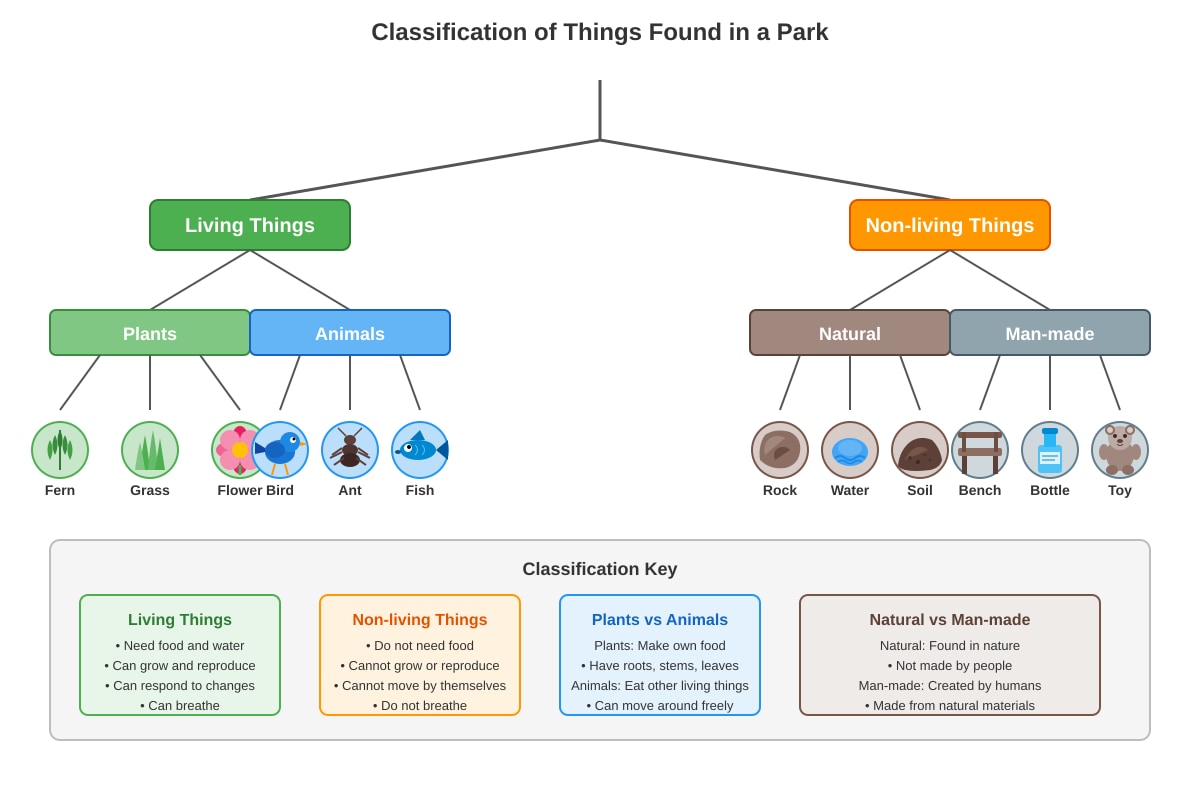
27. (a) Answer: Any one of: bench, bottle, toy
From diagram: These are the man-made non-living things in the classification tree.
Marks: 1 mark
27. (b) Answer: Mushrooms do not fit into "Plants" or "Animals" because they are fungi, which is a separate group of living things.
Explanation points for 3 marks:
- Mushrooms are not plants because they cannot make their own food with chlorophyll and sunlight—plants have green leaves for this, but mushrooms are not green and have no leaves
- Mushrooms are not animals because they cannot move by themselves and do not have features like legs, wings, or fur
- Mushrooms are fungi—they absorb nutrients from decaying matter around them
- This shows there are more groups than just "plants" and "animals"
Sample answer for 3 marks: "Mushrooms do not fit into Plants because they cannot make their own food—plants have green leaves with chlorophyll, but mushrooms are not green. They do not fit into Animals because they cannot move by themselves like animals do. Mushrooms are fungi, which is a different group of living things. Fungi get their food by absorbing nutrients from dead plants and animals around them."
Marks: 3 marks (1 mark for stating they are fungi/separate group; 1 mark for explaining why not plants; 1 mark for explaining why not animals)
27. (c) Answer: NO, this statement is NOT correct.
Examples:
- From classification: The toy (man-made) or other objects might be green but are not plants
- From own knowledge: A green plastic bottle / green car / green pencil case is green but not a plant
- Better biology example: Some animals are green—caterpillars, chameleons, green tree frogs, grasshoppers
Sample answer for 2 marks: "No, this is not correct. Something can be green but not be a plant. For example, a green toy from the 'man-made' group is green but is not alive. Also, some animals like grasshoppers and chameleons are green, but they are animals, not plants."
Marks: 2 marks (1 mark for stating "No"; 1 mark for valid example showing green non-plant or green animal)
28. (a) Answer:
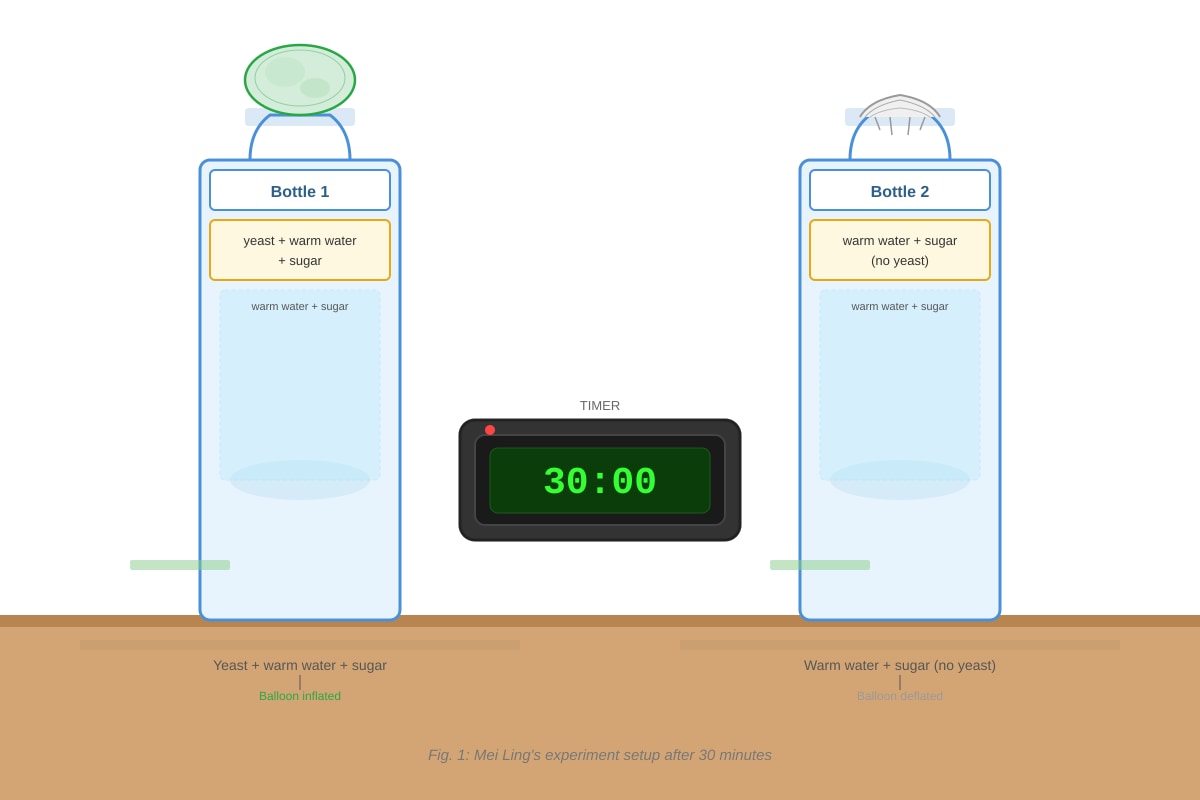
- Bottle 1 (with yeast): The balloon will be INFLATED / partially blown up / expanded
- Bottle 2 (without yeast): The balloon will stay DEFLATED / flat / unchanged
Explanation: Yeast is a living fungus that feeds on sugar and produces carbon dioxide gas. This gas fills the balloon and makes it inflate. Without yeast, no gas is produced, so the balloon stays flat.
Marks: 2 marks (1 mark for each correct observation)
28. (b) Answer: The experiment shows that yeast is a living thing because it can produce gas through a life process (respiration/fermentation).
Characteristic demonstrated: Reproduction / respiration / feeding / growth (any valid characteristic)
Detailed explanation: Yeast feeds on sugar and uses it for energy. This process is similar to how living things get energy from food. The production of carbon dioxide gas is evidence that chemical reactions for life are happening inside the yeast cells. This shows yeast is alive and carrying out life processes.
Sample answer for 3 marks: "This shows that yeast is a living thing because it can feed on sugar and produce a gas. This is a life process called respiration. The gas makes the balloon inflate, which proves the yeast is alive and active. Non-living things like sugar and water cannot do this by themselves. Yeast is growing and reproducing while it feeds, which is why so much gas is made."
Marks: 3 marks (1 mark for correct conclusion—yeast is living; 1 mark for identifying the characteristic (respiration/feeding/growth/reproduction); 1 mark for explaining the evidence—the gas production proves life processes are occurring)
28. (c) Answer: Bottle 2 is called a CONTROL setup.
Purpose: It allows Mei Ling to COMPARE with Bottle 1 and be sure that the yeast causes the balloon to inflate, not just the warm water and sugar alone. If both balloons inflated, she could not conclude yeast was responsible. Only when Bottle 2 stays flat and Bottle 1 inflates can she be confident that yeast is the cause.
Sample answer for 2 marks: "Mei Ling set up Bottle 2 to compare with Bottle 1. This is called a control experiment. It shows that the warm water and sugar alone cannot make the balloon inflate. Only when yeast is added does the balloon go up. This proves it is the yeast, not just the water and sugar, that causes the change."
Marks: 2 marks (1 mark for "control" or "control setup"; 1 mark for explaining the comparison purpose—proving yeast causes the effect)
Section C Total: 16 marks
MARKING SUMMARY
| Section | Marks |
|---|---|
| Section A | 20 |
| Section B | 24 |
| Section C | 16 |
| TOTAL | 60 |
END OF ANSWER KEY